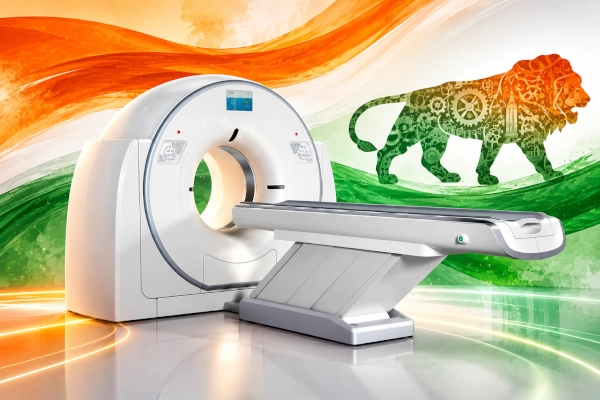
The Technology Development Board (TDB), under the Department of Science and Technology (DST), Government of India, has signed an agreement with Panacea Medical Technologies Pvt. Ltd., Malur, Karnataka, to support the development and commercialisation of an indigenous 32-slice Computed Tomography (CT) scanner. Announced on October 15, 2026, the initiative aims to strengthen India’s domestic medical device manufacturing capabilities and advance the development of sophisticated diagnostic imaging equipment under the Make in India programme.
The project represents an important step towards building indigenous capabilities in high-precision medical imaging technology, a segment of the healthcare industry that requires advanced engineering, specialised components and complex software integration. By supporting the development of a domestically manufactured CT scanner, the Technology Development Board seeks to encourage Indian companies to expand into high-value medical equipment manufacturing while improving access to modern diagnostic technologies.
Panacea Medical Technologies Expands into Advanced Diagnostic Imaging
Panacea Medical Technologies is an Indian medical equipment manufacturer specialising in radiotherapy and radiology technologies. The company has developed expertise in medical imaging systems, cancer treatment equipment, precision engineering and specialised technology modules used in healthcare applications. Building on these capabilities, Panacea has undertaken the development of a 32-slice CT scanner to expand its product portfolio into advanced diagnostic imaging.
The project involves the design, development and deployment of a CT scanner capable of producing detailed cross-sectional images of internal body structures. The equipment is intended to support diagnostic imaging across several clinical disciplines, including the assessment of neurological conditions, internal injuries, cardiovascular abnormalities and diseases affecting different organs.
Developing such a system requires the integration of precision mechanical assemblies, advanced electronic components, digital imaging detectors and specialised reconstruction software. The indigenous development programme will provide Panacea Medical Technologies with an opportunity to strengthen its expertise in these critical technologies while contributing to India’s expanding medical equipment manufacturing ecosystem.
How the Indigenous 32-Slice CT Scanner Will Work
Computed Tomography is a diagnostic imaging technique that uses rotating X-ray equipment and digital detectors to capture multiple measurements of the human body from different angles. Computer algorithms process these measurements to reconstruct detailed cross-sectional images, allowing medical professionals to examine bones, organs, blood vessels and other internal structures without invasive procedures.
A 32-slice CT scanner can generate multiple image sections during a scan, enabling the examination of different anatomical regions with considerable detail. Such systems are widely used in hospitals and diagnostic centres for investigating injuries, detecting abnormalities, planning medical procedures and monitoring treatment outcomes. The quality of CT imaging depends on several technical factors, including detector sensitivity, X-ray generation, mechanical precision, image reconstruction algorithms and accurate system calibration.
The development of an indigenous CT scanner therefore involves much more than assembling individual components. Engineers must ensure that the imaging system operates with the required precision, produces diagnostically useful images and incorporates appropriate radiation safety measures. Rigorous testing, calibration and compliance with applicable medical device standards are essential to achieving reliable performance and protecting patient safety.
Indigenous CT Scanner Development to Strengthen India’s Medical Device Industry
India’s diagnostic imaging sector is experiencing growing demand for advanced medical equipment as healthcare infrastructure expands across the country. Hospitals, medical colleges and diagnostic centres increasingly require reliable imaging technologies to support early disease detection, emergency medical care and specialised clinical treatment. The growing prevalence of chronic diseases and the need for timely diagnosis have further strengthened the importance of modern diagnostic imaging facilities.
Indigenous development of sophisticated equipment such as CT scanners can help Indian manufacturers build capabilities in technologies that have traditionally required substantial reliance on international suppliers. Domestic design and manufacturing also create opportunities for developing local component supply chains, specialised engineering services, technical maintenance capabilities and skilled employment in the medical technology sector.
The development of a locally manufactured CT scanner aligns with the government’s broader objective of strengthening India’s medical device industry and expanding domestic production of high-value healthcare equipment. By encouraging Indian companies to undertake complex technology development, the initiative can support technological self-reliance while creating opportunities to serve both domestic healthcare institutions and international markets.
Technology Development Board Supports Commercialisation of Indian Medical Technologies
The Technology Development Board plays an important role in supporting Indian enterprises engaged in developing and commercialising indigenous technologies. Operating under the Department of Science and Technology, the Board provides financial assistance to projects that demonstrate the potential to translate technological capabilities into commercially viable products and industrial applications.
Through its agreement with Panacea Medical Technologies, TDB aims to accelerate the development of advanced diagnostic imaging equipment while strengthening domestic manufacturing expertise. The collaboration reflects the importance of supporting Indian companies as they move from research and engineering development towards product manufacturing and commercial deployment.
Rajesh Kumar Pathak, Secretary of the Technology Development Board, stated that developing an indigenous CT scanner aligns with the government’s vision of strengthening domestic manufacturing of high-end medical devices. He emphasised that TDB’s support seeks to encourage Indian medical technology companies to develop innovative solutions that address the country’s healthcare requirements while creating opportunities for wider adoption in global markets.
Representing Panacea Medical Technologies, the company’s promoter expressed appreciation for TDB’s support and stated that the collaboration would accelerate efforts to develop indigenous diagnostic imaging technology. The company also highlighted its commitment to making advanced CT imaging more accessible across India through domestic technological development.
Make in India Initiative Expands into High-End Healthcare Equipment
The development of an indigenous 32-slice CT scanner marks another step in India’s efforts to establish a stronger domestic medical technology industry. Advanced diagnostic equipment requires expertise across electronics, precision manufacturing, medical physics, software engineering and quality assurance, making such projects important for developing capabilities across multiple industrial sectors.
By supporting Panacea Medical Technologies, the Technology Development Board is helping translate domestic engineering expertise into advanced healthcare products. The initiative will contribute to the development of indigenous medical imaging technology, strengthen opportunities for Indian manufacturers and support the expansion of specialised medical equipment production.
As India’s healthcare infrastructure continues to grow, domestic development of sophisticated diagnostic technologies will play an increasingly important role in improving equipment availability, supporting healthcare delivery and expanding the country’s medical technology manufacturing capabilities. The TDB-backed project reinforces India’s progress towards becoming a competitive developer and manufacturer of advanced medical devices under the Make in India initiative.
References
- Press Information Bureau, Ministry of Science and Technology, Government of India. TDB-DST Supports Development and Commercialisation of Indigenous 32-Slice CT Scanner by Panacea Medical Technologies Pvt. Ltd. October 15, 2026.www.pib.gov.in
- Technology Development Board, Department of Science and Technology, Government of India. Official information on indigenous technology development and commercialisation.www.tdb.gov.in
- Department of Science and Technology, Government of India. Official information on technology development, innovation and indigenous manufacturing initiatives.dst.gov.in
You may also like
-
India’s Exports to US Rise to $50.81 Billion in April–September 2026 Despite Tariff Disruptions
-
Tata Advanced Systems Reportedly Considering LAMV 4×4 Production in Morocco
-
Indian Navy Initiates Communication Systems Upgrade for Kamorta-Class Anti-Submarine Warfare Corvettes
-
India Reportedly Offers Mine-Protected Vehicles to Kenya to Strengthen Defence Cooperation
-
Sigma Advanced Systems and Munitions India Sign MoU for Indigenous 155mm Course-Correction Fuzes
