Among the most solemn episodes connected with the end of the Mahabharata is the departure of Krishna from the world. His earthly life does not end on a battlefield, in a royal court or during a confrontation with a mighty enemy. Instead, the final moment comes quietly in a forest, where an ordinary hunter named Jara mistakes Krishna’s partially visible foot for a deer and releases an arrow.
The event takes place after the destruction of the Yadava clan at Prabhasa. Krishna had already witnessed the fulfilment of the curse that brought ruin upon his own people, seen Balarama withdraw from the world, and understood that the purpose of his earthly incarnation had reached its completion. He then entered the forest alone and sat beneath a tree in deep meditation.
While Krishna rested there, part of his foot remained visible through the vegetation. Jara, moving through the forest in search of game, saw the exposed portion from a distance and believed that he was looking at a deer. He released an arrow, only to discover moments later that he had struck Krishna.
When the hunter realised what he had done, terror and grief overwhelmed him. He expected punishment and believed that he had committed an unforgivable act. Krishna, however, did not respond with anger. He comforted Jara and accepted the wound as part of a destiny that had already reached its appointed conclusion.
The scene brings the age of Krishna and the Yadavas to a quiet but deeply symbolic end.
The Destruction of the Yadavas
Krishna’s final days cannot be understood without the tragedy that overtook the Yadava clan. Long after the Kurukshetra War had ended, the Vrishnis, Andhakas and other branches of the Yadavas had become enormously powerful. Yet a curse already hung over them because of an incident involving Krishna’s son Samba and a group of young Yadavas.
The youths once attempted to mock a group of visiting sages by disguising Samba as a pregnant woman and asking what child “she” would give birth to. The sages immediately understood the deception and pronounced a terrible curse. Samba would produce an iron pestle, and that pestle would become the instrument through which the Yadava clan destroyed itself.
The prophecy eventually came true. The iron pestle was ground down and its fragments were thrown into the sea in an attempt to prevent the curse from being fulfilled. Yet destiny was not so easily avoided. The iron material returned in unexpected forms, and reeds that later grew along the shore became connected with the destruction that followed.
What the Yadavas had attempted to eliminate remained present in another form, waiting for its appointed moment.
The Gathering at Prabhasa
As ominous signs began appearing in Dvaraka, Krishna understood that the end of the Yadava clan was approaching. The Yadavas travelled to the sacred region of Prabhasa, where they gathered together in large numbers.
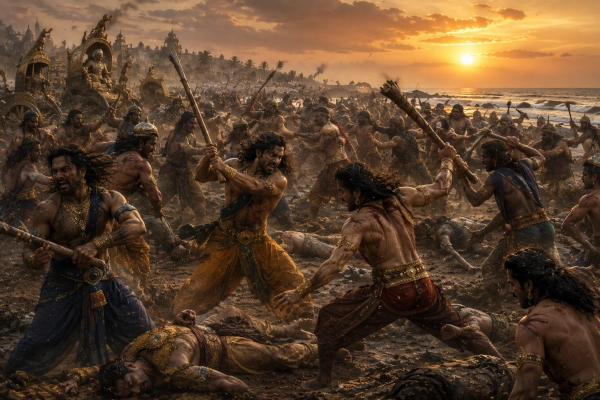
What began as a pilgrimage gradually descended into disaster. The warriors consumed intoxicating drinks, and old rivalries that had remained buried for years began resurfacing. Men who had fought beside one another remembered quarrels and accusations connected with the Kurukshetra War.
The tension eventually became uncontrollable. Arguments turned into insults, and insults gave way to violence. The mighty Yadava warriors, who had survived powerful enemies and great wars, began fighting among themselves.
Satyaki and Kritavarma Rekindle Old Hatreds
One of the most important confrontations occurred between Satyaki and Kritavarma. Both men had survived Kurukshetra, but they had fought on opposite sides. Satyaki had supported the Pandavas, while Kritavarma had fought for the Kauravas.
Satyaki accused Kritavarma of participating in the night attack led by Ashwatthama against the sleeping Panchala and Pandava forces after the main battle had effectively ended. Kritavarma responded by accusing Satyaki of his own violation of warrior conduct, particularly his role in the death of Bhurishravas.
Their argument quickly became violent, and Satyaki killed Kritavarma. That act shattered whatever restraint remained among the gathered Yadavas. The dispute spread from one warrior to another until the entire assembly was engulfed in bloodshed.
The Reeds Become Deadly Weapons
As the fighting intensified, the Yadavas seized reeds growing along the shore. These reeds were connected to the remains of the iron pestle associated with the ancient curse. In their hands, they became hard and deadly like iron clubs.
The Yadava warriors then turned these weapons upon one another. Men who had survived battles against some of the greatest fighters of their age fell at the hands of their own relatives and companions. The destruction became so complete that the clan effectively annihilated itself.
Krishna initially watched the catastrophe unfold, understanding that the curse and destiny of the Yadavas were being fulfilled. Eventually, when the violence became uncontrollable, he too took up the iron-like reeds and struck down warriors caught in the frenzy.
The end came not through invasion or conquest, but through self-destruction.
Krishna Finds Balarama
After the slaughter at Prabhasa, Krishna went in search of his elder brother Balarama. He found him seated alone near the seashore, absorbed in deep meditation.
The Mahabharata describes an extraordinary event associated with Balarama’s departure. A great white serpent emerged from him and moved toward the ocean, where it was received by divine serpent beings. The scene reflects Balarama’s deep association with Shesha or Ananta, the cosmic serpent.
Krishna watched his brother leave the mortal world. By this point, nearly everything that had defined his earthly life was disappearing. His clan had destroyed itself, Balarama had departed, and Dvaraka itself would soon face destruction.
Krishna understood that his own time had now arrived.
Krishna Enters the Forest
Krishna left the scene of destruction and entered the forest alone. The man who had guided kings, commanded armies, defeated powerful enemies and stood at the centre of the Kurukshetra War now withdrew completely from worldly activity.
He sat beneath a tree and entered deep meditation. There were no conch shells, chariots or warriors around him. The final scene of his earthly life unfolded in complete contrast to the great battles and royal assemblies that had filled his earlier years.
As Krishna rested, part of his foot remained visible through the vegetation. That small detail would become the immediate cause of what happened next.
The Hunter Named Jara
A hunter named Jara was moving through the forest in search of game. From a distance, he noticed something partially concealed among the leaves and grass.
Only a small portion of Krishna’s foot was visible, and Jara mistook it for part of a deer. Believing that an animal was resting nearby, the hunter placed an arrow upon his bow, took aim and released it.
The arrow struck Krishna in the foot.
Jara then approached the place where he believed his prey had fallen. As he drew closer, however, he realised that he had not shot a deer. Before him sat Krishna.
The hunter immediately understood the enormity of what had happened.
Jara Falls Before Krishna
Jara was horrified by his mistake. He fell before Krishna and begged forgiveness, believing that he had committed a terrible sin. There had been no hatred or intention to kill Krishna, but the hunter could not escape the knowledge that his arrow had struck one of the most revered figures of the age.
He expected anger, punishment or a curse. Instead, Krishna responded with calmness and compassion.
Krishna understood that Jara had acted in ignorance. The hunter had not deliberately attacked him, and the wound had arrived at a moment when Krishna had already withdrawn from the world and accepted that his earthly mission was complete.
Rather than condemning Jara, Krishna reassured him and removed his fear.
Krishna Does Not Blame the Hunter
This is one of the most important aspects of the episode. Jara is not presented as Krishna’s enemy. He does not come into the forest seeking revenge, nor does he knowingly attack the ruler of Dvaraka.
He simply mistakes what he sees.
Krishna’s response confirms this distinction. There is no anger and no final act of vengeance. Instead, the last human interaction associated with Krishna’s earthly life becomes an act of compassion toward a frightened man who believes he has committed an unforgivable offence.
The scene stands in remarkable contrast to the many violent confrontations of Krishna’s life.
The Iron Fragment and Jara’s Arrow
The arrow itself is connected to the earlier curse that destroyed the Yadavas. When the iron pestle produced by Samba was ground down, one portion of the metal could not be completely destroyed.
That remaining fragment eventually entered the sea and was swallowed by a fish. The fish was later caught, and the piece of iron was recovered from its body. The metal eventually came into Jara’s possession and was fashioned into an arrowhead.
Thus, the same curse that contributed to the destruction of the Yadavas also became linked to Krishna’s final wound.
The attempt to destroy the iron pestle had never truly removed its consequences. What had seemed like a useless remnant became significant at the final moment.
Krishna Had Already Accepted the End
The arrow should not be understood as defeating Krishna in the ordinary sense. By the time Jara entered the forest, Krishna had already witnessed the destruction of his people, seen Balarama depart and withdrawn into meditation.
He knew that the purpose of his earthly presence had come to an end.
Jara therefore became the immediate instrument through which that transition occurred. The event is very different from the death of a warrior overwhelmed in battle. Krishna is not caught in a desperate struggle or defeated by a superior opponent.
He simply accepts the moment when it arrives.
That acceptance gives the story much of its spiritual power.
Krishna Leaves the Mortal World
After reassuring Jara, Krishna prepared to leave his mortal body. The Mahabharata presents his departure in divine terms, describing him as returning to his higher state after completing the work for which he had appeared upon earth.
His earthly presence had now ended.
The generation that had produced Bhishma, Drona, Karna, the Pandavas, the Kauravas, Balarama and Krishna was rapidly disappearing. The world that had existed during the great events of the Mahabharata was drawing to a close.
Soon Arjuna would arrive and discover how completely that world had changed.
Arjuna Comes to Dvaraka
When news of the Yadava destruction reached the Pandavas, Arjuna travelled west. He found Dvaraka devastated by loss. The great warriors who had once filled the city were gone, and the surviving women, children and elderly people required protection.
Arjuna attempted to escort the survivors away before the sea overwhelmed Dvaraka. During the journey, however, another extraordinary event occurred. Bandits attacked the group, and Arjuna raised Gandiva expecting to defeat them as easily as he once had defeated entire armies.
But something had changed.
The divine weapons and extraordinary powers that had accompanied him during the Kurukshetra War were no longer available in the same way. Arjuna struggled to remember the celestial weapons that had once responded effortlessly to him.
The experience showed him that Krishna’s departure had marked the end of an age.
The Passing of an Age
Within later Hindu tradition, Krishna’s departure became closely associated with the beginning of Kali Yuga, the final age in the traditional cycle of four yugas.
Whether understood literally, cosmologically or symbolically, the meaning is profound. The world after Krishna was no longer the world of Kurukshetra.
The great heroes were disappearing, divine weapons were withdrawing, powerful kingdoms had been destroyed, and even Arjuna discovered that the extraordinary strength of his greatest years was fading.
Jara’s arrow therefore becomes more than the cause of Krishna’s final wound. It marks a boundary between two ages.
The Later Tradition Connecting Jara With Vali
A popular later tradition connects Jara with Vali, the vanara king killed by Rama in the Ramayana. According to this interpretation, Rama killed Vali from concealment, and Vali was later reborn as Jara. The hunter then unknowingly shot Krishna, the later incarnation of Vishnu, completing a form of karmic symmetry between the Ramayana and Krishna’s final moments.
This interpretation is widely repeated in later tradition, but it should be distinguished from the central account in the Mahabharata. The Mausala Parva primarily describes Jara as the hunter who mistakes Krishna’s foot for a deer and does not develop the full Vali-rebirth narrative in the form commonly told today.
The distinction helps separate the direct Mahabharata narrative from later devotional and interpretative traditions that grew around it.
Why Krishna’s Foot Became the Target
The fact that Krishna is struck in the foot has also attracted considerable symbolic interpretation. Throughout his life, Krishna had survived dangers that would have destroyed ordinary men. As an infant he survived the attempts of Kamsa, and as an adult he defeated powerful kings, warriors and enemies.
Yet his final wound comes through the foot, in a quiet forest, from an arrow released by a hunter who does not even know whom he is shooting.
The Mahabharata repeatedly presents destiny in unexpected forms. Bhishma falls because of circumstances shaped by his own vows. Drona is defeated after hearing that Ashwatthama is dead. Karna dies after his chariot wheel becomes trapped. Duryodhana falls when Bhima strikes his thigh.
Krishna’s own departure follows the same pattern of destiny arriving through an apparently ordinary event.
Jara Was Never Krishna’s Enemy
It would therefore be misleading to describe the story simply as the killing of Krishna by Jara. The hunter does not knowingly attack him, and he has no desire to harm him.
Jara believes that he is shooting a deer.
Once he realises the truth, he immediately falls before Krishna in grief and fear. Krishna’s reaction makes the nature of the episode unmistakable. There is no final duel between them and no desire for revenge.
The final meeting instead becomes one of forgiveness and reassurance.
That gives Jara a very different role from the many enemies Krishna encountered earlier in life.
A Quiet Ending to an Extraordinary Life
Krishna’s life had been filled with extraordinary events. He grew up among the cowherds of Vraja, defeated Kamsa, established Dvaraka, shaped alliances among the great kingdoms, protected the Pandavas and attempted to prevent the Kurukshetra War through diplomacy.
When war became unavoidable, Krishna became Arjuna’s charioteer and delivered the teaching remembered as the Bhagavad Gita. His presence influenced nearly every major turning point of the conflict.
Yet none of that grandeur surrounds his final earthly moment.
There is only a forest, a tree, a meditating Krishna and a hunter moving quietly through the vegetation.
The contrast gives the episode much of its emotional strength. The man who had stood at the centre of an entire age leaves the world without a palace, army or royal ceremony.
Destiny Reaches Even the Greatest
The story also completes one of the Mahabharata’s deepest themes. No earthly power lasts forever.
Victory at Kurukshetra did not preserve the Pandavas from sorrow. The destruction of the Kauravas did not bring permanent peace. The strength of the Yadavas could not protect them from internal collapse.
Even Krishna’s earthly presence had an appointed end.
The Mahabharata repeatedly reminds its audience that kingdoms, wealth, armies, friendships and even the greatest heroes exist within the larger movement of time.
Jara’s arrow becomes the final expression of that truth in Krishna’s story.
Krishna and Jara: The Final Meeting
When Jara entered the forest that day, he believed that he was hunting an ordinary animal. Instead, he became part of the closing scene of the Mahabharata’s great age.
His arrow struck Krishna’s exposed foot, but what followed was not an assassination or battle. Jara approached in horror, fell before Krishna and begged for mercy. Krishna answered him with calmness because the hunter had acted without hatred and because the time for Krishna’s departure had already arrived.
The Yadavas had fulfilled their destiny, Balarama had left the world, and Krishna’s earthly mission was complete. Jara, who feared that he had committed an unforgivable act, instead became the final instrument in a story that had already reached its appointed conclusion.
Krishna then departed from the mortal world, leaving behind a civilisation transformed by his presence.
The silence of that forest stands in powerful contrast to the thunder of Kurukshetra. An age filled with kings, prophecies, divine weapons and great wars finally closed with a single arrow released through the trees.
Mahabharata Source
The account of the destruction of the Yadavas, Balarama’s departure, Krishna entering the forest, Jara mistaking Krishna’s exposed foot for a deer and Krishna’s final departure from the world appears in the Mausala Parva of the Mahabharata, the Book of the Clubs, which narrates the destruction of the Yadava clan and the closing events of Krishna’s earthly life.
You may also like
-
Durga versus Mahishasura: Weapons, Battlefield Tactics and the Triumph of Shakti
-
National Institute of Naturopathy Opens Admissions for BNYS Programme at Pune for 2026–27
-
Yudhishthira’s Counter-Diplomacy With Shalya: Working With an Ally Who Has Joined the Other Side
-
Gnani AI Launches Nationwide Challenge Offering Up to 100 Paid AI Internships
-
NMMSS Scholarship Application Deadline Extended to October 31, 2026
