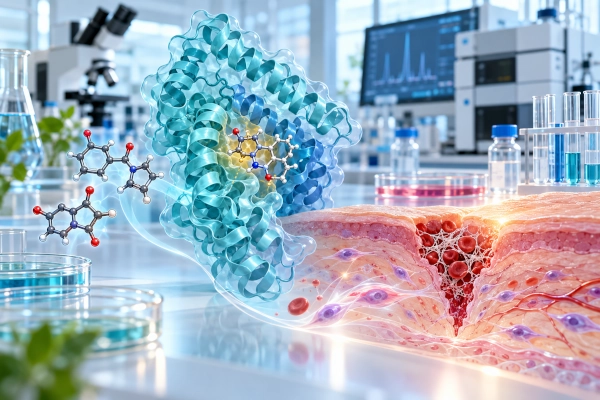
Researchers from IISER Berhampur, NIT Rourkela and collaborating institutions have reported promising biomedical properties in modified cotarnine compounds, including stronger interaction with human serum albumin, improved wound-healing activity, haemostatic potential and antibacterial effects.
The study was published in the September 2026 issue of Molecular Pharmaceutics by the American Chemical Society. It combines spectroscopic experiments, thermodynamic analysis, molecular docking and biological testing to examine how cotarnine and its derivatives behave in a biomedical environment.
Researchers Study Cotarnine Derivatives With Human Serum Albumin
Human serum albumin is the most abundant protein in blood plasma and plays an important role in transporting hormones, fatty acids and many therapeutic molecules through the bloodstream.
For this reason, studying how a potential therapeutic molecule binds to human serum albumin can provide useful information about its stability, transport behaviour and biological compatibility.
The researchers examined cotarnine and several modified derivatives to determine how strongly they bind to human serum albumin and whether this interaction alters the protein’s natural structure.
Modified Compounds Bind Without Major Structural Disturbance
The study found that the cotarnine derivatives bound efficiently to human serum albumin without substantially disrupting its native secondary structure.
This is an important observation because strong binding alone is not enough for a molecule to be considered useful in biomedical research. A compound that significantly damages or destabilises a major blood protein would raise concerns about compatibility.
The researchers found that the interactions were spontaneous and largely driven by non-covalent forces, while molecular docking studies showed favourable binding positions within human serum albumin.
Derivatives Performed Better Than Cotarnine
The modified cotarnine compounds generally showed stronger protein binding and better biological activity than the parent cotarnine molecule.
Among the tested derivatives, a compound identified as L2 showed the strongest binding affinity and the most promising biological performance. The researchers linked this enhanced behaviour to stronger hydrophobic interactions associated with its chloro-substituted aromatic structure.
The findings suggest that chemical modification of cotarnine can significantly influence both its interaction with proteins and its biological activity.
Wound-Healing Activity Shows Promising Results
The study also evaluated the compounds for wound-healing potential.
The modified cotarnine derivatives showed stronger wound-healing activity than unmodified cotarnine, indicating that structural modification could improve their usefulness in future therapeutic formulations.05
This does not mean the compounds are ready for clinical treatment, but it identifies them as promising candidates for further preclinical research in wound management and regenerative applications.
Haemostatic Activity Could Support Bleeding Control
The researchers also examined haemostatic activity, which relates to the body’s ability to stop bleeding through processes such as platelet aggregation and blood clot formation.
The cotarnine derivatives demonstrated stronger haemostatic activity than the parent compound, with L2 again showing particularly favourable results.
This raises the possibility that such molecules could eventually contribute to the development of materials or formulations designed to support bleeding control and wound treatment.
Antibacterial Activity Adds Another Biomedical Dimension
The study also assessed antibacterial behaviour, giving the compounds a broader multifunctional profile.
The combination of protein compatibility, wound-healing activity, haemostatic potential and antibacterial effects is significant because wound-care materials often need to perform more than one function. Preventing infection while supporting clotting and tissue recovery is particularly important in complex wound environments.
The researchers therefore describe the most promising derivatives as multifunctional candidates rather than compounds with a single isolated biological effect.
Experimental Work Was Supported by Molecular Docking
The research team combined laboratory experiments with computational modelling to understand how the molecules interacted with human serum albumin.
Molecular docking helped identify favourable binding orientations within the protein, while spectroscopic and thermodynamic studies provided experimental evidence of the strength and nature of those interactions.
This combination of computational and laboratory approaches gives the findings a stronger mechanistic basis and helps researchers identify which structural features contribute most to biological performance.
Collaboration Brings Together Multiple Indian Research Institutions
The study involved researchers from NIT Rourkela, IISER Berhampur, Berhampur University and other collaborating laboratories.
At IISER Berhampur, the work included participation from the Department of Chemical Sciences, while NIT Rourkela contributed expertise from chemistry, life science, biotechnology and medical engineering.
The multidisciplinary nature of the study allowed the researchers to evaluate the compounds from chemical, biophysical and biological perspectives within a single research framework.
Next Step Is Deeper Biomedical Evaluation
The present findings are preclinical and should not be interpreted as evidence of an approved therapy for wound healing, bleeding control or cancer treatment.
The study establishes that selected cotarnine derivatives, particularly L2, show promising biological properties and favourable interaction with human serum albumin. Further research will be needed to examine toxicity, dosage, pharmacokinetics, in-vivo performance and eventual clinical relevance.
The work nevertheless demonstrates how Indian research institutions are combining chemistry, protein science, computational modelling and biomedical testing to identify new therapeutic possibilities from modified small molecules.
Indian Research Expands the Biomedical Potential of Cotarnine
The study gives cotarnine derivatives a wider biomedical profile than previously recognised by linking protein compatibility with wound-healing, haemostatic and antibacterial activity.
With one derivative showing particularly strong performance across several tests, the research provides a useful foundation for future development of multifunctional wound-care and therapeutic materials.
The collaboration between IISER Berhampur, NIT Rourkela and partner institutions also highlights the growing depth of interdisciplinary biomedical research in India, where chemistry and life sciences are increasingly being brought together to develop new health technologies.
References
American Chemical Society, Molecular Pharmaceutics — “Human Serum Albumin Binding with Cotarnine Derivatives and Its Hemostatic, Wound-Healing, and Antibacterial Activities: Experimental and Molecular Docking Studies,” Volume 23, Issue 9, September 7, 2026.
PubMed — PMID 42704132, publication record for the cotarnine derivative study.
IISER Berhampur — Faculty research profile of Laxmidhar Rout listing the 2026 Molecular Pharmaceutics publication.
You may also like
-
ISRO Plans Four Operational Launch Pads by 2029 to Expand India’s Space Capabilities
-
Indian Scientists Discover How Rapidly Spinning Black Holes Produce High-Frequency X-Ray Oscillations
-
ISRO Completes Historic SPADEX Mission as Both Satellites Re-enter Earth’s Atmosphere After Successful Space Docking Experiments
-
Indian Scientists Discover Rare Accretion Disk Around Neutron Star 24,000 Light-Years Away
-
BARC Scientists Develop Indigenous Technology to Recover 90% of Lithium from Seawater
