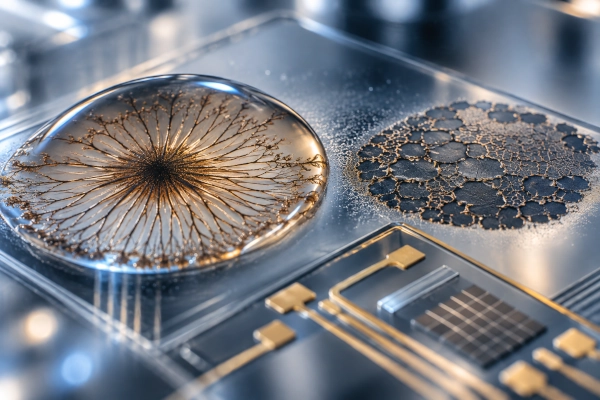
Researchers from DIT University, IIT Bombay, Bhabha Atomic Research Centre, Ben-Gurion University of the Negev and IIT Kharagpur have demonstrated how the size and oxidation level of graphene oxide nanosheets can determine the patterns formed when tiny droplets of the material dry on a surface.
The study, published in the American Chemical Society journal Langmuir, shows that graphene oxide suspensions can form dramatically different deposits, ranging from spider-web-like radial stripes to compact mosaic patterns. By identifying the physical mechanisms responsible for these structures, the researchers have opened a pathway toward more predictable deposition of graphene oxide in printed electronics, coatings, sensors and energy-storage technologies.
Graphene Oxide Droplets Produce Two Distinct Patterns
The research examined what happens when droplets containing graphene oxide nanosheets evaporate on a solid surface.
Larger graphene oxide sheets with relatively lower levels of oxidation produced thin radial stripes extending from the centre of the dried droplet toward its edge. The resulting structure resembled a spider web.
Smaller graphene oxide nanosheets with a greater degree of oxidation behaved very differently. Instead of producing long radial structures, they formed numerous small regions distributed across the surface, creating a mosaic-like appearance.
The researchers found that this difference was not random. It resulted from the way graphene oxide sheets organised themselves within the liquid before evaporation was complete.
Nanosheet Size Plays a Critical Role
The larger graphene oxide nanosheets examined in the study had an average lateral dimension of approximately 2.2 micrometres.
These sheets also had a carbon-to-oxygen ratio of about 14.4, indicating comparatively lower oxidation.
The smaller nanosheets measured approximately 0.5 micrometres across and had a carbon-to-oxygen ratio of about 10.4. The lower ratio indicated a greater concentration of oxygen-containing groups on the graphene oxide surface.
Changing these two material characteristics altered the internal organisation of the liquid suspension and ultimately determined the structure that remained after the water evaporated.
Internal Structure Determines the Final Deposit
The team found that the larger, less oxidised graphene oxide sheets formed relatively loosely organised nematic structures.
Within these arrangements, the nanosheets generally aligned in similar directions while retaining sufficient freedom to move and deform. As the droplet evaporated and contracted, the graphene oxide assembly was compressed against the underlying surface.
This compression caused the nanosheets to deform and wrinkle. The wrinkles gradually developed into the long radial structures visible in the final dried deposit.
The smaller and more strongly oxidised nanosheets formed more tightly organised structures with stronger spatial ordering. These assemblies behaved more like elastic structures and resisted the deformation caused by evaporation.
As a result, they did not develop the same long wrinkles. Instead, the material produced smaller, compact domains that generated the characteristic mosaic pattern.
Synchrotron X-Rays Reveal Nanoscale Organisation
To understand how the graphene oxide sheets were arranged inside the droplets, the researchers used synchrotron-based small-angle X-ray scattering.
The measurements were conducted using facilities at the Indus-2 synchrotron at the Raja Ramanna Centre for Advanced Technology in Indore.
Small-angle X-ray scattering allows researchers to examine structures at extremely small scales by analysing how X-rays scatter as they pass through a material. The technique enabled the team to distinguish the different forms of organisation produced by the two types of graphene oxide suspension.
The results confirmed that the differences visible in the dried deposits originated from structural differences already present while the graphene oxide remained suspended in water.
Rheology Confirms Different Mechanical Behaviour
The researchers also used rheology to study how the graphene oxide suspensions flowed and deformed.
The suspension containing larger, less oxidised sheets behaved more like a conventional liquid when subjected to shear forces. Its relatively weak internal organisation allowed the sheets to move and rearrange easily.
The suspension containing smaller, more highly oxidised sheets behaved differently. Its stronger internal structure produced an elastic response resembling a soft solid.
This difference in mechanical behaviour helped explain why the two suspensions produced different patterns during evaporation.
The research therefore links three stages of the process: nanosheet structure, mechanical behaviour within the droplet and the final deposit formed after drying.
Solving the Coffee-Ring Problem
The study is also connected to a familiar phenomenon known as the coffee-ring effect.
When a droplet containing suspended particles dries on a surface, evaporation can transport particles toward the perimeter. The particles accumulate at the edge and leave behind a visible ring.
While harmless in an ordinary coffee stain, this behaviour can create significant problems in advanced manufacturing.
Printed electronics, functional coatings and sensor surfaces often require materials to be deposited uniformly or according to carefully controlled patterns. Uncontrolled migration of particles can cause variations in electrical conductivity, optical behaviour or mechanical performance.
Understanding how graphene oxide can be made to form different structures gives researchers another method for controlling material deposition.
Potential for Printed Electronics
Graphene oxide is attractive for printed electronics because it combines many useful characteristics of graphene with the ability to disperse relatively easily in water.
Liquid suspensions can potentially be deposited using printing techniques similar to conventional inkjet printing. Once deposited and processed, the material can form functional layers used in electronic devices.
Controlling how those layers dry is essential. Even minor variations in the distribution or orientation of graphene oxide nanosheets can change the behaviour of the resulting electronic structure.
The new research demonstrates that adjusting nanosheet dimensions and oxidation levels provides a way to influence that drying process at the material level.
Applications Could Extend to Sensors and Coatings
The ability to create predictable graphene oxide structures could also support the development of advanced sensors.
Graphene-based materials are highly sensitive to changes in their surrounding chemical and physical environment. This makes them attractive for detecting gases, contaminants, biological molecules and other substances.
Low-cost printed sensing surfaces could eventually be used in environmental monitoring, industrial systems, healthcare diagnostics and water-quality testing.
The current study does not itself demonstrate a finished commercial sensor. Instead, it addresses one of the fundamental manufacturing challenges involved in creating reliable graphene oxide layers for such devices.
Predictable material deposition is essential if large numbers of sensors are to be manufactured with consistent performance.
Energy Storage Could Also Benefit
Graphene oxide and related graphene materials are also being investigated for use in batteries and supercapacitors.
The arrangement of graphene sheets influences surface area, ion transport and electrical behaviour within an energy-storage device.
Methods that allow researchers to control nanosheet orientation and packing could therefore become useful when designing electrodes and other functional components.
The study’s findings may also help researchers understand why graphene oxide obtained from different manufacturing processes can behave differently even when the material appears chemically similar.
Variations in sheet size and oxidation can significantly alter the way the material flows, assembles and dries.
Indian Research Infrastructure Supports the Study
The research brought together expertise from several Indian institutions covering physics, mechanical engineering, materials science and synchrotron-based characterisation.
IIT Bombay contributed expertise in droplet dynamics and mechanical engineering, while researchers from DIT University investigated graphene oxide and its physical behaviour. Bhabha Atomic Research Centre contributed expertise in advanced material characterisation, while the Indus-2 synchrotron facility provided the X-ray measurements needed to examine the nanoscale structures.
The involvement of multiple research institutions demonstrates how India’s scientific infrastructure can support fundamental materials research with potential applications across several technology sectors.
From Simple Droplets to Advanced Manufacturing
A drying droplet appears simple, but the study shows that a complex sequence of physical processes takes place inside it.
Graphene oxide nanosheets first organise themselves within the liquid. Their size and oxidation level determine how strongly they interact. Those interactions influence whether the suspension behaves primarily as a liquid or develops elastic characteristics. Evaporation then compresses the structure and converts those microscopic differences into visible patterns.
By understanding this chain of events, researchers can begin engineering the drying process instead of treating it as an unpredictable manufacturing limitation.
The ability to deliberately guide graphene oxide into different surface structures strengthens the scientific foundation for future printed electronics, sensing technologies, coatings and energy-storage systems. The work also highlights how fundamental materials research can provide solutions to practical manufacturing challenges long before a technology reaches commercial production.
References
American Chemical Society — Langmuir
Tunable Morphologies of Dried Colloidal Deposits in Graphene Oxide-Laden Aqueous Sessile Droplets Mediated by Mesophase Characteristics
https://doi.org/10.1021/acs.langmuir.6c04461
Bhabha Atomic Research Centre — Official Website
https://www.barc.gov.in/
Raja Ramanna Centre for Advanced Technology — Indus Synchrotrons
https://www.rrcat.gov.in/technology/accel/sr/indus.html
Indian Institute of Technology Bombay — Department of Mechanical Engineering
https://www.me.iitb.ac.in/
You may also like
-
ISRO Successfully Completes Critical Gaganyaan Crew Module Separation Tests at VSSC
-
ISRO’s Aditya-L1 Expands Global Solar Research as Joint Observations with Europe’s Proba-3 Reveal New Insights
-
ISRO Advances Indigenous 1,100 kN Methane Rocket Engine for Next-Generation Launch Vehicle
-
Indian Scientists Identify A Few Martian Analogue Sites
-
Climate History Finds Monsoon Fluctuation Footprints From Sediment Transport to Farming Adaptations
