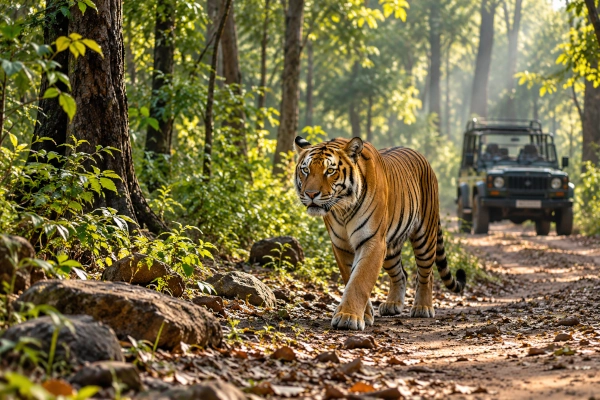
Chhattisgarh is preparing to reopen organised wildlife safaris in the Indravati Tiger Reserve from November 1, 2026, marking the return of regulated tourism to one of central India’s most important forest landscapes after nearly four decades. The reopening is planned in a phased and controlled manner, with safari routes being developed under the reserve’s Tiger Conservation Plan and visitor movement expected to remain subject to ecological carrying-capacity limits.
Located in Bijapur district in the south Bastar region, Indravati Tiger Reserve covers 2,799.07 square kilometres. The National Tiger Conservation Authority records 1,258.37 square kilometres as core or critical tiger habitat and 1,540.70 square kilometres as buffer and peripheral area. The reserve was brought under Project Tiger in 1982-83 and forms part of a wider forest landscape connected with neighbouring areas of Maharashtra and the forests further south.
Wildlife Tourism Returns to Indravati
Organised tourism is expected to reopen initially across a limited number of designated destinations rather than across the entire reserve. The phased approach is intended to allow forest authorities to assess visitor pressure, security requirements and ecological impact while gradually restoring access to parts of the landscape.
Safari routes are being mapped in accordance with the Tiger Conservation Plan. The forest department is also preparing dedicated vehicles and coordinating with local security agencies to assess routes before regular visitor movement begins.
The decision represents a major change for Indravati, where wildlife tourism remained severely restricted for decades because of persistent security challenges associated with Left-Wing Extremism. The difficult operating environment affected not only tourism but also forest management, monitoring and regular administrative access across parts of the reserve.
Improved access in recent years has allowed forest personnel to strengthen field activity in the region. The planned reopening of tourism reflects the broader return of forest management operations to areas that remained inaccessible or difficult to operate in for long periods.
One of Central India’s Largest Tiger Reserves
Indravati is among the largest tiger reserves in central India by area. The Indravati River forms much of its northern and western boundary and also marks sections of the interstate boundary between Chhattisgarh and Maharashtra.
Its location gives the reserve considerable ecological importance because the forests connect with larger forested landscapes extending towards Maharashtra and the southern part of central India. Such connectivity is especially important for wide-ranging wildlife, including tigers and other large mammals that require extensive habitats.
The reserve contains a mosaic of tropical deciduous forests, grasslands and river-associated habitats. These environments support a diverse wildlife community and make Indravati one of the significant remaining wilderness areas of the Bastar region.
Important Habitat for Wild Water Buffalo
Indravati is important not only for tiger conservation but also for the endangered wild water buffalo, Bubalus arnee. The National Tiger Conservation Authority has identified the reserve as one of the remaining habitats of the species in Chhattisgarh.
Wild water buffalo populations have undergone substantial decline across their former range, making the remaining populations of central and northeastern India particularly important from a conservation perspective.
Indravati also supports leopards, sloth bears, gaur, wild dogs, chital, nilgai and numerous smaller mammals, reptiles, birds and invertebrates. Its long period of limited tourism has meant that many sections of the reserve have experienced relatively little recreational disturbance.
The ecological value of Indravati therefore extends beyond any single flagship species. Tigers, wild buffalo, predators, herbivores, riverine habitats and forest ecosystems together make the reserve an important component of India’s wider wildlife conservation network.
Safari Numbers to Be Controlled
The reopening is not being planned as unrestricted mass tourism. Visitor access is expected to operate within carrying-capacity limits, with the number of vehicles and tourists regulated to prevent excessive pressure on sensitive habitats.
Carrying-capacity assessment is an important element of eco-tourism management in tiger reserves because vehicle traffic, noise and repeated visitor movement can affect wildlife if tourism becomes concentrated beyond sustainable levels.
The planned phased reopening provides an opportunity to develop Indravati as a conservation-oriented tourism destination rather than a high-density safari circuit. Regulated access can also make it easier for forest officials to monitor visitor behaviour, enforce route restrictions and adapt tourism operations to seasonal wildlife movements.
Bastar Communities to Participate in Eco-Tourism
A significant component of the Indravati safari plan is expected to involve communities living in and around the Bastar landscape.
Local residents are expected to participate as safari guides, drivers and hospitality providers. The wider tourism model could also support homestays, handicrafts and locally managed visitor services, allowing a greater share of tourism-generated income to remain within forest-fringe communities.
This approach is particularly relevant in landscapes where long-term conservation depends on cooperation between protected-area authorities and communities living near wildlife habitats.
When local employment is linked directly with healthy forests and wildlife populations, eco-tourism can create an additional economic incentive for conservation. Traditional knowledge of forests, wildlife movement and local geography can also make trained community members valuable participants in responsible tourism.
Conservation Remains the Central Priority
The return of visitors to Indravati will bring new opportunities, but the reserve’s primary role remains wildlife and habitat conservation.
The National Tiger Conservation Authority’s earlier management assessments have highlighted both the ecological potential of Indravati and the difficulties created by the region’s security environment. Strengthened patrolling, scientific monitoring, habitat management and protection of wildlife corridors will remain more important than tourism numbers.
Reopening safaris therefore represents only one part of a much larger conservation process. The success of the initiative will depend on maintaining strict controls over routes, visitor capacity and infrastructure while ensuring that wildlife protection remains the foundation of management decisions.
A New Chapter for Indravati and Bastar
The return of regulated wildlife tourism to Indravati Tiger Reserve after almost four decades carries significance well beyond safari activity.
For conservation authorities, it reflects improved access to an ecologically important landscape. For surrounding communities, it opens possibilities for employment and locally rooted tourism. For visitors, it will provide carefully managed access to one of central India’s least familiar major tiger reserves.
Indravati’s reopening also provides Chhattisgarh with an opportunity to build a wildlife tourism model around conservation, controlled visitor numbers and community participation from the beginning. With its extensive forests, tiger habitat, endangered wild water buffalo population and distinctive Bastar landscape, Indravati is well positioned to emerge as an important example of responsible eco-tourism linked directly with long-term wildlife protection.
References
National Tiger Conservation Authority — Indravati Tiger Reserve Profile
https://ntca.gov.in/assets/uploads/briefnote/indravati.pdf
National Tiger Conservation Authority — Tiger Reserves of India
https://ntca.gov.in/tiger-reserves/
National Tiger Conservation Authority — Management Effectiveness Evaluation Report: Indravati Tiger Reserve
https://ntca.gov.in/assets/uploads/Reports/MEE/MEE_TR_Report_2023.pdf
Indulge Express — Chhattisgarh’s Indravati Tiger Reserve to Reopen for Safaris After Four Decades, 29 September 2026
https://www.indulgexpress.com/travel/2026/Sep/29/chhattisgarhs-indravati-tiger-reserve-to-reopen-for-safaris-after-four-decades
You may also like
-
Thousands of Butterflies Migrate Across Tamil Nadu as Northeast Monsoon Arrives
-
Indian Researcher Surveys Over 3,000 Western Ghats Frogs to Track Deadly Amphibian Fungus
-
Zoological Survey of India Discovers Three New Centipede Species in Western Ghats of Kerala and Karnataka
-
Scientists Document 3,261 Flowering Plant Species in Agasthyamalai Biosphere Reserve, Including 1,018 Indian Endemics
-
Scientists Discover Two Rare Blind Fish Species in Assam’s Underground Waters, Revealing Hidden Biodiversity
