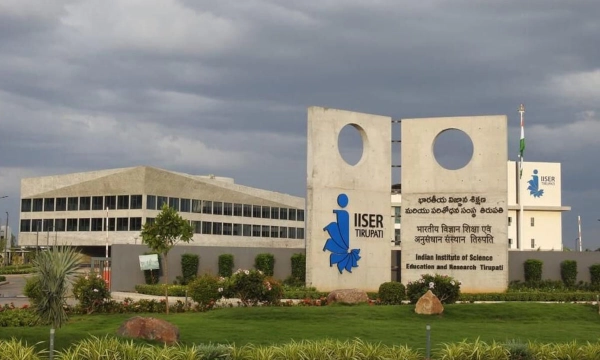
Researchers at the Indian Institute of Science Education and Research Tirupati have developed reversible DNA nanostructures whose shape can be tuned by changes in pH, opening a possible route toward more precisely controlled drug-delivery systems.
The work, published in ACS Applied Nano Materials and highlighted by IISER Tirupati on September 28, 2026, demonstrates how DNA can be engineered into nanoscale structures that respond predictably to acidic and neutral environments. Such behaviour is important because different parts of the human body, as well as diseased tissues, can exhibit distinct pH conditions.
DNA Nanostructures Designed to Respond to pH
The study, titled “Design of pH-Tunable Reversible DNA Nanostructures for Efficient Drug Delivery,” was carried out by J. Sathiri, A. M. Krishna and A. Sharma.
The researchers designed DNA-based nanostructures capable of undergoing controlled structural changes as the surrounding pH changes. Importantly, these changes are reversible, meaning the nanostructures can shift between configurations instead of undergoing a one-time transformation.
This reversible behaviour is particularly useful for biomedical applications because drug carriers often need to remain stable while circulating through the body and then change their structure only after reaching a specific environment.
Why pH Responsiveness Matters in Drug Delivery
The human body does not maintain identical pH levels across all tissues and cellular compartments.
Blood remains close to neutral pH, while environments such as endosomes and lysosomes inside cells are considerably more acidic. Some diseased tissues can also exhibit altered acidity compared with surrounding healthy tissue.
A drug-delivery system that can detect these changes could potentially remain closed or stable in one environment and release its therapeutic cargo after encountering another.
The IISER Tirupati work explores this principle using DNA itself as the structural material.
DNA as a Programmable Nanomaterial
DNA is best known for storing genetic information, but its predictable base-pairing behaviour also makes it an exceptionally useful engineering material at the nanoscale.
Researchers can design specific DNA sequences that naturally assemble into predetermined shapes. These structures can be engineered to open, close, fold or rearrange in response to chemical or physical triggers.
This field, known as DNA nanotechnology, allows researchers to build structures far smaller than conventional mechanical devices while maintaining precise control over their geometry.
IISER Tirupati already has an active research programme in single-molecule biophysics and DNA nanotechnology, providing the scientific foundation for this work.
Reversible Behaviour Offers Greater Control
One of the important features of the new system is reversibility.
Many responsive materials undergo irreversible chemical changes once activated. A reversible DNA nanostructure can instead return to its earlier configuration when the surrounding conditions change again.
This property could eventually support drug carriers that respond dynamically to changing biological environments.
It could also help researchers design nanoscale systems capable of repeated switching, sensing or controlled molecular transport.
Potential for More Selective Drug Release
Conventional drug administration often distributes medicines throughout the body, even when treatment is needed only at a specific location.
Targeted delivery systems attempt to concentrate therapeutic molecules at diseased tissues while reducing exposure elsewhere.
pH-responsive DNA nanostructures could contribute to this goal by serving as nanoscale containers or carriers that react only after encountering particular biochemical conditions.
The present research establishes the design principle rather than demonstrating a finished clinical therapy. Further work would be required to study stability in biological fluids, cellular uptake, toxicity, drug-loading capacity and performance in living systems.
DNA Nanotechnology Expands Biomedical Possibilities
The broader significance of the IISER Tirupati study lies in the convergence of molecular biology, chemistry and nanoscale engineering.
DNA-based structures can potentially be designed to carry drugs, detect biomarkers, respond to disease-associated conditions or perform multiple functions within a single nanoscale platform.
Because their geometry and behaviour can be programmed through nucleotide sequences, DNA nanostructures offer a degree of molecular precision that is difficult to achieve using many conventional materials.
The pH-tunable system developed by the IISER Tirupati researchers adds another controllable mechanism to this growing toolkit.
From Fundamental Research to Future Therapeutics
The new work remains at the research stage, but it addresses an important challenge in advanced drug delivery: how to release therapeutic molecules in a controlled and environmentally responsive manner.
By designing DNA nanostructures that can reversibly respond to acidity, the IISER Tirupati team has demonstrated a platform that could be adapted for future biomedical applications.
The study also highlights the expanding role of Indian research institutions in DNA nanotechnology, molecular engineering and precision drug-delivery research. As these technologies mature, programmable nanostructures may become increasingly important in targeted therapeutics, diagnostics and next-generation biomedical devices.
References
IISER Tirupati — Biology Publications, “Design of pH-Tunable Reversible DNA Nanostructures for Efficient Drug Delivery”
https://www.iisertirupati.ac.in/category/biology/
ACS Applied Nano Materials — Sathiri, J., Krishna, A. M., & Sharma, A. (2026), “Design of pH-tunable reversible DNA nanostructures for efficient drug delivery”
https://doi.org/10.1021/acsanm.6c03459
IISER Tirupati — Research and Development, Single Molecule Biophysics Lab
https://www.iisertirupati.ac.in/category/biology/research/
You may also like
-
ISRO Plans Four Operational Launch Pads by 2029 to Expand India’s Space Capabilities
-
Indian Scientists Discover How Rapidly Spinning Black Holes Produce High-Frequency X-Ray Oscillations
-
ISRO Completes Historic SPADEX Mission as Both Satellites Re-enter Earth’s Atmosphere After Successful Space Docking Experiments
-
Indian Scientists Discover Rare Accretion Disk Around Neutron Star 24,000 Light-Years Away
-
BARC Scientists Develop Indigenous Technology to Recover 90% of Lithium from Seawater
