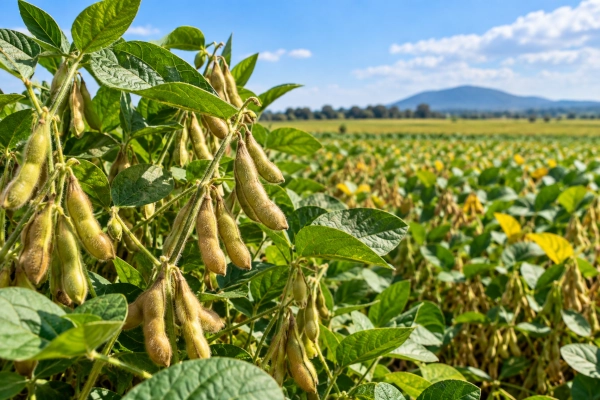
Two improved soybean varieties developed by the ICAR–National Soybean Research Institute (NSRI), Indore, have demonstrated promising productivity during preliminary harvest assessments, recording estimated yields of approximately 20 quintals per hectare despite adverse weather conditions. The results highlight the potential of improved crop varieties and scientific cultivation practices to increase soybean production in India.
The Indian Council of Agricultural Research (ICAR) evaluated the performance of NRC 268 and NRC 270 during Soybean Harvest Day, organised at its Indore institute on October 9, 2026. The Ministry of Agriculture and Farmers Welfare announced the findings on October 13, 2026.
The preliminary results are significant because India’s average soybean productivity currently stands at approximately 10–11 quintals per hectare, according to ICAR. The observed yields of the two improved varieties are therefore around 82–100% higher than the national average, although larger and longer-term assessments are necessary to establish their performance across different farming conditions.
NRC 268 and NRC 270 Deliver Encouraging Results Under Adverse Weather
The ICAR–National Soybean Research Institute conducted the harvest assessment on one acre each under NRC 268 and NRC 270. Preliminary calculations indicated productivity equivalent to approximately 20 quintals per hectare.
The findings attracted particular attention because the crop had experienced unfavourable weather conditions during the growing season. Despite these challenges, both improved varieties demonstrated encouraging productivity.
The assessment provides an early indication of their potential under the conditions experienced at the research site. However, it does not establish that the varieties will consistently achieve similar yields across different regions or withstand every form of climatic stress.
The institute will undertake a detailed scientific analysis of the harvested crop and associated production data to understand varietal performance and identify factors influencing productivity.
These results form part of ICAR’s continuing efforts to develop soybean varieties capable of delivering higher yields through improved genetic characteristics and appropriate crop management.
India’s Soybean Productivity Could Improve Through Better Varieties
Soybean is an important oilseed crop in India, contributing to domestic vegetable oil production, animal feed manufacturing and agricultural income. Improving its productivity is particularly relevant to India’s efforts to strengthen domestic oilseed production.
According to ICAR, the country’s average soybean productivity currently ranges between 10 and 11 quintals per hectare.
Research conducted by the ICAR–National Soybean Research Institute and the All India Coordinated Research Project on Soybean indicates that farmers can achieve yields of approximately 15–20 quintals per hectare by combining improved varieties with suitable production technologies.
Under favourable growing conditions, productivity may reach approximately 22–25 quintals per hectare.
These estimates demonstrate the considerable difference between average farm productivity and the yields achievable under improved cultivation conditions.
However, the higher figures represent potential outcomes rather than guaranteed harvests. Actual productivity depends on rainfall, soil conditions, crop nutrition, disease pressure, management practices and the suitability of individual varieties to local environments.
The findings suggest that targeted improvements in cultivation methods could help narrow the productivity gap without necessarily expanding the area under soybean cultivation.
ICAR Director General Highlights the Importance of Scientific Crop Management
Dr. M. L. Jat, Secretary of the Department of Agricultural Research and Education (DARE) and Director General of ICAR, welcomed the preliminary findings.
He observed that improved crop varieties and scientific production technologies play an important role in increasing soybean productivity.
Dr. Jat described the indications of approximately 20 quintals per hectare from NRC 268 and NRC 270, despite adverse weather conditions, as encouraging for India’s soybean research programme.
He also emphasised that systematic scientific analysis of the harvested crop and associated data would help researchers formulate future strategies for improving productivity.
His observations underline the importance of combining crop improvement with effective agronomic practices rather than relying on genetic improvements alone.
Long-Term Yield Data to Guide Future Soybean Research
The ICAR–National Soybean Research Institute has emphasised that the significance of Soybean Harvest Day extends beyond evaluating the performance of individual varieties during a single agricultural season.
The institute intends to use systematic yield assessments to examine changes in soybean productivity across different years, locations, varieties and cultivation conditions.
Long-term data can help researchers distinguish improvements arising from varietal characteristics and crop management from variations caused by weather or other environmental factors.
Such assessments are particularly important for soybean because rainfall distribution, soil moisture and temperature variations can influence crop growth and final yields.
By compiling comparable information over multiple seasons, scientists can evaluate the consistency of productivity improvements and identify technologies that perform reliably under different agricultural conditions.
The research will also help ICAR assess the effectiveness of its crop improvement programmes and agricultural technology dissemination activities.
Scientific Production Technologies Can Help Farmers Achieve Higher Yields
Improved seed varieties deliver their greatest benefits when combined with cultivation practices suited to local agricultural conditions.
ICAR’s soybean research programmes therefore focus on integrating varietal improvement with appropriate sowing methods, soil fertility management, weed control, crop protection and timely harvesting.
The institute also conducts farmer training programmes to demonstrate these practices and explain how scientific crop management can improve agricultural productivity.
On October 5–6, 2026, the ICAR–National Soybean Research Institute organised a two-day training programme in Indore covering improved soybean production technologies, crop protection, value addition and processing.
Union Agriculture and Farmers Welfare Minister Shivraj Singh Chouhan addressed the concluding session on October 6. He emphasised the importance of scientific supervision, demonstration plots and improved agricultural technologies in reducing cultivation costs and enhancing farmers’ income.
Such programmes complement varietal research by helping farmers understand how to adapt improved cultivation methods to their fields.
Soybean Harvest Day Connects Agricultural Research with Farmers
The ICAR–National Soybean Research Institute regularly organises Soybean Harvest Day to evaluate the actual productivity of different varieties under field conditions.
These events allow researchers to examine crop performance at harvest rather than relying exclusively on projected yields or observations during the growing season.
The resulting information helps scientists assess the influence of improved technologies, identify promising varieties and refine recommendations for farmers.
The initiative also strengthens coordination between agricultural research institutions and extension services responsible for disseminating scientific knowledge.
By linking field observations with laboratory analysis and long-term yield records, ICAR aims to make soybean research more responsive to practical agricultural challenges.
Higher Soybean Productivity Can Support India’s Oilseed Sector
Increasing soybean productivity is important for India’s agricultural economy because the crop provides both edible oil and protein-rich soybean meal.
Soybean oil contributes to the country’s vegetable oil supply, while soybean meal serves as an important ingredient in livestock and poultry feed. Soybean processing also supports industries involved in oil extraction, food manufacturing and agricultural exports.
Higher yields per hectare can increase production from existing cultivated land. This approach is particularly valuable where opportunities for expanding agricultural acreage are limited.
For farmers, improved productivity can increase the quantity of produce available for sale. However, actual income gains also depend on cultivation expenses, market prices, crop quality and access to buyers.
The potential of NRC 268 and NRC 270 must therefore be evaluated through continued field research, economic assessments and observations across different growing environments.
ICAR’s Improved Soybean Varieties Offer Encouraging Prospects for Indian Agriculture
The preliminary performance of NRC 268 and NRC 270 represents a promising development in India’s soybean improvement programme.
The estimated yield of approximately 20 quintals per hectare demonstrates the productivity achieved by the two varieties during the Indore harvest assessment, even under unfavourable seasonal conditions.
More importantly, the exercise provides valuable field information for scientists working to improve soybean cultivation through better varieties and production technologies.
Continued evaluation across agricultural regions and multiple cropping seasons will help establish the varieties’ adaptability, yield stability and suitability for farmers.
Through sustained research, scientific field assessments and wider dissemination of appropriate cultivation technologies, ICAR is strengthening the foundation for higher soybean productivity, improved farm incomes and greater domestic oilseed production in India.
References
1. Press Information Bureau, Government of India
Ministry of Agriculture and Farmers Welfare
Improved Soybean Varieties NRC 268 and NRC 270 Show Promising Signs of Yielding 20 Quintals per Hectare Despite Adverse Weather Conditions
Published: October 13, 2026, 3:12 PM
https://www.pib.gov.in/PressReleseDetail.aspx?PRID=2322744
2. Indian Council of Agricultural Research (ICAR)
Scientific Supervision, Demonstration Plots and Improved Technologies Essential to Reduce Cultivation Costs and Enhance Farmers’ Income: Shri Shivraj Singh Chouhan
October 6, 2026
https://icar.gov.in/hi/node/26727
3. Indian Council of Agricultural Research
ICAR Kharif Agro-Advisory 2025 — Soybean Cultivation Recommendations
https://icar.gov.in/sites/default/files/Circulars/ICAR-En-Kharif-Agro-Advisories-for-Farmers-2025.pdf
You may also like
-
Indian Railways Records 6.14% Freight Growth in September 2026 as Coal, Food Grains and Industrial Cargo Drive Demand
-
Kalanamak Rice of Uttar Pradesh — The Fragrant Black-Husked Grain of the Himalayan Terai
-
GE Aerospace to Double India Supply Chain Spending to $400 Million by 2030, Strengthening Indigenous Manufacturing
-
India’s Startup Ecosystem Expands Beyond Bengaluru and Hyderabad as Tier-II Cities Gain Momentum
-
NABARD Report Highlights Growing Strength of Women-Led Farmer Producer Organisations in India
