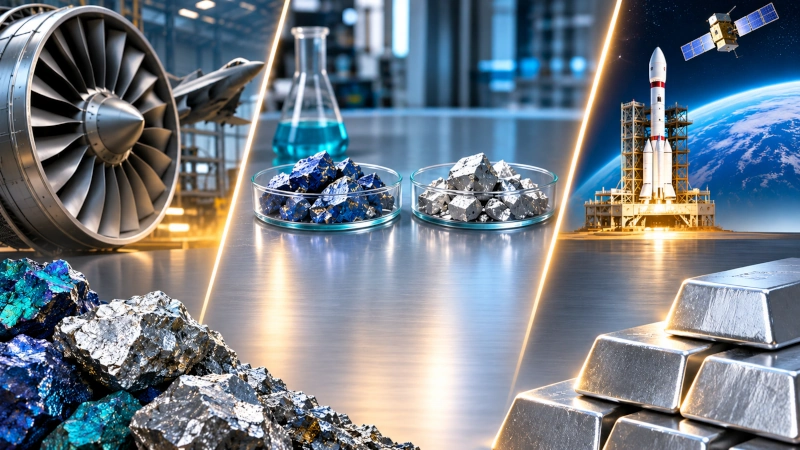
Three major Indian government organisations have joined forces to develop indigenous technologies for recovering strategically important cobalt and nickel from industrial residues, marking a significant initiative in critical mineral conservation, advanced metallurgy and domestic resource security. Mishra Dhatu Nigam Limited (MIDHANI), the Bhabha Atomic Research Centre (BARC) and the Heavy Water Board (HWB) have signed a tripartite Memorandum of Understanding (MoU) to develop efficient and economically viable processes for recovering these valuable metals from industrial plant reverts.
The Department of Atomic Energy announced the collaboration on November 3, confirming that the agreement was signed on October 27, 2026. The partnership brings together scientific research, specialised process technology and advanced metallurgical manufacturing to explore methods of converting secondary industrial materials into reusable strategic resources. The initiative is intended to reduce material losses, improve resource utilisation and strengthen India’s domestic supply chains for metals used in defence, aerospace, advanced manufacturing and clean-energy technologies.
Three Government Organisations Combine Scientific and Industrial Capabilities
The agreement establishes a collaborative framework between institutions possessing complementary technological capabilities. The Heavy Water Board, a constituent unit of the Department of Atomic Energy, will contribute its expertise in specialised industrial processes and technology development. BARC, also functioning under the Department of Atomic Energy, will provide scientific research capabilities, while MIDHANI, a defence public sector undertaking headquartered in Hyderabad, will contribute its experience in advanced metallurgy and industrial manufacturing.
The MoU was signed by V. V. S. A. Prasad, Chairman and Chief Executive of the Heavy Water Board; Dr. S. V. S. Narayana Murty, Chairman and Managing Director of MIDHANI; and Dr. Alok Awasthi, Associate Director of the Materials Group at BARC. The signing ceremony was attended by K. Madhubala, Director (Finance) of MIDHANI, and Sandeep Wadhwa, Executive Director of the Heavy Water Board, along with officials representing the participating organisations.
The collaboration seeks to establish technically effective and commercially viable recovery methods that can eventually support the industrial reuse of recovered cobalt and nickel. By integrating research expertise with manufacturing experience, the organisations aim to address both the scientific challenges associated with metal recovery and the practical requirements of developing processes suitable for industrial applications.
Recovering Valuable Metals from Industrial Plant Reverts
Industrial plant reverts are materials generated during manufacturing and processing operations that contain recoverable constituents capable of being returned to productive use. In metallurgical industries, such materials may include processing residues, offcuts, rejected materials and other recoverable fractions containing valuable metals. Their composition and suitability for recovery depend on the manufacturing processes from which they originate.
Cobalt and nickel are particularly important because they are used in demanding industrial applications where material performance, durability and resistance to extreme operating conditions are essential. Recovering these metals from suitable secondary materials can help preserve their economic value while reducing the need to obtain equivalent quantities exclusively from newly extracted mineral resources.
The proposed collaboration will focus on developing recovery processes capable of separating and reclaiming cobalt and nickel efficiently and economically. Such technologies must address the technical challenges associated with varying material compositions, separation efficiency and the quality of recovered products. Successful processes would need to produce materials suitable for subsequent industrial applications while maintaining acceptable operating costs and resource efficiency.
The Department of Atomic Energy has not announced a specific recovery capacity, commercial production target or implementation schedule for the proposed technologies. The present agreement therefore represents a research and technology development initiative rather than the commissioning of an operational metal recovery facility.
Strategic Importance for Aerospace and Defence Manufacturing
Cobalt and nickel are essential constituents of several advanced engineering materials, particularly high-performance alloys designed to withstand demanding mechanical and thermal conditions. Nickel-based superalloys are extensively used in aerospace propulsion systems, including turbine components operating under high temperatures and significant mechanical stresses. Cobalt also contributes to specialised alloys employed in applications requiring high-temperature strength, wear resistance and corrosion resistance.
These properties make the two metals strategically important for defence and aerospace industries, where the reliability and performance of advanced materials directly influence the capabilities of sophisticated equipment. Manufacturing high-performance components requires dependable access to materials that satisfy demanding technical specifications, making raw material availability an important element of industrial preparedness.
MIDHANI occupies a specialised position within India’s defence manufacturing ecosystem through its production of advanced alloys and metallurgical materials for strategic applications. Its participation provides a potential pathway for translating recovery technologies developed through scientific research into processes relevant to advanced materials manufacturing.
However, recovering cobalt or nickel does not automatically make the resulting material suitable for aerospace-grade or defence-grade applications. Such uses require stringent control over chemical composition, impurities, material processing and quality assurance. The collaboration’s industrial significance will therefore depend on whether the proposed recovery methods can produce metals of appropriate quality for their intended applications.
Supporting India’s Critical Mineral Security
The recovery initiative comes amid growing attention to the security of critical mineral supply chains, particularly as advanced manufacturing industries expand their requirements for specialised metals. Cobalt and nickel are widely used in battery technologies, electric vehicles, stainless steel production, aerospace components and high-performance industrial equipment.
Access to these materials is increasingly important for countries seeking to strengthen domestic manufacturing capabilities and reduce vulnerabilities associated with concentrated global supply chains. Although primary mining and mineral processing remain important sources of supply, recovering metals from industrial residues provides an additional route for obtaining valuable raw materials.
Secondary resource recovery can help conserve natural resources by extracting usable metals from materials that have already entered industrial production systems. It can also reduce material losses and potentially limit dependence on imported primary resources, provided the recovery processes are technically effective and economically competitive.
For India, developing such capabilities would complement wider efforts to strengthen critical mineral security through exploration, processing, refining, recycling and domestic technology development. The MIDHANI–BARC–HWB collaboration addresses the recovery component of this broader industrial challenge, with particular relevance to strategic manufacturing sectors.
Advancing Indigenous Recovery Technology and the Circular Economy
An important aspect of the initiative is its emphasis on developing recovery processes through Indian scientific and industrial institutions. Technologies for separating valuable metals from complex industrial materials often require specialised expertise in chemical processing, materials science, metallurgy and process engineering.
The participating organisations bring capabilities from these interconnected fields, creating opportunities to examine recovery methods from initial scientific development through potential industrial application. This approach can help ensure that research activities consider not only laboratory performance but also operating efficiency, technical feasibility and future manufacturing requirements.
The initiative also aligns with the principles of a circular economy, in which valuable materials are retained within productive use for as long as practical. Recovering cobalt and nickel from plant reverts would allow suitable industrial residues to be treated as potential sources of raw materials rather than materials with limited further utility.
Such practices can improve resource efficiency by reducing waste and recovering economic value from existing material streams. Where technically and environmentally viable, they may also reduce the demand for additional primary mineral extraction and associated processing activities.
The environmental and economic benefits of any particular recovery process will nevertheless depend on factors such as energy consumption, chemical requirements, recovery efficiency and the quality of the resulting materials. These considerations will be important when assessing the commercial feasibility of technologies developed under the agreement.
Strengthening Cooperation Between Research Institutions and Defence Industry
The partnership illustrates the importance of cooperation between government research institutions and manufacturing enterprises in developing strategically relevant technologies. Scientific organisations possess expertise in fundamental research and specialised processes, while industrial manufacturers understand the production requirements, material specifications and commercial constraints associated with practical applications.
By bringing these capabilities together, the collaboration seeks to create a pathway for translating research into potentially useful industrial technologies. BARC’s scientific expertise, HWB’s process technology capabilities and MIDHANI’s metallurgical manufacturing experience provide a foundation for jointly examining solutions to the challenges of cobalt and nickel recovery.
The agreement also creates an opportunity to develop domestic technical knowledge in a field relevant to multiple strategic industries. Recovery technologies developed for suitable industrial materials could contribute to broader expertise in secondary resource processing, materials separation and efficient utilisation of critical raw materials.
Such cooperation is particularly significant for specialised metallurgical applications, where securing a consistent supply of suitable materials is an important part of maintaining manufacturing capability. Developing indigenous knowledge across the resource recovery and materials processing chain can support long-term technological self-reliance.
Towards Greater Self-Reliance in Strategic Materials
The MIDHANI–BARC–Heavy Water Board agreement represents an effort to address critical mineral requirements through indigenous scientific research, specialised process development and industrial cooperation. Its focus on cobalt and nickel recovery connects resource conservation with the material requirements of India’s defence, aerospace, electric mobility and advanced manufacturing sectors.
The immediate objective is to develop recovery processes that are both technically efficient and economically viable. Further progress will depend on the results of research, process development and subsequent assessments of industrial feasibility. No commercial recovery output or production timeline has yet been announced.
By examining how valuable metals can be recovered from existing industrial resources, the three organisations are pursuing an additional approach to strengthening India’s strategic material supply chains. If the proposed technologies prove commercially viable, the collaboration could support more efficient resource utilisation, reduce dependence on external sources of critical raw materials and contribute to the development of a more resilient indigenous advanced manufacturing ecosystem.
You may also like
-
BAE Systems Explores Indian Manufacturing Partnership for Bofors TRIDON Mk2 Air Defence System
-
GE Aerospace Delegation Visits LMW’s Coimbatore Facility to Explore Aerospace Manufacturing Collaboration
-
Arunachal Pradesh Kiwi Reaches Dubai Market as APEDA Facilitates 1.5-Tonne Trial Export
-
APEDA Facilitates Export of 1.3 Tonnes of Sinduri Pomegranates from Himachal Pradesh to Dubai
-
IndiaAI Mission Releases Indigenous EKA-1 and Dhīr Foundation Models to Strengthen India’s AI Ecosystem
