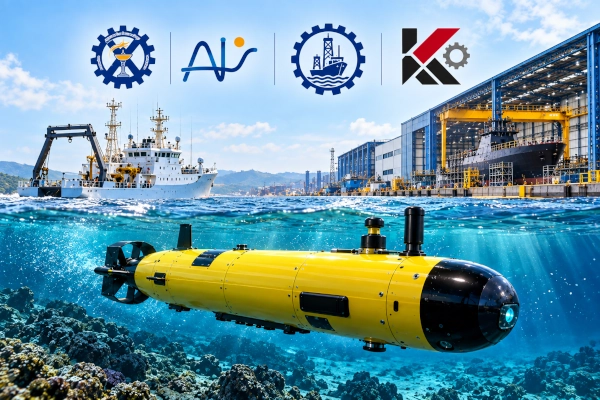
Hindustan Shipyard Limited is set to serially produce the indigenous JAYA Autonomous Underwater Vehicle developed by the CSIR-National Institute of Oceanography, taking an Indian underwater research platform from laboratory development towards industrial-scale manufacture.
The move follows the transfer of JAYA technology by CSIR-NIO to Hindustan Shipyard Limited during events associated with CSIR’s 85th Foundation Day in September 2026. CSIR-NIO has stated that the AUV was developed with support from the Naval Design (Submarine) Group. The technology was also transferred to Krishna Defence & Allied Industries Ltd., widening the industrial base available for indigenous underwater systems.
For Hindustan Shipyard, the programme represents a notable expansion beyond conventional shipbuilding and repair. JAYA gives the Visakhapatnam-based defence public sector undertaking an entry into autonomous underwater platforms, a field with growing importance in oceanographic research, seabed mapping, surveillance and maritime security.
From Research Platform to Serial Production
The most important aspect of the JAYA programme is the transition from indigenous research and development to repeatable industrial manufacture.
Developing a working AUV prototype is only one stage in creating an operational underwater capability. Serial production requires consistent manufacturing standards, integration of sensors and electronics, quality assurance, pressure-resistant construction, testing procedures and long-term maintenance support.
Hindustan Shipyard’s involvement provides a pathway for these requirements to move into an established industrial environment. The company has publicly stated that it will serially produce JAYA following the technology transfer from CSIR-NIO.
The initiative therefore creates a direct link between a national scientific laboratory, naval design expertise and a major Indian shipyard.
What Is an Autonomous Underwater Vehicle?
An Autonomous Underwater Vehicle is an unmanned submersible capable of carrying out underwater missions without remaining physically connected to a surface ship by a control cable.
Unlike remotely operated vehicles, which normally depend on a tether and continuous human control, an AUV can follow a pre-programmed mission using onboard navigation, sensors and control systems.
A typical AUV can be programmed to travel through a defined underwater area, maintain a selected depth or altitude above the seabed, collect sensor information and return to a recovery point after completing its mission.
This autonomy is particularly valuable when surveying large areas or operating in locations where continuous surface control is difficult.
JAYA Developed by CSIR-NIO with Naval Design Support
The National Institute of Oceanography is one of India’s principal institutions for ocean research and marine science. Its work covers physical, chemical, biological and geological oceanography as well as marine instrumentation and ocean engineering.
JAYA emerged from this broader capability in underwater systems.
CSIR-NIO has officially stated that the indigenous JAYA AUV was developed with support from the Naval Design (Submarine) Group. That connection is important because underwater vehicles operate in a technically demanding environment where hydrodynamics, structural integrity, buoyancy, stability, propulsion and equipment integration must work together reliably.
The technology transfer creates an opportunity to combine CSIR-NIO’s scientific and engineering experience with HSL’s manufacturing and maritime industrial infrastructure.
JAYA Can Support Oceanographic Research
One of the clearest applications for an indigenous AUV is marine scientific research.
India has a vast maritime area that requires continuous scientific observation. AUVs can collect information from areas that are difficult, expensive or time-consuming to study exclusively through research vessels.
Depending on the sensors installed, an underwater vehicle can support seabed surveys, water-column measurements, marine environmental studies and geological investigations.
Autonomous platforms can also conduct repeated survey patterns with considerable precision, making them useful for comparing changes in underwater conditions over time.
For Indian oceanographic institutions, domestically manufactured systems could reduce dependence on imported platforms for specialised surveys and make it easier to maintain and modify equipment for specific research programmes.
Seabed Mapping Is a Major Potential Application
Seabed mapping is one of the most important uses of modern AUVs.
Traditional surface vessels can map the ocean floor using sonar, but an AUV can operate much closer to the seabed. This can improve the resolution of survey data because the sensor is positioned nearer to the target area.
Such surveys are valuable for understanding underwater terrain, identifying geological structures and supporting the planning of subsea infrastructure.
Detailed seabed information can also contribute to marine archaeology, cable-route planning, offshore energy projects and scientific exploration.
India’s interest in the Blue Economy and deep-ocean research increases the relevance of domestically available underwater survey platforms.
Underwater Infrastructure Requires Better Survey Capability
India’s dependence on subsea infrastructure continues to expand.
International telecommunications cables, offshore energy installations, pipelines, ports and other maritime assets increasingly form part of the country’s economic infrastructure.
Autonomous underwater vehicles can support inspection and survey work around such installations.
They can help identify seabed changes, obstacles or structural abnormalities while reducing the need to deploy divers for routine inspection in difficult environments.
The availability of an Indian-built platform also creates scope for customised payloads designed around domestic operational requirements.
Maritime Surveillance Is Another Important Area
Hindustan Shipyard has specifically highlighted surveillance and national security among the areas strengthened by the JAYA programme.
AUV technology has wider relevance to maritime domain awareness because underwater systems can operate without the continuous presence of a manned vessel.
Such vehicles can potentially carry acoustic, optical or environmental sensors depending on mission requirements.
However, the technology-transfer announcement does not establish that the present JAYA configuration has been formally inducted by the Indian Navy for a specific combat or surveillance mission. Claims regarding anti-submarine warfare, mine warfare or other specialised military roles should therefore be distinguished from the capabilities officially announced for the platform.
Its importance at this stage lies in establishing an indigenous technological and manufacturing base from which increasingly specialised underwater systems can be developed.
Why Autonomous Underwater Systems Matter for India
The underwater domain is becoming increasingly important to both civilian and strategic maritime activity.
Surface ships, satellites and aircraft can monitor large areas of the ocean, but they cannot provide complete awareness below the surface. The underwater environment presents different challenges because electromagnetic signals weaken rapidly in seawater and conventional communications become much more difficult.
Autonomous underwater systems help address this problem by carrying their sensors directly into the operating environment.
They can gather information without requiring a crew onboard and can reach areas that would otherwise require expensive deployment of specialised vessels.
For a country with extensive maritime interests in the Indian Ocean, developing these technologies domestically has both scientific and strategic value.
Indigenous Production Reduces Dependence on Foreign Platforms
Advanced AUVs are produced by a relatively limited number of specialised companies and institutions worldwide.
Import dependence can create challenges involving acquisition costs, spares, maintenance, software access, payload integration and technology restrictions.
An indigenous platform offers greater control over system architecture and future modification.
Domestic production can also make it easier to integrate Indian sensors, navigation equipment, communications systems and mission software as these technologies mature.
The resulting capability is therefore broader than simply manufacturing an underwater vehicle. It can help create an ecosystem covering propulsion, batteries, pressure-resistant structures, embedded electronics, navigation, sensors, software and underwater communications.
HSL Moves Beyond Conventional Shipbuilding
The JAYA programme also reflects an evolution in the role of Hindustan Shipyard Limited.
HSL has traditionally been associated with ship construction, repair and refit work, including projects connected with India’s defence and maritime sectors.
The company is now increasingly positioning itself around higher-technology marine systems. Its own announcement on JAYA highlighted autonomous underwater vehicles, autonomous vessels, subsea systems and lifecycle support as areas of expanding capability.
Autonomous systems differ substantially from conventional shipbuilding because they combine marine engineering with robotics, control systems, artificial intelligence, navigation and compact sensor integration.
Building expertise in these areas could allow HSL to participate in a much wider segment of the maritime technology industry.
Visakhapatnam Offers an Important Maritime Ecosystem
Hindustan Shipyard’s location in Visakhapatnam gives the programme an additional industrial advantage.
Visakhapatnam already hosts major naval, shipbuilding and maritime infrastructure. It is also associated with submarine-related activities and specialised marine engineering capabilities.
Producing advanced underwater platforms within this ecosystem could improve access to engineering expertise, testing infrastructure and maritime support facilities.
Over time, the concentration of such capabilities can encourage participation by smaller Indian companies supplying electronics, mechanical components, sensors and specialist engineering services.
Technology Transfer Bridges the Research-Industry Gap
India has developed a substantial scientific research base, but converting laboratory technologies into manufactured products at scale remains one of the most important stages of technological self-reliance.
The JAYA transfer represents a practical example of this transition.
CSIR-NIO developed the technology, the Naval Design establishment contributed specialist expertise and industrial partners are now being brought in to manufacture it.
This model allows research institutions to concentrate on technology development while companies establish production, supply chains, quality systems and lifecycle support.
A successful transition could also provide a framework for commercialising other indigenous marine technologies developed by Indian laboratories.
Krishna Defence Also Receives JAYA Technology
The industrialisation of JAYA is not limited to Hindustan Shipyard.
CSIR-NIO announced on September 25, 2026, that the JAYA AUV technology had been transferred to both Hindustan Shipyard Limited and Krishna Defence & Allied Industries Ltd.
This detail is significant because it indicates an effort to create more than one industrial pathway for the technology.
A broader manufacturing ecosystem can support competition, adaptation and different configurations for scientific, commercial or government requirements.
It could also accelerate the development of Indian suppliers specialising in components needed across multiple autonomous marine platforms.
AUVs Depend on Several Critical Technologies
An autonomous underwater vehicle is a system of systems rather than a single piece of equipment.
Its effectiveness depends on propulsion, energy storage, navigation, sensing, computing, control algorithms and communications.
Navigation is particularly difficult underwater because satellite navigation signals such as GPS do not penetrate seawater effectively. An AUV therefore requires alternative methods to estimate its position while submerged.
These can include inertial navigation, acoustic positioning and other onboard navigation techniques.
Battery endurance is another major factor because underwater vehicles must carry their own energy supply. Improvements in battery technology can directly increase mission duration and operating range.
Reliable autonomous control is equally important because the vehicle must react to depth, heading and environmental conditions without continuous commands from an operator.
Sensor Integration Determines Mission Capability
The basic underwater vehicle provides mobility, but its mission value depends heavily on the sensors and payloads it carries.
Scientific missions may require instruments to measure temperature, salinity, currents or other characteristics of seawater.
Seabed surveys may use sonar or optical systems.
Other configurations can carry specialised sensors for inspection, environmental monitoring or maritime surveillance.
An indigenous AUV platform provides India with the ability to adapt these payloads without redesigning an entire foreign-built system for every new mission.
That modularity could become particularly important as domestic sonar, imaging and underwater communication technologies advance.
Scientific Fleets Can Reduce Pressure on Research Ships
Oceanographic research vessels are essential but costly assets.
They require crews, fuel, maintenance and substantial logistical planning. AUVs cannot replace research ships, but they can extend their reach.
A vessel can deploy multiple autonomous systems to conduct surveys before recovering them for data analysis and recharging.
This approach allows a research ship to cover a wider area and use its time more efficiently.
Serially produced Indian AUVs could therefore become valuable force multipliers for national oceanographic programmes.
Deep Ocean Mission Creates a Wider Requirement
India’s expanding interest in deep-ocean research provides additional context for technologies such as JAYA.
The country is investing in ocean science, seabed resources, underwater engineering and deep-sea exploration through multiple national programmes.
Different depths and missions require different classes of underwater vehicle, and JAYA should not automatically be equated with specialised ultra-deep-sea platforms.
Nevertheless, building domestic expertise in AUV production creates engineering knowledge that can contribute to future vehicles with greater depth, endurance or payload capacity.
Manufacturing experience is particularly valuable because the reliability requirements become progressively more demanding as operating depth increases.
Commercial Applications Could Broaden the Market
The market for autonomous underwater systems extends beyond government agencies.
Offshore energy companies, port operators, marine survey organisations, scientific institutions and subsea infrastructure companies all require underwater inspection and mapping capabilities.
An Indian production base could eventually support these sectors with locally maintained systems adapted to regional operating conditions.
Commercial demand would also help sustain production volumes and encourage continuous product development rather than limiting underwater technology to small numbers of specialised government platforms.
Serial Production Is the Next Test
The announcement that HSL will serially produce JAYA is an important industrial step, but serial manufacturing itself will be the next major test of the programme.
Publicly available announcements have not specified production numbers, delivery schedules, unit costs or confirmed orders from particular end users.
Those details will determine the eventual scale of the programme.
The current development should therefore be understood as the creation of manufacturing capability rather than evidence that a large operational JAYA fleet has already entered service.
Maintaining this distinction is important as the platform progresses from technology transfer to actual production and deployment.
Building an Indigenous Underwater Technology Ecosystem
JAYA’s wider significance lies in the capabilities that can grow around it.
India already has substantial expertise in shipbuilding, naval engineering, sonar, electronics and marine science. Autonomous underwater systems bring these disciplines together with robotics and software.
Serial production can create demand for specialised Indian suppliers while providing engineers with experience in manufacturing, operating and maintaining autonomous underwater platforms.
The knowledge accumulated through JAYA can subsequently feed into larger AUVs, specialised survey vehicles, underwater inspection systems and other unmanned maritime technologies.
JAYA Marks a Shift from Indigenous Development to Industrial Capability
The transfer of JAYA from CSIR-NIO to industrial partners represents an important transition for India’s underwater technology programme.
The platform combines national scientific research, specialised naval design input and domestic manufacturing capability. Hindustan Shipyard’s decision to move towards serial production adds the industrial element required to transform an indigenous prototype into a repeatable maritime product.
As India expands its oceanographic research, subsea infrastructure and maritime technological base, domestically produced autonomous underwater vehicles can provide a common platform for scientific, commercial and strategic applications.
JAYA therefore represents more than a single underwater vehicle. Its serial production can help establish the engineering skills, supply chains and manufacturing experience needed for a broader generation of Indian autonomous marine systems.
References
Hindustan Shipyard Limited — Official communication on serial production of JAYA Autonomous Underwater Vehicle, September 30, 2026.
CSIR-National Institute of Oceanography — Official announcement on transfer of JAYA AUV technology to Hindustan Shipyard Limited and Krishna Defence & Allied Industries Ltd., September 25, 2026.
Council of Scientific and Industrial Research — 85th CSIR Foundation Day, September 2026.
Indian Masterminds — HSL to Serially Produce Indigenous JAYA AUV, Boosting India’s Underwater and Maritime Capabilities, September 30, 2026.
You may also like
-
Zen Technologies Introduces Indigenous Hyper-Strike Falcon AI-Guided Counter-Drone Interceptor
-
L&T and Germany’s SCHOTTEL Expand Partnership for Controllable Pitch Propeller Systems in Indian Shipbuilding
-
PM Modi to Inaugurate RBI’s Tier IV Data Centre and Cybersecurity Training Institute in Bhubaneswar
-
India Creates 11 Crore Digital Farmer IDs Five Months Ahead of Target, Strengthening AgriStack Infrastructure
-
India Emerges as Major Arms Supplier to Europe, Defence Secretary Highlights Surge in Ammunition Exports
