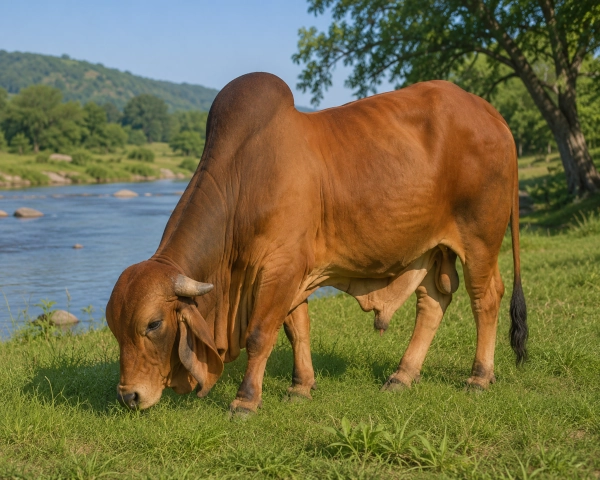
Gir cattle are among India’s most recognisable and internationally influential indigenous dairy breeds. Their broad domed forehead, exceptionally long hanging ears, inward-curving horns, loose skin and rich red coat give them an appearance unlike most other Indian cattle. Beneath these distinctive features lies a breed valued for milk production, fertility, longevity and the ability to remain productive in hot tropical conditions.
Originating in the Saurashtra region of Gujarat, the Gir belongs to the Indian zebu group, scientifically classified as Bos indicus. It is officially recognised by the ICAR–National Bureau of Animal Genetic Resources as an indigenous Indian cattle breed, with Gujarat recorded as its home tract.
Gir genetics have travelled far beyond India. The breed became particularly important in Brazil, where systematic selection produced the Gir Leiteiro, or Dairy Gir, and contributed to the creation of the Girolando, one of the most important tropical dairy cattle populations in the world. The Gir therefore represents both a treasured part of Gujarat’s rural heritage and one of India’s most significant contributions to global dairy breeding.
Origin in the Gir Landscape
The breed takes its name from the Gir forest and surrounding hills of Gujarat. Its traditional breeding tract extends across the Saurashtra region, particularly the districts of Junagadh, Gir Somnath, Amreli, Bhavnagar and Rajkot.
This landscape experiences wide variations in temperature, seasonal rainfall and fodder availability. Summers can become intensely hot, while dry periods place pressure on grazing resources. Gir cattle developed within this environment through generations of selection by farming and pastoral communities.
The Rabari, Bharwad, Maldhari and Charan communities played an especially important role in breeding, managing and preserving these cattle. Their knowledge of bloodlines, physical traits, grazing routes, temperament and milk performance helped shape the breed long before formal herd books and scientific breeding programmes emerged.
Gir cattle are also known by regional names such as Bhodali, Desan, Gujarati, Kathiawari, Sorthi and Surati. These names reflect the different areas and communities through which the breed became established.
How to Identify Gir Cattle
A mature Gir animal can usually be recognised immediately by the unusual shape of its head. The forehead is broad, heavy and strongly convex, giving it a rounded or domed appearance. It narrows considerably below the eyes and continues into a comparatively long face.
The eyes are almond-shaped and often partly covered by the eyelids, producing the calm or sleepy expression commonly associated with the breed. The muzzle is generally dark, with broad nostrils.
The ears are among the most striking features. They are exceptionally long, pendulous and folded like leaves, with the inner surface facing forward. A small notch is often visible near the end, while the tip turns inward. The National Dairy Development Board notes that Gir ears can reach around 30 centimetres and are among the longest found in Indian cattle breeds.
The horns emerge from the sides of the head, curve downward and backward, and then turn upward and inward. This creates a sweeping half-moon or spiral form. The horns are generally thicker and more pronounced in bulls.
Gir cattle possess a large hump above the shoulders, with bulls displaying a more muscular and developed hump than cows. The dewlap is broad and pendulous, while the skin is loose, soft and flexible. The tail is long and generally ends in a dark switch.
The body is deep and substantial, with a broad chest, strong limbs and a well-developed abdomen. Dairy cows usually have a capacious udder, although udder shape, teat placement and milk potential vary considerably between individual animals and bloodlines.
Coat Colours and Regional Varieties
Red is the predominant Gir colour, appearing in approximately four-fifths of animals described in the breed’s native tract. Shades range from light yellowish red and copper to dark red and deep brownish red.
Many Gir cattle carry white patches or speckles across the body. Some are predominantly white with red or golden patches, while others show an even mixture of red and white. Bulls commonly develop darker colouring around the neck, shoulders and hump.
Traditional cattle keepers use several local names for different colour patterns. A dark-red animal may be described as Gauri, while Kabari refers to a white animal carrying red or yellowish-red patches. Makadi describes a yellowish-red coat, and Bavadi refers to a more evenly distributed red-and-white pattern.
These regional terms demonstrate how closely pastoral communities studied and classified their cattle. Colour alone, however, cannot establish breed purity. Head structure, horn orientation, ear shape, body conformation, pedigree and genetic background must also be considered.
Size and Body Structure
Gir cattle are medium to large animals, with bulls appearing especially powerful through the shoulders, hump and neck.
Measurements compiled by the National Dairy Development Board recorded average male body weight at approximately 544 kilograms and average female weight at around 310 kilograms. Individual animals may be lighter or considerably heavier depending on age, bloodline, nutrition and management.
The same breed profile recorded average heights of about 160 centimetres for males and 131 centimetres for females, though field populations display wide variation.
The breed’s substantial frame reflects its historical dual role. Gir cows were selected primarily for milk, while bullocks were also used for transport and agricultural work. Older FAO descriptions characterised Gir bullocks as powerful, although generally slower than specialised light draught breeds.
Milk-Producing Ability
Gir is considered one of India’s major indigenous dairy breeds. Its reputation rests on the ability to produce commercially useful quantities of milk while retaining the climatic resilience and relatively low-input adaptability associated with Indian zebu cattle.
Milk performance varies widely according to genetics, age, number of lactations, feeding, reproductive health, milking frequency and farm management. A cow maintained on seasonal grazing in its native tract cannot be directly compared with an elite animal kept under controlled feeding, veterinary care and organised milk recording.
A detailed FAO breed study reported an average total lactation yield of approximately 2,063 litres over an average lactation period of 326 days. The average 300-day yield was around 1,930 litres, while recorded milk-fat levels ranged from approximately 4.7 to 5 per cent.
Other organised-herd studies have reported higher performance. Research covering selected Gir cattle recorded standard lactation yields above 2,500 kilograms, while another study reported average total lactation production of around 2,674 litres. These figures show the breed’s potential under improved breeding and management rather than a guaranteed yield from every animal.
Elite cows can produce far more than the breed average. Exceptional daily yields often receive publicity, yet such records should be viewed as the performance of specially selected animals under intensive care. For farmers, lifetime fertility, calving regularity, feed cost, disease burden and milk produced across several lactations matter as much as a single peak record.
Fertility, Mothering and Longevity
Gir cows are widely valued for fertility, maternal behaviour and long productive lives. Cows generally protect and attend to their calves closely, while the breed’s calm response to familiar handlers makes routine milking and management easier.
Good reproductive performance still depends upon balanced nutrition, heat detection, timely breeding and effective veterinary care. Mineral deficiencies, poor-quality fodder, reproductive infections and inadequate calf management can reduce the performance of even genetically valuable cattle.
The Gir’s economic strength lies in combining milk output with resilience and reproductive continuity. A cow producing a moderate but reliable quantity of milk over many lactations may provide greater long-term value than an animal with a higher first-lactation yield and weaker fertility.
NDDB describes Gir as a breed known for good fertility, milk-producing ability, heat tolerance, manageable maintenance requirements and longevity.
Adaptation to Heat and Tropical Conditions
Gir cattle evolved in a region where summer temperatures can rise to around 45 degrees Celsius. Their physical structure assists survival and production under such conditions.
Loose skin and the developed dewlap increase the surface available for releasing heat. The short coat and pigmented skin help animals cope with intense sunlight, while the breed’s sweating ability contributes to body-temperature regulation.
Their large ears may also assist heat exchange, though the full heat tolerance of zebu cattle arises from several interacting anatomical, physiological and behavioural traits.
Gir cattle often remain active and continue feeding during temperatures that can place greater stress on many temperate dairy breeds. This advantage has made them valuable in tropical and subtropical regions across the world.
The breed is also known for functioning on grazing systems and locally available fodder, although strong milk performance requires adequate energy, protein, minerals and clean water. Hardiness means the ability to cope with challenging environments; it never removes the need for responsible feeding and healthcare.
FAO identifies Gir among the zebu dairy breeds adapted to tropical production, while Indian breed-development literature emphasises its heat tolerance and ability to function under the variable conditions of Gujarat.
Temperament and Handling
Gir cattle are generally described as calm, intelligent and responsive to regular human contact. Many cows become strongly attached to their handlers and follow predictable milking routines.
Their long ears and relaxed facial expression can create an appearance of extreme gentleness. Individual temperament still varies, particularly among mature bulls, newly purchased animals and cattle exposed to stressful handling.
Patient movement, consistent routines and quiet handling are especially important. Shouting, beating, overcrowding and sudden restraint can make cattle fearful and difficult to manage. Calm stockmanship supports milk let-down, safer breeding and easier veterinary care.
Gir bulls require experienced handling because of their size, strength and breeding behaviour. Secure enclosures, appropriate restraint facilities and trained personnel are essential on farms maintaining mature breeding males.
Traditional Management in Gujarat
Gir cattle have traditionally been managed through combinations of open grazing, seasonal migration, stall feeding and household dairy production.
Pastoral groups often moved herds in search of grazing and water during periods of local fodder scarcity. Such movement spread Gir genetics beyond the central breeding tract and helped establish Gir-type cattle across other parts of Gujarat and neighbouring states.
Traditional diets included natural pasture, crop residues and locally cultivated fodder. Modern dairy farming can improve productivity through green fodder, dry roughage, oilseed cakes, compound feed, mineral mixtures and year-round access to water.
Animals require shade and ventilation during hot weather, clean and dry resting areas during the monsoon and protection from mud-related hoof and udder problems. Regular vaccination, deworming and disease surveillance remain necessary even for a naturally resilient breed.
Calves should receive sufficient colostrum soon after birth, followed by appropriate milk, starter feed and clean water. Female calves from proven high-yielding families require careful rearing because they represent the future of the herd.
Scientific Breeding and Performance Recording
The visible appearance of a Gir animal provides only part of its breeding value. A cow may display excellent ears, horns, colour and head structure while producing modest milk. Another may possess superior milk genetics while departing slightly from popular show-ring preferences.
Scientific improvement therefore requires pedigree records, milk measurement, lactation history, reproductive performance and information about the performance of related animals.
Pedigree-selection programmes identify high-performing cows and evaluate bulls through the milk production of their daughters. Artificial insemination allows semen from genetically evaluated bulls to reach a large number of herds, accelerating improvement while reducing dependence on untested village bulls.
Genomic selection, embryo transfer, ovum pickup and in-vitro fertilisation can support faster multiplication of elite germplasm. These technologies require careful regulation and broad genetic diversity so that a small number of fashionable bloodlines do not dominate the entire breed.
NDDB has emphasised animal identification, milk recording, pedigree selection, health monitoring and the future use of genomic tools as central elements in the development of Gir cattle.
Gir Cattle in Brazil
The international story of the Gir is most visible in Brazil. Indian zebu cattle were introduced there because European cattle frequently faced difficulties in the country’s heat, parasites and extensive grazing conditions.
Brazilian breeders recognised the Gir’s dairy potential and began selecting animals specifically for milk production. Over time, this produced the Gir Leiteiro, or Dairy Gir, supported by organised performance testing, progeny evaluation, artificial insemination and genetic selection.
Brazil’s experience demonstrated that an Indian zebu breed could be systematically developed into a specialised tropical dairy population while preserving heat tolerance and environmental adaptability.
The Brazilian breeding programme continues to evaluate Dairy Gir alongside Guzerat, Red Sindhi and Girolando cattle through Embrapa Dairy Cattle and breed organisations.
India supplied the original genetic foundation, while Brazilian breeding institutions invested in extensive data collection and selection. The result is a two-way relationship in which Gir genetics originating in Gujarat gained global prominence and improved descendants later became subjects of interest among Indian breeders.
The Development of Girolando
One of the Gir’s most important international contributions is the Girolando, created in Brazil by crossing Gir cattle with Holstein cattle.
Holsteins contribute high milk-production potential, while Gir cattle contribute heat tolerance, grazing ability, tropical adaptability and resilience. The cross was developed to combine these qualities within a dairy animal suited to Brazil’s climate and production systems.
Different Girolando genetic proportions exist, with breeders selecting the balance between Gir and Holstein ancestry according to climate, feeding intensity and farm objectives.
The Girolando demonstrates the strategic value of indigenous Indian genetics. The Gir’s greatest global contribution extends beyond purebred herds: its genes have helped make intensive dairy production possible in hot regions where pure temperate cattle can face severe climatic stress. NDDB and FAO both record the Gir’s contribution to Brazilian cattle development and tropical dairy breeding.
Contribution to Other International Breeds
Gir genetics also contributed to the development of the Indubrasil in Brazil, which combined Gir, Kankrej-derived Guzerat and Nelore ancestry.
Indian cattle, including Gir, later influenced the formation of the American Brahman. Brahman genetics subsequently contributed to composite breeds such as Brangus, Beefmaster and Simbrah.
This worldwide movement reflects the qualities tropical livestock producers sought from Indian zebu cattle: heat tolerance, insect resistance, durability, longevity and the ability to remain productive under variable fodder conditions.
The Gir therefore belongs to a wider history in which India’s livestock heritage reshaped cattle production across Latin America, North America and other tropical regions.
Cultural Importance in Gujarat
Gir cattle form part of the social and cultural history of Saurashtra. Pastoral communities built livelihoods around cattle movement, milk production, breeding and the exchange of animals.
A valuable cow represented household nutrition, recurring income and genetic wealth. Bulls carried the reputation of the family or community maintaining the bloodline, while the physical features of admired animals became part of oral knowledge passed across generations.
The breed’s place within Gujarat’s cultural landscape is connected with the wider Indian regard for cattle as sources of nourishment, agricultural support and rural prosperity.
Preserving Gir cattle consequently protects more than a dairy resource. It sustains pastoral knowledge, local vocabulary, traditional breeding systems and relationships between communities and landscape.
Threats to Breed Purity
The popularity of the Gir has created both opportunity and risk.
Demand for indigenous dairy cattle has raised the value of well-bred animals, encouraging farmers to retain and improve the breed. It has also produced misleading claims, unverified pedigrees and the sale of mixed animals as pure Gir.
Seasonal herd movement and uncontrolled mating can result in crosses with Kankrej and other cattle. Indiscriminate use of untested bulls can gradually weaken characteristic Gir traits and reduce predictable performance.
Visual selection alone may favour exaggerated ears, forehead shape or colour while neglecting milk production, fertility, udder structure and genetic diversity. Breed improvement should preserve the Gir’s functional qualities rather than turning it into an animal selected mainly for appearance.
NDDB has identified uncontrolled breeding, limited access to dependable artificial insemination, loss of pure germplasm and insufficient performance recording among the important challenges within the native tract.
Conserving Gir as a Working Dairy Breed
The strongest conservation programme is one that keeps Gir cattle economically useful to farmers.
Accurate identification, pedigree registration and milk recording can help genuine breeders receive better prices for superior animals. Village-level artificial insemination using evaluated bulls can improve herds while maintaining breed identity.
Milk cooperatives and specialised indigenous-breed value chains can provide stable markets. Farmer training can improve fodder cultivation, calf survival, reproductive management and disease prevention.
Conservation herds, semen banks, embryo banks and DNA repositories provide additional security for valuable genetic lines. These institutional measures should complement the work of farmers and pastoral communities who maintain living herds in the breed’s native environment.
Selection must balance milk yield with fertility, longevity, heat tolerance, udder health, temperament and structural soundness. Increasing one trait at the expense of the others would weaken the combination that made Gir cattle valuable in the first place.
Gir Cattle and Climate-Resilient Dairying
Rising temperatures are increasing interest in livestock capable of remaining productive under heat stress.
Many specialised temperate cattle produce very high milk yields under intensive management. Their performance can decline sharply when cooling, nutrition and veterinary support become inadequate. Gir cattle offer a different production model based on moderate-to-strong milk potential combined with tropical adaptation.
This makes the breed relevant to small and medium dairy farmers, especially in regions where temperatures are high and production depends partly on local fodder.
Future research can improve Gir productivity through genomic selection, precision feeding, reproductive technologies and disease surveillance while preserving the breed’s fundamental resilience.
The goal should be to develop Gir cattle as efficient indigenous dairy animals rather than measuring them entirely by standards created for temperate breeds.
A Living Contribution from Gujarat to the World
Gir cattle embody generations of knowledge developed by the farming and pastoral communities of Gujarat. Their striking forehead, hanging ears and red coat preserve a visible regional identity, while their milk production, fertility and heat tolerance carry practical economic value.
Their journey from Saurashtra to Brazil and other tropical regions demonstrates the global importance of India’s indigenous animal genetic resources. The Dairy Gir and Girolando stand as living evidence that genetics shaped within Indian villages can transform milk production across continents.
Protecting the Gir requires careful breeding, honest registration, scientific performance recording and continued support for the communities that maintain the breed.
The Gir is more than a beautiful indigenous cow. It is a climate-adapted dairy resource, an expression of Gujarat’s pastoral heritage and one of Bharat’s most influential contributions to the livestock history of the tropical world.
References
ICAR–National Bureau of Animal Genetic Resources. “Cattle Breeds of India: Gir.” Government of India.
https://nbagr.res.in/cattle-breed
National Dairy Development Board. “Approaches and Experiences of NDDB in Development of Gir: A Promising Indigenous Milch Breed.” September 2017.
https://www.nddb.coop/sites/default/files/Booklet-Development-of-Gir-Eng%20-low.pdf
National Dairy Development Board. “Gir.” Farmers’ Corner—Indigenous Cattle Breeds.
https://www.nddb.coop/farmer/animal-breeding/breeds/cattle/gir
National Dairy Development Board. “Latest Sire Proofs and Breeding Values of Gir Cattle.”
https://www.nddb.coop/services/animalbreeding/geneticimprovement/sireproofs
Food and Agriculture Organization of the United Nations. Joshi, N. R., and R. W. Phillips. “Zebu Cattle of India and Pakistan.” FAO Agricultural Studies No. 19.
https://www.fao.org/4/an469e/an469e00.pdf
Embrapa Dairy Cattle. “Breeding Strategies for Dairy Gir, Guzerat, Red Sindhi and Girolando in Sustainable Milk-Production Systems.”
https://www.embrapa.br/en/busca-de-projetos/-/projeto/208134/estrategias-de-melhoramento-genetico-para-racas-gir-leiteiro-guzera-sindi-e-girolando-em-sistemas-sustentaveis-de-producao-de-leite
Embrapa. “Dairy Gir: Brazil’s Major Genetic-Improvement Programme.”
https://www.infoteca.cnptia.embrapa.br/infoteca/bitstream/doc/595686/1/Gir-Leiteiro-o-maior-programa-de-melhoramento-genetico.pdf
Embrapa. “Brazilian Researchers Sequence the Dairy Gir Genome.” April 7, 2015.
https://www.embrapa.br/busca-de-noticias/-/noticia/2634883/pesquisadores-brasileiros-sequenciam-o-genoma-do-gir-leiteiro
You may also like
-
Satpura Tiger Reserve’s Barasingha Population Crosses 300 as Madhya Pradesh Plans New Wildlife Corridors
-
Karnataka’s Tiger Population Could Cross 700 as New Census Builds on Official Count of 563
-
Project Cheetah Expands as Veerangana Durgavati Tiger Reserve Becomes Madhya Pradesh’s Third Cheetah Habitat
-
Kashmir Markhor Population Rises to 227 as Kazinag Conservation Efforts Show Results
-
ICAR-CIFRI Pushes Conservation of Indigenous Himalayan Fish for Biodiversity and Livelihood Security
