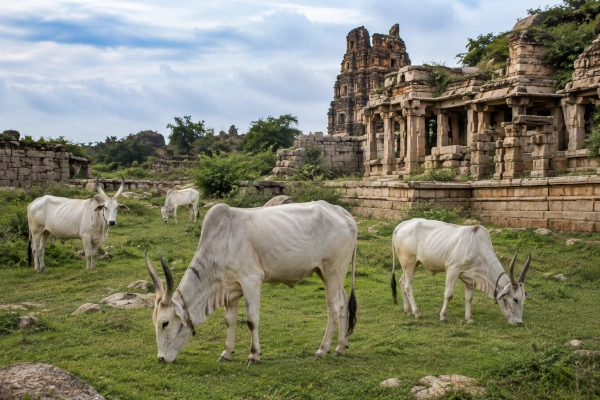
Nagori cattle are among India’s most celebrated draught breeds, renowned for their speed, agility, endurance and ability to work across the dry landscapes of Rajasthan. Developed principally for movement and agricultural labour, the breed became famous for pulling light carts at a fast trot and transporting people, crops and goods across long distances.
Unlike indigenous breeds selected primarily for dairy production, Nagori cattle were shaped by the practical requirements of farmers, traders and transporters living in an arid environment. Their long legs, powerful frame, strong feet and alert temperament enabled them to travel efficiently over hard, sandy and uneven ground.
The breed’s combination of speed and strength gave it an important place in the traditional rural economy of Rajasthan. Nagori bullocks ploughed fields, cultivated soil, drew water from wells and carried agricultural produce to markets. Their ability to maintain a rapid pace under harness made them particularly valuable before motorised transport became widely available.
Origin and Native Breeding Tract
Nagori cattle take their name from Nagaur district in Rajasthan, which forms the heart of their traditional breeding region.
Their recognised breeding tract includes Nagaur, Jodhpur and Bikaner districts. Significant populations have historically been found in areas adjoining Nagaur, including parts of Jodhpur district and the Nokha region of Bikaner. The ICAR–National Bureau of Animal Genetic Resources officially recognises Nagori as an indigenous cattle breed of Rajasthan under the breed accession code INDIA_CATTLE_1700_NAGORI_03018.
The region is characterised by a dry to semi-arid climate, high summer temperatures, limited and irregular rainfall and seasonal shortages of fodder and water. Agricultural animals raised in this environment had to remain functional despite heat, long journeys and relatively sparse feed resources.
Generations of selection by local livestock keepers produced animals suited to these demanding conditions. Breeders placed particular emphasis on alertness, sound legs, compact hooves, endurance and the capacity to move rapidly while pulling a cart or agricultural implement.
Nagori cattle show some physical resemblance to the Hariana and Kankrej breeds. The traditional breeding regions of Hariana cattle lie to the north and northeast, while the Kankrej tract lies toward the south and southwest. This geographical proximity has led livestock specialists to suggest that these neighbouring cattle populations may have influenced the historical development of the Nagori breed.
A Distinctive Draught Breed
Nagori cattle belong primarily to the draught category of Indian cattle.
The bullocks are valued more for work than for meat or dairy production. They were traditionally trained for ploughing, cultivation, drawing water and transporting goods. Among their most distinctive qualities is their ability to pull light iron-wheeled carts at a comparatively fast trot.
The National Dairy Development Board’s Dairy Knowledge Portal describes Nagori cattle as one of India’s most famous trotting draught breeds. Their speed made them highly valued for rapid road transport across the former Rajputana region.
This trotting ability distinguishes them from heavier draught breeds selected mainly for slow pulling power. Nagori animals combine strength with a relatively light and athletic build, enabling them to move quickly without sacrificing the stamina required for extended work.
Their traditional role included:
- Ploughing and preparing agricultural fields
- Intercultivation and other farm operations
- Drawing water from wells
- Carrying harvested crops to villages and markets
- Pulling carts used for rural passenger transport
- Moving supplies across dry and sparsely connected regions
- Supporting trade between farms, villages and market centres
Before tractors, trucks and rural buses became common, a dependable pair of Nagori bullocks represented both agricultural power and transportation capacity.
Physical Appearance
Nagori cattle are generally large, tall and upstanding animals with a distinctly alert and active appearance.
Their body is usually white or light grey. In some animals, slightly darker grey shading may appear on the head, face, neck or shoulders. Bulls may develop deeper grey colouring around the forequarters as they mature.
The body is long, deep and powerful, with a straight back and well-developed hindquarters. Despite their size, they generally appear athletic rather than excessively heavy.
One of the breed’s most recognisable features is its long and narrow face, which is sometimes compared with that of a horse. The forehead is relatively flat and less prominent than in several other zebu breeds.
The eyes are small, bright and alert. The eyelids may appear somewhat heavy or overhanging. The ears are comparatively large and pendulous, giving the head a distinctive profile.
Horns, Head and Neck
The horns are generally of moderate size. They emerge from the outer angles of the poll, extend outward and then rise upward in a gentle curve, often turning inward near the tips.
This horn pattern is balanced and less massive than the long sweeping horns seen in breeds such as Kankrej.
The muzzle is usually dark, while the head remains proportionate to the long face. The neck is strong and joins smoothly with the shoulders.
Bulls possess a well-developed hump, reflecting their draught character and zebu ancestry. The dewlap is usually moderate rather than excessively loose, helping preserve the breed’s relatively clean and athletic outline.
Legs and Hooves
The legs are among the most functionally important parts of the Nagori animal.
They are long, straight and relatively fine-boned but strong. This combination allows the animal to take long strides and move freely at a brisk pace.
The hooves are compact, hard and well formed. Strong feet were essential for animals expected to work on sandy tracks, firm village roads, cultivated soil and uneven terrain.
Poor leg structure would quickly reduce the usefulness of a draught animal. Traditional breeders therefore selected animals capable of remaining sound during repeated work and long journeys.
The breed’s agility is closely associated with its comparatively light bones, powerful muscles and strong compact feet. These traits enable Nagori bullocks to move with an ease and speed not normally associated with heavier draught cattle.
Size and Body Structure
Available breed records indicate that mature Nagori males are considerably taller and heavier than females.
Reported average measurements place males at approximately 148 centimetres in height and females at about 124 centimetres. Average body weights have been reported at around 363 kilograms for males and 318 kilograms for females, although actual size varies according to breeding, age, feeding and management.
The chest is deep and provides sufficient space for the heart and lungs, an important characteristic in animals selected for endurance.
The quarters are strong and muscular, supplying the power needed for pulling. The back is generally straight, allowing draught force to be transmitted efficiently through the harness.
The tail is of moderate length and normally terminates in a dark switch. The skin is comparatively fine and may remain closely fitted to the body.
Temperament and Movement
Nagori cattle are active, alert and generally manageable when properly trained.
A good draught animal must respond readily to voice commands and work calmly beside its partner. Bullocks selected for cart and field work were therefore required to combine energy with a sufficiently docile temperament.
Their movement is one of the breed’s greatest strengths. The gait is free, quick and balanced, with the legs moving cleanly beneath the body.
Nagori bullocks became particularly famous as trotters. When harnessed to a light cart, a trained pair could maintain a rapid and coordinated pace over considerable distances.
This ability made the breed valuable not only to farmers but also to traders and travellers who needed faster transportation between rural settlements.
Agricultural Work
Nagori bullocks were traditionally used for nearly every major form of animal-powered agricultural work in their native region.
Ploughing
Their strength and endurance enabled them to pull traditional ploughs through dry soils. Their active movement also allowed farmers to cover fields efficiently during the limited period available for land preparation following rainfall.
Cultivation
After sowing, the animals were used for intercultural operations and the removal of weeds between crop rows. Their responsiveness made them suitable for work requiring careful movement.
Drawing Water
Before the widespread installation of electric and diesel pumps, bullocks provided the power needed to lift water from wells. Nagori animals could walk repeated circuits while operating traditional water-lifting systems.
Transporting Produce
After harvest, bullock carts carried grain, fodder and other produce from fields to homes, storage areas and local markets. The speed of Nagori bullocks reduced journey times and improved the movement of agricultural goods.
General Rural Transport
Bullock carts also carried people, household materials, water, fuelwood and commercial supplies. In regions with limited road and railway connectivity, the bullock pair functioned as an essential rural transport system.
Adaptation to Rajasthan’s Arid Landscape
Nagori cattle developed under the difficult environmental conditions of western Rajasthan.
The breed is accustomed to high temperatures, dry winds and fluctuating availability of fodder. Its native tract includes areas where vegetation may become sparse during drought years and livestock must travel considerable distances in search of grazing and water.
The animal’s long legs assist movement over sandy and uneven ground, while its strong hooves provide durability on hard surfaces.
Its active body type allows heat to dissipate more effectively than in excessively heavy animals. The light coat also reflects a portion of the intense solar radiation experienced in open arid landscapes.
Adaptation does not mean that the cattle can remain productive without proper care. Working animals still require adequate water, shade, nutritious feed, mineral supplementation and rest, especially during periods of extreme heat.
Feeding and Management
Nagori cattle have traditionally been maintained using a combination of grazing, crop residues and locally available fodder.
Common feed resources in Rajasthan include dry grasses, cereal straw, pulse residues and fodder obtained from hardy trees and shrubs. During agricultural seasons, animals may also receive green fodder and concentrated feed depending on availability.
Working bullocks require additional nutritional support because sustained physical labour increases their energy requirements.
A suitable ration should provide:
- Adequate dry matter and roughage
- Energy-rich feed during heavy work
- Protein supplementation when crop residues are poor
- Mineral mixture and common salt
- Continuous access to clean drinking water
- Green fodder whenever seasonally available
Animals should not be subjected to heavy work immediately after consuming large quantities of feed or water. Rest intervals are important during hot weather, particularly around midday.
Harnesses and yokes must fit properly. Poorly designed equipment can cause wounds on the neck, shoulders and withers and may permanently reduce an animal’s ability to work.
Milk Production
Nagori cows are not considered specialised dairy animals.
Their milk production is modest because the breed was historically selected for draught qualities rather than high lactation yield. The milk was generally sufficient for rearing the calf and meeting some household requirements.
The Dairy Knowledge Portal reports an average lactation yield of approximately 603 kilograms, with recorded yields ranging from about 479 to 905 kilograms. Average milk fat has been reported at approximately 5.8 per cent.
An ICAR study examining records from 145 Nagori animals maintained at the Government Cattle Breeding Farm in Nagaur reported a least-squares average milk yield of approximately 535 kilograms over an average lactation length of about 268 days. Differences among published averages may reflect herd, period, feeding, management and analytical methods.
These figures confirm that milk is a secondary product of the breed.
The principal economic value of Nagori cattle traditionally lay in the work performed by males. Female animals were important for maintaining and reproducing the draught line rather than for supplying large quantities of market milk.
Reproductive Characteristics
Nagori cattle generally reproduce under the extensive and semi-intensive conditions of their native tract.
The ICAR performance study reported an average gestation period of approximately 284 days and an average calving interval of about 423 days in the government herd examined. The recorded average birth weight of calves was nearly 17 kilograms.
Good reproductive management is essential for breed conservation. Cows should receive adequate nutrition before breeding and during pregnancy, while calves require timely colostrum, protection from weather and appropriate health care.
Selection should place emphasis on sound conformation, fertility and the functional traits that distinguish the breed.
Traditional Selection of Bullocks
The value of a Nagori bullock was judged largely by its performance rather than appearance alone.
Farmers traditionally observed:
- Speed and smoothness of movement
- Ability to maintain a steady trot
- Strength under load
- Endurance during extended work
- Soundness of legs and hooves
- Responsiveness to commands
- Compatibility with the paired animal
- Recovery after strenuous labour
- Temperament under harness
Bullocks intended to work together were often matched for height, stride, speed and temperament.
An unmatched pair could pull unevenly, tire rapidly and place greater strain on the cart or agricultural implement. A well-matched pair, by contrast, moved almost as a single unit.
Economic Importance in Traditional Rajasthan
Nagori cattle supported several interconnected parts of Rajasthan’s rural economy.
They supplied power for crop production, transported food and merchandise, operated water-lifting equipment and provided mobility to households.
A productive bullock pair reduced dependence on hired labour and outside transport. It enabled farmers to cultivate their land at the correct time and move their produce when market conditions were favourable.
The breed also supported specialised occupations involving cattle breeding, training, cart manufacture, harness making and animal trading.
High-quality Nagori bullocks gained a reputation beyond their immediate home tract and were sold for work in other parts of Rajasthan.
Decline of Animal-Powered Transport
The expansion of tractors, motor vehicles, irrigation pumps and mechanised farm equipment reduced demand for draught cattle across much of India.
Nagori cattle were particularly affected because their greatest economic advantage was their capacity for fast transportation. As roads improved and motor vehicles became more accessible, bullock carts lost much of their commercial role.
Mechanisation also reduced the number of bullocks needed for ploughing and drawing water.
When the economic value of males declines, farmers have less incentive to maintain pure draught breeding populations. Crossbreeding with dairy breeds can further dilute the distinctive characteristics of indigenous draught cattle.
The loss of Nagori cattle would represent more than the disappearance of a traditional transport animal. It would mean the erosion of a genetic resource shaped for heat tolerance, endurance, agility and performance under arid conditions.
Conservation Importance
Nagori cattle remain part of India’s officially recognised livestock biodiversity. Their conservation is important for cultural, agricultural and genetic reasons.
A conservation strategy should include:
- Identification of purebred animals in the native tract
- Registration and systematic performance recording
- Selection of superior breeding bulls
- Preservation of semen and other genetic material
- Prevention of indiscriminate crossbreeding
- Support for farmers maintaining breeding herds
- Promotion of breed societies and community-based conservation
- Research into climate adaptation and draught performance
- Development of modern economic uses for the breed
Conservation cannot depend only on maintaining small herds at government farms. The breed must retain practical or economic value for farmers within its native region.
Relevance in Modern Agriculture
Animal traction has declined, but it has not lost all relevance.
Small and fragmented farms may still find bullocks useful where tractors are expensive, difficult to manoeuvre or unsuitable for particular operations. Draught cattle can work without fossil fuel and produce manure that returns nutrients and organic matter to the soil.
Bullocks may also support low-input and organic farming systems, village tourism, heritage transport and demonstrations of traditional agriculture.
Nagori cattle could have specialised value in areas where speed, endurance and adaptation to heat are more important than heavy pulling capacity.
Modern research could also examine their locomotion, heat tolerance, feed efficiency and genetic characteristics. Traits preserved within the breed may become increasingly important as agriculture responds to higher temperatures, water scarcity and the need for resilient livestock systems.
Nagori Cattle and Rajasthan’s Living Heritage
Nagori cattle embody the relationship between livestock and landscape.
Their long legs, alert expression, powerful frame and rapid gait developed in response to the practical needs of people living in a vast, dry region. They were bred to cross distances, work fields, lift water and connect isolated communities with markets.
The breed reflects generations of knowledge among Rajasthan’s cattle keepers. Farmers recognised that the ideal animal for the region required more than raw strength. It needed balance, intelligence, endurance, strong feet and the ability to move swiftly under harsh conditions.
For this reason, Nagori cattle became one of India’s best-known trotting draught breeds.
Conclusion
Nagori cattle are a specialised indigenous breed developed in the Nagaur region of Rajasthan and distributed across parts of Nagaur, Jodhpur and Bikaner.
Their reputation rests on their exceptional draught qualities. Tall, active and strong, Nagori bullocks were traditionally used for ploughing, cultivation, drawing water and carrying produce. Their ability to trot rapidly while pulling light carts made them especially valuable for rural transportation.
The breed’s white or light-grey coat, long horse-like face, moderate curved horns, straight legs and compact hooves give it a distinctive appearance. Its athletic structure reflects generations of selection for speed and endurance rather than dairy production.
Mechanisation has reduced the traditional demand for Nagori bullocks, creating challenges for the breed’s continued survival. Yet their genetic adaptation to heat, dry landscapes and sustained physical work remains valuable.
Protecting Nagori cattle requires more than remembering their historical importance. It requires systematic breeding, farmer participation, genetic conservation and the creation of new economic roles suited to contemporary agriculture.
As one of Rajasthan’s finest draught breeds, Nagori cattle remain a living symbol of the strength, mobility and resilience that sustained farming and trade across India’s arid northwest.
References
ICAR–National Bureau of Animal Genetic Resources. “Cattle Breeds of India: Nagori.” Breed accession code INDIA_CATTLE_1700_NAGORI_03018.
National Dairy Development Board, Dairy Knowledge Portal. “Nagori.” Breed origin, physical characteristics, draught use and milk-production information.
Vij, K., Tantia, M.S., Nivsarkar, A.E., Vijh, R.K., Kumar, P. and Joshi, B.K. “Performance Characteristics of Nagori Cattle.” The Indian Journal of Animal Sciences.
Press Information Bureau, Government of India. “Registered Breeds of Cattle.” Department of Animal Husbandry and Dairying.
You may also like
-
Satpura Tiger Reserve’s Barasingha Population Crosses 300 as Madhya Pradesh Plans New Wildlife Corridors
-
Karnataka’s Tiger Population Could Cross 700 as New Census Builds on Official Count of 563
-
Project Cheetah Expands as Veerangana Durgavati Tiger Reserve Becomes Madhya Pradesh’s Third Cheetah Habitat
-
Kashmir Markhor Population Rises to 227 as Kazinag Conservation Efforts Show Results
-
ICAR-CIFRI Pushes Conservation of Indigenous Himalayan Fish for Biodiversity and Livelihood Security
