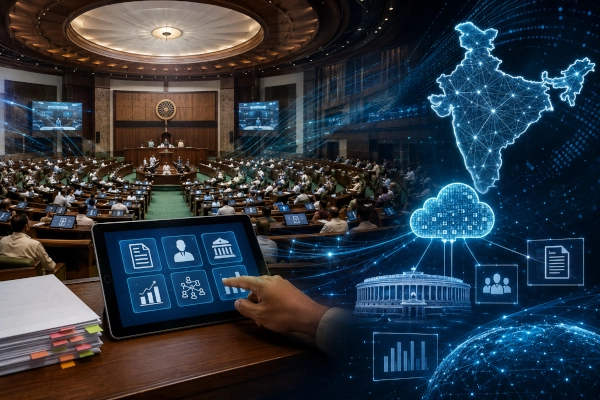
India’s programme to modernise State and Union Territory legislatures has reached a major milestone, with 21 Legislative Houses now conducting their work through the National e-Vidhan Application, or NeVA.
The Ministry of Parliamentary Affairs said that 33 of India’s 37 State and Union Territory legislatures had signed memoranda of understanding for implementing the platform by July 2026. The two Houses of Parliament are outside the scope of the NeVA programme, which is focused on State and Union Territory legislatures.
NeVA is intended to replace fragmented, paper-intensive legislative procedures with a common digital system through which members, secretariats and government departments can process questions, notices, bills, agendas, committee reports and other House business.
The initiative is built around the concept of “One Nation, One Legislative Application”, while allowing individual legislatures to retain their constitutional autonomy, rules and regional requirements.
From Paper Files to Digital House Business
A conventional legislative session produces large volumes of printed material. Questions, replies, bills, amendments, lists of business, committee documents and reports must be prepared, copied, distributed, stored and later retrieved.
NeVA seeks to move these processes to a unified electronic environment.
Members can access legislative documents through digital devices, while secretariat officials can receive notices, process questions, circulate agendas and manage records through workflow-based dashboards. Government departments can submit replies and documents electronically instead of depending entirely on physical communication.
The public portals connected to the system also provide access to legislative information, allowing citizens, researchers and journalists to follow House documents without relying exclusively on printed records or visits to legislative libraries.
According to the Ministry of Parliamentary Affairs, the platform has reduced dependence on paper, accelerated the processing and circulation of legislative business and lowered expenditure associated with printing, handling and document storage.
Twenty-One Houses Complete Digital Transition
The 21 digital Houses include legislatures in Punjab, Odisha, Bihar, Nagaland, Manipur, Tamil Nadu, Sikkim, Tripura, Haryana, Meghalaya, Mizoram, Uttar Pradesh, Gujarat, Puducherry, Himachal Pradesh, Uttarakhand, Assam, Rajasthan and Delhi.
The number of Houses is greater than the number of participating States because Bihar and Uttar Pradesh have bicameral legislatures consisting of a Legislative Assembly and a Legislative Council.
Some legislatures were early adopters, while others have joined the programme gradually as infrastructure, training and administrative preparations were completed.
In March 2026, the government reported that 21 legislatures were already conducting business digitally, while seven more were at different stages of implementation. By July, the number of legislatures signing implementation agreements had risen from 28 to 33, showing that adoption had continued to expand.
Implementation is undertaken through tripartite agreements involving the Union government, the concerned State government and the respective legislature.
Because State and Union Territory legislatures are autonomous institutions, the platform is introduced in consultation with each House and according to its preparedness.
₹673.94-Crore National Programme
NeVA is being implemented as a Centrally Sponsored Scheme with a total approved outlay of ₹673.94 crore. The Central Government’s contribution is capped at ₹423.60 crore.
The funding pattern varies according to the category of the participating legislature.
For North-Eastern and Himalayan States, the Centre and State share costs in a 90:10 ratio. Union Territories with legislatures receive full central funding, while most other States follow a 60:40 cost-sharing arrangement.
The financial support covers more than the purchase of computers and display screens. Legislatures require networking equipment, software integration, digital chambers, cybersecurity arrangements, staff training, data migration and continuing technical support.
The Central Project Management Unit under the Ministry of Parliamentary Affairs provides capacity-building and technical assistance to participating legislatures. NeVA Seva Kendras have also been established to train members and officials and help them adapt to electronic legislative procedures.
BHASHINI Brings Legislative Information to Indian Languages
One of NeVA’s most significant features is its integration with BHASHINI, India’s artificial-intelligence-based language platform.
Text-to-text machine translation allows public content on NeVA and State Assembly portals to be translated into the 22 languages listed in the Eighth Schedule of the Constitution, along with English.
This capability is important because State legislatures operate in different regional languages, while citizens, researchers and officials may need to access documents produced in another part of the country.
A Unicode-based content architecture supports the entry, storage and retrieval of multilingual text. This helps prevent the compatibility problems commonly associated with older fonts and localised software systems.
Machine translation will still require careful review when dealing with legal terminology, legislative drafting and politically sensitive statements. Nevertheless, BHASHINI integration gives NeVA the ability to make legislative information available to a much wider audience.
It could also support the exchange of legislative practices among States. A committee report, bill or policy debate produced in one language could become more easily accessible to members and researchers elsewhere.
Hosted on Government Cloud Infrastructure
The NeVA application has been migrated to the National Informatics Centre’s secure MeghRaj 2.0 cloud environment.
The move is intended to improve scalability, data protection, system reliability and cybersecurity. The platform has also been designed to operate across different devices rather than depending on one type of computer or operating system.
Role-based access allows different categories of users to receive permissions according to their responsibilities. Legislators, secretariat officials and government departments do not require identical access to every component of the platform.
Digital legislative infrastructure must remain available during active sessions, when delays could disrupt questions, voting, document circulation or government replies. Secure cloud hosting, backups and disaster-recovery arrangements are therefore essential to maintaining continuity.
Regular security reviews, controlled access and authentication mechanisms are equally important because legislative systems may contain unpublished bills, internal communications and documents awaiting formal presentation before a House.
The digital transition consequently involves a balance between accessibility and institutional security.
NITI Aayog Evaluation Finds Improved Workflows
A mid-term evaluation conducted by NITI Aayog found that NeVA had reduced paper use and improved legislative workflows.
The evaluation observed that better coordination among legislatures and government departments had enabled faster processing of House business. It also noted that the public portal provided real-time access to legislative documents and that training programmes and NeVA Seva Kendras had supported adoption.
These improvements can affect the functioning of a legislature in practical ways.
A member submitting a question digitally can receive acknowledgement and track its processing. The secretariat can forward it to the relevant department electronically. Officials can prepare a response within the same workflow, and the final material can be distributed without printing hundreds of copies.
Electronic records are also easier to search and retrieve than documents stored only in physical files. Over time, NeVA could create extensive searchable archives of questions, debates, bills and committee work across Indian legislatures.
Transparency Through Easier Public Access
Digitisation can strengthen transparency when legislative information is uploaded completely and without unnecessary delay.
Citizens can examine questions raised by their representatives, government replies, proposed laws, committee reports and the business scheduled before a House. Journalists and researchers can compare policy discussions across States without depending entirely on individual legislative websites with different formats.
A common digital architecture can also improve long-term preservation. Legislative documents form an important part of the constitutional and political history of each State, but older records are often difficult to locate or available only in physical archives.
Digitising both current work and legacy records can make this material more accessible to future generations.
Technology alone, however, cannot guarantee transparency. Its effectiveness will depend on the completeness of uploaded information, the speed of publication, the accuracy of metadata and the ability of citizens to navigate the portals.
Towards a Common Digital Legislative Ecosystem
NeVA represents an effort to reduce paper consumption. It is an attempt to build a common digital infrastructure connecting elected representatives, legislative secretariats, government departments and citizens.
The expansion to 21 digital Houses demonstrates that the concept can function across legislatures of different sizes, languages and administrative traditions.
The next phase will involve bringing the remaining participating Houses into full operation, improving the quality of public information, strengthening cybersecurity and ensuring that digital tools remain reliable during actual legislative work.
As more legislatures join the platform, India could develop an interconnected national repository of State-level lawmaking, questions, debates and committee activity.
That would make legislative institutions easier to study, compare and understand while helping members and officials carry out their work more efficiently.
You may also like
-
India Post and Blue Dart Join Forces to Expand Parcel Delivery Across Urban and Rural India
-
Starlink-Ukraine, Myanmar and Drug Smuggling: Why India Must Regulate Satellite Internet for National Security
-
GST Council Recommends Major Compliance Reforms, Raises Prosecution Threshold to ₹5 Crore
-
Narendra Modi Completes 25 Years in Government: From Gujarat to the Mission of Viksit Bharat
-
Andhra Pradesh Launches India’s First 3D Concrete-Printed Rural Housing Pilot With 177 Homes
