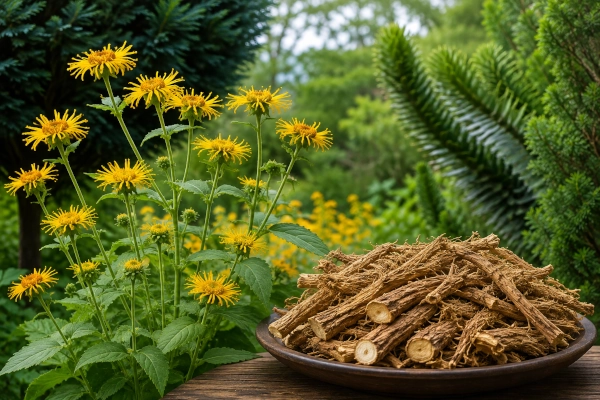
Pushkaramula, also called Pushkarmool or Pushkara, is an important aromatic root used in Ayurveda, especially in formulations for breathing difficulty, cough, chest discomfort, weak digestion and Kapha–Vata disorders. Its accepted botanical identity is Inula racemosa Hook.f., a perennial herb belonging to the Asteraceae family. The National Medicinal Plants Board of the Ministry of AYUSH officially lists Pushkarmool as Inula racemosa.
Pushkaramula is not the same plant as orris root. Orris root generally refers to the dried rhizomes of certain Iris species used mainly in perfumery and traditional European herbal preparations. Ayurvedic Pushkaramula refers specifically to the root and rhizome of Inula racemosa. Confusing the two can lead to incorrect identification and inappropriate medicinal use.
Names and Botanical Identity
Sanskrit names: Pushkaramula, Pushkara, Paushkara
Hindi: Pushkarmool, Pokharmool
English description: Indian elecampane, Himalayan elecampane
Botanical name: Inula racemosa Hook.f.
Family: Asteraceae
Part used: Root and rhizome
Kew’s Plants of the World Online accepts Inula racemosa as a valid species. It describes the plant as a perennial of temperate regions distributed from Afghanistan through the western Himalaya and adjoining parts of Central Asia and China.
Description of the Plant
Pushkaramula is a tall perennial herb with a strong underground root system. It produces erect stems, elongated leaves and yellow flower heads characteristic of the Asteraceae family. The plant grows naturally in cool, temperate Himalayan environments and is also cultivated for medicinal use.
The medicinal root is thick, branching and strongly aromatic. When dried, it becomes brown externally and possesses a penetrating odour and pungent-bitter taste. The fragrance is produced by volatile and resinous compounds concentrated in the root and rhizome.
Because the root is the commercially valuable part, harvesting destroys the plant. Heavy collection from wild populations has contributed to conservation concerns, making regulated cultivation and authenticated sourcing especially important. A scientific review has described Inula racemosa as a threatened Himalayan medicinal plant requiring stronger cultivation and conservation measures.
Ayurvedic Properties of Pushkaramula
Classical descriptions are commonly summarised as follows:
Rasa — taste: Katu and Tikta, or pungent and bitter
Guna — qualities: Laghu and Tikshna, or light and penetrating
Virya — potency: Ushna, or heating
Vipaka — post-digestive effect: Katu
Dosha action: Reduces Kapha and Vata; excessive use may aggravate Pitta
Principal actions: Deepana, Pachana, Kaphahara, Vatahara, Shwasahara, Kasahara, Hridya and Shoolahara
Its heating and penetrating character enables it to disperse accumulated Kapha, stimulate digestive activity and regulate obstructed Vata. Pushkaramula is therefore selected when respiratory congestion, chest tightness or abdominal discomfort occurs together with coldness, heaviness and sluggish digestion.
Pushkaramula and the Respiratory System
Pushkaramula is primarily known in Ayurveda as a herb for Shwasa and Kasa, broadly corresponding to patterns involving breathing difficulty and cough.
Its aromatic, warming and Kapha-reducing qualities are traditionally used where the airways feel congested and breathing is accompanied by mucus, heaviness or chest tightness. It may be included in powders, decoctions, medicated ghee and compound formulations along with herbs such as Vasa, Kantakari, Pippali, Shunthi and Bharangi.
Traditional applications include:
- Kapha-dominant cough;
- wheezing and difficult breathing;
- chest congestion;
- hiccups;
- discomfort associated with obstructed movement of Vata in the chest.
Modern reviews report that the plant has traditionally been used as an expectorant, antispasmodic and respiratory remedy. Laboratory and animal studies have investigated anti-inflammatory, antimicrobial and bronchodilatory-related effects, although these findings do not by themselves establish clinical efficacy in asthma or chronic respiratory disease.
Breathing difficulty, persistent wheezing, bluish lips, high fever or rapidly worsening chest symptoms require urgent medical attention.
Importance in Hridroga
Pushkaramula has a respected place in Ayurvedic descriptions of Hridroga, a broad category of disorders involving the heart and chest region.
The herb is described as Hridya, meaning supportive to cardiac function, and is traditionally considered particularly useful when Vata and Kapha interfere with circulation and produce chest pressure, pain, breathlessness or a sense of constriction.
Pushkaramula is sometimes combined with Guggulu, Arjuna, Pippali or other herbs in classical cardiac formulations. Historical and pharmacological literature has explored its potential cardioprotective, lipid-modulating and anti-ischaemic effects. Some older clinical work examined combinations containing Inula racemosa in patients with angina, but the evidence remains limited and does not justify replacing conventional cardiac treatment.
Any chest pain, pressure, sweating, nausea or pain spreading to the arm, jaw or back should be treated as a possible medical emergency rather than managed with home remedies.
Digestive Actions
Pushkaramula is also valued as a Deepana–Pachana herb. Its pungent, bitter and heating nature traditionally stimulates Jatharagni and helps digest Ama.
It may be considered in patterns involving:
- poor appetite;
- heaviness after meals;
- abdominal gas;
- sluggish digestion;
- colicky discomfort associated with Vata;
- nausea linked with Kapha accumulation.
Its aromatic root may also exert a carminative effect, helping the movement of gas through the digestive tract. Scientific reviews record traditional carminative, thermogenic and digestive uses, while also noting that stronger human studies are needed.
Because it is heating and sharp, Pushkaramula may not suit people with active gastritis, burning pain or pronounced acidity.
Use in Hiccups
Persistent hiccups are discussed under Hikka in Ayurveda. Pushkaramula appears in formulations for Hikka when the condition is associated with disturbed Vata, obstruction by Kapha and weakness of respiratory movement.
The root is traditionally combined with honey, warm water or other respiratory herbs depending on the individual condition. Persistent hiccups lasting many hours or recurring without explanation require medical evaluation because they may occasionally indicate neurological, gastrointestinal or metabolic illness.
Kapha–Vata Disorders
Pushkaramula demonstrates the Ayurvedic principle that a single herb may act across several organ systems when the underlying doshic pattern is similar.
In the lungs, Kapha may produce mucus and heaviness while Vata causes irregular breathing. In the heart and chest, Kapha may contribute to obstruction while Vata produces pain or constriction. In the digestive tract, Kapha slows digestion while Vata produces distension and colic.
The warm, sharp and aromatic root is traditionally used to break this pattern of Kapha obstruction combined with disturbed Vata.
Pushkaramula and Meda
Some Ayurvedic traditions also associate Pushkaramula with excessive Meda, or adipose and lipid-related tissue, particularly when accompanied by sluggish metabolism and Kapha dominance.
Experimental investigations have explored effects on blood lipids and oxidative stress. These studies remain preliminary and do not prove that Pushkaramula alone causes meaningful weight loss or treats high cholesterol in humans.
Diet, exercise, sleep, metabolic assessment and prescribed medication remain central to the management of obesity and lipid disorders.
Traditional External Uses
The root has also been used externally in certain regional practices. Pastes or medicated oils containing Pushkaramula have been applied around painful joints, swollen areas and chronic skin lesions.
Scientific literature records traditional antiseptic, antibacterial and antifungal applications, but raw root paste should not be applied to deep wounds, burns or infected skin without professional supervision.
Important Constituents
The root and rhizome contain aromatic and biologically active compounds, including sesquiterpene lactones. Frequently studied constituents include:
- alantolactone;
- isoalantolactone;
- isoalloalantolactone;
- essential oils;
- phytosterols;
- fatty acids;
- glycosidic compounds.
Alantolactone-related compounds are considered major markers of the plant’s chemistry. Experimental research has examined their antimicrobial, anti-inflammatory and other biological activities, although the relationship between individual constituents and the complete Ayurvedic action of the root remains incompletely understood.
Pushkaramula and Kustha: A Historical Relationship
Pushkaramula has sometimes been connected with Kustha, identified botanically as Saussurea costus or Saussurea lappa. Both plants belong to the Asteraceae family, possess aromatic roots and contain related sesquiterpene lactones.
Certain Ayurvedic traditions accept Kustha as a substitute for Pushkaramula when the genuine drug is unavailable. Historical market practice has also occasionally treated Pushkaramula as a sweeter variety of Kustha. This relationship may explain some regional variation in trade names, but the two remain botanically distinct plants and should not be regarded as automatically interchangeable in every formulation.
Correct identification is particularly important because substitution can alter potency, aroma and therapeutic action.
Methods of Ayurvedic Use
Pushkaramula may occur in several traditional dosage forms:
Churna: Fine powder of the authenticated dried root
Kwatha: Decoction prepared by boiling the coarse root in water
Kalka: Herbal paste used in compound preparations
Ghrita: Medicated ghee containing Pushkaramula
Taila: Medicated oil for selected external applications
Vati or Gutika: Herbal pills containing the root with other ingredients
Asava and Arishta: Fermented formulations in which it may form part of a compound recipe
The appropriate form depends on the condition, constitution, age, digestive strength and accompanying medicines.
Adulteration and Identification
Pushkaramula is vulnerable to substitution because the dried root may resemble other aromatic medicinal roots. Trade samples can contain related Inula species, Kustha or unrelated roots.
Reliable identification should consider:
- botanical source;
- root morphology;
- characteristic aroma;
- microscopic features;
- chemical marker profile;
- authenticated supply chain.
The National Medicinal Plants Board recognises Pushkarmool as Inula racemosa, making this identity the appropriate standard for cultivation and medicinal trade.
Conservation and Sustainable Cultivation
Pushkaramula grows slowly in the Himalayan region and is harvested for its underground parts. Removal of the mature root prevents natural regeneration, while indiscriminate wild collection reduces local populations.
Scientific reviews have stressed the need for:
- commercial cultivation;
- propagation through healthy planting material;
- protection of natural populations;
- controlled harvesting;
- development of standardised agro-technology;
- conservation of genetically diverse germplasm.
The National Medicinal Plants Board has supported cultivation of Pushkarmool in Himalayan states, including Himachal Pradesh and Uttarakhand.
Cultivated and traceable material should be preferred over roots of uncertain wild origin.
Precautions
Pushkaramula is a potent, heating medicinal root rather than an ordinary culinary spice. Unsupervised or excessive use may cause:
- gastric irritation;
- heartburn;
- burning sensation;
- nausea;
- loose stools;
- aggravation of Pitta-related symptoms;
- allergic reactions in people sensitive to Asteraceae plants.
Extra caution is advisable during pregnancy and breastfeeding, in children, and in people with active ulcers, severe acidity, liver or kidney disease, bleeding disorders or complex cardiovascular conditions.
People taking blood-pressure medicines, anticoagulants, antiplatelet drugs, cardiac medicines or several prescription medicines should consult a qualified physician before using concentrated Pushkaramula preparations.
The scientific literature notes major gaps in toxicity evaluation, dosage standardisation and clinical validation.
Modern Research and Its Limits
Research into Inula racemosa has examined potential:
- anti-inflammatory activity;
- antimicrobial activity;
- respiratory effects;
- cardiovascular support;
- lipid-modulating effects;
- antioxidant activity;
- gastrointestinal protection.
Much of the evidence comes from laboratory work, animal models, traditional records or small and older clinical studies. Robust modern human trials remain insufficient. Pushkaramula should therefore be described as a classical Ayurvedic medicine with promising experimental research rather than as a scientifically proven cure for asthma, angina, hypertension or other major diseases.
Conclusion
Pushkaramula is one of Ayurveda’s important aromatic Himalayan roots. Identified botanically as Inula racemosa, it is traditionally valued for conditions involving Kapha obstruction, disturbed Vata, respiratory congestion, chest discomfort and weak digestion.
Its special reputation in Shwasa, Kasa and Hridroga reflects the Ayurvedic connection between the lungs, heart, digestive fire and movement of Vata through the chest. The root’s pungent, bitter, heating and penetrating qualities make it useful in selected Kapha–Vata conditions, but those same qualities require careful dosage and professional supervision.
Pushkaramula should also be clearly distinguished from orris root, which comes from Iris species and represents a completely different botanical drug.
References
- National Medicinal Plants Board, Ministry of AYUSH, Government of India. Pushkarmool — Inula racemosa.
- Royal Botanic Gardens, Kew. Plants of the World Online: Inula racemosa Hook.f.
- Rathore S, Raj Y, Debnath P, Kumar M, Kumar R. Ethnopharmacology, phytochemistry, agrotechnology and conservation of Inula racemosa Hook.f.—a critically endangered medicinal plant of the western Himalaya. Journal of Ethnopharmacology. 2022;283:114613.
- Seca AML, Grigore A, Pinto DCGA, Silva AMS. The genus Inula and its metabolites: from ethnopharmacological to medicinal uses. Journal of Ethnopharmacology. 2014;154(2):286–310.
- National Medicinal Plants Board. Cultivation and medicinal-plant trade records for Pushkarmool, Inula racemosa.
- Ayurvedic Pharmacopoeia of India. Monograph on Pushkaramula, root of Inula racemosa.
- Charaka Samhita. Classical references to Pushkaramula in respiratory and cardiac formulations.
- Sushruta Samhita. Classical descriptions of aromatic and Kapha–Vata-reducing medicinal roots.
- Bhavaprakasha Nighantu. Pushkaramula and related aromatic root drugs.
- Medico-historical literature on the relationship between Pushkaramula and Kustha.
Health disclaimer: This article presents traditional Ayurvedic knowledge for education and documentation. It is not a diagnosis, prescription or substitute for medical care. Chest pain, breathing difficulty and persistent respiratory symptoms require prompt evaluation by a qualified medical professional.
You may also like
-
Ayurveda on Cold Foods and Iced Drinks: Why Food Temperature Matters for Digestion
-
Serum Institute of India-Manufactured Ebola Vaccine Enters Clinical Trial in Uganda
-
Ayurveda and Hydration: How Much Water Should We Really Drink?
-
Warm Water in Ayurveda: When and Why It Is Recommended
-
Women Make Up 43% of India’s Ayush Workforce as Sector Supports 17.6 Lakh Livelihoods
