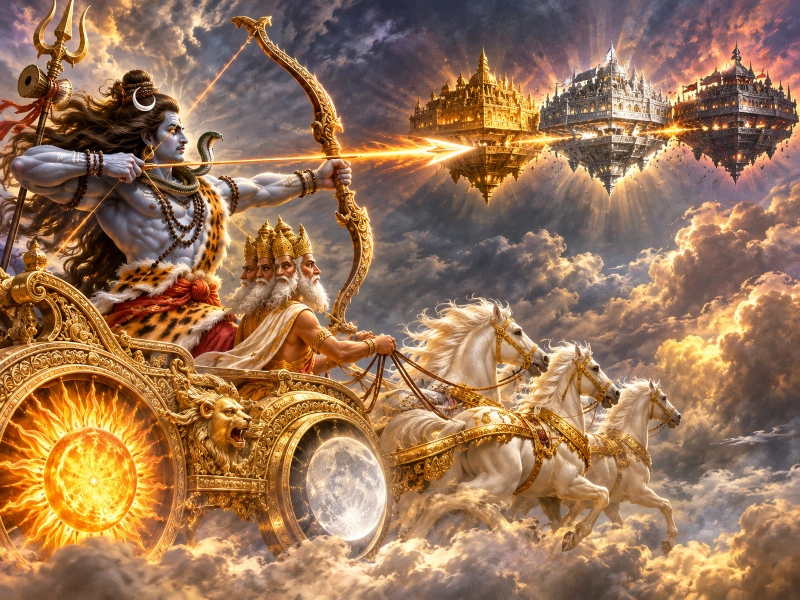
Warcraft Strategies from the Purāṇas | Śiva Purāṇa – Rudra Saṃhitā, Yuddha Khaṇḍa, Chapters 1–10 | Matsya Purāṇa – Tripura Narrative
Ancient Indian sacred literature contains extraordinary accounts of warfare in which military strength, strategic planning, intelligence and the precise employment of weapons determine the outcome of seemingly impossible conflicts. Among these narratives, the destruction of Tripura by Lord Śiva stands out as a remarkable illustration of how an overwhelmingly powerful enemy can be defeated by identifying and exploiting a single, narrowly defined vulnerability.
The three cities of Tripura were no ordinary fortifications. Constructed for three powerful Asura brothers, they possessed extraordinary defensive capabilities and could move through different regions of the cosmos. Their destruction was possible only under an exceptional condition: all three cities had to align simultaneously, allowing a single arrow to penetrate and destroy them together.
The Śiva Purāṇa, particularly the Rudra Saṃhitā’s Yuddha Khaṇḍa, narrates how Lord Śiva, supported by the assembled powers of the Devas, prepared for this extraordinary confrontation. Rather than attempting to overwhelm the fortresses through repeated attacks, Śiva waited for the precise moment when their otherwise formidable defences could be overcome.
The episode, celebrated as Tripura Dahana, offers a profound strategic lesson: victory does not always belong to the force that launches the greatest number of attacks, but to the one that understands the enemy’s vulnerability and strikes decisively at the correct moment.
The Rise of Tripura: Three Fortresses Designed for Invulnerability
Following the death of the powerful Asura Tārakāsura at the hands of Kārttikeya, his three sons—Tārakākṣa, Kamalākṣa and Vidyunmālī—undertook severe austerities to obtain extraordinary powers from Lord Brahmā.
Their initial desire was immortality. When Brahmā explained that absolute freedom from death could not be granted, the brothers devised an alternative intended to make their destruction practically impossible.
They requested three magnificent cities, each constructed from a different metal and capable of moving independently. One would be made of gold, another of silver and the third of iron. The cities would remain separate for an immense period, coming together in a single alignment only once in a thousand years.
Their most important condition concerned the manner of their destruction. The three cities could be destroyed only when they aligned, and only through a single arrow discharged by Lord Śiva.
Brahmā granted the boon, and Maya, the extraordinary architect of the Asuras, constructed the three cities. The resulting fortresses combined magnificent architecture with exceptional defensive protection, allowing their inhabitants to live securely beyond the reach of conventional assaults.
From a military perspective, the Asura brothers had created a defensive system founded on three advantages: geographical separation, mobility and an exceptionally narrow window of vulnerability.
The cities could not be destroyed independently. An attacking force would have to wait until all three became vulnerable simultaneously, and even then, the opportunity would exist only briefly.
Strategic Principle: A defence system can achieve extraordinary resilience by distributing its critical components and making their simultaneous destruction extremely difficult.
The Strength of Tripura: Mobility, Protection and Strategic Depth
The military significance of Tripura becomes clearer when its three cities are examined as an integrated defensive network rather than independent fortifications.
Each city occupied a different cosmic region and possessed the ability to move. Their separation prevented an adversary from concentrating an attack against all three simultaneously. Their mobility further complicated attempts to locate, surround or engage them.
This arrangement resembles the principle of distributed defence, in which important military assets are separated to prevent their destruction through a single conventional attack.
An adversary attempting to capture one fortress would still face the remaining two. Moreover, the supernatural conditions governing their destruction meant that ordinary assaults could not achieve the desired result.
The strength of Tripura therefore rested not merely on the durability of its fortifications but on the relationship between its components. The cities formed a defensive system whose survival depended on their remaining separated.
Yet this arrangement contained a concealed weakness. Their eventual alignment created the only moment when their collective destruction became possible.
The very condition that made Tripura nearly invulnerable also defined the circumstances under which it could be defeated.
Strategic Principle: Every defensive architecture must be examined not only for its strengths but also for the circumstances under which those strengths cease to operate.
The Strategic Problem: Why Conventional Warfare Could Not Defeat Tripura
As the Asuras’ power expanded, the Devas found themselves unable to overcome the three cities through ordinary means. The Śiva Purāṇa describes their growing difficulties and their eventual appeal for divine intervention.
The challenge was fundamentally different from a conventional battle. The Devas were not confronting an army that could simply be defeated through superior numbers, battlefield manoeuvres or prolonged siege operations.
Tripura’s protection arose from a specific boon that restricted the conditions under which the fortresses could be destroyed.
Even an overwhelming military force would be ineffective unless it could satisfy those conditions.
The central problem was therefore to identify the decisive vulnerability, prepare the means to exploit it and ensure that the required strike could be delivered within the available opportunity.
This transformed the campaign from a contest of sustained destruction into an operation requiring exceptional coordination, readiness and timing.
Lord Śiva’s eventual intervention addressed precisely this problem. The objective was not to engage the fortresses repeatedly but to eliminate all three through one carefully timed act.
Strategic Principle: When conventional methods cannot overcome an opponent’s defences, commanders must reconsider the nature of the problem rather than merely increasing the scale of ineffective attacks.
The Cosmic War Machine: Mobilising Every Available Capability
The Śiva Purāṇa provides an extraordinary description of the preparations undertaken for the destruction of Tripura.
Viśvakarmā, the celestial architect, constructed a magnificent chariot incorporating the powers and elements of the universe. The chariot was not represented as an ordinary military vehicle but as a manifestation of cosmic forces working together towards a single objective.
The Earth formed its foundation, while the Sun and Moon became its wheels. Lord Brahmā assumed the responsibility of charioteer, and the four Vedas were represented as the horses drawing the vehicle.
A mighty mountain became Śiva’s bow, while the serpent lord served as its bowstring. Lord Viṣṇu became the arrow, and Agni, the divine embodiment of fire, formed its destructive tip.
The imagery illustrates the scale of the collective effort assembled for the mission. Different divine powers contributed distinct capabilities, but their contributions were organised around a single decisive action.
Within the narrative, the cosmic chariot represents an integration of resources, knowledge, mobility, guidance and destructive power under one supreme commander.
The symbolism has an important military interpretation. Effective operations require more than an exceptional weapon. They also depend on the coordinated functioning of the systems that prepare, position, support and deliver that weapon.
Śiva’s campaign against Tripura thus presents an integrated approach in which numerous capabilities are brought together to accomplish one clearly defined objective.
Strategic Principle: The effectiveness of a decisive weapon depends on the integration of command, mobility, support systems and the capabilities required to deliver it at the correct moment.
The Long Wait: Timing as the Decisive Factor
The most remarkable aspect of the Tripura campaign was the necessity of waiting for the three cities to align.
According to the Śiva Purāṇa, their alignment would occur only after a thousand years, under specifically described celestial conditions involving the Abhijit period and the Puṣya constellation.
For nearly the entire period, the three fortresses remained beyond the reach of the prescribed destructive strike. Their separation preserved the protection granted by Brahmā.
The attacking force therefore required patience and an understanding of the precise conditions that would create the opportunity for victory.
The critical moment would be brief. If the arrow were released too early, the fortresses would not yet be aligned. If the strike were delayed until after their separation, the opportunity would be lost.
This made timing as important as the destructive capability of the weapon itself.
The narrative presents a powerful distinction between possessing superior force and knowing when that force can achieve its intended effect.
Śiva possessed overwhelming divine power, yet the destruction of Tripura was accomplished in accordance with the exceptional conditions governing the fortresses.
The campaign therefore illustrates the importance of maintaining readiness while waiting for a favourable operational opportunity.
Strategic Principle: A commander must distinguish between the ability to attack and the moment when an attack can produce a decisive result.
The Single Arrow: Concentration of Force at the Critical Moment
When the three cities finally aligned, the moment of decision arrived.
The Śiva Purāṇa, Yuddha Khaṇḍa, Chapter 10, describes how Brahmā and Viṣṇu informed Śiva that the opportunity had come and urged him to release the arrow before the cities separated.
Śiva prepared his bow and fitted the divine Pāśupata weapon. The text portrays the arrow as possessing extraordinary brilliance and destructive energy, embodying the power of Viṣṇu and the fire of Agni.
At the appointed moment, Śiva drew his bow and released the arrow.
The weapon struck the three aligned cities and consumed them in a devastating conflagration. The immense fortifications that had remained beyond the reach of the Devas were destroyed through a single, perfectly timed act.
The narrative makes an important distinction between the magnitude of a military operation and the number of weapons employed.
The destruction of Tripura required extensive preparation, the combined involvement of divine powers and the construction of an extraordinary war machine. Yet the decisive action itself involved only one arrow.
This illustrates the principle of concentrating overwhelming effect at the enemy’s most vulnerable point.
Instead of dispersing force across numerous engagements, the campaign directed its destructive capability towards one critical opportunity.
Strategic Principle: A single precisely delivered strike against a decisive vulnerability can achieve what repeated attacks against a resilient system cannot.
Tripurāntaka: The Destruction of the Enemy’s Entire Defensive System
Following the destruction of the three cities, Śiva came to be celebrated as Tripurāntaka, the destroyer of Tripura.
The significance of this victory extended beyond the elimination of three physical fortresses. Tripura represented an interconnected system of protection, mobility and power that had enabled the Asura brothers to resist their opponents.
By destroying all three cities simultaneously, Śiva eliminated the entire defensive structure rather than merely damaging one component.
Had the fortresses been vulnerable to individual destruction, the survival of even one might have allowed the remaining Asuras to preserve part of their military strength.
The conditions established by Brahmā, however, demanded complete and simultaneous destruction.
The operation consequently achieved a decisive result without requiring a prolonged sequence of separate victories.
The Śiva Purāṇa also preserves an important distinction between the destruction of Tripura and the fate of Maya, the architect. Its account describes Maya as a devotee of Śiva who survives the catastrophe.
This detail demonstrates that the narrative does not portray the destruction as the indiscriminate annihilation of every being associated with Tripura.
The episode’s military significance lies in the destruction of the opposing power structure through a single decisive operation.
Strategic Principle: Defeating a powerful adversary may require neutralising the system that sustains its military strength rather than engaging each component independently.
The Deeper Lesson: Intelligence, Patience and Precision
The destruction of Tripura presents several interrelated principles of warfare.
The first is the necessity of understanding the enemy’s defensive architecture. The Devas could not overcome Tripura merely by confronting its visible fortifications. They required knowledge of the special conditions governing its survival and destruction.
The second is the importance of operational patience. Although the attacking force possessed extraordinary capabilities, those capabilities became decisive only when the fortresses reached their moment of vulnerability.
The third is the integration of available resources. The cosmic chariot and its divine components symbolise the coordination required to transform separate capabilities into an effective instrument of action.
The fourth is concentration of force. Rather than attempting repeated engagements against three nearly invulnerable targets, Śiva directed one overwhelming strike against their collective vulnerability.
The fifth is the relationship between preparation and opportunity. The successful destruction of Tripura depended on ensuring that the necessary weapon and supporting capabilities were ready before the critical moment arrived.
Together, these principles establish a coherent strategic sequence: understand the adversary, identify the decisive vulnerability, prepare the necessary capabilities, maintain readiness and strike when the opportunity emerges.
The power of the narrative lies in demonstrating that superior strategy can transform an apparently impossible military problem into a decisive victory.
Modern Military Parallel: Time-Sensitive Targeting and Integrated Operations
The destruction of Tripura offers a conceptual parallel to modern military operations involving mobile, dispersed and heavily protected targets.
Contemporary military forces frequently distribute important assets across multiple locations to reduce their vulnerability to concentrated attacks. Mobile missile systems, dispersed command facilities and layered air-defence networks are designed to survive by denying an opponent a convenient opportunity to destroy them.
Such systems may nevertheless become more vulnerable under particular circumstances, including temporary concentration, movement through predictable routes or the exposure of critical supporting infrastructure.
Modern commanders seek to exploit these opportunities through intelligence, surveillance, reconnaissance and precision-strike capabilities.
The concept of time-sensitive targeting is especially relevant. Some targets become vulnerable only briefly, requiring rapid coordination between systems responsible for detecting, identifying, authorising and engaging them.
An operation may involve extensive intelligence gathering, multiple surveillance platforms, command networks and sophisticated weapons, even when the decisive engagement ultimately requires only a limited number of strikes.
Similarly, the concept of system-of-systems warfare recognises that modern military strength depends on interconnected capabilities rather than individual platforms operating independently. Neutralising a critical connection or supporting element can sometimes produce consequences extending far beyond the immediate target.
The parallel with Tripura is conceptual rather than technological. The Purāṇic account describes a supernatural event, not a historical demonstration of modern weapons or targeting systems.
Nevertheless, its strategic logic remains striking: distributed defences, narrow windows of vulnerability, integrated capabilities and precisely timed force are central considerations in military planning.
The Philosophical Dimension: The Destruction of Invulnerability
Beyond its military interpretation, the destruction of Tripura carries a profound philosophical significance within the Śaiva tradition.
The three cities have been interpreted symbolically in later spiritual traditions as representing forms of bondage, ignorance or the limitations that prevent the realisation of higher consciousness.
In this understanding, Śiva’s arrow represents the power of divine knowledge that destroys the conditions sustaining bondage.
The three cities appear impregnable because their inhabitants rely upon extraordinary protections. Yet their security remains conditional, demonstrating the limitations of power built upon assumptions of permanent invulnerability.
The philosophical interpretation complements the strategic reading without being identical to it.
Where the military lesson concerns the exploitation of a critical weakness, the spiritual lesson concerns the destruction of ignorance and the recognition that worldly power, however formidable, is not absolute.
Śiva as Tripurāntaka consequently represents both the divine destroyer of an overwhelming hostile power and the supreme force that dissolves the limitations of conditioned existence.
Conclusion: Victory Through the Perfect Convergence of Force and Opportunity
The destruction of Tripura is one of the most compelling warfare narratives in the Purāṇic tradition because its outcome depends on something more complex than superior physical strength.
The three Asura brothers possessed extraordinary fortresses that combined mobility, separation and exceptional protection. Their defensive architecture made conventional destruction practically impossible.
Yet the very boon that sustained their power contained a precise condition for their defeat.
Lord Śiva’s victory came through the fulfilment of that condition. The assembled divine powers provided the means, the alignment of the cities created the opportunity, and the single arrow delivered the decisive result.
The narrative therefore presents an enduring principle of military strategy: the greatest concentration of force is not necessarily the largest attack, but the one directed against the correct target at the moment when it can achieve the maximum effect.
Tripura was not defeated through a thousand attacks upon three impregnable fortresses. It was destroyed by one arrow released at the one moment when all three could be struck together.
The lesson of Tripurāntaka is that preparation creates capability, intelligence identifies vulnerability, patience preserves strength, and timing transforms a single decisive action into complete victory.
References
Primary Source: Śiva Purāṇa, Rudra Saṃhitā, Yuddha Khaṇḍa, Chapters 1–10. Chapter 1 describes the boon granted to the Asura brothers; Chapter 8 describes the cosmic chariot and its components; Chapters 9–10 narrate Śiva’s expedition and the destruction of Tripura.
Additional Traditional Source: Matsya Purāṇa, Tripura narrative. This version also describes the destruction of the three cities through Śiva’s divine arrow. Details of the celestial circumstances and divine preparations vary among Purāṇic recensions.
Related Literary Tradition: Mahābhārata, Karṇa Parva, the Tripura narrative. This account likewise preserves the tradition of Śiva’s destruction of the three cities and the participation of divine powers in preparing his chariot.
You may also like
-
The Immunity of Diplomatic Envoys: Vibhīṣaṇa’s Defence of Hanumān Before Rāvaṇa
-
Andhaka’s War Against Shiva: The Battle of Endless Regeneration and Strategic Adaptation
-
Traditional Indian Artisans Record ₹55 Lakh Sales at Shilp Samagam Mela in Delhi
-
Tārā’s Diplomacy: How Wise Counsel Prevented a Political Crisis Between Allies
-
Hanumān in Rāvaṇa’s Court: Courage, Strategic Messaging and the Responsibilities of an Envoy
