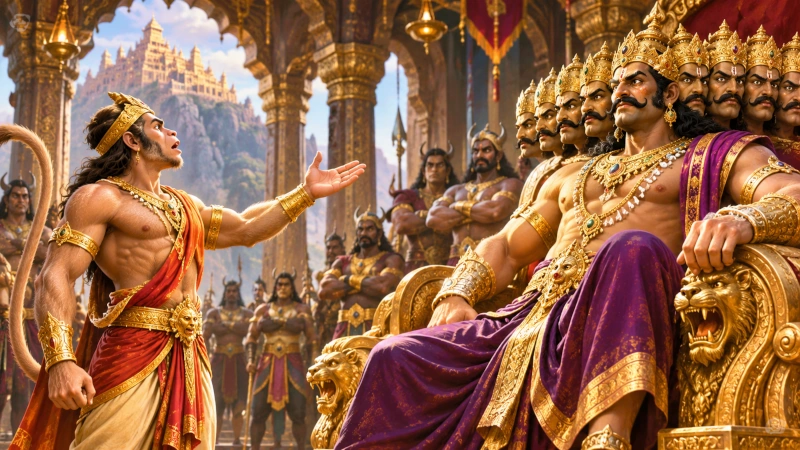
Ramayana Diplomacy Series | Vālmīki Rāmāyaṇa | Yuddha Kāṇḍa, Sargas 41–42
Diplomacy is often associated with negotiation, compromise and the peaceful settlement of disputes. Yet one of its most important responsibilities is to communicate clearly when a political or military confrontation has reached the point where continued defiance will carry unavoidable consequences. The ability to issue a credible warning, establish the conditions for avoiding conflict and demonstrate the determination to enforce those conditions is an essential dimension of statecraft.
The Vālmīki Rāmāyaṇa offers a powerful illustration of this principle through Aṅgada’s diplomatic mission to Rāvaṇa’s court immediately before the battle for Laṅkā. With his army already positioned outside the fortified capital, Rāma sends Aṅgada, the son of Vāli and a prominent commander in the Vānara army, to deliver a final message to the ruler of Laṅkā.
The mission takes place at an extraordinary moment. Rāma has crossed the ocean, secured the cooperation of Sugrīva’s forces, accepted Vibhīṣaṇa’s allegiance and surrounded Laṅkā with a formidable army. The military preparations are complete, and the opposing forces are approaching open confrontation. Nevertheless, Rāma chooses to communicate his position through an authorised envoy before the commencement of the principal battle.
Aṅgada’s mission, narrated in the Yuddha Kāṇḍa, Sarga 41, demonstrates the relationship between diplomacy and military power. His message is uncompromising, demanding accountability for Sītā’s abduction and warning Rāvaṇa of the consequences of refusing to restore her. The episode also illustrates the importance of diplomatic representation, the protection of envoys, political legitimacy and the dangers of allowing personal arrogance to override the interests of a kingdom.
The Strategic Situation: Rāma’s Army at the Gates of Laṅkā
By the time Aṅgada undertakes his mission, Rāma’s campaign has entered its decisive phase. The search for Sītā has succeeded through Hanumān’s extraordinary journey to Laṅkā, and the construction of the bridge across the ocean has enabled the allied forces to reach the island kingdom.
The arrival of Rāma’s army fundamentally changes the strategic position of both sides. Rāvaṇa can no longer rely upon the ocean as a natural barrier separating his capital from an advancing enemy. The Vānara forces have crossed this obstacle and established themselves before Laṅkā’s formidable defensive walls.
In Yuddha Kāṇḍa, Sarga 41, Vālmīki describes Rāma organising his army around the city’s principal gateways. Nīla commands the forces positioned towards the eastern entrance, Aṅgada occupies the southern approach, and Hanumān takes responsibility for the western gate. Rāma and Lakṣmaṇa establish their position near the northern gate, while Sugrīva maintains command over a central formation.
This deployment demonstrates that the allied army is not an undisciplined gathering of warriors. Its commanders have been assigned specific responsibilities, the entrances to Laṅkā are closely watched, and the entire force has been organised for coordinated military action.
The strategic significance of this arrangement is considerable. Rāma’s diplomatic communication is not being issued from a position of uncertainty or weakness. His forces have already demonstrated their capacity to overcome major geographical obstacles and threaten Rāvaṇa’s capital directly.
The mission therefore represents diplomacy backed by credible military capability. Rāvaṇa is being informed of the consequences of his decisions at a moment when those consequences are visibly approaching.
Rāma’s Decision: Consultation Before Confrontation
One of the most revealing aspects of the episode is the manner in which Rāma decides to dispatch Aṅgada.
After positioning his army, Rāma consults his advisers and considers the duties associated with righteous kingship. Vālmīki explicitly presents him as a ruler familiar with the traditional approaches to dealing with an adversary.
The relevant passage appears in Yuddha Kāṇḍa, Sarga 41, verses 58–60, where Rāma’s deliberations precede his decision to summon Aṅgada.
The narrative reflects the classical Indian understanding that political disputes may be approached through several methods, traditionally identified as Sāma (conciliation), Dāna (concessions or inducements), Bheda (division or strategic differentiation) and Daṇḍa (coercive punishment).
These methods do not necessarily represent a rigid sequence applicable to every political situation. Rather, they constitute a framework through which a ruler evaluates available means of influencing an adversary.
Rāma’s decision is significant because the military option is already available. His army surrounds Laṅkā, his commanders are prepared, and his objective remains unchanged. Yet he chooses to communicate through an envoy before proceeding further.
The decision demonstrates that military preparedness and diplomatic communication need not be mutually exclusive. A ruler may prepare for conflict while retaining a final opportunity for the opposing side to reconsider its actions.
In this episode, Rāma’s deliberation also highlights the importance of consultation. Even a commander possessing extraordinary personal strength does not dispense with advice, planning or the responsibilities of political leadership.
Why Aṅgada Was Chosen as the Envoy
Aṅgada‘s selection is particularly significant when examined within the political circumstances of the Rāmāyaṇa.
He is the son of Vāli, the former ruler of Kiṣkindhā, and belongs to the royal lineage of the Vānara kingdom. Following Vāli’s death, Aṅgada becomes an important member of Sugrīva’s political and military establishment.
Earlier in the narrative, he demonstrates leadership during the southern expedition to locate Sītā. His association with Hanumān, Jāmbavān and the other senior Vānara commanders establishes him as a warrior familiar with difficult missions and collective responsibility.
By the time the allied forces reach Laṅkā, Aṅgada has become one of the principal commanders entrusted with the city’s military containment.
His appointment as envoy therefore carries political and military significance. He is not an ordinary messenger but a recognised leader capable of representing Rāma before the ruler of an opposing kingdom.
The choice also demonstrates the integration of the Vānara leadership into Rāma’s wider campaign. Aṅgada’s mission is entrusted to a prince whose personal history is connected to the political transformation of Kiṣkindhā and whose present loyalty lies with the alliance led by Rāma.
His royal status, battlefield experience and personal courage make him suitable for a mission requiring both authority and composure.
An envoy entering the court of a hostile ruler must be prepared for intimidation, manipulation and the possibility of violence. Aṅgada possesses the qualities required to withstand such pressure without abandoning his responsibilities.
The Diplomatic Message: Accountability and the Consequences of Defiance
Rāma’s instructions to Aṅgada are direct and forceful.
In Yuddha Kāṇḍa, Sarga 41, verses 61–73, Rāma directs Aṅgada to enter Laṅkā without fear and convey his message to Daśagrīva, the ten-headed Rāvaṇa.
The communication condemns Rāvaṇa’s conduct, particularly his abduction of Sītā through deception. It also refers to the suffering inflicted upon sages, divine beings and others through the misuse of his power.
Rāma presents himself as the authority prepared to punish these actions. His message challenges Rāvaṇa to demonstrate in open battle the courage that he had displayed while abducting Sītā through deceptive means.
The central demand remains the restoration of Sītā. Rāma makes clear that Rāvaṇa’s refusal to correct his wrongdoing will result in military punishment.
The message also identifies Vibhīṣaṇa as the future ruler of Laṅkā following Rāvaṇa’s defeat. This is an important political element because it demonstrates that Rāma’s campaign has an alternative arrangement for the kingdom’s leadership.
The communication therefore operates on several levels. It identifies the grievance that has produced the conflict, establishes responsibility for that grievance, communicates the consequences of continued resistance and announces the political outcome that Rāma intends to establish if Rāvaṇa refuses to change course.
This is not a negotiation between two rulers seeking a mutually acceptable compromise over competing territorial claims. Rāma regards Sītā’s abduction as an act of grave injustice requiring correction.
The diplomatic opportunity lies in Rāvaṇa’s ability to abandon his wrongful course before the consequences become irreversible.
The Difference Between Negotiation and an Ultimatum
Aṅgada’s mission illustrates an important distinction in diplomatic practice.
Negotiation generally involves an exchange of proposals through which opposing parties attempt to reach an agreement. An ultimatum, by contrast, communicates a demand backed by specified consequences if the demand is rejected.
Rāma’s message belongs principally to the second category.
His objective is not to bargain over Sītā’s freedom or offer Rāvaṇa political rewards for returning her. The message establishes that her abduction is unacceptable and that Rāvaṇa must face the consequences of refusing to correct it.
The distinction is important because diplomacy does not always require compromise on the underlying principle at stake.
There are circumstances in which a ruler may communicate an unalterable demand while leaving the opponent an opportunity to comply voluntarily.
In such situations, diplomatic effectiveness depends upon clarity, credibility and the adversary’s understanding of the consequences.
Rāma’s military preparations make the warning credible, while Aṅgada‘s formal mission ensures that the message is communicated directly to the ruler responsible for the dispute.
The episode therefore demonstrates that a final diplomatic initiative may serve not to negotiate the terms of justice but to communicate clearly the consequences of refusing it.
Aṅgada in Rāvaṇa’s Court: Courage Without Submission
Having received Rāma’s instructions, Aṅgada enters Laṅkā and proceeds towards Rāvaṇa’s palace.
Vālmīki describes the Vānara prince reaching the royal court, where Rāvaṇa is seated among his ministers. Aṅgada presents himself openly and announces that he is the envoy of Rāma, the ruler of Kosala.
His declaration establishes the authority under which he speaks. He is not acting independently, nor is he seeking personal recognition. He is communicating the position of the sovereign who has entrusted him with the mission.
Aṅgada then delivers Rāma’s warning without concealing or softening its substance. He declares that Rāvaṇa’s destruction is imminent if he continues his present course and announces the consequences that will follow for the ruling establishment of Laṅkā.
This encounter demonstrates the distinction between respect for diplomatic office and submission to political intimidation.
Aṅgada does not allow the grandeur of Rāvaṇa’s court or the ruler’s military reputation to alter the message he has been instructed to deliver.
At the same time, the confrontation is not a personal quarrel initiated by the envoy. Its central purpose remains the communication of Rāma’s position.
The responsibility of an envoy is to represent the sender accurately, especially when the message is unwelcome to its recipient.
Aṅgada fulfils that responsibility with exceptional courage.
Rāvaṇa’s Response: The Failure to Respect Diplomatic Representation
Rāvaṇa reacts angrily to Aṅgada’s declaration.
Rather than treating the envoy’s communication as an opportunity to assess the seriousness of Rāma’s intentions, he orders his attendants to seize Aṅgada.
This decision transforms a diplomatic encounter into an act of coercion against the messenger.
The distinction between an envoy and the ruler he represents is fundamental to diplomatic conduct. A messenger communicates another authority’s position and should not be treated as personally responsible for the political demands contained in that communication.
The Rāmāyaṇa had already explored this principle during Hanumān’s earlier appearance in Rāvaṇa’s court. On that occasion, Vibhīṣaṇa intervened when Rāvaṇa sought Hanumān’s execution, arguing that killing an envoy was contrary to established norms of royal conduct.
Aṅgada’s encounter demonstrates that Rāvaṇa has failed to absorb the political significance of that earlier warning.
His order to seize the envoy is not merely an expression of anger. It reveals an inability to distinguish between receiving an unwelcome message and punishing the individual responsible for delivering it.
This failure has wider diplomatic consequences. A ruler who responds to messages through intimidation discourages honest communication and increases the likelihood that disputes will be resolved through force rather than deliberation.
Rāvaṇa’s conduct thus illustrates how personal arrogance can undermine the institutional practices necessary for responsible governance.
Aṅgada’s Escape: Demonstrating Strength Without Abandoning the Mission
Rāvaṇa’s attendants attempt to apprehend Aṅgada, but the Vānara prince proves impossible to restrain.
In Yuddha Kāṇḍa, Sarga 41, verses 85–92, Vālmīki describes Aṅgada allowing the attendants to seize him before rising into the air with them clinging to his arms. Unable to withstand his strength, the Rākṣasas fall away.
Aṅgada then lands upon a prominent structure of Rāvaṇa’s palace and breaks its summit through the force of his movement.
Having demonstrated his power before the inhabitants of Laṅkā, he announces himself and returns to Rāma’s army.
The incident serves several purposes within the narrative.
First, it establishes that Rāvaṇa’s court has failed to intimidate or detain the envoy. Second, it demonstrates the capabilities of a commander drawn from the army now surrounding Laṅkā. Third, it reinforces the credibility of the military warning Aṅgada has delivered.
The display of strength is especially significant because Aṅgada acts while surrounded by enemies and far from the immediate protection of his own forces.
His escape ensures that the diplomatic mission does not end with the capture of Rāma’s representative.
It is also important to distinguish the original Vālmīki narrative from popular later retellings. The familiar episode in which Aṅgada plants his foot in Rāvaṇa’s court and challenges the assembled warriors to move it is particularly prominent in later Rāmāyaṇa traditions. The corresponding account in Vālmīki’s Yuddha Kāṇḍa, Sarga 41, instead describes the attempted seizure, Aṅgada’s aerial escape and the destruction of the palace summit.
Military Preparedness as the Foundation of Credible Diplomacy
One of the most important strategic features of Aṅgada’s mission is its timing.
Rāma does not send his representative while his army remains distant from Laṅkā. The mission occurs after the bridge has been constructed, the ocean crossed and the city’s principal approaches surrounded.
This sequence gives the diplomatic warning exceptional credibility.
Rāvaṇa has already witnessed Hanumān’s ability to penetrate Laṅkā and survive the hostility of its defenders. He now faces a much larger force commanded by Rāma, Sugrīva, Lakṣmaṇa and their senior allies.
The threat of military action is therefore supported by visible preparations rather than unsupported declarations.
In diplomatic strategy, credibility depends partly on whether the opposing party believes that a stated course of action can and will be implemented.
Rāma’s preparations establish the capability to act, while his decision to send Aṅgada demonstrates that the immediate resort to battle is not the only option being considered.
The episode illustrates the relationship between diplomatic communication and the military balance of power.
A warning becomes more consequential when the adversary can see that the force necessary to implement it is already available.
At the same time, Rāma’s conduct demonstrates that possessing military superiority does not eliminate the responsibility to communicate clearly before employing it.
Political Legitimacy: Rāma’s Recognition of Vibhīṣaṇa
An important aspect of Aṅgada’s message concerns the future political leadership of Laṅkā.
Rāma’s declaration that Vibhīṣaṇa will become its ruler reflects a decision already made during the campaign. When Vibhīṣaṇa abandoned Rāvaṇa and sought refuge with Rāma, he was accepted despite objections and concerns expressed by some members of the Vānara leadership.
By recognising Vibhīṣaṇa, Rāma establishes a distinction between the kingdom of Laṅkā and the conduct of its existing ruler.
The campaign is directed against Rāvaṇa’s actions and the power structure sustaining them, rather than asserting that Laṅkā must remain permanently without sovereign leadership.
Vibhīṣaṇa’s presence also demonstrates that opposition to Rāvaṇa exists within his own family and political establishment.
This weakens the claim that Rāvaṇa’s personal decisions necessarily represent the interests of every inhabitant of his kingdom.
From a diplomatic perspective, the recognition of an alternative ruler creates a political framework for the period following the anticipated conflict.
Military victory alone cannot establish stable governance unless the question of political authority is also addressed.
Rāma’s message therefore combines the demand for accountability with a declaration concerning the future administration of Laṅkā.
The episode illustrates how political planning and military objectives can be integrated before the decisive confrontation begins.
Leadership and the Dangers of Rejecting Unwelcome Advice
Aṅgada’s mission must also be understood within the wider pattern of Rāvaṇa’s response to counsel.
Throughout the Sundara Kāṇḍa and Yuddha Kāṇḍa, Rāvaṇa receives warnings concerning the consequences of retaining Sītā and confronting Rāma.
Hanumān communicates Rāma’s position during his earlier mission. Vibhīṣaṇa advises Rāvaṇa to restore Sītā and avoid disaster. Malyavān, an experienced elder, also counsels restraint and recognises the dangers facing Laṅkā.
These interventions differ in circumstance and authority, but they reveal a recurring political problem. Rāvaṇa possesses access to advice yet repeatedly refuses to accept conclusions that challenge his personal desires.
Aṅgada’s mission provides another opportunity to reconsider the consequences of his actions.
His response demonstrates the danger of a political system in which the ruler’s pride becomes more important than the security of the kingdom.
Effective leadership requires more than personal courage or military power. It also requires the ability to recognise changing circumstances, evaluate adverse information and distinguish between the ruler’s interests and those of the state.
Rāvaṇa’s refusal to respond constructively to repeated warnings contributes to the destruction of the very kingdom he seeks to preserve.
The Rāmāyaṇa thus presents an enduring lesson in political leadership: the failure to listen can become a strategic weakness more dangerous than the strength of an external enemy.
From Diplomatic Warning to Open Warfare
The transition from Aṅgada’s mission to the battle for Laṅkā occurs immediately in the following chapter of the Yuddha Kāṇḍa.
Sarga 42 describes the intensification of the siege and the commencement of direct combat between the Vānara forces and the defenders of Laṅkā.
Rāvaṇa learns that his capital is surrounded and strengthens his military arrangements. The Vānara commanders advance towards the fortifications, while the Rākṣasa forces prepare to resist them.
The sounds of conches, war cries and weapons fill the battlefield as the confrontation develops into open warfare.
The sequence is significant because Vālmīki places Aṅgada’s diplomatic mission immediately before this escalation.
The envoy has delivered Rāma’s message. The opposing ruler has responded with hostility, and the opportunity to avert the approaching catastrophe has not been accepted.
The political confrontation consequently passes into its military phase.
This progression demonstrates that diplomacy and warfare are connected through decisions made by political leaders. A conflict may remain avoidable even when armies have assembled, but that possibility depends upon the willingness of those leaders to address the demands and grievances underlying the confrontation.
Aṅgada’s mission shows how the rejection of a final diplomatic warning can become the immediate prelude to battle.
Modern-Day Parallel: The Kargil War of 1999 — Diplomacy Backed by Military Strength
A compelling modern parallel to Aṅgada’s mission to Rāvaṇa can be found in India’s diplomatic approach during the 1999 Kargil conflict. After Pakistani forces occupied positions across the Line of Control, India launched military operations to reclaim the territory while maintaining diplomatic channels to communicate its demand for withdrawal.
On 12 June 1999, India’s External Affairs Minister Jaswant Singh met Pakistan’s Foreign Minister Sartaj Aziz in New Delhi. During the discussions, Singh demanded the withdrawal of Pakistani forces from Indian territory and the restoration of the situation that existed before the intrusion. India maintained that the violation of the Line of Control was responsible for the crisis and that de-escalation required Pakistan to reverse its actions. Meanwhile, the Indian Army and Air Force were conducting operations against the intruding forces, demonstrating India’s determination to enforce its position.
Diplomatic pressure intensified as Indian military operations continued. On 4 July 1999, Pakistani Prime Minister Nawaz Sharif met American President Bill Clinton in Washington, where both leaders agreed that the Line of Control must be respected and that concrete steps should be taken to restore it. The subsequent withdrawal of Pakistani forces, together with India’s military successes, contributed to the resolution of the conflict.
The parallel with Aṅgada’s mission lies in the combination of a clear diplomatic demand and credible military capability. Aṅgada entered Rāvaṇa’s court to communicate Rāma’s demand for Sītā’s return while the Vānara army stood prepared for battle. Similarly, India communicated its demand for the restoration of the Line of Control while its armed forces were already engaged in military operations.
The outcomes differed, as Rāvaṇa rejected the opportunity for reconciliation, whereas the Kargil crisis ended with the restoration of the Line of Control. Nevertheless, both episodes illustrate an enduring principle of statecraft: diplomatic communication acquires greater weight when supported by the demonstrable capability and determination to enforce legitimate demands.
Diplomatic Lessons from Aṅgada’s Mission
Aṅgada’s mission offers several enduring lessons for diplomacy, statecraft and political leadership.
The first is the importance of communicating demands clearly. Rāma does not leave Rāvaṇa uncertain about the grievance or the consequences of continued resistance. The demand concerning Sītā and the warning of military punishment are communicated through an authorised representative.
The second is that diplomatic credibility depends upon preparation. Rāma’s army is already positioned around Laṅkā, and his commanders are prepared for coordinated action. The warning is therefore supported by the visible capacity to enforce it.
The third concerns the selection of envoys. Aṅgada combines royal standing, military experience, personal courage and loyalty to the mission. These qualities enable him to represent Rāma effectively in a hostile political environment.
The fourth is the importance of respecting diplomatic representation. Rāvaṇa’s decision to seize Aṅgada demonstrates the dangers of treating an envoy as an enemy combatant merely because he delivers an unwelcome message.
The fifth concerns political legitimacy. Rāma’s recognition of Vibhīṣaṇa shows that military operations may be accompanied by decisions regarding the political order that is intended to follow the conflict.
The final lesson concerns the responsibility of rulers to evaluate warnings objectively. Rāvaṇa’s repeated rejection of counsel illustrates how arrogance and personal attachment can prevent a leader from recognising a deteriorating strategic position.
Taken together, these principles demonstrate that diplomacy is not simply the exchange of messages. It is an instrument through which political objectives, military capabilities, leadership judgment and the possibility of avoiding conflict are brought into direct relationship.
Conclusion: The Final Responsibility of Diplomacy Before War
Aṅgada’s mission to Laṅkā occupies an important place in the diplomatic history presented by the Vālmīki Rāmāyaṇa.
It occurs at the point where Rāma has acquired the military strength necessary to confront Rāvaṇa, yet still chooses to communicate his demands through an authorised envoy.
The mission demonstrates the value of consultation, the careful selection of representatives, clarity in political communication and the importance of maintaining diplomatic channels even under circumstances of extreme hostility.
Aṅgada fulfils his responsibilities without yielding to intimidation. He delivers Rāma’s message, withstands Rāvaṇa’s attempt to seize him and returns to the allied army after demonstrating that the authority he represents cannot easily be threatened into submission.
Rāvaṇa, however, responds to the warning as an affront to his pride rather than an opportunity to reconsider the political and military consequences of his decisions.
The result is the transition from diplomatic confrontation to open warfare.
The episode illustrates that diplomacy does not always succeed in preventing conflict, even when the demands are clear and the consequences credible. Its importance also lies in ensuring that the opposing leadership understands the choices before it and the responsibility attached to those choices.
Rāma’s decision to send Aṅgada reveals a ruler who combines military preparedness with political deliberation. Aṅgada’s conduct reveals an envoy who understands the obligations of representation. Rāvaṇa’s response reveals the dangers of allowing arrogance to obstruct rational statecraft.
The enduring lesson of Aṅgada’s mission is that military strength establishes the ability to act, but responsible diplomacy ensures that the consequences of confrontation are clearly communicated before the decisive use of force.
In the Rāmāyaṇa, the final warning reaches Laṅkā before the great battle begins. The tragedy lies not in the absence of diplomatic communication, but in Rāvaṇa’s refusal to heed it.
References
Vālmīki Rāmāyaṇa – Yuddha Kāṇḍa, Sarga 41, Verses 1–10: Rāma admonishes Sugrīva for undertaking a dangerous action without consultation, illustrating the responsibilities of political and military leadership.
Yuddha Kāṇḍa, Sarga 41, Verses 25–57: Rāma’s army advances towards Laṅkā and establishes military positions around the principal entrances to the city.
Yuddha Kāṇḍa, Sarga 41, Verses 58–60: Rāma consults his advisers, considers the duties of kingship and decides to send Aṅgada as his representative.
Yuddha Kāṇḍa, Sarga 41, Verses 61–73: Rāma instructs Aṅgada to deliver his warning to Rāvaṇa, condemning Sītā’s abduction and announcing the consequences of continued resistance.
Yuddha Kāṇḍa, Sarga 41, Verses 74–83: Aṅgada enters Rāvaṇa’s court, identifies himself as Rāma’s envoy and communicates the warning.
Yuddha Kāṇḍa, Sarga 41, Verses 84–93: Rāvaṇa orders Aṅgada’s seizure; the Vānara prince escapes, damages the palace summit and returns to Rāma’s forces.
Yuddha Kāṇḍa, Sarga 42: The siege of Laṅkā intensifies, and direct combat begins between Rāma’s allied forces and Rāvaṇa’s army.
Related Reference: Vālmīki Rāmāyaṇa, Sundara Kāṇḍa, Sarga 52, concerning Vibhīṣaṇa’s defence of the principle that an envoy should not be killed.
Modern Historical Reference: United Nations Security Council Resolution 678, adopted on 29 November 1990, and the diplomatic developments preceding the commencement of coalition military operations against Iraq on 17 January 1991.
You may also like
-
Shiva Destroys Tripura: The Three Flying Fortresses and the Strategy of a Single Decisive Strike
-
India and EU Review Free Trade Agreement, Economic Security and Strategic Cooperation
-
India and France Advance Strategic Cooperation in Space, Critical Technologies and Economic Security
-
PM Modi Reaffirms India’s Support for Peaceful Resolution of Ukraine Conflict in Talks with Zelenskyy
-
India and Lebanon Hold Foreign Office Consultations, Prioritise Trade, Digital Infrastructure and Pharmaceuticals
