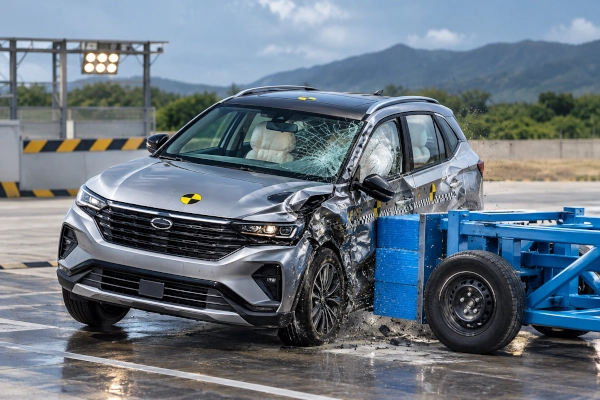
India is preparing a major expansion of its vehicle-safety rating system, with Bharat NCAP 2.0 scheduled to come into effect from October 2027 and assess cars across the entire chain of road safety rather than concentrating mainly on how occupants survive a crash.
Union Minister for Road Transport and Highways Nitin Gadkari said the second phase of the Bharat New Car Assessment Programme will examine not only crash protection but also crash avoidance, pedestrian and vulnerable-road-user protection, and post-crash evacuation and care. The broader framework is intended to encourage manufacturers to incorporate increasingly sophisticated active and passive safety technologies into vehicles sold in India.
The existing Bharat NCAP framework came into effect on October 1, 2023 and remains valid until September 30, 2027. The Ministry of Road Transport and Highways subsequently prepared a substantially expanded second phase under the draft AIS-197 Revision 1, published in November 2025. The draft describes Bharat NCAP 2.0 as an assessment system built around five separate safety verticals rather than the narrower occupant-protection approach of the first phase.
Under the proposed system, every eligible vehicle would receive an overall score out of 100 points. Crash protection would remain the largest component with 55 points, while protection of pedestrians and other vulnerable road users would account for 20 points. Safe-driving technologies and accident-avoidance systems would contribute 10 points each, while another five points would be available for post-crash safety.
The change would significantly broaden what a Bharat NCAP star rating actually represents. A high score would no longer indicate only that the occupants have a relatively good chance of surviving specified crash tests. Manufacturers would also need to demonstrate that their vehicles can help prevent accidents, reduce injuries to people outside the vehicle and facilitate rescue after a collision.
Crash testing itself is proposed to become considerably more demanding. Bharat NCAP 2.0 would evaluate vehicles through five principal crash configurations, including the existing offset frontal and side-impact tests as well as additional full-width frontal, oblique pole-side and rear-impact evaluations.
The proposed full-width frontal test would be conducted at 50 km/h, while the oblique pole-side impact would take place at 32 km/h. A new rear-impact assessment is also proposed at 50 km/h. The existing offset frontal impact would continue at 64 km/h, while lateral impact testing would remain part of the expanded assessment.
The pole-impact requirement would also become tougher. The test speed is proposed to rise from the present 29 km/h to 32 km/h, increasing the challenge for side structures, airbags and occupant-protection systems.
Another major change concerns equipment that manufacturers will need to provide before a vehicle can even qualify for a Bharat NCAP star rating. Under the draft framework, Electronic Stability Control and curtain airbags would become mandatory for rating eligibility. Autonomous Emergency Braking would remain optional, but manufacturers could earn additional points by demonstrating its effectiveness and that of other advanced driver-assistance technologies.
Electronic Stability Control is designed to help a driver maintain control when a vehicle begins to skid or deviate from its intended path. Curtain airbags provide additional head protection during severe side impacts and rollover-type events. Making both technologies prerequisites for a rating would create a strong incentive for manufacturers to install them more widely across passenger-vehicle ranges rather than restricting them to expensive variants.
Pedestrian protection will also receive much greater attention. The new Vulnerable Road User Protection category is proposed to evaluate how the front of a vehicle interacts with pedestrians during an impact, including tests involving the bumper, bonnet and windscreen areas. Systems such as Autonomous Emergency Braking capable of detecting pedestrians or two-wheelers could contribute further points.
This is particularly significant for Indian road conditions, where cars routinely share space with pedestrians, cyclists and two-wheelers. Bharat NCAP 2.0 therefore attempts to evaluate safety beyond the people sitting inside the vehicle.
The separate Safe Driving and Accident Avoidance categories would further expand the importance of electronics and software. Future vehicles seeking high ratings could increasingly depend on technologies that warn drivers of developing hazards or intervene automatically when a collision becomes imminent.
Gadkari said the government intends to examine advanced safety technologies already being deployed internationally while also considering solutions being developed by Indian startups. He invited automobile manufacturers to contribute suggestions based on their research, engineering experience and safety practices in global markets as the enhanced framework is developed.
The initiative could therefore create opportunities for Indian companies developing automotive sensors, cameras, radar, electronic control units, driver-monitoring systems, collision-warning technologies and advanced driver-assistance software. As vehicle safety ratings become increasingly dependent on active electronics rather than purely structural strength, the domestic automotive technology ecosystem could play a larger role.
Bharat NCAP 2.0 also introduces a new emphasis on what happens after an accident. The proposed five-point post-crash category includes areas such as management of electrical and fire hazards and the ability of rescuers or occupants to open doors and release seat belts after an impact.
Such considerations become especially important as electric vehicles become more common. High-voltage battery systems require safeguards against electrical shock and other hazards following a severe collision, while effective occupant extraction can influence survival after any major accident.
Obtaining the highest star rating would also progressively become harder. Under the proposed transition, a vehicle would require at least 70 points out of 100 for a five-star rating when Bharat NCAP 2.0 begins in 2027. From 2029, the threshold is proposed to increase to 80 points, forcing manufacturers to continue improving safety rather than designing vehicles merely to clear a fixed standard.
Overall points alone would not necessarily guarantee five stars. The proposed system also contains minimum-performance safeguards across the individual assessment categories. A vehicle would not be able to compensate for extremely poor performance in one critical safety area simply by collecting large numbers of points elsewhere.
The changes mark a significant evolution from the Bharat NCAP programme introduced in 2023. The first phase gave Indian consumers an indigenous mechanism for comparing the crashworthiness of passenger vehicles through standardised testing and star ratings. The second phase aims to turn that basic crash-test programme into a much broader measure of overall vehicle safety performance.
The transformation also brings India’s assessment architecture closer to the direction taken by established international programmes such as Euro NCAP, where active safety, pedestrian protection and accident prevention increasingly influence vehicle ratings alongside crashworthiness. The MoRTH draft itself acknowledges the use of experience from Euro NCAP, Global NCAP and ASEAN NCAP in developing the revised framework.
For automobile manufacturers, this means future five-star vehicles will need more than a strong passenger compartment and airbags. Safety will increasingly have to be designed across the entire lifecycle of a crash: preventing the collision where possible, protecting occupants and vulnerable road users when an impact occurs, and making rescue safer after the vehicle comes to rest.
For consumers, the change could make the familiar star rating far more comprehensive. Two cars that appear similarly safe under today’s occupant-focused assessment could perform very differently once pedestrian protection, stability systems, autonomous accident avoidance and post-crash safety are included.
The details published under AIS-197 Revision 1 remain part of the proposed framework and could still be modified before final implementation. However, Gadkari’s confirmation that Bharat NCAP 2.0 is intended to operate from October 2027 gives the automobile industry a clear timeline for preparing for the next generation of Indian vehicle-safety assessment.
You may also like
-
Jawahar Dweep Becomes India’s First Plastic-Free Oil Terminal at Mumbai Port
-
Defence Accounts Department Launches SAKSHAM Integration, PRISM and Revamped National Compilation System
-
Indian Captain’s Courage Helps Save Flydubai Flight During Mid-Air Cockpit Crisis
-
India Simplifies Foreign Guest Reporting for Hotels Under New Immigration Framework
-
India Signs UN Convention Against Cybercrime as Global Digital Security Cooperation Expands
