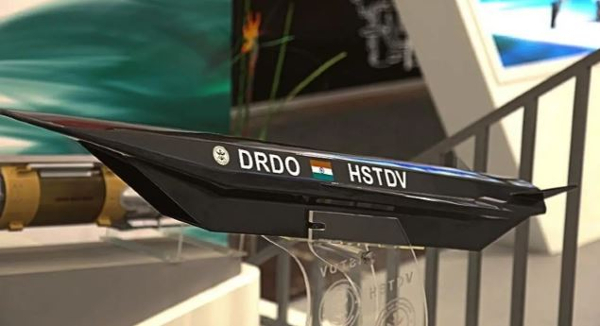
India’s drive to develop indigenous hypersonic weapons rests on a series of difficult advances in propulsion, aerodynamics, high-temperature materials and guidance. One of the most important steps in that journey was the Hypersonic Technology Demonstrator Vehicle, or HSTDV, developed by the Defence Research and Development Organisation to prove that an Indian-built air-breathing vehicle could sustain powered flight at around Mach 6.
HSTDV was never intended to be an operational missile by itself. It was a technology demonstrator, created to validate the technologies India would need before attempting longer-range hypersonic cruise missiles powered by scramjet engines. Its successful flight on September 7, 2020 demonstrated several of those technologies together under actual hypersonic flight conditions and became an important foundation for the more advanced hypersonic propulsion work DRDO is pursuing today.
The programme was led primarily by the Defence Research and Development Laboratory, or DRDL, in Hyderabad, part of DRDO’s Dr APJ Abdul Kalam Missile Complex. At the heart of HSTDV was an indigenous Supersonic Combustion Ramjet, or scramjet, designed to burn fuel while the airflow passing through its combustion chamber remained supersonic.
This distinguishes a scramjet from a conventional jet engine. Conventional turbojets and turbofans contain compressors and turbines that mechanically compress incoming air before combustion. A ramjet has no compressor and instead relies on the high forward speed of the vehicle to compress incoming air. A scramjet takes the concept further by allowing combustion to occur while air continues travelling through the engine at supersonic velocity.
That seemingly simple difference creates an enormous engineering challenge. At hypersonic speed, air passes through the engine in milliseconds. Fuel must be injected, mixed with the incoming oxygen and burned efficiently within that extremely short period while the engine is simultaneously subjected to intense aerodynamic pressure and temperatures.
The principal advantage is equally important. Because a scramjet draws oxygen directly from the atmosphere, it does not need to carry the large quantity of oxidiser required by a rocket during the atmospheric cruise phase. In a future weapon, this could permit more of the vehicle’s mass to be devoted to fuel, payload or other systems and make sustained hypersonic atmospheric flight more practical.
A scramjet cannot, however, accelerate efficiently from rest. It first needs to be carried to very high speed by another propulsion system. This explains the distinctive flight sequence used for HSTDV.
During the landmark September 7, 2020 test, the HSTDV cruise vehicle was mounted on a proven solid-rocket booster and launched from the Dr APJ Abdul Kalam Launch Complex on Abdul Kalam Island off the Odisha coast. The booster accelerated the system into the hypersonic regime and carried it to an altitude of approximately 30 kilometres.
Once the required conditions were reached, the aerodynamic heat shields protecting the cruise vehicle separated. The HSTDV then separated from the launch vehicle, its air intake opened and the scramjet propulsion sequence began.
DRDO reported that fuel injection and automatic ignition took place successfully and that hypersonic combustion was sustained. The vehicle subsequently travelled along its intended flight path at approximately Mach 6 — nearly two kilometres every second — for more than 20 seconds.
The duration may appear short when compared with an operational cruise missile, but HSTDV’s objective was not range. Its purpose was to prove that a complete Indian-designed hypersonic air-breathing system could survive separation, establish airflow through its intake, ignite its fuel and maintain controlled scramjet combustion while travelling through the atmosphere at six times the speed of sound.
Multiple tracking radars, electro-optical systems and telemetry stations monitored the mission. A ship deployed in the Bay of Bengal also observed the cruise phase. DRDO reported that the scramjet operated under conditions of high dynamic pressure and very high temperature and that the mission’s performance parameters confirmed the success of the demonstration.
The flight validated far more than the engine alone. DRDO said the test demonstrated an aerodynamic configuration capable of hypersonic manoeuvring, scramjet ignition and sustained combustion in hypersonic airflow, thermal and structural behaviour of high-temperature materials, and the mechanisms required to separate different sections of the vehicle at hypersonic velocity.
Each of these is critical to an operational weapon.
Aerodynamic heating becomes one of the defining problems above Mach 5. Compression and friction dramatically heat the air surrounding a vehicle, while stagnation regions around the nose and leading edges can reach temperatures capable of weakening ordinary aerospace materials. A practical hypersonic missile therefore requires carefully designed structures, specialised thermal protection and materials capable of maintaining strength under severe heat loads.
The engine faces an additional problem. A scramjet combustion chamber must remain cool enough to survive even while burning fuel continuously inside a stream of extremely hot, high-speed air. HSTDV demonstrated short-duration operation, but an operational hypersonic cruise missile would need to sustain those conditions for much longer.
That is where DRDO’s subsequent work becomes particularly important.
In January 2025, DRDL successfully tested an actively cooled scramjet combustor for 120 seconds. DRDO described the demonstration as a crucial milestone toward long-duration scramjet-powered hypersonic technology. The test validated stable combustion, improved performance and advanced thermal-management techniques.
Progress accelerated only months later. On April 25, 2025, DRDL conducted a subscale actively cooled scramjet combustor test lasting more than 1,000 seconds at its Scramjet Connect Test Facility in Hyderabad. DRDO said this brought the programme closer to testing a full-scale, flight-worthy combustor.
The next major jump came in January 2026, when DRDL successfully ground-tested a full-scale actively cooled long-duration scramjet combustor for more than 12 minutes. The combustor and test infrastructure were designed by DRDL and realised with Indian industry partners.
On May 9, 2026, DRDO extended this achievement dramatically. The full-scale actively cooled combustor operated for more than 1,200 seconds — over 20 minutes at the Hyderabad facility. According to the Ministry of Defence, the system used an indigenously developed liquid hydrocarbon endothermic fuel, high-temperature thermal-barrier coatings and advanced manufacturing processes. Defence Minister Rajnath Singh described the demonstration as a solid foundation for India’s Hypersonic Cruise Missile Development Programme.
These later tests should not be confused with additional flights of the original HSTDV airframe. They represent the next generation of propulsion technology emerging from India’s wider hypersonic research effort, particularly the challenge of converting short-duration scramjet combustion into the sustained operation required for a useful cruise weapon.
This progression illustrates the importance of HSTDV. The 2020 vehicle demonstrated that India could make scramjet propulsion work in actual Mach 6 flight. The subsequent programme has concentrated on making such propulsion long-duration, thermally manageable and eventually suitable for a full-scale weapon.
DRDO’s present hypersonic technology roadmap extends well beyond the combustor. The organisation publicly lists work on long-duration scramjet propulsion, actively cooled engines, endothermic fuels, high-temperature thermal-protection materials, ultra-high-temperature coatings, hypersonic glide-vehicle configurations, reaction-control systems and advanced RF technologies.
This shows why developing a hypersonic weapon is far more complex than simply building a faster missile.
Guidance electronics must function while the vehicle is experiencing enormous thermal and aerodynamic stresses. Communications and radar systems must operate through complex high-speed flow conditions. Control surfaces must generate useful manoeuvring forces without destabilising the vehicle. Fuel must simultaneously provide propulsion and potentially assist with removing heat from the engine and structure.
Even manufacturing becomes more difficult because the engine and thermal-management system can involve complex internal cooling passages and materials that must survive temperatures well beyond those encountered by conventional cruise missiles.
The military attraction of solving these problems is substantial.
A conventional subsonic cruise missile may travel at less than the speed of sound, giving a sophisticated air-defence network more time to detect, track and engage it. A hypersonic cruise missile travelling above Mach 5 dramatically compresses that reaction time.
Unlike a ballistic missile, which follows a largely predictable high-altitude trajectory for much of its flight, an air-breathing hypersonic cruise missile can potentially remain within the atmosphere while manoeuvring along a less predictable route. That combination of extreme speed, atmospheric flight and manoeuvrability complicates detection, tracking and interception.
DRDO itself notes that hypersonic weapons have the potential to penetrate existing air-defence systems and conduct rapid, high-impact strikes.
Such weapons could potentially be developed for roles involving high-value land targets or heavily defended maritime targets, although the precise operational configurations of India’s future scramjet-powered weapons have not been publicly disclosed.
HSTDV should also be distinguished from another major Indian hypersonic achievement.
On November 16, 2024, DRDO successfully conducted the flight trial of what the Ministry of Defence described as India’s first long-range hypersonic missile from Abdul Kalam Island. The system was designed to carry different payloads to ranges greater than 1,500 kilometres and demonstrated successful terminal manoeuvres and accurate impact.
That weapon is a separate programme from HSTDV. The Ministry of Defence has not publicly identified it as an HSTDV derivative or described its propulsion architecture in sufficient detail to make such a connection. It would therefore be incorrect to portray the 2024 missile simply as an operational version of HSTDV.
What the two developments demonstrate together is the widening depth of India’s hypersonic research.
HSTDV established indigenous scramjet-powered atmospheric flight. The separate long-range hypersonic missile demonstrated a weapon capable of carrying payloads beyond 1,500 kilometres and executing terminal manoeuvres. Meanwhile, the 2025 and 2026 DRDL ground tests are advancing the long-duration air-breathing propulsion needed for future hypersonic cruise missiles.
The original HSTDV therefore occupies a particularly important place in this progression.
Before September 2020, India had conducted extensive laboratory work on scramjet propulsion, aerodynamics and high-temperature systems. The successful HSTDV mission brought those technologies together in a complete vehicle and demonstrated them under real hypersonic flight conditions.
The achievement also carried an important element of technological sovereignty. Hypersonic propulsion, high-temperature materials, guidance systems and specialised manufacturing processes sit among the most tightly controlled areas of modern military technology. India cannot assume that such technologies will be available through conventional foreign procurement or technology transfer.
Building them domestically gives DRDO and Indian industry the ability to design future systems around India’s own operational requirements and progressively improve them without relying entirely on external suppliers.
That indigenous ecosystem is becoming increasingly important as DRDO moves from technology demonstrators toward longer-duration and full-scale systems. The Ministry of Defence has specifically acknowledged the role of Indian industry partners in realising the latest full-scale scramjet combustors and associated facilities.
HSTDV’s real significance should therefore not be measured by its 20-second cruise alone.
Those seconds proved that an Indian-designed vehicle could separate at hypersonic speed, establish stable airflow through an indigenous scramjet, automatically ignite its fuel and maintain controlled combustion while travelling at approximately Mach 6 through the atmosphere.
The programme then provided a technological base from which DRDO could tackle the much harder problem of maintaining similar propulsion for minutes rather than seconds.
By May 2026, India’s scramjet development had progressed from the 20-second Mach 6 HSTDV flight to a full-scale actively cooled combustor operating for more than 1,200 seconds on the ground. A future flight vehicle will still have to combine that endurance with propulsion, thermal protection, guidance and manoeuvring under real atmospheric conditions, but the progression is substantial.
HSTDV was therefore not India’s hypersonic missile.
It was something more fundamental: the experimental vehicle that demonstrated India possessed the core technologies needed to begin building one.
As DRDO now advances full-scale scramjet engines, endothermic fuels, thermal-protection systems and long-duration hypersonic propulsion, the successful flight from Abdul Kalam Island in September 2020 increasingly looks like the point at which India’s hypersonic ambitions moved from laboratory research into sustained technological capability.
You may also like
-
SCI and India’s Push for a Larger Indigenous Maritime Fleet
-
India and France Discuss Aerospace Manufacturing, UPI Integration and India-EU FTA
-
Takshak Heavyweight Torpedo: How India’s Indigenous Submarine Weapon Compares With the World’s Leading Torpedoes
-
Embraer Builds Dual Aerospace Strategy in India Through C-390 Military and E175 Regional Aircraft Programmes
-
NextLeap Tests Indigenous Jet Engine for Long-Range Stryker Kamikaze UAV
