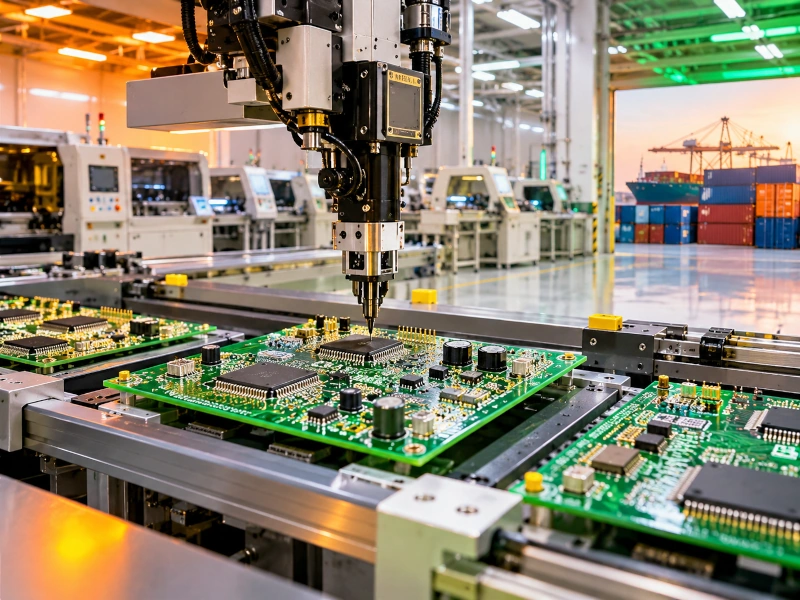
India’s exports of mounted printed circuit board (PCB) parts and accessories have registered exceptional growth, increasing from US$63.3 million to US$2.10 billion during April–September 2026–27, representing a year-on-year expansion of approximately 3,219%. Exports of populated printed circuit boards also increased substantially, rising from US$213.7 million to US$864.1 million during the corresponding period, reflecting the growing importance of electronic components and specialised equipment within India’s export economy.
The figures, released by the Ministry of Commerce and Industry in November 2026, highlight a significant change in the composition of India’s electronics exports. While smartphones have traditionally dominated the country’s electronics export performance, the latest trade data indicate that electronic components, circuit board assemblies, networking equipment, memory integrated circuits and storage devices are increasingly contributing to overall growth.
India’s total electronic goods exports reached US$31.97 billion during April–September 2026–27, compared with US$22.20 billion during the corresponding period of the previous financial year, registering growth of approximately 44%. This expansion reflects the increasing international commercial presence of India’s electronics sector and its participation in global manufacturing and technology supply chains.
Mounted PCB Parts and Accessories Exports Register Exceptional Growth
The most striking increase was recorded in the export category covering parts and accessories comprising mounted printed circuit boards, classified under Harmonised System code 84733030. Exports in this category increased from US$63.3 million during April–September 2025–26 to US$2.10 billion during April–September 2026–27, representing an increase of approximately US$2.04 billion within six months. The growth rate of 3,219% made this one of the most prominent developments highlighted in the government’s electronics export assessment.
Singapore emerged as the largest destination for these products, accounting for US$1.87 billion of India’s exports in the category. China followed with shipments valued at US$111.5 million. Singapore’s position is particularly relevant because the country is an established international centre for semiconductor-related activities, electronics manufacturing, component distribution and technology supply chains. Its importance as a destination demonstrates the role of regional manufacturing and trading networks in India’s expanding electronics exports.
Mounted PCB assemblies are important intermediate products in the electronics industry because they bring together circuit boards and electronic components required for the operation of computing, communication and industrial systems. Depending on their configuration, these assemblies may incorporate processors, memory components, connectors, capacitors, resistors and other electronic devices. Their production can involve specialised manufacturing processes such as automated component placement, soldering, inspection and electrical testing, making them an important part of the electronics value chain.
The sharp increase in exports demonstrates substantial growth in India’s recorded trade in this product category. However, customs export statistics do not independently establish how much of the value originated from domestic fabrication, imported components or other supply-chain activities. Understanding the full industrial significance of this expansion requires examining domestic manufacturing output, sourcing patterns and the proportion of value added within India.
Populated Printed Circuit Board Exports Increase by 304%
Another important development was the expansion of exports of populated, loaded or stuffed printed circuit boards, classified under HS code 85177910. India’s exports in this category increased from US$213.7 million during April–September 2025–26 to US$864.1 million during the corresponding period of 2026–27. The increase of approximately US$650.4 million represented year-on-year growth of 304%, indicating a substantial expansion in international shipments of assembled electronic circuit boards.
China emerged as the largest destination for populated PCB exports, accounting for US$789.2 million during the six-month period. Exports to Hong Kong also increased, rising from US$5.9 million to US$25.3 million. These trade flows highlight the importance of established Asian electronics markets, where circuit boards and other intermediate products move between specialised manufacturing, assembly and distribution centres.
A populated PCB differs from a bare printed circuit board because electronic components have already been mounted onto its surface or inserted into designated positions. The process involves combining conductive circuit pathways with electronic devices to create an assembly capable of performing specific electrical functions. Depending on its intended application, the board may undergo automated optical inspection, electrical testing and additional quality-control procedures before being integrated into a finished electronic product.
Populated circuit boards are used extensively in telecommunications equipment, computers, networking devices, industrial control systems and consumer electronics. Their manufacturing requires coordination between circuit board suppliers, component manufacturers, assembly facilities and testing organisations. The increase in exports therefore highlights growing commercial activity in a product category closely associated with electronic assembly and equipment manufacturing.
Why Printed Circuit Boards Are Essential to Modern Electronics
Printed circuit boards form the physical and electrical foundation of almost every modern electronic device. They provide the platform on which components are mounted and the conductive pathways through which electrical signals and power move between different parts of a system. Without these boards, the compact, reliable and scalable production of modern electronic equipment would be considerably more difficult.
The complexity of printed circuit boards varies according to their intended applications. Basic electronic products may use relatively simple boards containing a limited number of components, while advanced computing, telecommunications, aerospace and defence systems may require multilayer boards with dense circuitry, high-speed signal connections and sophisticated thermal-management arrangements. These advanced designs demand greater manufacturing precision, specialised materials and rigorous testing procedures.
PCB production also involves several distinct industrial capabilities. Bare-board fabrication requires processes such as laminate preparation, circuit patterning, drilling, plating and surface finishing. PCB assembly involves the placement and attachment of electronic components, followed by inspection and testing. More sophisticated products may require specialised packaging, reliability testing and compliance with demanding industry standards.
Developing capabilities across these stages is important for India because electronics manufacturing depends on an extensive network of suppliers rather than a single assembly operation. Domestic availability of high-quality circuit boards, electronic components and testing services can help manufacturers improve supply-chain reliability, shorten production cycles and increase the proportion of value generated within the country. The growth in PCB-related exports provides an important commercial indicator, while the expansion of indigenous production capabilities remains a separate and equally significant measure of industrial progress.
Non-Smartphone Electronics Become a Major Driver of Export Growth
The growth in PCB-related exports forms part of a wider expansion in India’s non-smartphone electronics trade. According to the Ministry of Commerce and Industry, exports of electronic products other than smartphones increased from US$8.81 billion during April–September 2025–26 to US$13.79 billion during April–September 2026–27. This represented year-on-year growth of approximately 56.5%, substantially exceeding the growth rate recorded in smartphone exports.
As a result, the share of non-smartphone products in India’s total electronics exports increased from approximately 39.7% to 43.2%. This change is significant because it demonstrates that the country’s electronics export basket is becoming more diversified. Products such as circuit board assemblies, networking equipment, memory devices and storage systems are contributing a larger proportion of export earnings, reducing the relative concentration of growth in one major product category.
Smartphones nevertheless continued to account for the largest share of India’s electronics exports. Smartphone shipments increased from US$13.38 billion during April–September 2025–26 to US$18.17 billion during April–September 2026–27, registering growth of approximately 35.8%. Despite this substantial increase, the smartphone share of overall electronics exports declined from 60.3% to 56.8% because other electronic product categories expanded more rapidly.
The simultaneous growth of smartphone and non-smartphone exports represents a broader development in India’s electronics trade. A competitive electronics industry benefits from having multiple product categories, manufacturing specialisations and export markets. The increasing contribution of intermediate products and specialised electronic equipment offers opportunities for Indian manufacturers to participate in different stages of the international electronics value chain.
Networking Equipment Exports Nearly Double
India also recorded substantial growth in exports of network transmission and routing equipment, another important category within the electronics sector. Exports classified under HS code 85176290 increased from US$732.9 million during April–September 2025–26 to US$1.45 billion during the corresponding period of 2026–27, representing growth of approximately 98%. This expansion highlights the increasing contribution of communication and data-networking products to India’s electronics export performance.
Hong Kong emerged as the largest destination for these exports, with shipments increasing from US$264.7 million to US$857.7 million. The United States and the Netherlands were also important markets, accounting for US$130.9 million and US$124.4 million, respectively. The geographical distribution of these shipments demonstrates India’s commercial links with both Asian electronics trading centres and major Western technology markets.
Network transmission and routing equipment performs essential functions in modern digital infrastructure by enabling information to move between computers, communication networks, industrial devices and data-processing systems. Such equipment is used in telecommunications networks, enterprise computing facilities, data centres and increasingly connected industrial environments. Its production depends on electronic components, circuit boards, networking processors, communication interfaces and sophisticated system integration.
The expansion of exports in this category is relevant to India’s broader ambitions in telecommunications equipment and digital infrastructure manufacturing. Greater participation in networking hardware markets can support the development of domestic capabilities in electronic design, component integration, quality assurance and industrial production. It can also create opportunities for closer collaboration between electronics manufacturers, technology developers and specialised component suppliers.
Memory Integrated Circuit Exports Record Sharp Expansion
The Ministry of Commerce and Industry also reported a substantial increase in exports of memory integrated circuits, classified under HS code 85423200. Shipments increased from US$23.1 million during April–September 2025–26 to US$562.4 million during April–September 2026–27, representing growth of approximately 2,333%. Although the category began from a comparatively small export base, the increase demonstrates a significant expansion in India’s recorded trade involving semiconductor-related products.
Malaysia emerged as the largest destination, accounting for exports valued at US$390.8 million. Singapore followed with US$102.4 million, while Hong Kong accounted for US$25.2 million. These markets are important participants in international semiconductor manufacturing, electronics assembly and component distribution networks, where integrated circuits frequently move between specialised production, testing and manufacturing facilities.
Memory integrated circuits are essential components used to store digital information in computers, communication devices, industrial systems and numerous other electronic products. Different memory technologies support different requirements, ranging from temporary high-speed data storage to the long-term retention of information. Their development and production involve specialised semiconductor technologies, while their incorporation into finished electronic equipment requires complementary capabilities in circuit design, assembly and testing.
The increase in memory integrated circuit exports is commercially significant, but it is important to distinguish semiconductor trade from domestic semiconductor fabrication. Export statistics identify the value and classification of products shipped from India, but they do not establish whether the underlying chips were fabricated in Indian semiconductor facilities. The expansion nevertheless highlights the importance of semiconductor-related trade within India’s increasingly diversified electronics export basket.
Solid-State Storage Device Exports Expand Rapidly
Another fast-growing category was solid-state non-volatile storage devices, classified under HS code 85235100. India’s exports increased from US$14.6 million during April–September 2025–26 to US$260.5 million during the corresponding period of 2026–27, representing growth of approximately 1,680%. This substantial increase demonstrates growing export activity in products associated with digital data storage and computing infrastructure.
China emerged as the largest destination for these products, accounting for US$108.6 million in exports. Singapore followed with US$76.8 million, while Hong Kong and the United States accounted for US$22.3 million and US$20.7 million, respectively. The spread of destinations across Asia and North America reflects the international character of markets for electronic storage equipment and related components.
Solid-state storage devices retain digital information electronically and are widely used in personal computers, servers, industrial equipment, communication systems and specialised electronic applications. Unlike conventional mechanical storage systems, solid-state devices do not depend on moving mechanical components for data storage. Their performance, reliability and compact design make them important components in modern computing infrastructure.
The expansion in storage-device exports complements the growth recorded in circuit boards, memory integrated circuits and networking equipment. Together, these categories demonstrate increasing trade activity across several interconnected segments of the electronics industry, from intermediate components to equipment used in computing and communication systems.
India’s Growing Integration with Asian Electronics Supply Chains
One of the most notable features of the latest export figures is the importance of Singapore, China, Hong Kong and Malaysia as destinations for different electronics categories. Singapore accounted for the overwhelming majority of mounted PCB parts and accessories exports, while China was the principal destination for populated printed circuit boards. Malaysia emerged as the leading market for memory integrated circuits, and Hong Kong accounted for a substantial proportion of networking equipment exports.
These trade patterns reflect the interconnected structure of the international electronics industry. Modern electronic products often involve components sourced from several countries, with semiconductor fabrication, packaging, circuit board assembly, final equipment manufacturing and distribution taking place at different locations. Countries participating in these networks may specialise in particular manufacturing processes, technologies or logistics functions.
India’s expanding exports to established electronics centres indicate growing commercial participation in these regional supply chains. Such relationships can provide access to international customers, support specialised manufacturing activities and create opportunities for domestic companies to develop capabilities that meet global industrial requirements. However, export destinations do not necessarily identify the final markets where products are consumed or the locations where subsequent manufacturing operations occur.
For India, the longer-term industrial opportunity lies in combining international market access with the development of domestic manufacturing capabilities. Participation in global supply chains can be particularly valuable when it encourages investment in production technology, workforce skills, research and development, component manufacturing and quality-control systems within the country.
Significance for India’s Indigenous Electronics Manufacturing Ecosystem
The expansion of PCB-related exports is particularly relevant to India’s efforts to strengthen its indigenous electronics manufacturing ecosystem. A modern electronics industry requires a wide network of specialised suppliers capable of producing circuit boards, electronic components, connectors, sensors, semiconductor devices, testing equipment and advanced materials. These capabilities support the manufacture of finished products while also creating opportunities for companies that specialise in intermediate components and industrial technologies.
India has introduced several policy initiatives aimed at expanding electronics manufacturing and attracting investment into the sector. These include production-linked incentive programmes, semiconductor development initiatives and support for domestic electronic component manufacturing. The broader objective is to strengthen India’s participation across the electronics value chain rather than relying primarily on the assembly of finished consumer products.
Printed circuit board fabrication and assembly are important elements of this industrial development because they connect component production with the manufacture of complex electronic systems. Stronger domestic capabilities in these areas can benefit industries such as telecommunications, automotive electronics, medical devices, renewable energy, industrial automation, aerospace and defence. Each of these sectors depends on reliable electronic assemblies manufactured to specific performance and quality requirements.
The latest export growth provides evidence of increasing international trade in several component-related categories. Continued development of domestic fabrication facilities, advanced assembly technologies, testing infrastructure and component supply chains would help India capture a larger proportion of the value associated with this expanding market. Greater integration between Indian manufacturers, research institutions and specialised technology companies could further support industrial diversification and technological development.
Electronics Components Gain Importance in India’s Industrial Development
The rapid increase in electronics exports demonstrates the growing importance of intermediate products and specialised equipment in India’s industrial economy. While finished products such as smartphones remain major contributors to export earnings, components and assemblies occupy an equally important position in the broader manufacturing ecosystem because they support production activities across numerous industries.
Circuit boards and electronic assemblies are particularly relevant to the development of indigenous technologies. Defence communication systems, radar equipment, unmanned aerial vehicles, industrial control platforms, medical diagnostic equipment and advanced computing systems all depend on specialised electronic components. Expanding domestic expertise in the design, fabrication and assembly of such components can therefore support technological capabilities beyond the consumer electronics market.
A stronger electronics components industry can also create opportunities for smaller and medium-sized manufacturers. Many stages of electronics production, including PCB assembly, precision fabrication, testing, connectors, specialised enclosures and component integration, involve industrial activities in which specialised companies can participate. The development of these capabilities can strengthen the relationships between large electronics manufacturers and smaller domestic suppliers.
The increase in PCB-related exports is consequently important not only because of the immediate growth in trade value, but also because of the industrial opportunities associated with electronic components and assemblies. Translating these opportunities into sustained manufacturing development will depend on investment, technological capability, quality standards, infrastructure and the ability of domestic manufacturers to compete in international markets.
Towards a More Diversified and Technologically Capable Electronics Economy
India’s electronics export performance during April–September 2026–27 illustrates an important shift towards a broader and more diversified range of electronic products. Total electronic goods exports reached US$31.97 billion, with non-smartphone electronics contributing US$13.79 billion. Within this expanding export basket, mounted PCB parts and accessories reached US$2.10 billion, while populated printed circuit board exports increased to US$864.1 million.
The strong performance of networking equipment, memory integrated circuits and solid-state storage devices further demonstrates the growing contribution of specialised electronics categories. Although the figures primarily measure international trade rather than domestic value addition, they establish that India’s electronics export expansion is increasingly supported by products beyond finished smartphones.
For India’s industrial development, the next important objective is to strengthen the manufacturing capabilities that underpin these exports. Greater domestic participation in PCB fabrication, component assembly, semiconductor-related activities, electronic testing and advanced product design can help establish a more integrated electronics ecosystem while supporting the requirements of other technology-intensive industries.
The exceptional growth in PCB-related exports provides a positive indication of India’s expanding presence in international electronics trade. By combining growing export opportunities with investment in indigenous component manufacturing, research, specialised skills and industrial infrastructure, India can progressively strengthen its position in global electronics supply chains and build a more technologically capable, diversified and self-reliant manufacturing economy.
You may also like
-
CSIR Transfers Five Indigenous Technologies to Industry for Sustainable Infrastructure and Industrial Development
-
Sigma Advanced Systems and Spain’s Escribano Launch Joint Venture for Advanced Defence Manufacturing in India
-
Guntur Sannam Chilli — Andhra Pradesh’s Fiery Red Spice and the Agricultural Heritage of Guntur
-
Collins Aerospace Begins Construction of India’s First Foreign-OEM-Authorised Propeller MRO Facility in Bengaluru
-
NALCO Partners with Russia’s RUSAL to Explore Scandium Recovery from Aluminium Industry Waste
