GI Produce of India | Andhra Pradesh | Spices and Agricultural Heritage
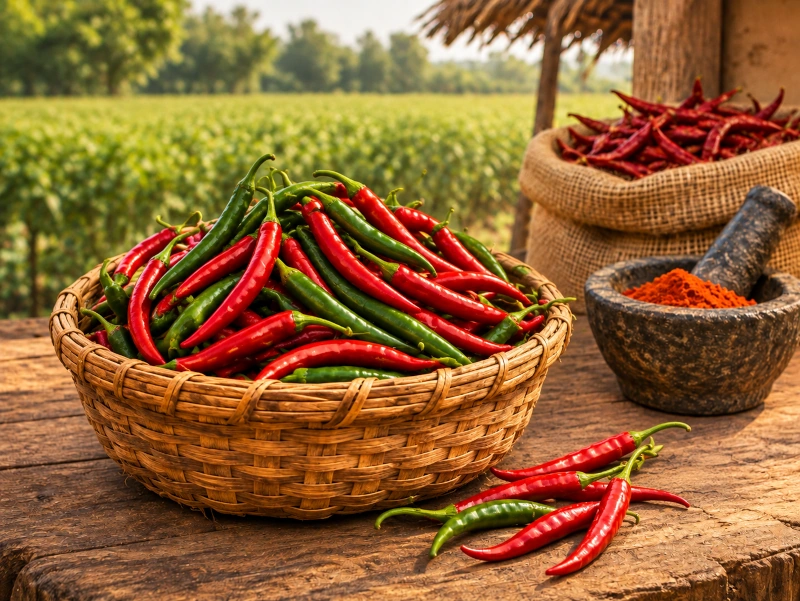
Guntur Sannam Chilli, one of India’s most recognised red chilli varieties, represents the agricultural expertise, regional identity, and spice-trading traditions of Andhra Pradesh. Cultivated principally in the Guntur region, this distinctive chilli is valued for its intense pungency, characteristic red colour, elongated shape, and suitability for culinary and industrial applications.
Known commercially as S4 chilli, Guntur Sannam has earned an established reputation in India’s domestic spice markets and international trade. Its distinctive characteristics have developed through generations of cultivation, local agricultural knowledge, and adaptation to the growing conditions of the region.
The name itself reflects its geographical identity. In Telugu, Sannam means thin or slender, referring to the elongated appearance of the chilli, while Guntur identifies the agricultural region with which it is closely associated.
Recognising its distinctive characteristics and geographical reputation, the Government of India granted Guntur Sannam Chilli Geographical Indication protection, with its registration certificate issued on 28 May 2010.
Historical Origins and the Rise of Guntur’s Chilli Heritage
Chillies originated in the Americas and entered India following the expansion of maritime trade during the early modern period. Over subsequent centuries, chilli cultivation spread across the Indian subcontinent, where different regions developed varieties adapted to their climates, soils, agricultural practices, and culinary preferences.
Andhra Pradesh gradually emerged as one of India’s important chilli-producing regions. The warm climate, suitable agricultural soils, availability of irrigation, and growing commercial demand encouraged farmers to expand chilli cultivation.
Guntur became particularly prominent because of its agricultural production and extensive spice-trading networks. Farmers developed considerable expertise in cultivating, harvesting, drying, grading, and marketing chillies, while traders established commercial connections with buyers across India and overseas.
Among the different chillies cultivated and traded through the region, Guntur Sannam acquired a distinct commercial identity because of its pungency, physical characteristics, and established market demand.
Unlike some agricultural products associated with ancient indigenous cultivation, Guntur Sannam’s heritage reflects the successful adaptation of an introduced crop into India’s regional farming and food traditions.
Geographical Origin and the Agricultural Landscape of Guntur
Guntur Sannam Chilli is principally associated with the Guntur district of Andhra Pradesh, where chilli cultivation forms an important part of the agricultural economy.
The wider historical production belt also includes neighbouring areas such as Prakasam, Warangal, and Khammam. The latter two districts are now located in Telangana following the state’s formation in 2014. The official GI Registry nevertheless records Andhra Pradesh as the geographical area of the registered indication.
The Guntur region experiences a predominantly tropical climate, with hot summers, seasonal monsoon rainfall, and relatively dry conditions during important stages of chilli harvesting and processing.
Well-drained agricultural soils, including red and black soils found across parts of the wider chilli-growing belt, support chilli cultivation when appropriate moisture and nutrient conditions are maintained.
The region’s agricultural landscape has been shaped by a combination of natural conditions, irrigation development, accumulated farming experience, and access to established trading markets.
These factors have helped Guntur become an important centre for chilli production, processing, storage, and distribution.
What Makes Guntur Sannam Chilli Unique?
Guntur Sannam Chilli belongs to the species Capsicum annuum, traditionally identified in its GI specifications as Capsicum annuum var. longum.
Its most recognisable characteristic is its elongated, slender fruit. According to the documented GI specifications, the chillies generally measure approximately 5–15 centimetres in length and 0.5–1.5 centimetres in diameter.
The dried chilli possesses a relatively thick skin, characteristic red colouring, and pronounced pungency. Its distinctive shape and commercial quality distinguish it from other Indian chilli varieties cultivated primarily for colour, flavour, or specialised culinary uses.
One of its most important characteristics is its heat intensity. The documented average pungency ranges from approximately 35,000 to 40,000 Scoville Heat Units (SHU), placing it among the considerably pungent commercial chilli types.
The chilli’s pungency is associated with capsaicin, the naturally occurring compound responsible for the burning sensation produced by chillies.
The GI specifications record a capsaicin content of approximately 0.226%, while the reported ASTA colour value is around 32.11. The ASTA measurement is used in the spice industry to assess the extractable colour characteristics of chilli products.
These figures represent documented characteristics of the registered product rather than fixed values for every harvested batch. Actual measurements can vary with cultivation conditions, maturity, processing, and storage.
The combination of pungency, physical appearance, and established trading reputation gives Guntur Sannam its distinctive commercial identity.
Traditional Cultivation and Agricultural Practices
Cultivating Guntur Sannam Chilli requires careful management of soil preparation, seedlings, irrigation, plant nutrition, and crop protection.
Farmers generally begin by preparing suitable agricultural land and raising healthy seedlings before transplanting them into the main field. Proper spacing between plants supports their development and facilitates field operations.
Chilli plants require adequate sunlight, well-drained soil, and a balanced supply of moisture. Excessive waterlogging can damage root systems, while prolonged moisture stress may affect flowering, fruit development, and yield.
Farmers traditionally rely on their understanding of seasonal weather, soil conditions, and crop behaviour to manage cultivation. Modern practices increasingly incorporate improved irrigation systems, soil testing, balanced fertilisation, and integrated pest management.
Pests and diseases remain important concerns in chilli cultivation. Thrips, mites, fruit borers, and various fungal and viral diseases can affect crop performance, making timely monitoring and appropriate agricultural management essential.
Agricultural research institutions and horticultural extension agencies play an important role in helping farmers improve productivity while maintaining the desirable characteristics of commercially valuable chilli varieties.
Harvesting, Sun-Drying, and Traditional Processing
Harvesting is an important stage in determining the commercial quality of Guntur Sannam Chilli.
The crop is generally harvested when the fruits have reached the desired maturity and developed their characteristic red colour. Depending on growing conditions and crop management, harvesting may take place in several rounds as individual fruits mature.
The documented principal harvesting period extends from December to May, although actual harvesting schedules vary according to sowing dates, weather conditions, and local agricultural practices.
After harvesting, the chillies are dried to reduce their moisture content and prepare them for storage, transportation, and commercial processing.
Traditional sun-drying has long been associated with chilli production in Andhra Pradesh. Farmers spread harvested chillies in suitable drying areas, allowing sunlight and circulating air to remove moisture gradually.
Careful drying is essential because excessive moisture can encourage fungal growth and deterioration, while unsuitable handling can affect the colour, appearance, and market value of the produce.
Modern processing practices increasingly emphasise hygienic drying surfaces, moisture control, sorting, improved storage, and prevention of contamination.
Once dried, the chillies are graded, packed, and transported to traders, processors, and spice markets.
Commercial Grades of Guntur Sannam Chilli
The traditional trading system recognises different commercial grades of Guntur Sannam Chilli according to physical appearance, colour, and size.
The documented grading categories include Sannam Special, Sannam General, Sannam Fair, and Non-Specified grades.
Sannam Special (SS) generally refers to bright, light-red chillies with a shining appearance and lengths of approximately five centimetres or more.
Sannam General (SG) includes light-red chillies with relatively shining skin, generally measuring three to five centimetres in length.
Sannam Fair (SF) describes chillies with a duller, sometimes dark-red appearance, generally measuring three to five centimetres.
Non-Specified (NS) is a category intended to accommodate particular buyer requirements that do not fall within the regular grading classifications.
These grades help traders and buyers distinguish between different commercial qualities and facilitate pricing according to market requirements.
The grading system also reflects the long-established relationship between agricultural production and commercial spice trading in the Guntur region.
Culinary Importance in Andhra Pradesh and Indian Cuisine
Chillies occupy an important place in Andhra Pradesh’s culinary traditions, where their pungency contributes to the distinctive character of many regional dishes.
Guntur Sannam Chilli is particularly valued for producing the pronounced heat associated with traditional spicy preparations.
Dried red chillies are used in spice powders, pickles, chutneys, vegetable preparations, curries, and numerous regional recipes. Their pungency complements tamarind, garlic, mustard seeds, curry leaves, and other ingredients widely used in Telugu cooking.
Andhra Pradesh’s famous avakaya, a traditional mango pickle, demonstrates the cultural importance of chilli powder in regional food preservation and preparation.
Red chilli powders also form an essential component of numerous spice mixtures used in household cooking, restaurants, and commercial food manufacturing.
The importance of Guntur Sannam extends beyond Andhra Pradesh. Its established reputation for pungency makes it relevant to manufacturers and consumers seeking strongly flavoured chilli products across India.
Its culinary significance is therefore closely connected with both regional food traditions and the wider development of India’s commercial spice industry.
Capsaicin and the Industrial Importance of Guntur Sannam
Apart from its culinary applications, Guntur Sannam Chilli has commercial importance because of its capsaicin content.
Capsaicin is the principal pungent compound found in chillies and is used in the production of specialised extracts and industrial ingredients.
Commercial chilli processing can produce oleoresins containing pungent and colouring compounds. These extracts are used in food manufacturing to provide standardised flavour, pungency, and other desired characteristics.
Capsaicin also has applications in certain pharmaceutical and topical formulations, although such products require controlled concentrations, appropriate processing, and compliance with applicable standards.
The documented pungency of Guntur Sannam makes it commercially relevant to processors seeking chilli raw material for capsaicin extraction.
This industrial application contributes to demand beyond the conventional markets for whole dried chillies and chilli powder.
Geographical Indication Recognition and the GI Tag Journey
Guntur Sannam Chilli received formal recognition under India’s Geographical Indications system to protect its established regional identity and distinguish it from similar products originating elsewhere.
The application was submitted by the Spices Board, functioning under the Ministry of Commerce and Industry, Government of India.
The application was filed on 29 October 2008 under Class 30, covering the agricultural product Guntur Sannam Chilli.
The application was subsequently published in Geographical Indications Journal No. 31, made available on 30 December 2009.
Following the registration process, Certificate No. 122 was issued on 28 May 2010.
The registration provided legal recognition to the geographical name and the distinctive characteristics associated with the product.
The Spices Board continues to serve as the registered proprietor and custodian of the GI.
GI Registration Details at a Glance
| Particulars | Details |
|---|---|
| Geographical Indication | Guntur Sannam Chilli |
| State | Andhra Pradesh |
| Product Category | Agricultural Product / Spice |
| Botanical Species | Capsicum annuum |
| Commercial Identification | S4 Type Chilli |
| GI Application Number | 143 |
| Date of Filing | 29 October 2008 |
| Class | 30 |
| GI Journal Number | 31 |
| Journal Availability Date | 30 December 2009 |
| Certificate Number | 122 |
| GI Certificate Date | 28 May 2010 |
| Registered Proprietor | Spices Board, Ministry of Commerce and Industry, Government of India |
| Registered Geographical Area | Andhra Pradesh |
| Registration Valid Until | 28 October 2028 |
| Registration Status | Registered |
The registration details are based on the official records of the Geographical Indications Registry, Intellectual Property India.
Protecting Authenticity and Supporting Chilli Farmers
The GI designation establishes a recognised connection between Guntur Sannam Chilli and its geographical origin.
However, GI protection involves more than the registration of a geographical name. It also requires preserving product specifications, ensuring traceability, and distinguishing authentic produce from products that do not satisfy the registered requirements.
The Spices Board has issued guidelines for obtaining authorised-user registration for GI-protected spices, including Guntur Sannam Chilli.
Under this framework, eligible producers, producer groups, buyers, and exporters may seek authorised-user status by fulfilling the prescribed requirements.
The system includes verification of production details, geographical origin, product specifications, and relevant records.
For export consignments marketed under the GI designation, the Spices Board’s guidelines provide for sampling and testing to assess compliance with prescribed standards.
These measures are intended to protect the integrity of the geographical indication and strengthen confidence among domestic and international buyers.
Effective implementation can help farmers and producer organisations benefit more directly from the reputation associated with their regional agricultural products.
Economic Importance and the Guntur Chilli Market
Guntur’s economic relationship with chilli extends beyond cultivation.
The region supports an extensive network of farmers, agricultural labourers, commission agents, traders, warehouse operators, processors, transporters, and exporters.
The Guntur chilli market is an important centre for the aggregation and commercial distribution of dried chillies. Produce arriving from farming areas is sorted, graded, traded, stored, and transported to domestic processing centres and export destinations.
Chilli cultivation provides an important source of agricultural income, while the associated trading and processing activities generate employment across several connected sectors.
The crop also contributes to India’s wider spice economy through the production of whole dried chillies, chilli powder, and processed spice ingredients.
Nevertheless, chilli prices are influenced by production levels, weather conditions, crop quality, domestic consumption, export demand, and storage availability.
Price fluctuations can affect farmers’ earnings, particularly when production costs rise or market arrivals increase sharply.
Strengthening farmer-producer organisations, improving market information, and expanding access to scientific storage and processing facilities can help growers manage these commercial challenges more effectively.
The GI identity provides an additional opportunity to differentiate authentic Guntur Sannam Chilli from other chilli products within competitive markets.
Research, Agricultural Development, and Quality Improvement
Agricultural research has an important role in maintaining the productivity and commercial value of chilli cultivation.
Institutions working in horticulture, agricultural sciences, and spice research contribute to the development of improved cultivation practices, pest-management methods, and post-harvest technologies.
Research into soil health, irrigation efficiency, crop nutrition, and disease management can help farmers improve yields while managing production costs.
Post-harvest research is equally important because dried chillies must meet increasingly demanding standards concerning moisture, cleanliness, pesticide residues, and other quality parameters.
Improved drying methods, hygienic handling, scientific storage, and reliable testing facilities can strengthen the competitiveness of Indian chilli products.
A study published in the Indian Journal of Agricultural Sciences in 2025 examined agricultural and price trends associated with GI-tagged Guntur Sannam Chilli using historical data from 1993–94 to 2022–23.
The study identified growth in cultivation area and production over the period examined, while highlighting the continuing importance of productivity improvement and price-risk management.
Such research demonstrates the need to combine geographical heritage with scientific agricultural development.
Preserving Traditional Knowledge and Regional Agricultural Identity
The value of Guntur Sannam Chilli is closely connected with the knowledge accumulated by farming communities.
Farmers understand the importance of selecting suitable planting material, managing seasonal irrigation, identifying the appropriate harvest stage, and protecting produce during drying and storage.
These practices influence the physical appearance, pungency, and commercial quality of the harvested chillies.
Preserving this agricultural knowledge is particularly important as production systems become increasingly mechanised and market requirements evolve.
The GI framework offers an opportunity to document traditional production characteristics while encouraging quality assurance and more organised commercial practices.
Farmer-producer organisations and agricultural extension programmes can help transfer this knowledge to younger generations of cultivators.
Maintaining the distinct identity of Guntur Sannam also requires careful differentiation between the registered GI product and the numerous other chilli varieties cultivated or traded in the wider Guntur region.
Not every chilli produced in Guntur automatically qualifies as Guntur Sannam Chilli. Authentic GI identification depends on the prescribed geographical and product specifications.
Future Prospects for Guntur Sannam Chilli
The future of Guntur Sannam Chilli lies in combining its established agricultural reputation with improvements in cultivation, processing, quality assurance, and market development.
The expansion of food processing, spice extraction, and specialised ingredient manufacturing offers opportunities to increase value addition within India’s chilli industry.
Greater adoption of scientific drying, grading, and storage systems can help preserve product quality and reduce post-harvest losses.
Traceability systems, authorised GI-user registration, and improved packaging can strengthen the distinct market identity of authentic Guntur Sannam Chilli.
Farmers may also benefit from stronger producer organisations, access to agricultural research, and improved connections with processors and exporters.
Promoting the geographical identity of Guntur Sannam alongside its measurable quality characteristics can support the long-term development of a more differentiated and competitive spice market.
These efforts would reinforce the relationship between regional agricultural heritage and modern commercial opportunities.
Guntur Sannam Chilli — A Fiery Expression of Andhra Pradesh’s Agricultural Heritage
Guntur Sannam Chilli represents the transformation of a cultivated spice into a product of regional identity and national commercial importance.
Its slender red fruits, pronounced pungency, and established reputation reflect the combined influence of agricultural conditions, cultivation expertise, traditional processing methods, and generations of spice trading.
The geographical indication recognises this connection between a distinctive agricultural product and the region that established its reputation.
For Andhra Pradesh, Guntur Sannam is more than a commercially valuable chilli. It is part of the state’s agricultural heritage, culinary traditions, and contribution to India’s wider spice economy.
By preserving its authenticity, supporting farming communities, and strengthening quality-oriented production, Guntur Sannam Chilli can continue to represent the distinctive agricultural identity of Guntur in Indian and international markets.
References
- Geographical Indications Registry, Intellectual Property India: Guntur Sannam Chilli, Application No. 143, Certificate No. 122, registered 28 May 2010.
- Spices Board, Ministry of Commerce and Industry, Government of India: Guidelines for Obtaining GI Authorised User Certificate, Circular No. MKTG/GI/01/2021-22, dated 6 May 2021.
- Agricultural and Processed Food Products Export Development Authority (APEDA): Geographical Indications of India — Guntur Sannam Chilli, Andhra Pradesh.
- Government of Andhra Pradesh, Guntur District Administration: One District One Product — Guntur Sannam Chilli, product characteristics and agricultural information.
- Government of India, National Portal of India: One District One Product — Guntur Sannam Chilli, Guntur, Andhra Pradesh.
- Indian Journal of Agricultural Sciences, ICAR: Assessing the Dynamics of Agricultural and Price Trends of Geographical Indication (GI) Tagged Guntur Sannam Chilli in Andhra Pradesh, India, 2025.
You may also like
-
NALCO Partners with Russia’s RUSAL to Explore Scandium Recovery from Aluminium Industry Waste
-
ICAR Develops India’s First Indigenous H5N1 Chicken Vaccine to Strengthen Poultry Disease Control
-
DIVERSIFARM-India Maps 652 Community Seed Banks, Releases Manual to Strengthen Indigenous Seed Conservation
-
India’s Exports Surge 58% to ASEAN and 22% to South Asia as Trade Expands Across Global Markets
-
Tata Steel Plans India’s First Hydrogen Production Facility Using Steel Plant Off-Gases in Odisha
