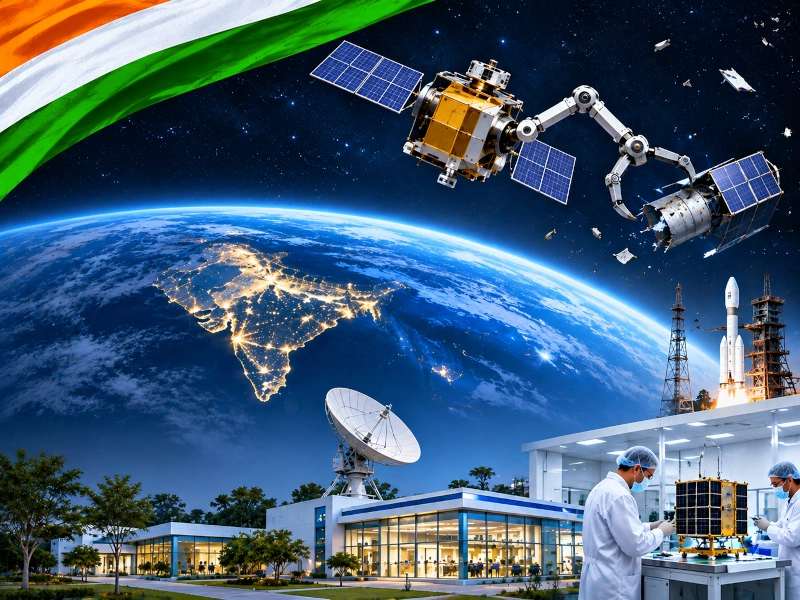
India has taken a significant step towards developing indigenous capabilities in active space debris removal and satellite servicing, with Union Minister of State for Science and Technology and Space Dr. Jitendra Singh inaugurating Cosmoserve Space’s advanced Base 1 facility in Hyderabad. Outlining a vision of debris-free space by 2030, the Minister described the development as an important milestone in India’s emergence as a global contributor to sustainable space operations and advanced orbital technologies.
Speaking virtually from Kartavya Bhawan in New Delhi, Dr. Jitendra Singh highlighted India’s growing capabilities in addressing the challenges posed by orbital debris, which increasingly threatens operational satellites, spacecraft and future space missions. He emphasised that the country’s expanding private space ecosystem is developing sophisticated technologies that can contribute to international efforts to preserve the safety and long-term usability of Earth’s orbital environment.
The inauguration took place at VSD Tech Park in Gachibowli, Hyderabad, in the presence of Telangana Minister for Information Technology and Industries D. Sridhar Babu and Cosmoserve Space Founder and Chief Executive Officer Dr. Chiranjeevi Phanindra. The new facility represents an important addition to India’s space technology infrastructure, bringing together specialised engineering laboratories, spacecraft integration facilities and mission operations capabilities within a single development centre.
Cosmoserve’s Base 1 Establishes Advanced Space Robotics Infrastructure
Cosmoserve Space’s Base 1 is a 14,800-square-foot integrated facility designed to support the development, construction, testing and operation of advanced robotic systems for orbital debris removal and in-space satellite servicing. The centre provides specialised infrastructure for engineering systems capable of approaching, interacting with and eventually capturing objects moving through Earth’s orbital environment.
The facility houses orbital rendezvous and capture laboratories, space robotics innovation laboratories, microgravity simulation platforms and satellite integration clean rooms. These specialised environments enable engineers to develop robotic mechanisms, evaluate spacecraft interaction technologies and assess the performance of critical components under simulated space conditions before deploying them in orbit.
Orbital rendezvous and capture technology is particularly important for debris-removal missions because inactive satellites and other objects may be travelling at extremely high orbital velocities. A servicing spacecraft must precisely determine the target’s position, match its orbital movement and approach safely before attempting capture or other operations.
The space robotics laboratories will support the development of mechanisms capable of interacting with objects that were not originally designed for docking or servicing. Such technologies have applications beyond debris removal, including satellite inspection, maintenance, repair and the extension of operational spacecraft lifetimes.
By integrating these capabilities with satellite assembly and mission control infrastructure, Base 1 creates an environment in which complex orbital servicing systems can be developed and evaluated within India.
Mission EMBRACE Demonstrates India’s Emerging Orbital Robotics Capabilities
Congratulating Cosmoserve Space’s leadership and engineering team, Dr. Jitendra Singh acknowledged the company’s progress in developing active debris removal technologies, particularly its Mission EMBRACE programme. The mission conducted an in-space technology test involving soft robotic petals in July 2026, within approximately one year of the company’s formation.
Soft robotic capture systems are being developed as a potential method for interacting with satellites and orbital debris. Unlike conventional rigid docking mechanisms, compliant robotic structures can be designed to accommodate variations in an object’s shape and movement, potentially enabling more flexible capture operations.
Mission EMBRACE formed part of the company’s efforts to validate the technologies required for future orbital debris capture. The July flight provided an opportunity to evaluate elements of the system in space, although it did not constitute a completed debris-removal mission. The company is continuing to refine its capture technology through additional testing and planned demonstrations.
Dr. Jitendra Singh particularly appreciated the experience that members of the Cosmoserve Space team had gained through their association with the Indian Space Research Organisation and the Gaganyaan human spaceflight programme. He noted that this accumulated expertise was now contributing to a collaborative model of technological development within India’s private space sector.
The programme illustrates how engineering knowledge developed through national space missions can support the emergence of specialised private enterprises working in advanced fields such as orbital robotics, autonomous spacecraft operations and space sustainability.
Active Space Debris Removal Becomes an Important Global Priority
The rapid expansion of satellite constellations, commercial launch activity and space-based services has increased the importance of managing debris in Earth’s orbit. Defunct satellites, discarded rocket components and fragments generated by collisions or break-ups can remain in orbit for extended periods, creating hazards for operational spacecraft.
Even relatively small debris fragments can cause substantial damage because of the extremely high relative velocities encountered during orbital collisions. Growing congestion therefore presents challenges for satellite operators, launch service providers, national space agencies and organisations planning long-duration operations in space.
Active debris removal involves using specialised spacecraft to approach and capture selected objects or otherwise modify their trajectories so that they can be removed safely from operational orbital regions. These missions require a combination of autonomous navigation, precision control, robotic manipulation and reliable spacecraft propulsion.
The technologies being developed by Cosmoserve Space could contribute to this emerging field by creating indigenous systems for locating, approaching and capturing orbital objects. The company’s work also has potential applications in extending the operational lifetimes of satellites through inspection, refuelling and maintenance services.
India’s increasing involvement in these technologies is particularly relevant as the country expands its satellite infrastructure and prepares for more complex missions involving human spaceflight and future orbital facilities.
India Outlines Vision of Debris-Free Space by 2030
During the inauguration, Dr. Jitendra Singh outlined a vision of achieving debris-free space by 2030, presenting the development of active debris removal technologies as an important contribution to a safer and more sustainable orbital environment.
The announcement reflects India’s growing emphasis on responsible space operations and the development of capabilities that support the long-term sustainability of satellite services. The 2030 vision should be understood as a strategic objective rather than a declaration that all existing orbital debris can be eliminated within that period.
The Indian Space Research Organisation has already advanced the country’s approach to orbital sustainability through the Debris Free Space Missions initiative, which seeks debris-free outcomes for Indian space missions by 2030. This national effort focuses on improving responsible mission design, reducing the generation of new orbital debris and ensuring that spacecraft and launch vehicle stages are managed appropriately at the end of their operational lives.
Private-sector developments in active debris removal can complement these preventive measures by establishing capabilities for dealing with selected debris objects already present in orbit.
Together, responsible mission planning, improved end-of-life disposal practices and active debris removal technologies form important elements of a comprehensive approach to sustainable space operations.
Indian Space Startups Build an Integrated Technology Ecosystem
Dr. Jitendra Singh highlighted the growing collaboration between Indian space technology companies, observing that partnerships across spacecraft manufacturing, propulsion, launch services and specialised payload development are creating a more integrated domestic industry.
He referred to Cosmoserve Space’s collaborations with Pixel for satellite systems, Dhruv Aerospace Netherlands for propulsion systems and Skyroot Aerospace for launch services. These partnerships illustrate how specialised enterprises can combine their capabilities to develop complex space missions without requiring every component to be manufactured by a single organisation.
The development model brings together complementary expertise in satellite platforms, propulsion technologies, launch systems, robotics and mission operations. It also allows innovative startups to concentrate on specialised technological capabilities while drawing upon a wider industrial ecosystem for essential mission infrastructure.
Such collaborations are particularly important for emerging fields like in-orbit servicing, where mission success depends on the coordinated performance of multiple advanced systems. By developing integrated capabilities through domestic and international partnerships, Indian startups are positioning themselves to participate in specialised segments of the global space services market.
India’s Space Startup Ecosystem Expands to Nearly 450 Enterprises
The Minister credited the space-sector reforms introduced under Prime Minister Narendra Modi with creating an enabling environment for private participation, investment and technological innovation.
According to Dr. Jitendra Singh, India’s space startup ecosystem has expanded from a single-digit number of enterprises to nearly 450 companies following reforms that opened new opportunities for private industry. The establishment of NewSpace India Limited and the Indian National Space Promotion and Authorisation Centre, together with wider changes in the regulatory and institutional framework, has supported this transformation.
These developments have enabled private companies to participate more actively in satellite manufacturing, launch vehicle development, propulsion systems, space-based applications and advanced mission technologies. They have also encouraged entrepreneurs and researchers to pursue commercially oriented projects in specialised areas previously dominated by national space agencies.
The emergence of companies working on debris removal and orbital servicing demonstrates the increasing sophistication of this ecosystem. Rather than concentrating exclusively on satellite manufacturing and launch services, Indian startups are moving into advanced technologies associated with the operational management and sustainability of space infrastructure.
Dr. Jitendra Singh observed that India had never lacked scientific talent or technological capabilities. He emphasised that the creation of an enabling environment had allowed the country’s engineers, researchers and young entrepreneurs to translate their expertise into new enterprises and technological innovations.
India’s Space Economy Targets USD 40–45 Billion
Highlighting the economic opportunities emerging from the country’s expanding space industry, Dr. Jitendra Singh stated that India’s space economy has grown to nearly USD 9 billion and is projected to reach USD 40–45 billion over the coming decade.
The projected growth reflects the increasing commercial importance of satellite communications, Earth observation, navigation, launch services, spacecraft manufacturing and specialised technologies supporting orbital operations.
Advanced space servicing could become an important additional segment of this expanding industry. As satellite operators deploy increasingly sophisticated and expensive spacecraft, technologies capable of extending operational lifetimes, repairing damaged systems or managing end-of-life disposal may create opportunities for specialised service providers.
Cosmoserve Space’s development of debris removal and satellite servicing technologies places the company within this emerging market. Its investment in dedicated engineering and testing infrastructure also reflects the growing capacity of India’s private space industry to undertake complex development programmes involving advanced robotics and autonomous spacecraft operations.
The Minister encouraged domestic and international investors to increase their participation in India’s space sector, while also emphasising the importance of philanthropy in supporting scientific research and technological innovation. He identified sustained investment, collaboration and research funding as essential elements in accelerating the development of advanced indigenous capabilities.
Space Sustainability Reflects India’s Global Responsibilities
Dr. Jitendra Singh described Cosmoserve Space’s initiative as an expression of the spirit of Vishwa Bandhu Bharat, reflecting India’s commitment to contributing technological solutions that benefit the international community.
Space debris presents a shared challenge because orbital hazards are not confined by national boundaries. Satellites operated by different countries and organisations frequently use overlapping orbital regions, making cooperation and responsible operational practices essential for maintaining a safe space environment.
The development of debris-removal technologies therefore has significance beyond India’s immediate national requirements. Indigenous capabilities in this field could contribute to international collaboration, support commercial satellite operators and strengthen India’s participation in global efforts to improve orbital sustainability.
The Minister also linked India’s growing space capabilities with the broader objective of technological self-reliance. He emphasised that national programmes such as Chandrayaan and Gaganyaan demonstrate India’s ability to undertake complex missions while developing sophisticated technologies and engineering expertise.
Space technology, he observed, also delivers practical benefits on Earth through applications supporting infrastructure planning, smart cities, disaster preparedness and other public services. The continued development of India’s space industry consequently contributes both to strategic technological capabilities and to national economic and social development.
Hyderabad Strengthens Its Position as an Advanced Space Technology Centre
The establishment of Cosmoserve Space’s Base 1 facility further strengthens Hyderabad’s growing aerospace and space technology ecosystem. The city already hosts important scientific institutions, engineering organisations, manufacturing enterprises and technology companies, providing a foundation for the development of specialised space-sector capabilities.
The presence of advanced facilities for orbital robotics, satellite integration and mission simulation creates opportunities for collaboration among researchers, engineering teams, component manufacturers and emerging technology enterprises.
By locating sophisticated development and testing infrastructure within India, companies such as Cosmoserve Space can help expand domestic expertise in high-value engineering activities while supporting the gradual localisation of technologies required for complex space missions.
The Base 1 facility also illustrates the increasing role of private enterprises in building India’s advanced research and development infrastructure, complementing the capabilities established by national institutions such as ISRO.
A New Chapter in India’s Space Technology Development
The inauguration of Cosmoserve Space’s Base 1 facility on November 5, 2026, represents a significant development in India’s efforts to establish capabilities in active orbital debris removal and in-space satellite servicing. By bringing together robotics research, microgravity simulation, satellite integration and mission operations infrastructure, the facility creates a dedicated platform for advancing technologies that could become increasingly important to the global space industry.
Dr. Jitendra Singh’s announcement of a debris-free space vision for 2030 places the initiative within India’s broader commitment to responsible space exploration and technological self-reliance. His acknowledgement of the country’s expanding space startup ecosystem, now comprising nearly 450 enterprises, further highlights the transformation of India’s space sector into a diversified environment supporting specialised private innovation.
As India continues developing advanced satellite systems, launch capabilities and human spaceflight infrastructure, indigenous technologies for maintaining and protecting the orbital environment will become increasingly valuable. Cosmoserve Space’s initiative demonstrates how India’s emerging space enterprises are extending the country’s technological ambitions beyond reaching space to developing the capabilities required to operate there safely, efficiently and sustainably.
You may also like
-
Nagaland University Researchers Develop AI Framework to Preserve India’s Endangered Languages and Cultural Heritage
-
Team led by Indian Astronomers Redefine Star Cluster UBC 63 as a Double Cluster System Spotted After Close Flyby
-
IIT Bombay Develops Low-Cost Blood Screening Technology for Anaemia and Sickle Cell Disease
-
NITI Aayog Launches India S&T Scoreboard to Map Scientific and Technological Capabilities Across States
-
ISRO Successfully Places NVS-03 Navigation Satellite into Geosynchronous Orbit After Four Manoeuvres
