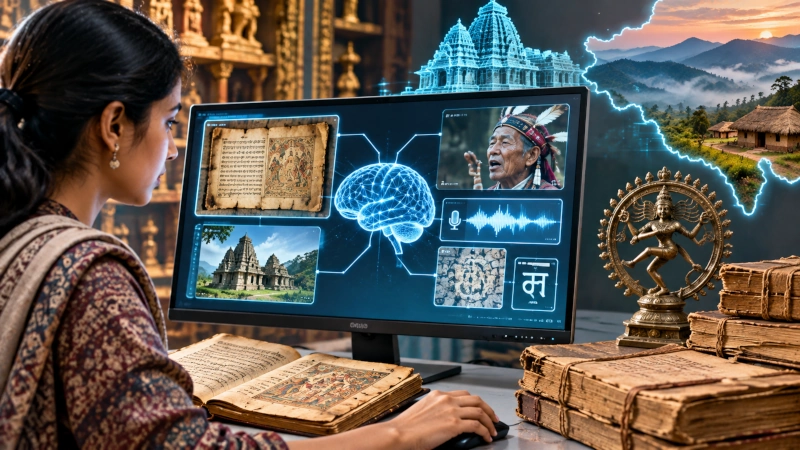
Kohima, November 3, 2026: A multidisciplinary research team led by Nagaland University has developed an artificial intelligence-based evaluation framework to support the preservation of India’s ancient manuscripts, endangered languages, oral traditions, historical records and cultural knowledge. The research explores how emerging digital technologies can help document, organise and safeguard India’s diverse cultural heritage while preserving the historical meanings, linguistic characteristics and traditional knowledge associated with these materials.
The study, titled Digital Humanities and Cultural Preservation in the Age of Artificial Intelligence, brings together researchers from institutions across Nagaland, Tamil Nadu, Delhi, Uttar Pradesh, Telangana and Karnataka. Published in the peer-reviewed journal Acta Innovations, the research establishes a structured approach for evaluating the suitability of artificial intelligence in cultural preservation. It identifies nine assessment areas and examines how technologies such as machine learning, natural language processing, computer vision and speech recognition can support historians, archivists, linguists and heritage institutions.
Artificial Intelligence Opens New Possibilities for Preserving Ancient Knowledge
India possesses an extensive cultural and intellectual heritage preserved through manuscripts, inscriptions, regional literature, traditional narratives, historical documents and oral transmission. These materials represent centuries of accumulated knowledge covering language, philosophy, history, science, medicine, astronomy, agriculture, architecture and social traditions.
A considerable portion of this knowledge survives in handwritten documents, fragile historical records and oral traditions maintained by communities across the country. Preserving these materials requires methods capable of documenting their contents while retaining the historical and cultural information necessary for their interpretation.
Artificial intelligence offers new capabilities for processing large and diverse collections of heritage material. Optical character recognition can help convert scanned manuscripts into machine-readable text, while natural language processing can support linguistic analysis, translation and the organisation of multilingual records.
Speech recognition technologies provide opportunities to transcribe oral narratives and document spoken languages, including those with limited written resources. Computer vision can assist researchers in examining historical photographs, identifying visual patterns and analysing damaged artworks or cultural objects.
The Nagaland University-led research examines these capabilities within the expanding field of digital humanities, which combines computational technologies with the study of history, literature, languages and cultural traditions.
The researchers emphasise that technological preservation should extend beyond the digital reproduction of historical materials. Their framework incorporates the interpretation of cultural meaning, ensuring that digitally preserved records remain connected to the traditions and communities from which they originate.
Researchers Introduce Nine-Parameter Framework for AI-Assisted Preservation
A central contribution of the research is the development of an evaluation framework covering nine aspects of artificial intelligence-assisted heritage preservation.
These include digitisation accuracy, text recognition, classification, translation, visual reconstruction, descriptive information, cultural context, accessibility and ethics. Together, the parameters provide a systematic foundation for examining how AI technologies can be applied to different categories of cultural resources.
Digitisation accuracy concerns the faithful conversion of physical documents, photographs and other historical materials into digital formats. Text recognition evaluates the ability of computational systems to identify written information, including material recorded in older scripts or preserved in damaged manuscripts.
Classification and descriptive information address the organisation of digital heritage collections, enabling institutions to catalogue records and make them more accessible to researchers. Translation examines the conversion of cultural and linguistic material between languages, while visual reconstruction considers digital methods for representing damaged or incomplete heritage objects.
The framework also incorporates accessibility, making it possible to examine how digital collections can be used by researchers, students and wider communities.
Cultural context and ethics form essential components of the proposed approach. These considerations address the importance of preserving historical meanings, recognising community knowledge and establishing appropriate practices for the ownership, documentation and use of cultural information.
Professor Ravi Ranjan Kumar of Nagaland University’s Department of Hindi explained that technical accuracy alone does not necessarily establish cultural accuracy. Artificial intelligence may successfully recognise written words or translate spoken information while missing historical references, traditional meanings or cultural associations.
The proposed framework therefore combines technical evaluation with assessments conducted by subject specialists and communities associated with the heritage being documented.
Five Major Areas Identified for Cultural Heritage Preservation
The researchers identified five broad categories in which artificial intelligence can contribute to cultural preservation: printed and handwritten documents; photographs and artworks; oral histories and endangered languages; archaeological and architectural heritage; and folklore and community knowledge.
For manuscripts and historical documents, artificial intelligence can support the creation of searchable digital archives. Text recognition and classification systems can assist institutions in organising collections, identifying related materials and facilitating research across historical sources.
In the preservation of photographs and artworks, computer vision offers methods for cataloguing images, identifying patterns and examining the condition of cultural objects. Digital imaging and analytical tools can also assist specialists in documenting deterioration and developing detailed records of valuable collections.
For oral histories and endangered languages, speech recognition and language-processing technologies offer opportunities to document spoken narratives, compile linguistic resources and improve access to recordings preserved by communities.
Archaeological and architectural heritage represents another important application area. Digital mapping, image processing and three-dimensional modelling can help researchers document historical sites, study their structural characteristics and create detailed records for educational and conservation purposes.
The preservation of folklore and community knowledge is especially relevant to India’s cultural diversity. Digital repositories can support the documentation of traditional narratives, ceremonies, customary knowledge and community histories, enabling these materials to remain accessible to future generations.
By examining these different categories within a common framework, the research provides heritage institutions with a structured method for identifying appropriate technological applications.
Endangered Languages and Oral Traditions Receive Special Attention
One of the significant applications identified by the research concerns the preservation of endangered languages and oral traditions.
India’s linguistic heritage includes numerous regional and community languages, many of which preserve distinctive histories, social practices and traditional knowledge systems. Some languages have limited written documentation, making oral recordings and community participation especially important to their preservation.
Artificial intelligence-based speech recognition can support the transcription of spoken narratives, while linguistic analysis tools can assist researchers in studying vocabulary, grammatical structures and relationships between languages.
Multilingual digital repositories can also create opportunities for accessing historical materials across linguistic boundaries. Researchers working with manuscripts or oral records may be able to identify related themes and cultural information that would otherwise remain difficult to discover.
These possibilities are particularly relevant to Northeast India, where communities preserve extensive traditions of oral literature, folklore, customary knowledge and indigenous languages.
The researchers highlight the importance of involving community representatives in documenting these traditions. Local speakers and cultural custodians possess knowledge of linguistic expressions, historical references and traditional meanings that computational systems alone may not fully capture.
By bringing together digital technologies and community expertise, the proposed framework supports an approach to language preservation that recognises both the linguistic content and cultural significance of traditional knowledge.
Distinguishing Digital Restoration from Reconstruction
The study also examines the distinction between restoring existing cultural material and digitally reconstructing information that is incomplete or missing.
Digital restoration involves the preservation or recovery of information already present in a historical source. Reconstruction may involve producing a representation of missing portions using available evidence and computational interpretation.
Artificial intelligence can assist researchers in identifying damaged sections of manuscripts, analysing visual patterns and developing possible reconstructions of incomplete cultural objects. Such applications can expand the methods available to specialists working with fragile historical collections.
The researchers recommend retaining original digital records alongside any modified or reconstructed versions. They also emphasise documenting the changes introduced through artificial intelligence and identifying material generated through computational interpretation.
This approach provides researchers and heritage institutions with a clear distinction between original historical evidence and digitally produced representations.
For India’s extensive manuscript collections and archaeological heritage, these principles offer a useful foundation for applying advanced imaging and computational technologies while maintaining reliable historical documentation.
Seven Researchers Collaborate Across Indian Institutions
The study was conducted by a seven-member research team representing academic institutions across six Indian states and regions.
Professor Ravi Ranjan Kumar of Nagaland University led the collaboration. The other researchers were Major Dr N. Kavitha of Vellalar College for Women, Tamil Nadu; Dr Nisha Sengar of PGDAV College (Evening), University of Delhi; Dr Sonia Gouri of ABES Engineering College, Ghaziabad; Dr J. Lalitha Sridevi of VNR Vignana Jyothi Institute of Engineering and Technology, Hyderabad; Kumar Sai Deepak B of Sapthagiri NPS University, Bengaluru; and Dr P. Deepavathi of Joy University, Tamil Nadu.
The collaboration brought together researchers from humanities, history, political science, engineering, management and computer science backgrounds.
This interdisciplinary approach reflects the nature of digital humanities, where technological applications benefit from the combined expertise of computing specialists, historians, linguists and cultural researchers.
Nagaland University Vice-Chancellor Professor Jagadish K. Patnaik welcomed the research, highlighting the potential of artificial intelligence to support the documentation and transmission of India’s cultural knowledge.
He emphasised the importance of respecting cultural contexts, community rights and ethical considerations while developing technological solutions for heritage preservation.
The research demonstrates how cooperation among Indian universities can contribute to new approaches in areas where technological innovation intersects with traditional knowledge and cultural scholarship.
Digital Archives Can Expand Access to India’s Knowledge Traditions
The framework offers important possibilities for universities, libraries, museums, archives and cultural research institutions seeking to preserve historical collections.
Digital documentation can make fragile manuscripts and archival records accessible to researchers without requiring repeated physical handling of original materials. Searchable databases can also simplify the identification of relevant documents across large collections.
Artificial intelligence-assisted classification can support the organisation of historical records by language, subject, period or cultural category. Such systems can help researchers discover connections between materials preserved in different institutions and geographical locations.
Multilingual access represents another important opportunity. Digital tools can support the translation and interpretation of historical material, expanding research possibilities for scholars who may not possess expertise in every language represented in a collection.
For educational institutions, digitally accessible heritage resources can contribute to teaching, historical research and the wider study of India’s intellectual traditions.
The researchers recommend evaluating the framework through practical applications involving different collections, scripts and dialects. Such studies would enable institutions to assess technical performance while incorporating the expertise of historians, linguists and community representatives.
The framework therefore provides a research foundation for developing cultural preservation projects that combine digital accessibility with informed historical interpretation.
Indian Research Connects Artificial Intelligence with Cultural Preservation
The Nagaland University-led study represents a contribution to the growing field of digital humanities, demonstrating how artificial intelligence can be applied to the preservation of cultural knowledge.
By establishing a structured evaluation framework, the researchers have identified ways in which emerging technologies can support manuscript digitisation, endangered-language documentation, oral-history preservation and the study of archaeological and architectural heritage.
The research also highlights the importance of integrating technological expertise with India’s established traditions of historical scholarship, linguistic research and community-based knowledge preservation.
Its interdisciplinary approach provides a foundation for cooperation among universities, archives, museums, cultural institutions and local communities, encouraging the development of digital resources that remain connected to their historical and cultural origins.
For a country possessing an extraordinary diversity of languages, manuscripts, oral traditions and historical records, the application of artificial intelligence offers new opportunities to document and share knowledge across generations.
The study strengthens India’s contribution to research at the intersection of artificial intelligence and cultural heritage. By combining advanced computational methods with human expertise and community participation, the proposed framework provides a pathway for making India’s extensive cultural and intellectual traditions more accessible to researchers, educational institutions and future generations.
Source: Acta Innovations, Volume 63, Special Issue 1, September 25, 2026; Nagaland University research announcement reported November 2–3, 2026.
You may also like
-
Team led by Indian Astronomers Redefine Star Cluster UBC 63 as a Double Cluster System Spotted After Close Flyby
-
IIT Bombay Develops Low-Cost Blood Screening Technology for Anaemia and Sickle Cell Disease
-
NITI Aayog Launches India S&T Scoreboard to Map Scientific and Technological Capabilities Across States
-
ISRO Successfully Places NVS-03 Navigation Satellite into Geosynchronous Orbit After Four Manoeuvres
-
Novel Silicon Chip AllowingTerahertz Waves to Pass Through Barriers Could Enable Future 6G Networks
