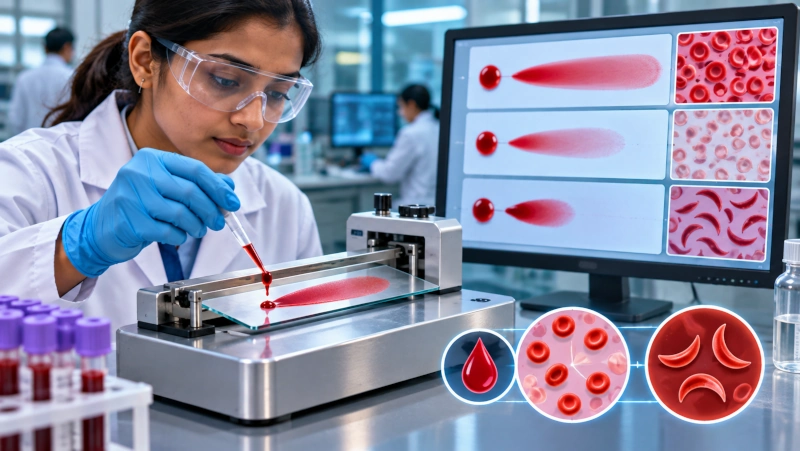
Researchers at the Indian Institute of Technology Bombay (IIT Bombay) have developed an innovative, low-cost blood-screening technology capable of identifying severe anaemia and sickle cell disease using a small blood sample. The approach examines how blood spreads across a glass slide under controlled conditions, using the relationship between blood viscosity and disease-related changes in red blood cells to provide a potentially affordable screening solution for hospitals and healthcare centres.
The research, conducted by IIT Bombay’s Department of Chemical Engineering, combines fluid mechanics with biomedical diagnostics to develop a practical method for assessing blood disorders. Led by Professor Mahesh S. Tirumkudulu, the team designed an automated blood-smear device that measures the distance travelled by a blood sample across a glass slide. The findings were published in the peer-reviewed journal Lab on a Chip, while IIT Bombay highlighted the development on October 23, 2026. The technology has also been licensed to an IIT Bombay startup for further development towards clinical applications.
Innovative Technology Uses the Flow Properties of Blood
The technology is based on a fundamental principle of fluid mechanics: the distance a liquid travels across a surface depends partly on its viscosity, or resistance to flow. Blood viscosity is influenced by several factors, including the concentration of red blood cells, their mechanical properties and the composition of blood plasma.
Conventional blood-smear preparation involves placing a small blood sample on a glass slide and spreading it into a thin film using another slide. The resulting smear is generally examined under a microscope to evaluate the appearance and characteristics of blood cells. However, the dimensions of manually prepared smears can vary depending on the technique used by laboratory personnel.
To overcome this variation, the IIT Bombay researchers developed an automated device that maintains a fixed angle between two glass slides and moves the spreading slide at a controlled speed. This arrangement produces a more consistent blood film, allowing the researchers to examine variations in smear length and establish their relationship with blood viscosity.
The team observed that blood with greater viscosity produces a shorter, thicker smear under identical testing conditions, while blood with lower viscosity spreads farther across the glass surface. This relationship enabled the researchers to investigate whether the physical behaviour of a blood sample could provide useful information about conditions affecting red blood cells.
The device requires approximately 10 microlitres of blood, making it suitable for investigations involving very small samples. Its relatively simple operating principle also provides opportunities for developing compact screening systems that can function without extensive laboratory infrastructure.
Field Testing Demonstrates Strong Results for Severe Anaemia
Anaemia occurs when the blood has insufficient healthy red blood cells or haemoglobin to transport oxygen effectively throughout the body. Severe anaemia can affect physical health and daily functioning and may require timely medical evaluation and treatment.
The IIT Bombay research team investigated whether blood viscosity could serve as an indicator of low haemoglobin levels. Because reduced red blood cell concentration generally decreases blood viscosity, researchers examined whether the length of a controlled blood smear could help identify individuals with severe anaemia.
The researchers evaluated the technique using blood samples from 516 individuals, comparing smear-derived viscosity measurements with conventional haemoglobin testing. Severe anaemia was defined in the study as a haemoglobin concentration below 8 grams per decilitre.
The experimental method correctly identified 95.1% of participants with severe anaemia and 86% of participants without the condition. These results demonstrated that blood-smear measurements can provide useful information for identifying individuals who may require further medical investigation.
The team also developed a separate imaging-based technique that estimates haemoglobin concentration by examining the colour intensity of dried blood films. Rather than measuring smear length alone, this approach analyses the appearance of the blood sample to estimate its haemoglobin content.
Testing involving more than 1,000 patients demonstrated agreement with conventional laboratory measurements, with haemoglobin estimates accurate to approximately ±0.5 grams per decilitre. The researchers reported that the technique could measure haemoglobin concentrations as low as 2 grams per decilitre.
Together, the viscosity-based and imaging-based approaches offer complementary methods for assessing anaemia using small blood samples and relatively simple equipment.
Researchers Develop Screening Method for Sickle Cell Disease
The research team extended the technique to investigate sickle cell disease, an inherited blood disorder associated with abnormal haemoglobin. Under conditions of reduced oxygen availability, red blood cells containing sickle haemoglobin can become rigid and assume abnormal shapes, affecting their ability to move through small blood vessels.
Unlike anaemia, sickle cell disease cannot be reliably identified through ordinary blood-smear length measurements alone. The researchers therefore developed a modified procedure that examines changes in blood viscosity before and after a reduction in oxygen levels.
The method uses sodium metabisulfite, an inexpensive chemical that reduces oxygen availability in the blood sample. Researchers compare the length of the untreated blood smear with that of the treated sample, allowing them to estimate how much the blood’s viscosity changes following deoxygenation.
In individuals without sickle cell disease, this treatment generally produces only a small change in viscosity. People carrying the sickle cell trait exhibit a greater increase, while individuals with sickle cell disease typically demonstrate substantially larger changes because their red blood cells become more rigid.
The researchers tested the method on 394 individuals from tribal regions of Maharashtra and central India, where access to specialised diagnostic services can be limited.
The results showed that blood viscosity increased by less than 17% in participants without the sickle cell condition, between 17% and 70% in individuals carrying the sickle cell trait, and by more than 70% in participants with sickle cell disease.
Using these differences, the researchers reported approximately 95% correct classification during field testing. The findings demonstrate the potential of a simple fluid-mechanics-based approach for screening blood disorders that ordinarily require specialised laboratory investigations.
Technology Shows Potential for Monitoring Treatment Response
Beyond identifying blood disorders, the IIT Bombay researchers investigated whether their method could help assess responses to treatment among patients with sickle cell disease.
The team examined changes in blood viscosity among patients receiving hydroxyurea, a medicine used in the management of sickle cell disease. The treatment can improve the behaviour of red blood cells and reduce complications associated with the condition.
During the research, the investigators observed that the average increase in blood viscosity following deoxygenation declined from approximately 125% to 70% in patients responding to treatment.
These findings suggest that changes in the physical behaviour of blood could provide additional information about treatment response. The research establishes an avenue for developing affordable monitoring techniques that may complement established medical assessments.
This capability is particularly relevant to healthcare systems serving patients who require repeated examinations, where simple and accessible monitoring methods can improve the availability of useful clinical information.
Low-Cost Device Designed for Resource-Limited Healthcare Settings
An important feature of the IIT Bombay technology is its relatively simple equipment requirement. The blood-smear method uses glass slides, a pipette and a device for creating controlled smears, while sickle cell screening additionally requires an inexpensive chemical and basic sample-handling materials.
The researchers have developed a patented automated smearing device intended to produce consistent results without relying on complex laboratory equipment. Measurements can be obtained using a ruler or imaging arrangement, depending on the configuration of the screening system.
The approach could be particularly valuable in rural and tribal communities where access to specialised diagnostic laboratories is limited. By enabling preliminary screening closer to patients, the technology offers opportunities to improve access to investigations for conditions such as severe anaemia and sickle cell disease.
India has undertaken extensive efforts to strengthen sickle cell disease screening, particularly among tribal populations. Affordable screening technologies developed by Indian research institutions can contribute to these efforts by supporting greater accessibility and decentralised healthcare services.
The IIT Bombay technique is designed as a screening method rather than a replacement for established confirmatory tests. Individuals identified through screening would continue to require appropriate clinical assessment and laboratory confirmation, including specialised haemoglobin testing where indicated.
IIT Bombay Startup Takes Technology Towards Clinical Applications
The technology has been licensed to Rheoheme Private Limited, a startup associated with IIT Bombay, providing a pathway for translating the research into a practical healthcare product.
The research team is collaborating with the National Institute for Research in Tribal Health, Jabalpur, and AIIMS Nagpur as part of its efforts towards regulatory approval and further clinical evaluation.
These institutional partnerships bring together engineering research, healthcare expertise and experience in addressing medical requirements in tribal communities. They also support the development of a screening system suited to practical healthcare environments.
The researchers are exploring whether the principles underlying the device could be extended to other medical measurements, including blood clotting time and glucose levels. These investigations reflect the broader possibilities of applying fluid mechanics and simple imaging techniques to biomedical diagnostics.
The project illustrates how fundamental engineering research can generate solutions to important healthcare challenges. The original investigation into the spreading behaviour of blood developed into a screening technology with potential applications in public health and clinical medicine.
Indian Engineering Research Opens New Opportunities in Affordable Diagnostics
The development represents an important contribution by IIT Bombay to biomedical engineering and low-cost healthcare innovation. By applying fluid mechanics to blood screening, researchers have demonstrated that useful information about disease can be obtained from the physical behaviour of small blood samples.
The technology combines a straightforward analytical principle with encouraging field-test results, providing a foundation for affordable screening systems suited to healthcare facilities with limited laboratory resources. Its application to both severe anaemia and sickle cell disease also illustrates the potential for a single underlying technology to address multiple diagnostic requirements.
The collaboration between IIT Bombay, medical research institutions and an indigenous startup highlights the growing connection between academic research and healthcare technology development in India. The approach brings together scientific discovery, engineering design and practical product development to address an important public health requirement.
As India continues expanding access to medical screening and strengthening healthcare services in underserved regions, innovations of this kind demonstrate the value of indigenous research in developing accessible medical technologies. IIT Bombay’s blood-smear screening technique adds to the country’s capabilities in affordable biomedical diagnostics and contributes to the development of healthcare solutions designed around India’s diverse public health needs.
Sources: IIT Bombay, Research Highlight, October 23, 2026; Lab on a Chip, Royal Society of Chemistry, 2026.
You may also like
-
NITI Aayog Launches India S&T Scoreboard to Map Scientific and Technological Capabilities Across States
-
ISRO Successfully Places NVS-03 Navigation Satellite into Geosynchronous Orbit After Four Manoeuvres
-
Novel Silicon Chip AllowingTerahertz Waves to Pass Through Barriers Could Enable Future 6G Networks
-
VELC on Board Aditya-L1 Reveals Asymmetric Expansion of Solar Eruption that Could Impact Space Weather
-
University of Hyderabad and IIT Researchers Develop Advanced Titanium Alloys for Safer, Longer-Lasting Medical Implants
