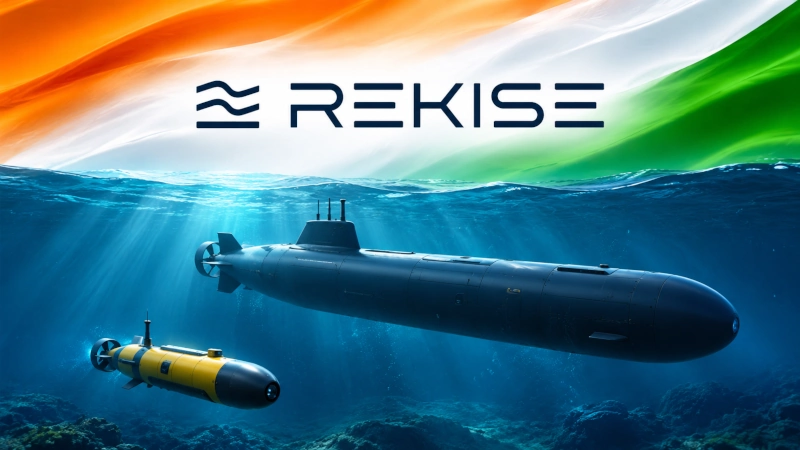
Indian maritime robotics company Rekise Marine is advancing the development of two indigenous autonomous underwater vehicle programmes, the Man-Portable Autonomous Underwater Vehicle (MPAUV) and Jalkapi Extra-Large Autonomous Underwater Vehicle (XLAUV), with extensive sea trials of its underwater autonomy technology underway off Goa. The development marks an important step in India’s efforts to establish domestically controlled unmanned underwater capabilities for the Indian Navy, strengthening technological self-reliance in autonomous maritime operations.
The company confirmed that its common autonomy software architecture, previously demonstrated aboard the Swadheen autonomous surface vessel, is undergoing rigorous testing on its underwater platforms in Goa. The development was reported on November 4, 2026, following Rekise Marine’s updates surrounding the Indian Navy’s SWAVLAMBAN 2026 initiative, which brings together defence innovators, technology companies and naval stakeholders to accelerate indigenous maritime capabilities.
Rekise Marine is developing the MPAUV and Jalkapi platforms to address different operational requirements, ranging from compact underwater reconnaissance and surveillance to extended-duration autonomous submarine missions. The company has emphasised that its engineering approach is built around indigenous software, domestically controlled technologies and collaboration with the Indian Navy and Indian defence shipyards.
Goa Sea Trials Advance Indigenous Underwater Autonomy
The ongoing trials off Goa are focused on evaluating Rekise Marine’s common autonomy technology under operational maritime conditions. The company’s software architecture is intended to support multiple classes of autonomous vessels, allowing the same underlying navigation, control and mission-management technologies to be adapted for different surface and underwater platforms.
Autonomous underwater operations present engineering challenges that differ considerably from those encountered by unmanned surface vessels. Unlike surface platforms, underwater vehicles cannot continuously depend on satellite navigation signals, requiring alternative positioning systems, onboard sensors and autonomous decision-making capabilities to navigate safely.
Such vehicles must also operate with limited communication links while submerged, making onboard mission planning, obstacle avoidance and reliable control systems particularly important. Testing under real maritime conditions allows developers to evaluate how these technologies perform when exposed to currents, changing underwater visibility, environmental conditions and other operational variables.
Rekise Marine’s ongoing trials are therefore an important part of developing reliable autonomous underwater systems. The company has confirmed that its underwater software is undergoing extensive sea testing, although the announcement does not establish that both platforms have completed their full qualification programmes or achieved operational induction.
Jalkapi XLAUV: India’s Indigenous Extra-Large Autonomous Underwater Vehicle
Jalkapi is Rekise Marine’s flagship extra-large autonomous underwater vehicle programme, being developed under the Indian Navy’s iDEX–ADITI 1.0 framework. The project is based on a design developed by the Indian Navy’s Submarine Design Group and is intended to provide capabilities for extended underwater operations without requiring an onboard crew.
According to technical specifications published by Rekise Marine, Jalkapi is designed as an approximately 11-metre-long, 20-tonne diesel-electric autonomous underwater platform. The vehicle has a stated operating depth of up to 300 metres and a proposed mission endurance of 30–45 days, enabling it to undertake extended operations across substantial maritime distances.
The platform is being developed with lithium-ion battery propulsion supported by an onboard diesel generator for recharging. Its proposed autonomous energy-management system is intended to allow the vehicle to resurface when necessary, recharge its batteries and continue its mission without requiring a conventional crewed support vessel.
Jalkapi’s intended operational roles include intelligence, surveillance and reconnaissance, anti-submarine warfare support, seabed mapping, mine countermeasure operations and strategic maritime monitoring. These capabilities could provide the Indian Navy with additional options for undertaking persistent underwater missions while reducing the requirement to deploy crewed submarines for certain surveillance and reconnaissance tasks.
The vehicle’s proposed sensor architecture includes passive acoustic arrays, forward-looking sonar, multibeam echo sounders, radar, electro-optical and infrared systems, and underwater navigation equipment. The combination is designed to support autonomous navigation, environmental awareness and the collection of mission-specific information.
These specifications represent the manufacturer’s published design capabilities. The ongoing development and testing programme will provide the basis for validating the platform’s operational performance.
MPAUV: Compact Underwater Platform for Reconnaissance and Mine Detection
Alongside Jalkapi, Rekise Marine is developing the MPAUV, a compact autonomous underwater vehicle designed for rapid deployment by a single operator or a small team. The programme is being undertaken in collaboration with Goa Shipyard Limited, contributing to the development of indigenous underwater robotic capabilities for specialised maritime missions.
The MPAUV is intended for reconnaissance, surveillance, mine detection, environmental monitoring and coastal or offshore inspection activities. Its compact configuration is designed to simplify transportation, deployment and recovery, allowing it to operate in areas where larger underwater vehicles may be less practical.
According to the company’s published specifications, the MPAUV weighs approximately 50 kilograms in air and is designed to operate at depths of up to 100 metres. It has a stated endurance of up to ten hours at a cruising speed of three knots and a maximum speed of six knots.
The vehicle can carry side-scan sonar and other mission-specific sensors for collecting information about underwater terrain, objects and environmental conditions. Such capabilities are relevant to harbour surveillance, underwater infrastructure inspection, seabed reconnaissance and mine countermeasure operations.
Compact autonomous underwater vehicles can also support naval missions in shallow coastal waters, where maritime traffic, underwater obstacles and complex seabed conditions create demanding operating environments. Their smaller size and relatively straightforward deployment requirements make them suitable for specialised operations that do not require the endurance or payload capacity of larger unmanned submarines.
The MPAUV programme demonstrates how Indian companies are developing autonomous underwater systems across different size and mission categories, creating complementary capabilities within the country’s emerging unmanned maritime technology ecosystem.
Common Autonomy Software Forms the Core of Rekise Marine’s Technology
A significant aspect of Rekise Marine’s development strategy is its emphasis on a unified autonomy software architecture that can be deployed across different classes of maritime platforms.
The company has stated that its autonomous software stack was previously demonstrated aboard Swadheen, an autonomous surface vessel developed in collaboration with Garden Reach Shipbuilders & Engineers Limited. The experience gained through surface operations is now contributing to the development and testing of autonomous underwater systems.
By maintaining a common software architecture, Rekise Marine aims to simplify the integration of navigation, vehicle control, mission planning and autonomous decision-making capabilities across its portfolio.
This approach can reduce the need to develop entirely separate software systems for every new platform. It also enables engineering improvements and tested software components to be adapted across multiple vehicles, supporting more efficient development and maintenance.
The company has specifically highlighted its complete ownership of the software source code, firmware and control protocols used in its autonomous systems. Retaining control over these technologies is particularly important for defence applications because it allows domestic engineering teams to maintain, modify and upgrade critical systems without depending on external proprietary software providers.
For the Indian Navy, sovereign control over autonomous mission software can support long-term maintenance, operational security and the ability to adapt unmanned systems to evolving mission requirements.
Rekise Marine’s focus on indigenous software development therefore extends beyond individual underwater platforms to the creation of a domestically controlled technological foundation for future autonomous maritime systems.
Collaboration with Indian Navy, iDEX and Defence Shipyards
Rekise Marine’s underwater vehicle programmes are being supported through collaboration with the Indian Navy, the Innovations for Defence Excellence initiative and leading Indian defence shipyards.
The company’s flagship Jalkapi programme is being developed under the iDEX–ADITI 1.0 initiative, which supports the development of advanced defence technologies through collaboration between the armed forces and Indian innovators.
The programme brings together Rekise Marine’s capabilities in autonomous systems engineering with the Indian Navy’s submarine design expertise and operational requirements.
The MPAUV is being developed with support from Goa Shipyard Limited, while Rekise Marine’s Swadheen autonomous surface vessel programme has involved collaboration with Garden Reach Shipbuilders & Engineers Limited.
These partnerships demonstrate the expanding role of Indian startups in developing specialised technologies alongside established defence public-sector enterprises.
Rekise Marine showcased its autonomous surface and underwater vehicle programmes at the Sagar Sankalp defence conclave in Kolkata on March 6, 2026. The event provided an opportunity for the company to present the progress of Jalkapi, MPAUV and Swadheen to senior defence officials and representatives of the maritime industry.
The company has also acknowledged support from the Indian Navy, the Defence Innovation Organisation, defence research institutions and partner shipyards during the development of its autonomous maritime technologies.
Autonomous Underwater Vehicles Strengthen Future Naval Operations
Autonomous underwater vehicles are becoming increasingly important in modern maritime operations because they allow naval forces to conduct selected missions without placing personnel directly inside the operational platform.
These systems can be employed for persistent surveillance, seabed reconnaissance, underwater infrastructure inspection and the detection of potential maritime threats.
In mine countermeasure operations, autonomous underwater vehicles equipped with specialised sensors can survey designated areas and identify suspicious underwater objects. Such capabilities can help reduce the exposure of crewed vessels and diving teams during hazardous inspection and reconnaissance activities.
Larger autonomous underwater platforms offer additional possibilities for extended surveillance and monitoring missions. Their capacity to operate for long periods without an onboard crew creates opportunities to maintain underwater awareness across larger maritime areas.
The development of different classes of indigenous underwater vehicles is particularly relevant for India, given the country’s extensive coastline, strategically important island territories and maritime interests across the Indian Ocean.
Technologies such as autonomous navigation, underwater acoustic sensing and mission-management software can also support applications beyond defence, including oceanographic research, seabed mapping and inspection of critical underwater infrastructure.
Rekise Marine Expands India’s Deep-Tech Defence Startup Ecosystem
Rekise Marine’s progress reflects the growing participation of Indian deep-technology startups in advanced defence development programmes traditionally associated with large industrial organisations and government research institutions.
The company is developing a portfolio of autonomous surface and underwater vessels, including Jaldoot, Swadheen, MPAUV and Jalkapi. These platforms address different maritime requirements while drawing upon the company’s common expertise in robotics, embedded systems, autonomous navigation and software engineering.
In June 2026, Rekise Marine announced a seed funding round of approximately USD 9.7 million, led by Accel and NKSquared, the investment firm associated with Zerodha co-founder Nikhil Kamath.
The company indicated that the investment would support the completion and sea trials of Jalkapi, further development of its indigenous autonomy software and expansion of its engineering workforce across robotics, artificial intelligence, machine learning, embedded systems and naval architecture.
The investment illustrates the increasing interest of private capital in Indian defence-related deep technology, particularly in sectors where domestic innovation can contribute to strategically important capabilities.
As autonomous technologies become more important to maritime operations, companies developing specialised platforms and sovereign control systems are creating new opportunities within India’s defence manufacturing and engineering ecosystem.
Indigenous Underwater Robotics Supports India’s Maritime Self-Reliance
The ongoing Goa sea trials represent a meaningful stage in the development of India’s indigenous autonomous underwater capabilities. By advancing both a compact man-portable vehicle and a much larger autonomous submarine platform, Rekise Marine is contributing to the creation of technologies suited to different maritime operational requirements.
The development of these systems within India, supported by domestic software ownership and cooperation with the Indian Navy and defence shipyards, aligns with the broader objective of strengthening self-reliance in critical defence technologies.
The distinction between the two platforms is particularly significant. While the MPAUV is designed for relatively short-duration, specialised underwater missions, Jalkapi is intended to provide extended endurance and substantially greater operational capacity. Together, they illustrate the range of autonomous systems being developed within India’s maritime technology sector.
Rekise Marine’s announcement also highlights the importance of developing indigenous control software alongside the physical underwater vehicles themselves. Autonomous navigation, mission execution and onboard decision-making are essential components of unmanned maritime operations, making domestic expertise in these areas increasingly valuable.
The sea trials underway off Goa provide an important opportunity to advance these capabilities under actual maritime conditions. As the company progresses through its development programme, the technologies being evaluated will contribute to India’s growing expertise in underwater robotics, autonomous naval systems and advanced maritime engineering.
Rekise Marine’s MPAUV and Jalkapi programmes demonstrate the expanding contribution of Indian startups to indigenous naval technology development, combining advanced robotics, sovereign software capabilities and collaboration with established defence institutions to strengthen India’s future underwater operational capabilities.
You may also like
-
Indian Space Startup PierSight Advances Antenna Testing for Varuna 2.0 Maritime Surveillance Satellite
-
Chennai Deep-Tech Startup Torus Motion Develops Indigenous Axial-Flux Motors for Electric Vehicles and Industrial Automation
-
Hyderabad Startup Perceptyne Develops Semi-Humanoid Robotic Platform for Precision Industrial Automation
-
India’s Steel Consumption Nears 100 Million Tonnes as Domestic Demand Grows 7.5% in April–October 2026
-
Indian Startup insideFPV Reports Successful Anti-Jamming Trials of Indigenous Advik Drone at 18,000 Feet in Ladakh
