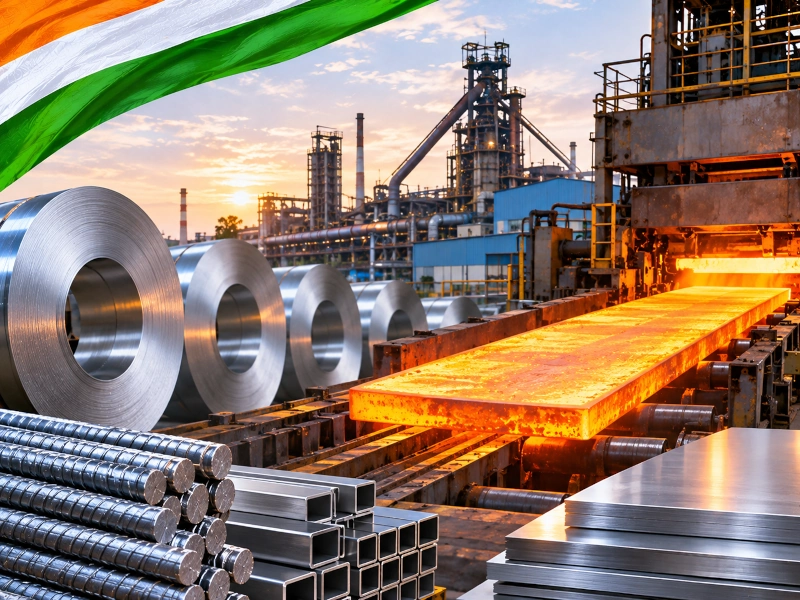
India’s finished steel consumption reached 99.3 million tonnes (MT) during April–October 2026, registering a 7.5% increase over the corresponding period of the previous year, according to provisional data released by the Ministry of Steel. The figures highlight the continued expansion of domestic steel demand, accompanied by higher crude and finished steel production, increased industrial investment and significant developments across India’s public and private steel manufacturing sectors.
The Ministry’s latest industry review indicates that finished steel consumption increased from 92.4 MT during April–October 2025 to 99.3 MT during the first seven months of the current financial year. October 2026 alone recorded consumption of 14.3 MT, compared with 13.4 MT in October 2025, representing year-on-year growth of 6.6%.
The sustained increase in steel consumption reflects the expanding requirements of India’s infrastructure, construction, manufacturing and engineering sectors. Steel remains a fundamental input for transportation networks, industrial machinery, housing, automobiles, energy infrastructure and several other industries contributing to the country’s economic development.
India’s Crude Steel Production Reaches 99.1 Million Tonnes
India’s crude steel production reached 99.1 MT during April–October 2026, increasing by 2.6% from 96.6 MT during the corresponding period of the previous financial year. Finished steel production also recorded positive growth, rising by 3.9% from 91.9 MT to 95.5 MT.
During October 2026, crude steel production stood at 14.1 MT, compared with 14 MT in October 2025, representing an increase of 0.7%. Finished steel output reached 13.4 MT during the month, recording growth of 2.8% over the 13.1 MT produced in October 2025.
Hot metal production during the seven-month period increased by 1.9% to 56.3 MT, compared with 55.3 MT in the previous year. However, monthly hot metal output declined by 2.9% in October, falling from 8.1 MT to 7.9 MT.
The production figures indicate that India’s steel industry continued expanding its output during the financial year, although domestic consumption grew at a faster pace than finished steel production. This difference highlights the strength of domestic demand and the importance of continued investment in steelmaking capacity.
Large Steel Producers Account for More Than Half of National Output
India’s seven major steel-producing groups collectively manufactured 55.6 MT of crude steel during April–October 2026, accounting for approximately 56% of the country’s total crude steel production.
These producers include Steel Authority of India Limited (SAIL), Rashtriya Ispat Nigam Limited (RINL), NMDC Steel Limited (NSL), Tata Steel Group, ArcelorMittal Nippon Steel India, Jindal Steel and JSW Group.
The seven major producers collectively manufactured 51.4 MT of finished steel, while the remaining producers contributed 44.1 MT. Smaller and medium-sized steel manufacturers therefore continue to play an important role in meeting domestic requirements across construction, engineering and downstream industrial applications.
India’s annual crude steel production capacity stood at approximately 223 MT, comprising 117.4 MT among the seven major producers and 105.6 MT among the remaining manufacturers.
Public-sector enterprises accounted for 15.5% of crude steel production, 13.6% of finished steel output and 29.4% of hot metal production during the period. These figures demonstrate the continuing contribution of government-owned steel enterprises alongside India’s expanding private manufacturing industry.
Domestic Steel Prices Register Significant Annual Increases
The Ministry’s review also recorded substantial year-on-year increases in domestic steel prices across several important product categories.
The average price of 10 mm thermomechanically treated (TMT) reinforcement bars reached ₹66,645 per tonne in October 2026, increasing by 26% compared with the corresponding period of the previous year. Prices also rose by 2.1% compared with September 2026.
Hot-rolled coils measuring 2 mm were priced at ₹77,620 per tonne, reflecting a year-on-year increase of 31.6%, while cold-rolled coils measuring 0.63 mm reached ₹87,010 per tonne, recording an annual increase of 33.3%.
Galvanised plain sheets of 0.63 mm thickness registered the highest annual price increase among the four categories reported, rising by 33.6% to ₹95,365 per tonne.
These prices represent averages from the second fortnight of October across Kolkata, Delhi, Mumbai and Chennai and include Goods and Services Tax.
Steel price movements have implications for construction costs, infrastructure project expenditure, industrial manufacturing and the competitiveness of downstream enterprises. The increase in prices also illustrates the changing market conditions facing both steel producers and steel-consuming industries.
Steel Imports Increase as Domestic Consumption Expands
India remained a net importer of finished steel in quantity terms during April–October 2026, with imports increasing by 28.9% to 4.90 MT from 3.80 MT during the corresponding period of the previous year.
The value of finished steel imports reached ₹52,493.7 crore, compared with ₹35,232.8 crore in April–October 2025, representing an increase of 49%.
October 2026 recorded a particularly substantial rise in imports, with volumes increasing by 65.8% from 0.46 MT to 0.76 MT. The value of imports during the month increased by 118.6% to ₹8,803.6 crore.
Finished steel exports, meanwhile, increased by 15.5% during the seven-month period, reaching 3.98 MT compared with 3.45 MT in the previous year. Export earnings rose by 21% to ₹32,177.2 crore.
However, monthly exports declined in October 2026, with shipments falling by 32% to 0.44 MT from 0.64 MT in October 2025.
The difference between cumulative import and export volumes resulted in net finished steel imports of approximately 0.92 MT during April–October 2026.
The trade figures underline the importance of strengthening domestic steel manufacturing capabilities, particularly in specialised and value-added product categories, while supporting the international competitiveness of Indian steel producers.
SAIL Records Strong Profit Growth and Approves ₹1,714 Crore Expansion
Public-sector steel manufacturer Steel Authority of India Limited reported improved financial performance during the first half of FY2026–27, supported by operational improvements, higher sales volumes and cost optimisation.
SAIL’s sales volume increased by 5% year-on-year to 5.16 MT during the second quarter of FY2026–27. The company also reported a substantial improvement in profitability, with profit after tax rising by approximately 315% to ₹1,774 crore.
In an important development for domestic manufacturing, SAIL approved an investment of ₹1,714 crore for the expansion and modernisation of its Alloy Steels Plant at Durgapur in West Bengal.
The project is intended to strengthen the production of high-grade alloy and special steels required by strategically important industries, including defence, railways and automobiles.
The investment is particularly significant for India’s efforts to develop domestic capabilities in specialised steel grades, which require advanced manufacturing processes, quality control systems and metallurgical expertise.
By expanding production capabilities in high-value steel categories, SAIL aims to support industrial requirements while strengthening the domestic supply chain for critical engineering applications.
NMDC Reports 22% Growth in Iron Ore Production
India’s leading public-sector iron ore producer, NMDC Limited, recorded significant growth in mineral production during the current financial year.
The company produced 5.04 MT of iron ore in October 2026, registering an increase of 18% compared with the corresponding month of the previous year.
Cumulative iron ore production during April–October FY2026–27 reached 32.32 MT, representing year-on-year growth of 22%.
Iron ore is a fundamental raw material for steel manufacturing, and increased domestic production supports the availability of essential inputs for India’s expanding steel industry.
NMDC’s production growth is particularly relevant as the country continues investing in additional steelmaking capacity and seeks to strengthen raw material supply chains for domestic manufacturers.
The company also expanded its international engagement by establishing an office in Sydney, Australia. The office was inaugurated by the Secretary of the Ministry of Steel and is intended to facilitate cooperation with Australian government agencies and industry partners in the minerals sector.
MOIL Strengthens Manganese Ore Sales and Profitability
Public-sector manganese ore producer MOIL Limited also reported improved financial performance during the first half of FY2026–27.
The company’s manganese ore sales increased by 9.67% year-on-year to 0.78 MT, while profit after tax rose by 22.5% to ₹149.39 crore.
Manganese is an important input in steel manufacturing because of its role in improving metallurgical properties and supporting the production of several steel grades.
MOIL’s increased sales and profitability reflect the continuing importance of domestic mineral production in supporting India’s steel value chain.
The Ministry’s review also recorded changes in manganese ore prices during October. MOIL manganese ore lump prices increased by 5% from ₹17,603 per tonne in September to ₹18,483 per tonne in October.
Government Extends Quality Control Exemption for Stainless Steel Inputs
The Ministry of Steel has granted an exemption from Quality Control Order compliance for 162 grades of semi-finished stainless steel products covered under Indian Standard IS 14650.
The exemption will remain valid until March 31, 2027, and is intended to address concerns raised by micro, small and medium enterprises regarding the availability of intermediate materials used in stainless steel manufacturing.
The measure is expected to facilitate access to specified semi-finished stainless steel inputs and support downstream manufacturing operations.
Stainless steel products are used extensively in engineering, food processing equipment, healthcare, transportation, industrial machinery and consumer applications. Ensuring the availability of intermediate materials is therefore important for manufacturers operating across several industrial sectors.
The exemption represents a targeted regulatory measure aimed at supporting manufacturing continuity while addressing practical challenges faced by smaller industrial enterprises.
India and Australia Strengthen Cooperation in Steel and Critical Minerals
India continued expanding its international engagement in the mining and steel sectors during October 2026, with a Ministry of Steel delegation visiting Australia for the International Mining and Resources Conference, IMARC 2026.
The delegation was led by the Secretary of the Ministry of Steel, who participated in ministerial discussions and inaugurated the Ministry of Steel Pavilion at the conference.
The Secretary also delivered the keynote address at the Australia-India Business Meet 2026, organised by the Consulate General of India in Sydney.
During the visit, the Indian delegation held discussions with the Premier of New South Wales, the state’s Minister for Natural Resources and representatives of Austrade.
The engagements focused on strengthening cooperation in mining, steel manufacturing, critical minerals, raw material security, investment and technology.
Australia is an important international source of mineral resources, and deeper cooperation in these areas can support India’s efforts to establish resilient supply chains for its expanding industrial economy.
The delegation subsequently visited Auckland, where discussions were held with representatives of Invest New Zealand and the country’s Ministry of Foreign Affairs and Trade.
These interactions explored opportunities for strengthening bilateral cooperation in investment, trade and steel-related industries.
Green Steel Certification Expands Across Indian Manufacturing
India’s transition towards environmentally responsible steel production continued to gather momentum under the Ministry of Steel’s Green Steel Initiative.
According to the Ministry’s latest review, 108 distinct steel producers had received Green Steel Certificates across the certification lists issued through October 2026.
The certifications cover a range of steel products, including TMT reinforcement bars, hot-rolled and cold-rolled coils, plates, wire rods, pipes and other manufactured steel products.
A large majority of the certified products received five-star ratings, reflecting progress in the adoption of production practices associated with lower greenhouse gas emissions.
Green steel certification provides a framework for identifying steel products according to their emissions performance, supporting greater transparency and encouraging manufacturers to improve the environmental efficiency of their operations.
The initiative is particularly important as international industrial markets increasingly focus on the carbon intensity of manufacturing processes and the environmental performance of traded products.
For Indian manufacturers, the development of recognised green steel standards can support technological modernisation and provide a foundation for participation in markets where emissions-related requirements are becoming more significant.
India’s Steel Industry Supports Expanding Industrial Requirements
The Ministry of Steel’s April–October 2026 review presents a picture of an industry experiencing sustained domestic demand growth, expanding production and continued investment in manufacturing capabilities.
Finished steel consumption of 99.3 MT during the first seven months of the financial year highlights the scale of India’s domestic market. The corresponding increases in crude steel production, finished steel output and iron ore production demonstrate the continuing contribution of the steel and mining sectors to industrial activity.
The developments reported by SAIL, NMDC and MOIL also underline the role of public-sector enterprises in strengthening India’s industrial supply chains. Investments in special steel manufacturing, increased mineral production and improved operational performance contribute to the availability of materials required by infrastructure, engineering, defence and manufacturing industries.
At the same time, the expansion of green steel certification, targeted regulatory measures for stainless steel manufacturers and growing international cooperation in critical minerals reflect the industry’s continuing technological and structural development.
With finished steel consumption approaching 100 MT within seven months, India’s steel sector remains an important foundation for the country’s infrastructure development, manufacturing expansion and industrial modernisation. The latest figures highlight the growing scale of domestic demand and the contribution of Indian steel producers to meeting the requirements of an expanding economy.
You may also like
-
Rekise Marine Advances Indigenous MPAUV and Jalkapi Autonomous Submarine Programmes with Sea Trials in Goa
-
Hyderabad Startup Perceptyne Develops Semi-Humanoid Robotic Platform for Precision Industrial Automation
-
Indian Startup insideFPV Reports Successful Anti-Jamming Trials of Indigenous Advik Drone at 18,000 Feet in Ladakh
-
PM Modi Highlights India’s Metro Revolution as Network Expands Nearly Fivefold After 2014 to 1,200 km Across 26 Cities
-
Indian Fintech Startup Decentro Launches Advanced UPI Soundboxes with Dynamic QR and Contactless Payment Capabilities
