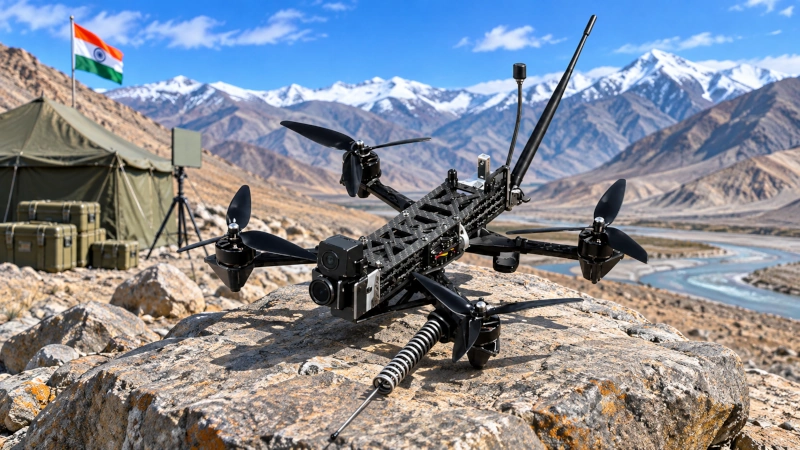
Gujarat-based defence technology startup insideFPV has announced the successful completion of high-altitude trials of its indigenously developed Advik kamikaze first-person-view (FPV) drone under active electronic warfare conditions in Ladakh. According to the company, the unmanned aerial platform maintained its flight stability and communication link while electronic jamming systems were operating at an altitude of approximately 18,000 feet. The development represents an important step in the company’s efforts to create compact, affordable and electronically resilient tactical drones for India’s armed forces.
In an announcement published on November 5, 2026, the Surat-headquartered company also stated that the tested drone systems had been delivered to the Indian Army. The trials reportedly involved electronic warfare equipment, including an Advanced Drone Defence System, operating during the flight evaluation. insideFPV described the demonstration as a significant achievement for indigenous drone development, particularly in addressing the challenges posed by electronic interference and demanding high-altitude operating conditions.
Indigenous Communication Technology Designed to Resist Electronic Jamming
A major feature of the Advik drone is its domestically developed radio-frequency communication system, which insideFPV designed to improve operational reliability in environments affected by electronic warfare. Modern military drones depend on reliable communication links for navigation, flight control and transmission of visual information. Electronic jamming can interfere with these links, potentially disrupting an unmanned aircraft’s ability to complete its assigned mission.
To address this challenge, insideFPV developed an RF communication switching link using its proprietary antenna-rack system. The technology combines multiple radio-frequency systems with customised electronic hardware to improve communication resilience in contested electromagnetic environments.
According to the company, its engineers designed the system to minimise additional weight and electrical power consumption while maintaining compatibility with the aircraft’s onboard cameras and flight-control electronics. This approach is particularly relevant to small tactical drones, where additional equipment can affect flight endurance, payload capacity and manoeuvrability.
The company reported that Advik maintained its control link throughout the active-jamming trials conducted in Ladakh. The demonstration was intended to assess the drone’s ability to operate under conditions in which conventional unmanned systems may experience communication disruptions.
insideFPV Chief Technology Officer Deyvant Bhardwaj explained that the company’s objective was to develop electronic-warfare-resistant drones without significantly increasing their cost, weight or complexity. The company has been developing low-cost tactical unmanned systems since 2020, with an emphasis on indigenous engineering and manufacturing.
High-Altitude Ladakh Trials Test Drone Performance Under Harsh Conditions
The decision to conduct the trials at approximately 18,000 feet in Ladakh added an important environmental dimension to the evaluation. High-altitude operations present considerable challenges for small electric-powered unmanned aerial systems, particularly because reduced air density affects aerodynamic performance and propeller efficiency.
At higher elevations, drone propulsion systems must operate under conditions where thinner air can reduce the lift generated by propellers. This can place additional demands on motors and power systems, especially when aircraft are carrying specialised equipment.
Low temperatures create further challenges for battery-powered systems. Cold weather can reduce battery efficiency and available power, potentially affecting flight endurance and the reliability of onboard electronics.
By combining high-altitude flight conditions with active electronic interference, the trials were designed to evaluate multiple operational characteristics of the Advik platform. According to insideFPV, the drone maintained its communication link during the evaluations, demonstrating the performance of its indigenous RF system in the conditions tested.
The company has presented the results as relevant to the Indian Army’s requirements for unmanned systems capable of operating in mountainous terrain. Ladakh’s geographical conditions make high-altitude performance an important consideration for military equipment intended for deployment in the Himalayan region.
Advik Developed as a Compact Tactical Kamikaze Drone
Advik forms part of insideFPV’s portfolio of indigenous unmanned aerial systems, which includes FPV drones, loitering munitions and interceptor platforms developed for defence applications. The company focuses on compact drone systems designed to combine operational flexibility with affordability and domestic manufacturing capabilities.
FPV drones use onboard cameras to provide operators with a live visual perspective from the aircraft. This enables precise control during flight and makes the technology suitable for applications requiring manoeuvrability and close observation.
Kamikaze FPV drones are designed as expendable tactical platforms that can carry a payload towards a designated target. Their relatively compact configuration and comparatively low production cost have contributed to their increasing importance in contemporary military operations.
insideFPV’s official product catalogue lists several Advik kamikaze configurations, with differences in payload capacity, flight endurance, camera systems and operating characteristics. The company’s published product information includes variants equipped with day and night imaging capabilities and options for thermal observation.
The precise configuration used during the Ladakh trials has not been publicly identified. However, insideFPV has confirmed that the tested Advik platform incorporated its internally developed communication technology intended to improve resilience against electronic interference.
Company Reports Delivery of Advanced Drone Systems to Indian Army
Alongside the trial results, insideFPV announced that the advanced drone systems had been delivered to the Indian Army. The company presented the development as part of its continuing efforts to supply indigenous tactical unmanned systems suited to India’s defence requirements.
The announcement follows the company’s earlier participation in military drone evaluations. insideFPV states that it secured first place in the FPV category at the Him-Drone-A-Thon organised by the Indian Army and the Federation of Indian Chambers of Commerce and Industry at Wari La in Ladakh during Himtech 2024.
That earlier recognition provided an opportunity for the company to demonstrate its drone technologies in a demanding mountainous environment. The latest reported trials represent a separate development, focusing specifically on communication resilience under active electronic warfare conditions.
The November announcement did not disclose the number of Advik drones delivered, the financial value of the supply arrangement or the precise dates on which the trials were conducted. The delivery and performance details have been reported by the manufacturer, while a separate public confirmation from the Indian Army was not available at the time of reporting.
Electronic Warfare Resilience Becomes Important for Modern Military Drones
Electronic warfare has become an increasingly important factor in the development of unmanned aerial systems. Military forces employ electronic countermeasures to interfere with hostile drones by disrupting their communication links, satellite navigation signals and other electronic systems.
Small tactical drones are particularly sensitive to communication disruptions because their operations often depend on continuous interaction between the aircraft and its operator. Improving the reliability of these links has consequently become an important area of research and development for drone manufacturers.
Different technological approaches are being explored internationally, including specialised radio systems, alternative communication architectures and autonomous navigation capabilities. Each approach addresses particular operational requirements involving reliability, cost, weight and mission flexibility.
insideFPV’s reported development focuses on strengthening communication resilience through an indigenous RF switching architecture. The company’s emphasis on compact hardware and low power consumption reflects the engineering requirements associated with small unmanned platforms.
For India’s defence technology sector, the ability to develop such electronic systems domestically is relevant to building specialised capabilities in drone communications, avionics and electronic warfare resilience.
The ongoing development of these technologies also creates opportunities for Indian companies specialising in radio-frequency engineering, embedded electronics, antennas, sensors and autonomous systems.
Indigenous Drone Manufacturing Supports India’s Defence Self-Reliance
Founded in 2020, insideFPV Ventures Private Limited is headquartered in Surat, Gujarat, and maintains an office in New Delhi. The company develops and manufactures FPV drones, kamikaze platforms, loitering munitions and interceptor systems for defence applications.
Its activities form part of India’s expanding private-sector defence technology ecosystem, where startups and specialised manufacturers are contributing to the development of unmanned aerial vehicles, advanced electronics, autonomous systems and military-grade components.
Domestic development of drone platforms and their associated technologies can strengthen India’s ability to manufacture, maintain and upgrade unmanned systems according to operational requirements. Indigenous engineering also provides opportunities to improve production flexibility and develop specialised configurations suited to different operating environments.
The increasing participation of Indian startups in defence technology development complements the activities of established defence public sector enterprises, research institutions and private manufacturers. Together, these organisations are contributing to the emergence of a broader industrial ecosystem capable of supporting advanced military technologies.
The Advik programme illustrates how specialised startups are addressing operational requirements through focused engineering initiatives. The company’s reported high-altitude trials bring together indigenous communication technology, compact unmanned aircraft design and an emphasis on performance in electronically contested environments.
insideFPV’s announcement of successful trials at approximately 18,000 feet and subsequent delivery to the Indian Army represents a development in its indigenous tactical drone programme. The reported results highlight the growing role of Indian defence startups in developing unmanned technologies for demanding military applications, particularly where high-altitude operations and electronic interference present significant engineering challenges.
You may also like
-
India’s Steel Consumption Nears 100 Million Tonnes as Domestic Demand Grows 7.5% in April–October 2026
-
Indian Fintech Startup Decentro Launches Advanced UPI Soundboxes with Dynamic QR and Contactless Payment Capabilities
-
OneStack Enables Indian Cooperative Banks to Access UPI Network Directly Through Indigenous Banking Technology
-
IIT Bombay-Incubated Peppermint Robotics Raises ₹100 Crore to Expand Indigenous Robot Manufacturing and Global Operations
-
IIT Gandhinagar Startup Cellegant Raises ₹2.61 Crore to Develop Indigenous Hydrogen-Powered Drones
