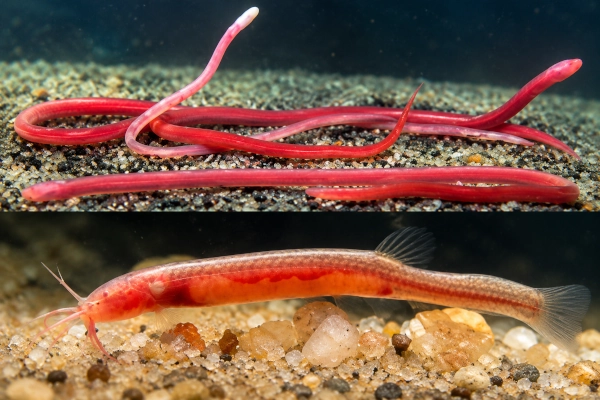
Scientists have discovered two extraordinary species of blind, nearly transparent fish living in underground groundwater systems in Assam’s Goalpara district, revealing a previously unexplored dimension of India’s aquatic biodiversity. The species, Gitchak nakana and Rakthamichthys anchi, inhabit groundwater aquifers accessed through village wells. Their unusual anatomical characteristics demonstrate how aquatic organisms can adapt to environments where sunlight is absent.
The discoveries resulted from international research involving Assam Don Bosco University, the Kerala University of Fisheries and Ocean Studies (KUFOS), Dhanamanjuri University in Manipur and European scientific institutions. The first species was formally described in Scientific Reports on February 26, 2026, while the second appeared in Zootaxa on July 30, 2026. The findings attracted renewed public attention in October, highlighting the scientific importance of groundwater ecosystems that remain largely unexplored.
Discovery Begins with an Unusual Creature in a Village Well
The investigation began when Wimarithy K. Marak, a researcher associated with Assam Don Bosco University, encountered an unusual small aquatic organism in a village well in Goalpara district. Similar creatures had previously been noticed in local wells, but their biological identity remained unknown.
In 2021, Marak collected a specimen after recognising that the animal might represent an unusual form of aquatic life. The specimen was subsequently examined by researchers specialising in fish taxonomy and subterranean biodiversity.
The initial investigation revealed that the animal was not a worm, as its appearance might suggest, but a miniature loach belonging to the family Cobitidae. Its body was nearly transparent, its eyes were absent and its internal structures displayed unusual adaptations to life beneath the surface.
Further field investigations recovered additional specimens from the same groundwater environment. Detailed anatomical examinations established that the fish belonged not only to a previously undescribed species but also to an entirely new genus.
The discovery encouraged scientists to examine the groundwater habitats of Goalpara more closely. Their subsequent investigations identified another unusual fish belonging to the swamp eel family, demonstrating that the underground waters supported more than one specialised vertebrate species.
Gitchak Nakana: A Tiny Blind Fish with an Extraordinary Anatomy
The first species, Gitchak nakana, is a miniature subterranean loach measuring approximately two centimetres in length. Its body lacks normal pigmentation and appears translucent, allowing internal organs and circulating blood to influence its visible colour.
Researchers identified several anatomical characteristics that distinguish the fish from other members of the loach family. Most notably, the species lacks a bony roof over its skull, leaving the brain covered dorsally only by skin. This unusual feature separates it from other known cobitid loaches.
The fish also lacks functional eyes, an adaptation commonly associated with animals that spend their lives in permanently dark environments. The evolutionary reduction or loss of eyes has occurred independently in numerous subterranean organisms, including cave fish and groundwater-dwelling invertebrates.
The species belongs to a group of fishes generally associated with freshwater environments. However, its specialised anatomy indicates that it has adapted to conditions very different from those experienced by typical surface-dwelling loaches.
The researchers established Gitchak nakana as a new genus and species based on its distinctive anatomical features. The discovery represents the first scientifically documented groundwater-dwelling fish of its kind from northeastern India.
Rakthamichthys Anchi: A Transparent Swamp Eel from the Same Underground Habitat
The second species, Rakthamichthys anchi, belongs to the family Synbranchidae, commonly known as swamp eels. Unlike the miniature loach, this fish possesses an elongated, slender body adapted to movement through confined aquatic spaces.
The researchers described the species using specimens collected from wells in a village in Goalpara district. Its pale, translucent appearance and reduced visual structures are consistent with adaptation to underground environments where sunlight is absent.
Detailed examinations revealed anatomical differences separating Rakthamichthys anchi from other members of its genus. The researchers investigated features of the skull, sensory structures and vertebral column to establish its distinct identity.
The species differs from related swamp eels found in northeastern India and the Western Ghats. Comparative genetic analysis also revealed substantial differences between the new species and its relatives from southern India.
One particularly important finding was the discovery of Rakthamichthys anchi in groundwater habitats associated with the same village where Gitchak nakana had been documented. The presence of two specialised subterranean fish species in such a limited area demonstrates the previously unrecognised biological diversity of Assam’s underground waters.
Underground Aquifers Support a Hidden Aquatic Ecosystem
Groundwater aquifers are geological formations containing water within spaces between soil particles, sand, gravel or fractured rock. Although these environments are primarily recognised as sources of drinking water and irrigation, they can also support specialised aquatic organisms.
Unlike rivers, lakes and surface wetlands, underground aquifers receive little or no sunlight. Organisms inhabiting these environments must survive without the direct support of photosynthetic food production within their immediate surroundings.
Many subterranean animals have evolved reduced pigmentation, specialised sensory capabilities and changes in body structure that help them survive in darkness. Such adaptations are collectively known as troglomorphic characteristics.
The Assam discoveries are scientifically important because most previously documented subterranean fish species were found in caves rather than groundwater aquifers. Of the more than 300 subterranean fish species known worldwide when the research was published, fewer than ten percent had been recorded from aquifer environments.
The discovery of two distinct species in Assam therefore expands scientific understanding of the types of habitats capable of supporting specialised underground vertebrates.
Scientists Examine the Evolution of Life Without Sunlight
The anatomical characteristics of the newly discovered fishes provide opportunities to investigate how vertebrates evolve under conditions of permanent darkness.
Eye reduction is one of the most recognisable adaptations among subterranean animals. In environments where light is absent, maintaining functional eyes may provide little advantage, while other sensory systems can become more important for detecting surroundings and locating food.
The loss of pigmentation represents another common evolutionary characteristic. Surface-dwelling fishes generally possess specialised cells that produce colours and patterns, but these features may become reduced in species that spend their entire lives underground.
The unusual skull structure of Gitchak nakana presents an additional question concerning skeletal development and evolutionary adaptation. Its lack of a conventional skull roof distinguishes it from other known loaches and provides material for comparative anatomical research.
By examining these characteristics alongside genetic relationships, scientists can investigate how different fish lineages have adapted to underground environments.
The presence of a loach and a swamp eel in the same groundwater system is particularly interesting because the animals belong to different evolutionary groups. Their similarities reflect adaptations to comparable environmental conditions rather than close evolutionary relationships.
International Research Collaboration Reveals Previously Unknown Biodiversity
The scientific investigations involved researchers from several Indian and international institutions. Ralf Britz, Wimarithy K. Marak, Kangjam Velentina, Yumnam Lokeshwor and Amanda K. Pinion contributed to the research describing the new swamp eel.
The study of Gitchak nakana additionally involved Rajeev Raghavan of the Kerala University of Fisheries and Ocean Studies and Lukas Rüber of the University of Bern.
The collaboration combined local knowledge, field collection, comparative anatomy, genetic analysis and specialist taxonomic expertise. Researchers used detailed examinations of preserved specimens to identify anatomical characteristics that could reliably distinguish the new species from previously described fishes.
For the swamp eel investigation, the team employed advanced imaging techniques, including micro-computed tomography, to examine internal skeletal structures. Such technology allows scientists to investigate complex anatomical features without relying entirely on destructive examination methods.
The research demonstrates the value of combining field observations made by Indian scientists with specialised analytical capabilities available through international scientific partnerships.
Groundwater Conservation Becomes Important for Rare Aquatic Species
The discovery raises important questions about the ecological condition of groundwater systems and the survival of organisms inhabiting them.
Groundwater aquifers are vulnerable to changes caused by excessive water extraction, contamination, agricultural chemicals, wastewater discharge and alterations to surrounding land use. These disturbances can affect underground organisms that depend on stable aquatic conditions.
Species with extremely restricted known distributions may be particularly vulnerable because environmental changes affecting a single groundwater system could influence a substantial portion of their population.
At present, the known distribution of Gitchak nakana is limited to its recorded locality in Goalpara. The discovery of Rakthamichthys anchi from the same general area suggests that additional underground habitats may contain specialised aquatic organisms.
However, the geographical extent of these species remains incompletely understood. Further surveys will be required to determine whether they occupy larger aquifer systems extending beyond the wells where researchers collected specimens.
The findings reinforce the importance of considering biodiversity when evaluating groundwater resources. Protecting underground water quality can benefit both human communities and the specialised organisms that inhabit these environments.
Assam’s Groundwater May Conceal Additional Undiscovered Species
The discovery of two previously unknown fish species from wells in Goalpara suggests that groundwater ecosystems in northeastern India have received relatively limited biological investigation.
The region possesses complex geological formations shaped by the Brahmaputra river system, surrounding hills and extensive alluvial deposits. These formations create different groundwater environments that may support specialised aquatic organisms.
The scientists’ findings indicate that aquifers associated with alluvial deposits can sustain vertebrate species adapted to permanent darkness. Such habitats may contain additional organisms that remain undocumented because they are difficult to observe using conventional biological survey methods.
Unlike cave environments, where researchers can sometimes enter underground passages, groundwater aquifers are generally inaccessible. Scientists often encounter their inhabitants only when animals appear in wells or are recovered during water extraction.
Future investigations may therefore require cooperation with local communities, groundwater specialists and researchers trained in subterranean ecology.
The discoveries provide a strong scientific basis for expanding biological surveys of northeastern India’s underground aquatic habitats.
Local Knowledge Plays an Important Role in Scientific Discovery
The Assam research also highlights the contribution of local observations to biodiversity science.
The first unusual fish was encountered in a village well, where residents had previously noticed similar organisms without recognising their scientific significance. Marak’s decision to investigate the animal transformed an ordinary local observation into an important taxonomic discovery.
Such experiences demonstrate how communities living close to natural habitats can contribute valuable information about poorly documented species.
In remote and difficult-to-access environments, observations by residents may provide the first indication that unusual organisms are present. Researchers can then investigate these records through systematic collection, anatomical examination and scientific documentation.
The collaboration between local observers and professional scientists is particularly valuable in regions where biological surveys remain incomplete.
In Assam, the discovery has revealed that familiar sources of household water can also provide access to ecological systems that are largely invisible from the surface.
New Discoveries Strengthen India’s Biodiversity Research
The identification of Gitchak nakana and Rakthamichthys anchi represents an important contribution to India’s freshwater biodiversity records and the global study of subterranean fishes.
The discoveries establish the presence of specialised groundwater-dwelling vertebrates in a region where this form of biodiversity had received limited scientific attention. Their unusual anatomy also provides new material for studying evolutionary adaptation in environments without sunlight.
For Indian research institutions, the findings demonstrate the importance of field investigations, taxonomic expertise and advanced biological imaging. They also highlight opportunities for expanding scientific understanding of habitats that remain largely unexplored.
The research offers a foundation for future investigations into the geographical distribution, ecology and conservation requirements of these species.
Protecting the Hidden Biodiversity Beneath India’s Surface
The discovery of two blind fish species in Assam’s underground waters has revealed an extraordinary component of India’s natural heritage. While forests, rivers and wetlands receive considerable attention in biodiversity conservation, groundwater aquifers remain among the least understood aquatic environments.
The identification of Gitchak nakana and Rakthamichthys anchi demonstrates that these hidden ecosystems can support unique vertebrate life with remarkable evolutionary adaptations.
Further research will help establish the distribution and ecological requirements of the species while improving understanding of the groundwater systems on which they depend.
The findings also strengthen the scientific case for protecting groundwater quality and recognising underground ecosystems as part of India’s broader biodiversity conservation efforts. Through continued exploration and collaboration between researchers and local communities, the discoveries can open new avenues for understanding and conserving the remarkable aquatic life hidden beneath northeastern India.
References
- Britz, R., Marak, W. K., Velentina, K., Lokeshwor, Y., Raghavan, R., Pinion, A. K. and Rüber, L. (2026). A Miniature, Subterranean, Blind Cobitid Loach, Gitchak nakana, New Genus and Species, Is the First Groundwater-Dwelling Fish from Northeast India. Scientific Reports, Volume 16, Article 7746. Published February 26, 2026.
https://doi.org/10.1038/s41598-026-40425-6 - Britz, R., Pinion, A. K., Marak, W. K., Velentina, K. and Lokeshwor, Y. (2026). Rakthamichthys anchi, a New Species of Phreatobitic Synbranchid Eel from Assam. Zootaxa, Volume 5857, Issue 3, pages 462–482. Published July 30, 2026.
https://doi.org/10.11646/zootaxa.5857.3.3 - Nature Portfolio – Scientific Reports: Original peer-reviewed research article documenting the discovery, anatomical characteristics and scientific classification of Gitchak nakana.
https://www.nature.com/articles/s41598-026-40425-6 - Magnolia Press – Zootaxa: Original scientific description of Rakthamichthys anchi, including diagnostic anatomical characteristics and geographical occurrence.
https://mapress.com/zt/article/view/zootaxa.5857.3.3
You may also like
-
Zoological Survey of India Discovers Three New Centipede Species in Western Ghats of Kerala and Karnataka
-
Scientists Document 3,261 Flowering Plant Species in Agasthyamalai Biosphere Reserve, Including 1,018 Indian Endemics
-
India Begins National Red List Assessment of 1,211 Bird Species to Strengthen Wildlife Conservation
-
Wild Water Buffaloes Return to Madhya Pradesh’s Kanha Landscape After Nearly 100 Years
-
Indian Scientists Discover New Seahorse Species in Indian Ocean, Resolve 150-Year-Old Scientific Mystery
