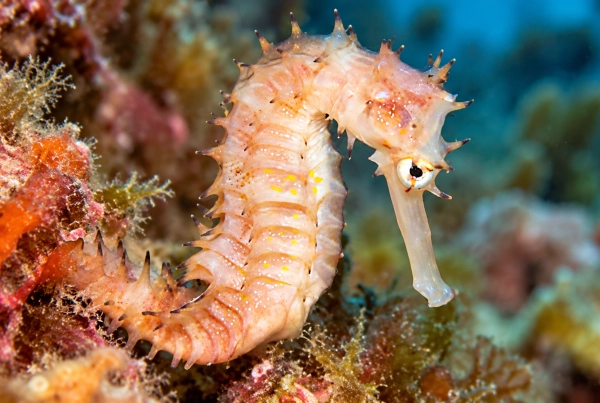
An international research team led by scientists from the Kerala University of Fisheries and Ocean Studies (KUFOS) has discovered a new species of spiny seahorse in the Indian Ocean, resolving a scientific classification problem that persisted for more than 150 years. The newly identified species, Hippocampus amandavincentae, was distinguished from other spiny seahorses through detailed anatomical examinations and genetic analysis. The findings establish that populations previously classified under a single species actually represent three distinct species distributed across the Indian and Pacific Oceans.
The research was published on August 5, 2026, in the international taxonomy journal Zootaxa. The discovery is based on specimens collected from fishing bycatch at Thoothukudi in Tamil Nadu, supported by comparisons with museum specimens and genetic records from several countries. The study provides new evidence about marine biodiversity in Indian waters and establishes a stronger scientific foundation for the conservation of seahorses across the Indo-Pacific region.
Kerala University Researchers Lead International Scientific Investigation
The research was led by Kannan Shalu of the Kerala University of Fisheries and Ocean Studies in Kochi. The international team included Graham Short, Rajeev Raghavan, Ghosh Ramvilas and Kutty Ranjeet, bringing together expertise in marine biology, fish taxonomy and molecular research.
Graham Short is associated with the Australian Museum Research Institute, California Academy of Sciences and Burke Museum in the United States. The collaboration allowed the researchers to compare Indian specimens with historical collections and scientific records maintained by international institutions.
The study examined the identity of the thorny seahorse, Hippocampus histrix, originally described by zoologist Johann Jakob Kaup in 1856. For generations, scientists considered this species to have an exceptionally broad distribution extending from the Red Sea and western Indian Ocean to Japan, Indonesia and other parts of the western Pacific.
However, the researchers found that this classification concealed important differences between geographically separated populations. Their investigation demonstrated that the traditional understanding of Hippocampus histrix included multiple distinct species.
New Seahorse Species Identified from Tamil Nadu Waters
The newly described species was identified using specimens obtained from the southeastern coast of India near Thoothukudi, Tamil Nadu. The specimens were collected from fishing bycatch, which consists of marine animals unintentionally captured during commercial fishing operations.
The scientific examination revealed distinctive anatomical features separating the Indian Ocean specimens from the true Hippocampus histrix found in the Pacific Ocean.
The new seahorse possesses a comparatively short snout, five prominent spines forming a crown-like structure on its head and spines along the principal ridges of its body and tail. These characteristics distinguish it from closely related species that can appear remarkably similar during ordinary observation.
The specimens provided the foundation for a formal taxonomic description, allowing the researchers to establish Hippocampus amandavincentae as a separate species recognised by scientific classification.
The California Academy of Sciences’ Eschmeyer’s Catalog of Fishes subsequently recognised the species as valid. Its taxonomic record identifies Thoothukudi as the type locality and records the specimens used to establish the species.
Genetic Analysis Reveals Three Distinct Seahorse Species
One of the most significant aspects of the research was the use of molecular evidence to distinguish seahorse populations previously grouped under the same scientific name.
The researchers analysed mitochondrial cytochrome c oxidase subunit I, commonly known as COI, a gene frequently used in DNA barcoding studies to examine differences between animal species.
By comparing genetic sequences from Indian Ocean specimens with those associated with other spiny seahorses, the team identified a distinct evolutionary lineage corresponding to Hippocampus amandavincentae.
The findings established that the historically broad classification of Hippocampus histrix encompassed at least three recognisable species.
The original Hippocampus histrix is now understood to occur primarily in the Pacific Ocean, including waters around Japan, Indonesia and the Philippines. Hippocampus jayakari, first described in 1900, represents a separate species associated with the northwestern Indian Ocean. The newly identified Hippocampus amandavincentae occupies parts of the Indian Ocean, including waters around southeastern India.
These findings correct longstanding identification errors in scientific collections and provide a more accurate understanding of the geographical distribution of spiny seahorses.
New Species Named in Honour of Marine Conservationist Amanda Vincent
The researchers named the new species Hippocampus amandavincentae in honour of marine biologist Dr Amanda Vincent of the University of British Columbia in Canada.
Dr Vincent is the director and co-founder of Project Seahorse, an internationally recognised marine conservation initiative dedicated to protecting seahorses and their habitats.
Her scientific work has contributed to understanding seahorse biology, fisheries-related threats, marine conservation policies and the international trade affecting seahorse populations.
The University of British Columbia formally acknowledged the naming of the species on August 12, 2026. Its announcement highlighted the significance of the discovery and the continuing need to protect seahorses from destructive fishing practices.
The newly described fish can reach approximately 16 centimetres in length. Despite its distinctive appearance, researchers had previously encountered similar specimens without recognising that they belonged to a separate species.
The discovery demonstrates how careful taxonomic investigation can reveal previously unrecognised biodiversity even among animals that have been studied for generations.
New Evidence Expands Understanding of Indian Ocean Biodiversity
Although the specimens used for the formal description originated from southeastern India, the researchers identified additional evidence suggesting that Hippocampus amandavincentae occurs across a wider area of the Indian Ocean.
Published genetic sequences support its occurrence in waters associated with Madagascar, Mozambique and the Seychelles. Additional genetic evidence suggests that the species may also occur in the northern Red Sea.
The researchers observed that the possible presence of Hippocampus amandavincentae in the northern Red Sea overlaps with the known range of Hippocampus jayakari. This raises questions about the geographical boundaries separating the two species.
Further field investigations will be necessary to clarify their distributions and determine whether they occupy overlapping habitats in particular regions.
The discovery also demonstrates the importance of Indian coastal waters for marine biodiversity research. The Arabian Sea, Bay of Bengal and surrounding Indian Ocean environments support a wide range of marine organisms whose taxonomy and geographical distribution remain incompletely understood.
Historical Museum Collections Help Resolve Scientific Misidentification
The research illustrates the continuing importance of museum specimens in modern biodiversity studies. Historical collections preserve biological material that scientists can examine using techniques unavailable when the specimens were originally collected.
For more than a century, many spiny seahorses from the Indian Ocean were identified as Hippocampus histrix. Similarities in external appearance made it difficult to distinguish these animals from populations inhabiting the Pacific Ocean.
The international research team examined anatomical characteristics and compared genetic information from specimens representing different geographical regions. These comparisons revealed consistent differences that supported recognition of the three species.
The results also help correct scientific databases in which records from separate species were previously combined.
Accurate identification is essential because conservation assessments depend on knowing where a species occurs, how widely it is distributed and whether its population is declining.
When several species are incorrectly treated as one, their individual conservation requirements may remain concealed within records describing an apparently widespread population.
Discovery Highlights Conservation Challenges Facing Seahorses
Seahorses face several conservation pressures associated with coastal habitat degradation, destructive fishing practices and international wildlife trade.
Many species inhabit shallow marine environments, including seagrass beds, coral reefs and other coastal habitats. Their relatively limited mobility and specialised ecological requirements can make them vulnerable to environmental disturbance.
Bottom trawling presents a particular concern because fishing equipment can unintentionally capture seahorses alongside commercially targeted marine species. Such incidental catches can affect populations even when seahorses are not the intended target of fishing operations.
The discovery of Hippocampus amandavincentae demonstrates the importance of distinguishing individual species when evaluating these threats.
The previously broad concept of Hippocampus histrix included populations occupying different marine regions. Recognising separate species allows conservation researchers to examine their population trends and geographical risks more accurately.
The new species will require its own conservation assessment based on available information about population size, habitat conditions, distribution and threats.
Scientific Classification Supports More Effective Marine Conservation
The identification of a new species is more than an addition to a scientific catalogue. Taxonomic research provides the foundation for understanding biodiversity and developing conservation strategies appropriate to individual organisms.
When researchers establish the identity of a species, they can begin mapping its distribution, identifying important habitats and examining changes in its population.
Such information supports the work of scientific institutions, marine conservation organisations and government agencies responsible for protecting threatened wildlife.
The discovery of Hippocampus amandavincentae also highlights the value of integrating traditional morphological examinations with modern molecular techniques.
Anatomical observations established the physical characteristics distinguishing the species, while genetic analysis provided additional evidence of its separate evolutionary identity.
Combining these methods strengthens the reliability of scientific classification and helps researchers resolve longstanding uncertainties in marine biodiversity records.
Indian Marine Research Makes an Important Contribution to Global Taxonomy
The discovery represents a significant contribution by Indian researchers to international marine taxonomy and biodiversity science.
Scientists from the Kerala University of Fisheries and Ocean Studies played a leading role in investigating specimens collected from Indian waters, while collaboration with international institutions provided access to comparative material and genetic information.
The research demonstrates how Indian universities can contribute to resolving complex scientific questions with implications extending far beyond the country’s territorial waters.
Its findings are relevant to the conservation and classification of seahorses across the Indian and Pacific Oceans. They also provide a foundation for additional surveys of Indian coastal habitats and further examination of historical museum collections.
The formal recognition of Hippocampus amandavincentae adds to scientific knowledge of the extraordinary diversity found in India’s marine ecosystems.
A New Chapter in India’s Marine Biodiversity Research
The discovery of Hippocampus amandavincentae has resolved a classification problem that began with the original description of Hippocampus histrix in 1856. Through detailed anatomical studies, genetic analysis and international scientific collaboration, researchers have demonstrated that what was once considered a single widespread seahorse actually comprises multiple distinct species.
The findings improve understanding of seahorse diversity in the Indian Ocean and provide an important basis for future conservation assessments. They also demonstrate the scientific value of investigating marine organisms recovered from fisheries and preserved in museum collections.
For India, the discovery highlights the growing capabilities of its marine research institutions and the importance of exploring coastal biodiversity through systematic scientific investigation.
As further research examines the distribution, habitats and conservation needs of the newly recognised species, the work of the KUFOS-led team will contribute to a more accurate understanding of marine life and strengthen efforts to protect the biological richness of the Indian Ocean.
References
- Shalu, K., Short, G., Raghavan, R., Ramvilas, G. and Ranjeet, K. (2026). A New Species of Spiny Seahorse, Hippocampus amandavincentae, with Redescription of H. histrix and H. jayakari (Teleostei: Syngnathidae). Zootaxa, Volume 5862, Issue 2, pages 271–292. Published August 5, 2026.
https://doi.org/10.11646/zootaxa.5862.2.4 - University of British Columbia, Faculty of Science, August 12, 2026. New Seahorse Species Named After UBC Marine Conservationist. Institutional announcement describing the discovery, naming and conservation significance.
https://science.ubc.ca/news/2026-08/new-seahorse-species-named-after-ubc-marine-conservationist - California Academy of Sciences, Eschmeyer’s Catalog of Fishes, September 2026. Hippocampus amandavincentae – Valid species record, type locality, type specimens and geographical distribution.
https://research.calacademy.org/research/ichthyology/catalog/fishcatget.asp?spid=78618 - Project Seahorse, University of British Columbia. Scientific research and marine conservation programmes concerning seahorses and their habitats.
https://projectseahorse.org/
You may also like
-
Chhattisgarh Plans Innovative Tree Surgery to Save Over 500 Damaged Trees in Udanti Sitanadi Tiger Reserve
-
Kerala’s Peechi Wildlife Survey Records 395 Species, Adds 36 New Entries to Biodiversity Checklists
-
Tiger Returns to Maharashtra’s Beed Forests After Nearly 100 Years, Highlights Importance of Wildlife Corridors
-
Himachal Pradesh Achieves Major Success in Rare Cheer Pheasant Conservation
-
Blackbucks to Return to Chhattisgarh’s Gomarda Wildlife Sanctuary After Five Decades
