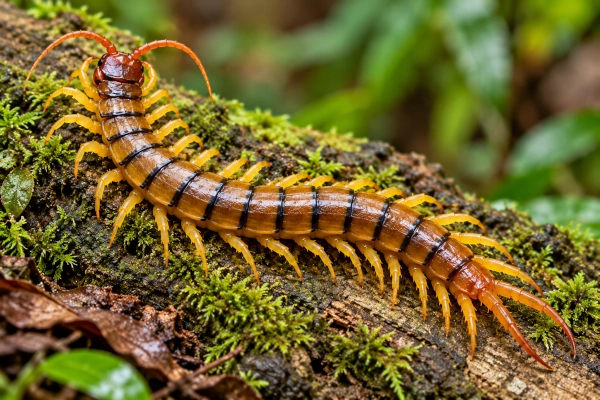
Scientists from the Zoological Survey of India (ZSI) and Malabar Christian College in Kozhikode have identified three previously undescribed centipede species from the Western Ghats of Kerala and Karnataka. The discovery expands scientific knowledge of India’s invertebrate biodiversity and highlights the ecological richness of one of the world’s most important biodiversity hotspots.
The three species, identified as Rhysida quadrispinosa, Rhysida coorgensis and Rhysida neyyarensis, belong to the centipede genus Rhysida. Their descriptions were published on October 12, 2026, in the International Journal of Tropical Insect Science.
Researchers from ZSI’s Western Ghats Regional Centre in Kozhikode and Malabar Christian College conducted detailed examinations of preserved centipede specimens. The study identified distinctive anatomical characteristics that distinguish the three species from previously documented members of the genus.
The discovery brings the reported number of Rhysida species documented in India to 23, further demonstrating the importance of systematic biodiversity research and the scientific examination of historical zoological collections.
Three New Centipede Species Identified from Southern India
The newly described centipedes belong to the family Scolopendridae, a group of predatory arthropods found in tropical and subtropical environments. Members of this family possess elongated, segmented bodies and specialised venom-bearing appendages used to capture prey.
The researchers identified the new species through a detailed comparison of anatomical structures, including antennae, body segments, leg spines and specialised features near the posterior end of the body.
Although closely related centipede species can appear almost identical, small differences in their physical structures often provide reliable characteristics for scientific identification.
The study identified Rhysida quadrispinosa through its distinctive arrangement of spines, while the other two species were named after their geographical associations with Coorg in Karnataka and Neyyar Wildlife Sanctuary in Kerala.
Together, these findings extend the documented diversity of the genus across southern India and provide additional information about its geographical distribution.
Rhysida quadrispinosa Distinguished by Four Specialised Spines
The first species, Rhysida quadrispinosa, received its scientific name from a distinctive anatomical characteristic involving four spines on the prefemur of its ultimate legs.
The prefemur is a segment of the leg, while the ultimate legs are the final pair located at the posterior end of a centipede’s body. Their structures are particularly important in identifying members of the genus Rhysida.
Researchers observed four ventrolateral spines on the ultimate leg prefemur, providing one of the diagnostic features that distinguish the species from its relatives.
The centipede also possesses antennae consisting of 18 segments, together with distinctive characteristics involving the margins of its body plates.
The study documented the arrangement of these structures and compared them with existing descriptions of related species. The combination of anatomical characteristics supported the identification of R. quadrispinosa as a distinct species.
Rhysida coorgensis Named After Karnataka’s Coorg Region
The second species, Rhysida coorgensis, takes its name from Coorg, also known as Kodagu, in Karnataka. The name recognises the geographical region associated with the specimen’s collection.
Coorg forms part of the Western Ghats landscape and contains extensive forest ecosystems supporting numerous species of invertebrates, amphibians, reptiles, birds and mammals.
Researchers found that R. coorgensis resembles the previously described species Rhysida ikhalama. However, detailed examination revealed differences in the arrangement of anatomical structures that distinguish the two species.
These characteristics include the position and development of paired longitudinal sutures on the dorsal body plates, along with differences in the configuration of spines near the posterior part of the body.
The study demonstrates how detailed taxonomic examination can reveal distinct species among organisms that initially appear similar.
The recognition of R. coorgensis also adds to the documented invertebrate diversity of Karnataka’s Western Ghats.
Rhysida neyyarensis Discovered from Kerala’s Neyyar Wildlife Sanctuary
The third species, Rhysida neyyarensis, was named after Neyyar Wildlife Sanctuary in Thiruvananthapuram district, Kerala.
Located in the southern Western Ghats, Neyyar Wildlife Sanctuary contains forest habitats associated with the Agasthyamalai landscape. The region supports considerable biological diversity and forms part of an important conservation area in southern India.
Researchers distinguished R. neyyarensis through the arrangement of spines and specialised structures on its legs.
One of its notable diagnostic features is the presence of two tarsal spurs on each of the first 19 pairs of walking legs. The species also displays a distinctive arrangement of tibial spurs and spines on its ultimate legs.
These anatomical characteristics separate it from closely related members of the genus, including species previously documented from the Western Ghats.
The identification of R. neyyarensis adds another scientifically recognised invertebrate species to the biodiversity records associated with Kerala’s protected forest landscapes.
Scientists Examine Preserved Specimens in National Zoological Collection
An important aspect of the discovery is that the researchers examined unidentified centipede specimens already preserved in the National Zoological Collection maintained by the Zoological Survey of India.
Scientific collections preserve animal specimens gathered during field surveys and research expeditions. These collections provide permanent reference material that scientists can examine as taxonomic knowledge and research techniques improve.
The researchers used microscopes and digital imaging equipment to study fine anatomical structures that are difficult to distinguish through ordinary visual examination.
Their observations included the number and arrangement of antennal segments, spines on the walking legs, structural characteristics of body plates and specialised features associated with the final body segments.
The scientists compared these observations with published taxonomic descriptions and information available through ChiloBase 2.0, an international database documenting centipede taxonomy.
This process allowed them to determine whether the specimens belonged to previously described species or possessed sufficiently distinctive characteristics to justify their recognition as new species.
The findings demonstrate the continuing scientific value of preserved zoological collections. Specimens collected in earlier periods can yield new discoveries when examined using improved methods and updated taxonomic information.
Why Centipedes Are Important to Forest Ecosystems
Centipedes are predatory arthropods that occupy an important position within terrestrial food webs. They commonly inhabit soil, leaf litter, decaying wood and other sheltered environments where suitable prey is available.
Unlike millipedes, which generally feed on decaying organic matter and plant material, centipedes primarily hunt other small animals. Their prey can include insects, spiders and various soil-dwelling invertebrates.
Centipedes capture prey using specialised appendages called forcipules, which are modified legs located near the head. These structures contain venom-delivery mechanisms that assist in immobilising prey.
Through their predatory activities, centipedes participate in the ecological relationships that regulate invertebrate populations within forest habitats.
They also form part of the food web, providing prey for larger animals while contributing to the diversity of organisms inhabiting forest floors.
Understanding centipede diversity is therefore relevant to broader research into soil ecology, invertebrate communities and the functioning of tropical forest ecosystems.
Western Ghats Continue to Reveal Previously Undocumented Biodiversity
The Western Ghats are recognised internationally as a major biodiversity hotspot. Extending along western peninsular India, the mountain system contains a wide range of habitats, including tropical evergreen forests, moist deciduous forests, montane grasslands and freshwater ecosystems.
The region supports numerous endemic species, many of which have restricted geographical distributions. Its varied elevations, rainfall patterns and forest environments have contributed to the evolution and persistence of diverse biological communities.
While large mammals, birds and flowering plants often receive the greatest public attention, invertebrates account for a substantial portion of terrestrial biodiversity.
Centipedes, spiders, beetles and other arthropods occupy specialised ecological niches that remain incompletely documented in many tropical regions.
The discovery of three additional Rhysida species from Kerala and Karnataka demonstrates that the biological diversity of the Western Ghats is still being documented.
It also highlights the importance of research institutions conducting systematic surveys and maintaining scientific collections that support future taxonomic studies.
Zoological Survey of India’s Contribution to Biodiversity Research
The Zoological Survey of India, established in 1916, serves as one of the country’s principal institutions for zoological research, animal taxonomy and biodiversity documentation.
Operating under the Ministry of Environment, Forest and Climate Change, ZSI conducts scientific surveys, maintains reference collections and publishes research concerning India’s animal diversity.
Its regional centres undertake research across different ecological and geographical regions, including the Western Ghats.
The Western Ghats Regional Centre in Kozhikode has contributed to the documentation of the region’s fauna through taxonomic investigations and biodiversity studies.
The collaboration with Malabar Christian College demonstrates the value of cooperation between government research institutions and academic establishments in advancing biological research.
Such partnerships contribute to scientific training, species identification and the development of knowledge required for biodiversity conservation.
New Discoveries Reinforce the Importance of Forest Conservation
The identification of new species has implications for conservation because effective biodiversity protection depends partly on understanding which organisms occur within particular habitats.
Species with limited geographical distributions may be especially vulnerable to habitat loss, fragmentation and environmental changes. However, the precise distribution and conservation requirements of newly described species can only be established through additional field studies.
The present discovery identifies previously undocumented members of the genus Rhysida and provides anatomical information necessary for recognising them in future research.
Further investigations can help determine their distribution, habitat preferences, population characteristics and relationships with other species.
Protecting forest ecosystems, maintaining ecological connectivity and supporting scientific research remain important elements of conserving the Western Ghats’ biological diversity.
The discovery also demonstrates that biodiversity conservation extends beyond protecting conspicuous or well-known animals. Smaller organisms are essential components of natural ecosystems and deserve attention in scientific research and habitat management.
Three New Species Add to India’s Growing Biodiversity Records
The discovery of Rhysida quadrispinosa, Rhysida coorgensis and Rhysida neyyarensis represents another contribution to India’s expanding knowledge of its native wildlife.
By examining preserved specimens and comparing detailed anatomical characteristics, researchers from the Zoological Survey of India and Malabar Christian College have identified three distinct members of a predatory centipede genus.
The findings add scientific recognition to previously undocumented biodiversity associated with Kerala and Karnataka, while demonstrating the continuing importance of the National Zoological Collection.
The discovery reinforces the Western Ghats’ significance as a centre of biological diversity and provides additional information for future studies of centipede taxonomy, distribution and evolution.
Continued scientific exploration, careful documentation and protection of natural habitats will strengthen India’s ability to understand and conserve the remarkable diversity of life found within its forests.
References
- International Journal of Tropical Insect Science — October 12, 2026. Discovery of Three New Species of the Genus Rhysida Wood, 1862 (Chilopoda: Scolopendromorpha), from Southern India. Original scientific research paper describing the three newly identified centipede species.DOI: https://doi.org/10.1007/s42690-026-02054-4
- Zoological Survey of India, Ministry of Environment, Forest and Climate Change. National Zoological Collection and Western Ghats Regional Centre, Kozhikode. Institutional background relating to zoological taxonomy and biodiversity documentation.https://zsi.gov.in/
- Research Matters — October 16, 2026. India’s Centipede Family Tree Extended with Discovery of Three New Species from South India. Research communication identifying the species, examining institutions and principal taxonomic findings.https://researchmatters.in/news/indias-centipede-family-tree-extended-with-discovery-of-three-new-species-from-south-india
You may also like
-
Scientists Document 3,261 Flowering Plant Species in Agasthyamalai Biosphere Reserve, Including 1,018 Indian Endemics
-
Scientists Discover Two Rare Blind Fish Species in Assam’s Underground Waters, Revealing Hidden Biodiversity
-
India Begins National Red List Assessment of 1,211 Bird Species to Strengthen Wildlife Conservation
-
Wild Water Buffaloes Return to Madhya Pradesh’s Kanha Landscape After Nearly 100 Years
-
Indian Scientists Discover New Seahorse Species in Indian Ocean, Resolve 150-Year-Old Scientific Mystery
