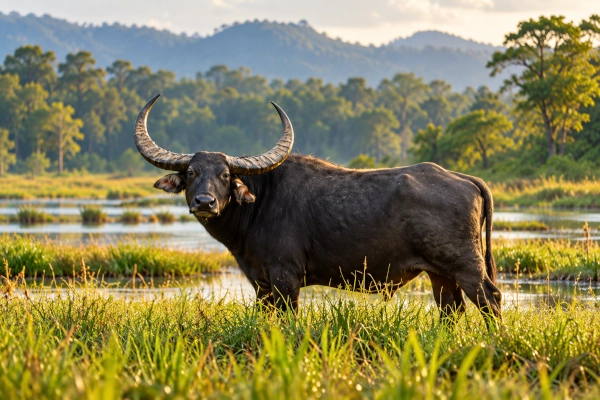
India has taken an important step towards restoring an endangered species to its historical habitat, with eight wild water buffaloes from Assam’s Kaziranga National Park entering a specially developed enclosure in Madhya Pradesh’s Kanha Tiger Reserve. The initiative marks the beginning of a long-term effort to re-establish the species in a landscape where wild buffaloes had disappeared nearly a century ago.
On October 11, 2026, Madhya Pradesh Chief Minister Dr. Mohan Yadav released six female and two male wild water buffaloes into a 17-hectare acclimatisation enclosure in the Supkhar range of Kanha Tiger Reserve. The animals had been transported from Kaziranga earlier in the year and initially housed in a smaller enclosure for quarantine, monitoring and adjustment to their new surroundings.
The Madhya Pradesh government aims to establish a population of 50 wild water buffaloes in the Kanha landscape over the next three years. The programme brings together the forest departments of Madhya Pradesh and Assam, supported by scientific research into habitat suitability, animal management and long-term conservation requirements.
Wild Water Buffaloes Complete Their Journey from Kaziranga to Kanha
The eight wild water buffaloes were transported from Kaziranga National Park in Assam to Kanha Tiger Reserve in two separate groups during April and May 2026. The first group, comprising three females and one male, arrived on April 28, followed by another group with the same composition on May 9. Together, the two groups completed a journey of approximately 2,200 kilometres to reach their new conservation habitat in Madhya Pradesh.
Following their arrival, the animals were placed in a one-hectare enclosure in the Supkhar range, where forest officials monitored their health, behaviour and adaptation to local environmental conditions. The initial quarantine and acclimatisation period allowed the buffaloes to adjust gradually before being transferred to a larger facility.
The October 11 event marked the next stage of this rehabilitation process. Chief Minister Mohan Yadav formally released the animals into a 17-hectare enclosure, providing them with considerably more space while retaining the supervision necessary during the early stages of reintroduction. The buffaloes have not yet been released into unrestricted forest habitat, making the larger enclosure an important transitional stage in the programme.
Supkhar Range Selected for Restoration of Historical Buffalo Habitat
The Supkhar range was selected for the programme because of its historical association with wild water buffaloes and its potential to provide suitable grassland and wetland conditions. The species once inhabited parts of central India’s natural landscapes before disappearing from the region following a prolonged decline in its distribution.
Restoring the species requires careful assessment of habitat conditions because wild water buffaloes depend on landscapes that provide sufficient grazing opportunities, access to water and relatively undisturbed areas for movement and breeding. These environmental requirements influence both the selection of reintroduction sites and the management strategies adopted after translocation.
The Kanha landscape contains extensive forest and grassland ecosystems that support several large herbivores. Its established protected-area management system provides an institutional foundation for implementing a carefully monitored wildlife restoration programme. The selection of Supkhar reflects the objective of reintroducing wild buffaloes into an area considered suitable for their ecological requirements rather than relocating them without prior habitat assessment.
Wildlife Institute of India Provides Scientific Foundation for Reintroduction
The Wildlife Institute of India initiated a feasibility study in August 2020 to examine the possibility of reintroducing wild water buffaloes into Kanha Tiger Reserve. The research was supported by the Madhya Pradesh Tiger Foundation Society and the Madhya Pradesh Forest Department, with the objective of identifying suitable habitats, evaluating potential source populations and developing recommendations for long-term management.
The study examined several ecological factors that influence the survival of large grazing mammals. Researchers assessed vegetation characteristics, terrain, grassland distribution, seasonal rainfall patterns and the extent of human disturbance. These investigations helped identify areas capable of supporting the animals and provided guidance for managing potential risks associated with reintroduction.
The assessment also considered the importance of selecting appropriate source populations. Wildlife translocation requires attention to animal health, genetic characteristics and the ability of relocated individuals to adapt to unfamiliar environments. By incorporating these considerations into the planning process, the programme has sought to establish a scientific basis for restoring wild buffaloes to Kanha.
The institute’s work demonstrates the importance of integrating field research with conservation management. Successful reintroduction depends not only on finding a suitable location but also on understanding how the animals will interact with their environment over successive generations.
Phased Rehabilitation to Prepare Buffaloes for Life in the Wild
The Kanha reintroduction programme follows a gradual rehabilitation process designed to help the relocated animals adjust to their new habitat. Instead of releasing them directly into the open forest, authorities initially placed the buffaloes in a controlled enclosure where their condition and behaviour could be observed.
The transfer into the larger 17-hectare enclosure represents a continuation of this process. The expanded area allows greater freedom of movement and provides opportunities for the animals to develop familiarity with local vegetation and environmental conditions. Forest officials can continue monitoring their health, feeding behaviour and social interactions during this period.
The next stage will involve assessing the animals’ readiness for eventual movement into suitable open habitats. Such decisions require careful consideration of their adaptation, the availability of food and water, and the capacity of the surrounding landscape to support a growing population.
Phased reintroduction is particularly important for large herbivores because successful establishment requires more than short-term survival. The animals must eventually reproduce, maintain healthy social groups and establish a population capable of persisting without continuous human intervention.
Madhya Pradesh Plans to Establish a Population of 50 Wild Buffaloes
The Madhya Pradesh government has announced a target of establishing 50 wild water buffaloes in the Kanha landscape over the next three years. The initial group of eight animals forms the foundation of this conservation effort, with the programme expected to involve further measures to expand the population.
Achieving this objective will require sustained attention to habitat management, animal health and breeding success. The initial population contains six females and two males, providing a starting group for the restoration initiative. However, long-term viability will also depend on maintaining adequate genetic diversity and ensuring that the population can reproduce successfully under natural conditions.
The programme will require continued monitoring to evaluate how the animals adapt to their surroundings and whether additional translocations are necessary. Conservation managers must also assess potential interactions with other wildlife and livestock, particularly where there are risks of disease transmission or competition for resources.
The three-year population target provides a defined objective for the state government’s restoration programme. Establishing a self-sustaining wild population, however, remains a longer-term conservation goal that will require scientific evaluation beyond the initial period.
Wild Water Buffaloes Among India’s Endangered Large Mammals
The wild water buffalo, scientifically known as Bubalus arnee, is classified as Endangered on the International Union for Conservation of Nature Red List. It is one of Asia’s largest wild bovines and is distinguished by its powerful body, broad head and long, curved horns.
Historically, wild water buffaloes occupied extensive grassland, floodplain and wetland habitats across South and Southeast Asia. Their distribution has contracted considerably because of habitat degradation, hunting, human disturbance and increasing pressure from domestic livestock.
One of the significant threats to the species is hybridisation with domestic and feral water buffaloes. Interbreeding can affect the genetic integrity of wild populations, making the protection of genetically suitable conservation groups an important requirement. Disease transmission from livestock and competition for grazing resources also present challenges in landscapes where human and wildlife activities overlap.
Conserving wild water buffaloes therefore involves protecting suitable habitats while carefully managing interactions with domestic animals. Reintroduction programmes must address these concerns to ensure that newly established populations remain healthy and retain the characteristics of the wild species.
Kaziranga Supports Restoration of Wild Buffaloes Beyond Assam
Kaziranga National Park is one of India’s most important habitats for wild water buffaloes. Its extensive grasslands, wetlands and floodplain ecosystems provide suitable conditions for the species, alongside other threatened mammals such as the greater one-horned rhinoceros and Asian elephant.
The park’s conservation importance extends beyond protecting wildlife within Assam. Established populations can also support carefully planned restoration initiatives in other regions where suitable habitats remain available but native species have disappeared. The transfer of wild buffaloes to Kanha demonstrates this wider contribution to national biodiversity conservation.
The programme required coordination between the forest authorities of Assam and Madhya Pradesh. Madhya Pradesh Chief Minister Mohan Yadav acknowledged the assistance provided by Assam Chief Minister Himanta Biswa Sarma in facilitating the relocation of the animals.
This cooperation illustrates how state governments can work together to restore threatened species across their historical ranges. By combining the conservation resources of Kaziranga with the habitat and management capabilities of Kanha, the initiative creates an opportunity to establish an additional population of an endangered Indian mammal.
Return of Wild Buffaloes Adds a New Dimension to Kanha’s Grassland Conservation
Wild water buffaloes are large grazing animals that form part of the ecological communities associated with natural grasslands and wetlands. Their feeding, movement and use of water sources can influence vegetation patterns and contribute to the ecological processes that shape these habitats.
Large herbivores affect their surroundings through grazing, trampling and the redistribution of nutrients. These activities can influence plant growth, habitat structure and the availability of resources for other species. However, the ecological effects depend on local conditions, animal numbers and the characteristics of the vegetation.
The restoration of wild buffaloes to Kanha creates an opportunity to reintroduce a native grazing species that has been absent from the landscape for several generations. Scientific monitoring will help determine how the animals interact with grasslands, water bodies and other herbivores once they become established.
Kanha Tiger Reserve is already recognised for its conservation of the hard-ground barasingha, a threatened deer associated with the region’s grassland ecosystems. The wild buffalo initiative adds another element to the reserve’s biodiversity management by focusing on the restoration of a large native bovine.
India Strengthens Its Wildlife Reintroduction and Habitat Restoration Efforts
The Kanha wild buffalo programme forms part of India’s wider conservation efforts to restore threatened wildlife populations within suitable habitats. Wildlife reintroduction has become an increasingly important conservation approach in areas where species have disappeared but environmental conditions can support their return.
Madhya Pradesh has undertaken several major wildlife conservation initiatives, including habitat management for threatened grassland animals and programmes involving the reintroduction of species into protected landscapes. These activities require cooperation between government departments, research institutions, veterinarians and field conservation teams.
The restoration of wild water buffaloes presents challenges that differ from those associated with maintaining an existing population. Translocated animals must adapt to unfamiliar surroundings, establish stable social relationships and eventually reproduce under natural conditions. The receiving habitat must also provide sufficient resources while limiting threats from disease, human disturbance and competition.
The programme’s effectiveness will therefore depend on continued scientific observation and adaptive management. Monitoring the animals over several years will provide valuable information about their survival, reproduction and ability to establish a viable population in central India.
Kanha’s Wild Buffalo Restoration Marks an Important Conservation Milestone
The return of eight wild water buffaloes to Kanha Tiger Reserve represents an important milestone in India’s efforts to restore endangered wildlife to historical habitats. After an absence approaching a century, the species has once again become part of the landscape through a carefully planned conservation programme.
The initiative combines scientific feasibility studies, inter-state cooperation, protected-area management and phased animal rehabilitation. The transfer from Kaziranga and subsequent movement into the larger Supkhar enclosure have established the initial foundation for restoring a wild buffalo population in Madhya Pradesh.
The state’s target of establishing 50 animals over three years provides a framework for expanding the programme, while long-term monitoring will help determine the success of population establishment and habitat adaptation.
Beyond the return of a single species, the initiative highlights the importance of protecting India’s grasslands, wetlands and natural herbivore communities. It also demonstrates how coordinated conservation programmes can help restore native wildlife to landscapes where ecological relationships have been disrupted.
With the first eight animals progressing through acclimatisation, Kanha has begun a new chapter in its conservation history. The programme strengthens India’s commitment to protecting endangered species and rebuilding the ecological richness of its natural landscapes.
References
- Akashvani News, Government of India — October 12, 2026. MP Begins Wild Buffalo Reintroduction in Kanha After Nearly a Century; CM Mohan Yadav Releases Eight Buffaloes. The report documents the transfer of eight wild buffaloes into a 17-hectare enclosure, their origin in Kaziranga and the proposed three-year conservation target.https://newsonair.gov.in/mp-begins-wild-buffalo-reintroduction-in-kanha-after-nearly-a-century-cm-mohan-yadav-releases-eight-buffaloes/
- Wildlife Institute of India, Ministry of Environment, Forest and Climate Change — Annual Report 2020–21. Feasibility Study of Wild Buffalo Reintroduction in Kanha Tiger Reserve. The report documents the scientific project initiated in August 2020, including habitat assessment, source-population identification and conservation planning.https://wii.gov.in/uploads/topics/wii_annual_report_2020-21_english-17372684206541.pdf
- Madhya Pradesh Forest Department. Wild Buffalo Reintroduction Project, Kanha Tiger Reserve, Supkhar Range. Official conservation initiative implemented in cooperation with the Assam Forest Department.
- International Union for Conservation of Nature (IUCN). Bubalus arnee — Wild Water Buffalo. IUCN Red List of Threatened Species. Conservation status, historical distribution and major threats.https://www.iucnredlist.org/
You may also like
-
Indian Scientists Discover New Seahorse Species in Indian Ocean, Resolve 150-Year-Old Scientific Mystery
-
Chhattisgarh Plans Innovative Tree Surgery to Save Over 500 Damaged Trees in Udanti Sitanadi Tiger Reserve
-
Kerala’s Peechi Wildlife Survey Records 395 Species, Adds 36 New Entries to Biodiversity Checklists
-
Tiger Returns to Maharashtra’s Beed Forests After Nearly 100 Years, Highlights Importance of Wildlife Corridors
-
Himachal Pradesh Achieves Major Success in Rare Cheer Pheasant Conservation
