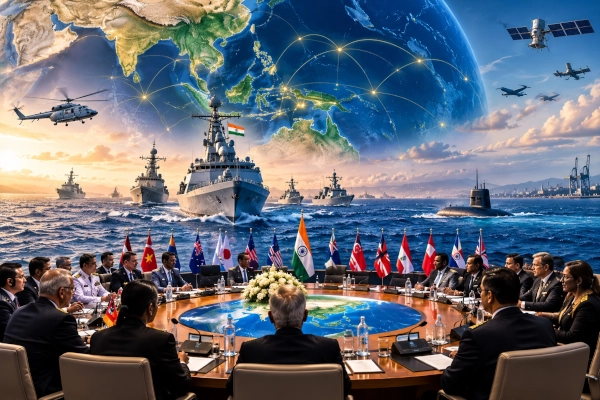
The Indian Navy will host the Indo-Pacific Regional Dialogue 2026 (IPRD-2026) in New Delhi from 3 to 5 November 2026, bringing together maritime experts, scientists, academicians, policymakers and strategic specialists from 18 countries. The three-day international conference will focus on strengthening scientific research, technological innovation and academic partnerships across the Indo-Pacific region.
Announcing the event on 23 October 2026, the Ministry of Defence confirmed that the conference will take place at the Manekshaw Centre in New Delhi. The Indian Navy will organise the dialogue in close association with the National Maritime Foundation (NMF), which serves as its knowledge partner and the principal organiser of the event.
The theme of this year’s conference, Science, Technology and Academic Cooperation in the Indo-Pacific, reflects India’s growing emphasis on collaborative research, emerging maritime technologies, ocean governance and the development of scientific capabilities across the region.
The conference will examine practical opportunities for international cooperation in maritime security, climate resilience, critical infrastructure protection and oceanographic research. It will also explore ways to strengthen institutional partnerships and improve the exchange of scientific knowledge among Indo-Pacific countries.
Indo-Pacific Regional Dialogue as India’s Premier Naval Strategic Forum
The Indo-Pacific Regional Dialogue serves as the Indian Navy’s annual apex-level international outreach conference at the strategic level. It provides a platform for maritime professionals, policymakers, research institutions and academic organisations to examine issues affecting the Indo-Pacific maritime environment.
Successive editions of the dialogue have explored different aspects of maritime cooperation, including ocean security, scientific development, environmental sustainability and regional partnerships. The conference seeks to connect strategic discussions with practical initiatives that can strengthen cooperation among countries sharing interests in the Indian Ocean and wider Indo-Pacific.
The programme also supports India’s efforts to develop closer relationships with regional maritime institutions and international research communities. By bringing together specialists from different disciplines, the dialogue encourages a broader understanding of maritime challenges that extend beyond traditional naval operations.
IPRD-2026 places particular emphasis on translating discussions into practical measures that governments, scientific institutions and maritime organisations can pursue through existing cooperative arrangements.
Conference Supports India’s Indo-Pacific Oceans Initiative
The Indo-Pacific Regional Dialogue draws upon the framework established by India’s Indo-Pacific Oceans Initiative (IPOI), announced by Prime Minister Narendra Modi at the 14th East Asia Summit in Bangkok in November 2019.
The initiative identifies seven interconnected areas of maritime cooperation, including maritime security, maritime ecology, maritime resources, capacity building and resource sharing, disaster risk reduction and management, science and technology cooperation, and trade connectivity and maritime transport.
These areas provide a framework for addressing challenges that affect countries across the Indo-Pacific. The initiative recognises that maritime security, economic development and environmental sustainability are closely connected and require coordinated responses.
According to the Ministry of Defence, successive editions of the Indo-Pacific Regional Dialogue have examined different dimensions of these seven areas while identifying opportunities for more focused international cooperation.
The 2026 conference will advance this approach by concentrating on scientific collaboration, technological development and academic partnerships that can support practical maritime initiatives.
Advancing India’s MAHASAGAR Vision for Regional Cooperation
The conference also reflects India’s maritime vision of MAHASAGAR — Mutual and Holistic Advancement for Security and Growth Across Regions.
MAHASAGAR emphasises cooperation among countries to promote maritime security, economic progress and sustainable development. Within this broader framework, scientific research and technology partnerships provide important opportunities for countries to address shared challenges.
The Ministry of Defence has identified the Indo-Pacific Oceans Initiative as an important framework for translating India’s maritime vision into specific areas of cooperation. The Indo-Pacific Regional Dialogue seeks to develop these broad objectives into more detailed proposals and collaborative programmes.
Through discussions involving governments, research organisations and maritime specialists, IPRD-2026 will examine how participating institutions can strengthen existing partnerships and establish practical arrangements for future cooperation.
The conference will therefore connect India’s broader maritime policy with scientific research, institutional development and collaborative technological initiatives.
Five Thematic Sessions to Examine Maritime Challenges
The three-day conference will feature five professional thematic sessions covering important aspects of maritime science, technology and international cooperation.
The first session, Academic Networks, Research, and Human Capital Development, will examine opportunities for strengthening collaboration between universities, research institutions and professional training organisations.
Participants will consider ways to expand joint research, improve institutional partnerships and develop specialised expertise in maritime disciplines. The discussions will also address the role of academic networks in supporting long-term scientific and technological development across the Indo-Pacific.
The second session, Maritime Situational Awareness and Protection of Critical Maritime Infrastructure, will focus on understanding maritime activity and protecting essential infrastructure.
Maritime situational awareness involves collecting, analysing and sharing information about activities taking place at sea. Effective awareness supports navigation, maritime safety, law enforcement and the protection of infrastructure.
The conference will consider opportunities for cooperation in monitoring maritime environments and protecting critical assets such as ports, subsea communication cables, offshore installations and associated maritime infrastructure.
Oceanographic Science and Climate Resilience Receive Special Attention
The third professional session, Oceanographic Science and Climate Resilience, will examine the role of scientific research in understanding changing ocean conditions and strengthening the ability of coastal communities to respond to environmental challenges.
Oceanographic research provides information about ocean circulation, marine ecosystems, sea temperatures, coastal processes and other environmental conditions. Such knowledge supports maritime planning, disaster preparedness, sustainable resource management and climate-related assessments.
Climate change presents challenges across the Indo-Pacific, particularly for coastal regions and island nations exposed to rising sea levels, extreme weather events and changes in marine ecosystems.
The conference will explore opportunities for improving scientific cooperation, exchanging research information and strengthening institutional arrangements for addressing these challenges.
By encouraging collaboration between scientists and maritime policymakers, the discussions aim to connect research findings with practical approaches to climate resilience and ocean management.
Collaborative Ocean Governance and Maritime Resilience
The fourth session, Collaborative Approaches to Ocean Governance and Maritime Resilience, will examine how countries and institutions can work together to manage shared maritime resources and respond to regional challenges.
Ocean governance encompasses the policies, institutions and cooperative arrangements through which maritime activities and marine resources are managed. It involves considerations relating to environmental protection, resource use, maritime safety and the responsible development of ocean-based economic activities.
The interconnected nature of the world’s oceans makes international cooperation particularly important. Developments affecting one maritime region can have consequences for neighbouring countries, shipping routes, marine ecosystems and coastal economies.
IPRD-2026 will provide a forum for discussing collaborative approaches that strengthen institutional coordination and improve the ability of maritime communities to respond to environmental, economic and security challenges.
The deliberations will also consider mechanisms for strengthening international partnerships and developing practical measures at national, sub-regional and wider regional levels.
Emerging Maritime Technologies and Their Dual-Use Applications
The fifth professional session, Transformative Maritime Technologies and Dual-Use Implications, will examine technological developments that are changing maritime operations and scientific research.
Emerging technologies increasingly influence how countries monitor ocean environments, manage maritime infrastructure and conduct research. Innovations in autonomous systems, advanced sensors, artificial intelligence, communication networks and data processing offer opportunities for improving maritime capabilities.
Many technologies developed for civilian applications also possess potential military or security uses. These dual-use characteristics create opportunities for collaboration while raising questions relating to governance, responsible development and appropriate information sharing.
The conference will examine how technological innovation can support maritime research and operational capabilities while encouraging responsible international cooperation.
Discussions will also consider collaborative technology development, access to scientific data and institutional partnerships capable of supporting future maritime innovation.
Former Naval Chiefs of India and Sri Lanka to Discuss Maritime Cooperation
IPRD-2026 will feature a special session titled Perspectives from the Flag Bridge, bringing together former naval chiefs from India and Sri Lanka.
The session will examine opportunities for strengthening cooperation through the Indian Ocean Naval Symposium (IONS), an important forum for engagement among navies of the Indian Ocean region.
The former naval leaders will share their perspectives on how the existing regional framework can support greater cooperation in science, technology and academic engagement.
Their discussions will focus particularly on the Indian Ocean, which forms the western segment of the wider Indo-Pacific maritime region.
The session will provide an opportunity to connect the operational experience of senior naval professionals with emerging opportunities for scientific and institutional cooperation.
Special Ambassadorial Dialogue to Promote International Partnerships
Another special session, Sahyog Ka Samvaad, will bring together diplomatic representatives for discussions on cooperation across the Indo-Pacific.
The Hindi terms Sahyog and Samvaad mean cooperation and dialogue, respectively, reflecting the session’s emphasis on constructive engagement among participating countries.
Diplomatic cooperation plays an important role in establishing the institutional frameworks necessary for international scientific research, technological collaboration and information sharing.
The ambassadorial interaction will provide an opportunity to examine how diplomatic relationships can support maritime initiatives and strengthen cooperation among governments, research institutions and other organisations.
By including diplomatic engagement alongside scientific and naval discussions, the conference seeks to develop a more comprehensive approach to regional maritime cooperation.
Defence Minister Rajnath Singh and Science Minister Jitendra Singh to Address Conference
The Ministry of Defence has confirmed that Defence Minister Rajnath Singh and Union Minister of State (Independent Charge) for Science and Technology Dr Jitendra Singh will deliver special addresses during the conference.
Rajnath Singh will deliver the commemorative address, while Dr Jitendra Singh will address participants on matters connected with science and technology.
Their participation reflects the conference’s emphasis on connecting maritime security considerations with scientific research, technological innovation and institutional development.
The official programme places the two ministerial sessions on the second day of the conference, alongside professional thematic discussions.
The ministerial addresses will form part of a wider programme involving maritime practitioners, scientists, academicians and policymakers from across the Indo-Pacific.
National Maritime Foundation to Support International Maritime Research Cooperation
The National Maritime Foundation will serve as the Indian Navy’s principal knowledge partner and organiser for IPRD-2026.
The foundation is an Indian maritime think tank engaged in research, analysis and policy discussions on maritime security, ocean governance and the wider maritime domain.
Its involvement provides a connection between naval strategic thinking, academic research and public policy discussions.
The conference will bring together specialists from different professional backgrounds, allowing participants to examine maritime challenges through scientific, technological, economic, environmental and strategic perspectives.
This multidisciplinary approach reflects the increasing complexity of maritime affairs, where effective solutions often require cooperation among several institutions and fields of expertise.
Scientific Cooperation Beyond Traditional Engineering Disciplines
A distinctive feature of IPRD-2026 is its emphasis on examining scientific cooperation beyond the conventional boundaries of physical sciences and engineering.
The Ministry of Defence has highlighted the importance of including life sciences, social sciences and other academic disciplines in discussions about the maritime domain.
The management of ocean resources, climate resilience, maritime trade and coastal development involves scientific questions as well as social, economic and institutional considerations.
Research into marine ecosystems, environmental change, human activity and international governance can contribute to a more complete understanding of these challenges.
The conference will therefore encourage interdisciplinary cooperation, recognising that technological solutions become more effective when supported by appropriate institutions, policies and trained personnel.
Participation from 18 Countries to Strengthen Indo-Pacific Cooperation
Experts from 18 countries across the Indo-Pacific are expected to participate in the conference, representing a broad range of maritime and scientific perspectives.
Participants will include maritime professionals, scientists, academic specialists, policymakers and experts working in areas connected with ocean governance and technological development.
The international participation will allow different institutions to exchange knowledge and examine opportunities for collaborative research.
The Ministry of Defence has emphasised that the conference will concentrate on identifying practical measures that can be pursued through existing bilateral, trilateral and wider international cooperation mechanisms.
These arrangements can provide channels for advancing research partnerships, technology development and scientific exchanges after the conference concludes.
The approach reflects an intention to connect strategic dialogue with continued institutional engagement and practical cooperation.
Indian Navy Strengthens India’s Role in Indo-Pacific Maritime Cooperation
The Indo-Pacific Regional Dialogue 2026 represents another step in the Indian Navy’s efforts to encourage maritime cooperation through scientific research, technological development and international partnerships.
By bringing together experts from 18 countries, the conference will provide a platform for examining shared challenges involving ocean governance, critical infrastructure protection, climate resilience and emerging maritime technologies.
The emphasis on academic networks and human capital development also recognises the importance of building long-term institutional capabilities across the region.
Through its association with the National Maritime Foundation and participation from scientific, diplomatic and defence communities, IPRD-2026 will connect maritime strategic discussions with practical opportunities for cooperation.
The conference will further advance India’s Indo-Pacific Oceans Initiative and MAHASAGAR vision by encouraging collaborative research, responsible technology development and stronger maritime partnerships.
As India continues to expand its engagement with countries across the Indian Ocean and wider Indo-Pacific, the Indo-Pacific Regional Dialogue provides an important platform for building scientific partnerships and strengthening regional maritime cooperation.
References
- Ministry of Defence, Government of India. Indian Navy to Host Indo-Pacific Regional Dialogue 2026 to Explore Science, Technology and Academic Cooperation. Press Information Bureau, 23 October 2026. Release ID: 2327189.
https://www.pib.gov.in/PressReleasePage.aspx?PRID=2327189 - Ministry of Defence, Government of India. Official announcement on the five thematic sessions, special interactions, ministerial addresses and participation of experts from 18 countries at IPRD-2026. Press Information Bureau, 23 October 2026.
https://www.pib.gov.in/PressReleasePage.aspx?PRID=2327189
You may also like
-
Zen Technologies Introduces Indigenous Hyper-Strike Falcon AI-Guided Counter-Drone Interceptor
-
L&T and Germany’s SCHOTTEL Expand Partnership for Controllable Pitch Propeller Systems in Indian Shipbuilding
-
India to Train 60,000 Civil Defence Volunteers Across 12 States and UTs with Indian Army Support
-
Indian Army’s Northern Command Opens 75-Day Defence Technology Internship Programme for Young Innovators
-
India Emerges as Major Arms Supplier to Europe, Defence Secretary Highlights Surge in Ammunition Exports
