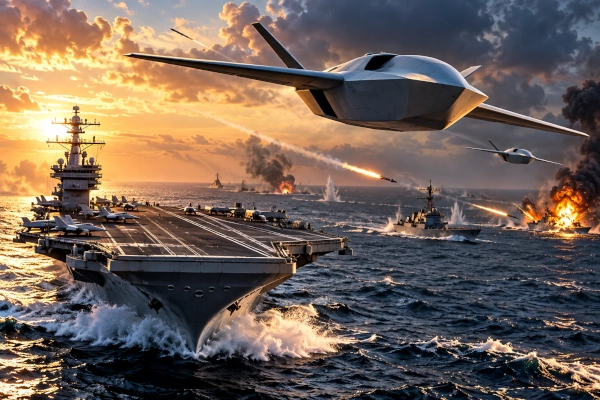
American aerospace and defence manufacturer General Atomics Aeronautical Systems (GA-ASI) has reportedly proposed its Gambit 5 carrier-based unmanned combat aircraft to the Indian Navy, opening the possibility of expanding cooperation between India and the United States in advanced naval aviation. The aircraft belongs to General Atomics’ Gambit family of Collaborative Combat Aircraft (CCA), designed to operate alongside crewed fighter jets while undertaking complementary military missions.
According to media reports online published on October 15, 2026, General Atomics is promoting the Gambit 5 as a potential addition to India’s carrier-based aviation capabilities. The proposal reportedly involves exploring adaptations that would allow the aircraft to operate from Indian aircraft carriers, which employ Short Take-Off But Arrested Recovery (STOBAR) systems rather than the catapult-assisted launch arrangements used by American supercarriers.
General Atomics introduced the Gambit 5 concept in 2024 as part of its expanding autonomous combat aircraft portfolio. The company subsequently announced in October 2025 that the United States Navy had selected it to undertake conceptual design work for carrier-based Collaborative Combat Aircraft. Although the reported offer to India has not been formally announced by General Atomics or the Indian Ministry of Defence, the development highlights growing international interest in unmanned combat aircraft capable of operating alongside conventional naval fighters.
General Atomics Reportedly Proposes Gambit 5 for Indian Aircraft Carriers
General Atomics is reportedly exploring opportunities to introduce the Gambit 5 into India’s future naval aviation architecture. The aircraft has been conceived as an autonomous platform capable of complementing crewed fighter jets by undertaking selected missions and supporting larger naval air operations. Its development forms part of a broader international effort to integrate unmanned combat aircraft into frontline aviation formations.
According to media reports online, the company has presented the Gambit 5 concept as a potential solution for the Indian Navy’s future carrier aviation requirements. The reported proposal includes examining whether the aircraft could be adapted to operate from India’s existing aircraft carriers, INS Vikramaditya and INS Vikrant. Both vessels employ ski-jump launch arrangements and arresting gear, creating specific performance and structural requirements for aircraft operating from their flight decks.
The proposed adaptation would involve assessing the aircraft’s compatibility with carrier launch and recovery systems, available deck space, operational procedures and onboard aviation infrastructure. Such considerations are particularly important for unmanned aircraft because autonomous launch, approach and recovery functions must operate reliably within the confined and demanding environment of an aircraft carrier.
The reported engagement reflects the increasing importance of collaborative unmanned aviation in maritime operations. Rather than functioning as replacements for all conventional naval fighters, aircraft such as Gambit 5 are intended to provide additional capabilities that complement existing aviation assets and expand the range of missions a carrier air wing can undertake.
Gambit 5 Designed for Carrier-Based Collaborative Combat Operations
General Atomics officially identifies Gambit 5 as the carrier-capable member of its Collaborative Combat Aircraft family. The company has designed the platform around a modular aircraft architecture intended to support autonomous operations alongside crewed fighter aircraft. This approach reflects a shift towards aviation formations in which conventional aircraft and autonomous systems operate together under coordinated mission control.
The Gambit 5 concept incorporates design considerations associated with naval aviation, where aircraft must withstand demanding maritime conditions while operating from relatively restricted flight decks. Carrier-capable aircraft require specialised structural arrangements, landing equipment and flight control capabilities to accommodate shipboard operations. These requirements become especially significant when developing unmanned aircraft intended to function safely alongside crewed naval aviation platforms.
According to General Atomics, Gambit 5 is intended to complement fourth- and fifth-generation fighter aircraft while supporting the evolving requirements of future carrier air wings. Collaborative Combat Aircraft can potentially perform reconnaissance, surveillance and other missions according to their equipment and operational configuration. Their deployment may also allow crewed fighters to concentrate on tasks requiring direct pilot involvement while unmanned aircraft perform complementary functions.
The aircraft remains part of a developing technology programme rather than an operationally deployed naval combat platform. Nevertheless, General Atomics’ work on carrier-based Collaborative Combat Aircraft establishes an industrial and technological foundation for future unmanned naval aviation programmes.
Modular Gambit Core Supports Multiple Aircraft Configurations
A distinguishing feature of the Gambit aircraft family is its modular design architecture, which allows several aircraft configurations to share a common engineering foundation. General Atomics developed this approach to reduce manufacturing complexity, improve component commonality and support the development of mission-specific unmanned aircraft without designing every platform entirely from the beginning.
The company describes this shared foundation as the Gambit Core, incorporating essential aircraft systems such as landing gear, baseline avionics and structural components. According to General Atomics, the common core accounts for approximately 70% of the cost of the aircraft configurations within the family. Different variants can incorporate modified wings, propulsion arrangements and mission equipment while retaining substantial commonality with other Gambit platforms.
This design philosophy provides advantages in manufacturing, logistics and long-term fleet support. Standardised components can simplify the production process and reduce the number of specialised parts required for maintenance. Military operators adopting multiple aircraft variants from the same family may also benefit from common technical training, support equipment and maintenance procedures.
For Gambit 5, the modular architecture provides a foundation for incorporating the specialised characteristics needed for carrier operations. The concept allows General Atomics to combine common aircraft technologies with naval aviation requirements, supporting its wider objective of developing adaptable unmanned combat aircraft for different operational environments.
Gambit Aircraft Family Covers Multiple Military Missions
General Atomics has developed the Gambit programme around a series of aircraft concepts intended to support different operational requirements. Each configuration employs the common-core approach while incorporating mission-specific design characteristics. The programme reflects the company’s strategy of building a family of complementary unmanned aircraft rather than relying on a single platform to perform every mission.
Gambit 1 focuses on long-endurance intelligence, surveillance and reconnaissance operations. Its design emphasises flight efficiency and the ability to remain airborne for extended periods while supporting other military aircraft. Such capabilities are particularly relevant to operations requiring persistent surveillance and continuous monitoring of designated areas.
Gambit 2 incorporates air-to-air combat capabilities and has been conceived as an autonomous aircraft capable of supporting crewed fighters during aerial engagements. Gambit 3 addresses advanced fighter training requirements, providing a platform that can simulate sophisticated airborne adversaries during military aviation exercises. Gambit 4 introduces low-observable design characteristics for specialised combat reconnaissance missions where reducing aircraft detectability is an important operational consideration.
Gambit 5 extends the family into carrier-based operations, combining collaborative combat aviation concepts with the specialised demands of maritime aviation. General Atomics has also introduced Gambit 6 as an air-to-ground combat configuration associated with electronic warfare, suppression of enemy air defences and precision-strike mission concepts. Together, these variants demonstrate the company’s approach to developing a flexible autonomous aircraft family capable of supporting different military services and operational requirements.
US Navy Selects General Atomics for Carrier-Based CCA Design Programme
General Atomics announced on October 17, 2025, that the United States Navy had selected the company to support the conceptual design of carrier-based Collaborative Combat Aircraft. The programme represents an important step in the development of unmanned combat aircraft intended to operate as part of future naval air wings.
According to the company’s official announcement, the design effort focuses on modular aircraft architectures and the integration of autonomous platforms with existing and future carrier aviation capabilities. The US Navy is examining how unmanned combat aircraft can support crewed fighters while providing additional flexibility in conducting complex aviation missions. General Atomics’ Gambit 5 concept forms part of its technical approach to this emerging requirement.
Carrier-based Collaborative Combat Aircraft must address challenges beyond those encountered by conventional land-based unmanned aircraft. Their design must account for shipboard storage, maintenance, deck movement, launch and recovery procedures, and integration with naval command systems. These requirements influence aircraft size, structural design, flight controls and operational support arrangements.
The US Navy programme provides General Atomics with an opportunity to develop its carrier-based unmanned aviation technologies within an established naval design framework. Although the contract concerns American requirements rather than an Indian procurement programme, it confirms that General Atomics is actively developing the technical capabilities associated with Gambit 5.
General Atomics Demonstrates Unmanned Aircraft Operations from British Aircraft Carrier
General Atomics has already demonstrated its ability to develop unmanned aircraft capable of operating from aircraft carriers. On November 15, 2023, the company’s Mojave unmanned aircraft successfully conducted take-off and landing operations aboard the Royal Navy aircraft carrier HMS Prince of Wales. The demonstration took place while the British warship was operating off the eastern coast of the United States.
According to General Atomics’ official announcement, Mojave completed take-off, flight circuits and approaches before landing back aboard the carrier. An operating crew controlled the aircraft from a ground control station installed aboard the ship. The demonstration represented an important milestone in establishing the feasibility of operating relatively large unmanned aircraft from aircraft carriers without conventional catapult-assisted launch systems.
Mojave was developed as a short take-off and landing unmanned aircraft incorporating specialised aerodynamic characteristics, propulsion arrangements and landing equipment. Its design allows operations from relatively short runways and austere locations, extending the potential applications of unmanned aircraft beyond conventional airfields. The aircraft belongs to a different category from the proposed Gambit 5 and was not developed as a direct equivalent of a carrier-based jet combat aircraft.
Nevertheless, the Royal Navy demonstration provided General Atomics with valuable experience in integrating unmanned aircraft with shipboard aviation procedures. Such experience supports the company’s broader research into naval unmanned aviation, including aircraft handling, flight control, operational safety and coordination with carrier aviation personnel.
Gambit 5 Could Complement India’s Carrier-Based Fighter Aircraft
The Indian Navy currently operates INS Vikramaditya and INS Vikrant, both equipped with Short Take-Off But Arrested Recovery aviation systems. These arrangements allow carrier-based fighter aircraft to launch using ski-jump ramps and recover through arresting gear installed on the flight deck. The system differs from the catapult-assisted launch equipment used by large American aircraft carriers, creating distinct requirements for aircraft performance and integration.
India’s carrier aviation operations have traditionally relied on crewed fighter aircraft supported by helicopters undertaking surveillance, anti-submarine warfare and other naval missions. Collaborative Combat Aircraft could eventually expand this operational structure by providing additional unmanned aviation capabilities. Such platforms may support reconnaissance, electronic warfare and selected combat tasks while operating alongside conventional naval fighters.
According to media reports online, the proposed Gambit 5 configuration is being considered for compatibility with the Indian Navy’s existing carrier arrangements. This would require evaluating the aircraft’s ability to meet the specific launch, recovery, structural and operating requirements of STOBAR aircraft carriers. Factors such as aircraft weight, thrust, flight characteristics, landing equipment and automated recovery capabilities would influence the feasibility of carrier integration.
General Atomics has officially identified Gambit 5 as a carrier-capable aircraft concept, but its published information does not establish demonstrated compatibility with the Indian Navy’s STOBAR carriers. The reported proposal therefore represents a potential development opportunity rather than an established operational capability. Any future integration would involve technical evaluation and certification appropriate to the requirements of Indian naval aviation.
Collaborative Combat Aircraft Represent a New Approach to Naval Air Power
Collaborative Combat Aircraft are being developed to support a new approach to military aviation in which crewed fighter jets and autonomous aircraft operate together. The concept seeks to increase the operational flexibility of air formations by distributing selected missions among multiple aircraft. Advanced autonomous systems can perform designated tasks while remaining integrated with the broader mission objectives established by human commanders.
In conventional naval aviation, crewed fighter aircraft undertake missions requiring sophisticated sensors, weapons, communications and pilot decision-making. Introducing unmanned combat aircraft could allow certain supporting functions to be assigned to additional platforms. These may include extended reconnaissance, surveillance, electronic warfare support and missions involving elevated operational risks. The actual capabilities of individual aircraft depend upon their equipment, mission configuration and level of technological maturity.
General Atomics has developed the Gambit family around this concept, placing particular emphasis on autonomous flight capabilities, modular designs and collaboration with existing military aircraft. The company envisages its platforms supporting fourth- and fifth-generation fighters while complementing emerging sixth-generation combat aviation systems. This approach reflects growing international interest in aircraft formations capable of combining crewed and unmanned technologies.
For aircraft carriers, integrating Collaborative Combat Aircraft would also require changes in aviation planning and operational coordination. Naval personnel would need to manage unmanned aircraft alongside conventional fighters and helicopters while maintaining safe flight deck operations, reliable communications and effective mission control. These requirements make carrier-based Collaborative Combat Aircraft a specialised area within the wider development of autonomous military aviation.
Indian Navy Strengthening Unmanned Maritime Surveillance Capabilities
India has already established a significant relationship with General Atomics through the MQ-9B SkyGuardian and SeaGuardian remotely piloted aircraft programmes. These aircraft belong to the high-altitude, long-endurance category and are designed to undertake extended intelligence, surveillance and reconnaissance missions. Their capabilities are particularly relevant to monitoring large maritime areas where continuous surveillance is essential for maintaining operational awareness.
The Ministry of Defence officially confirmed in its 2024 year-end review that India had signed a contract with the United States Government in October 2024 for the tri-service procurement of 31 MQ-9B aircraft. The agreement represents a major expansion of India’s long-endurance unmanned aviation capabilities and supports the operational requirements of the Indian Army, Indian Navy and Indian Air Force.
The government also confirmed a separate agreement with General Atomics Global India Private Limited for performance-based logistics support. This arrangement includes depot-level maintenance, repair and overhaul activities in India, strengthening domestic technical capabilities associated with advanced remotely piloted aircraft. The programme establishes a long-term framework for supporting the aircraft throughout their operational service lives.
Although MQ-9B and Gambit 5 address different operational requirements, they demonstrate the breadth of General Atomics’ unmanned aviation portfolio. The MQ-9B focuses primarily on long-endurance operations, while Gambit 5 is intended for carrier-based collaborative combat missions. India’s existing MQ-9B programme therefore provides an established defence industrial relationship within which additional technological cooperation may be explored.
India Signs ₹1,943 Crore SeaGuardian Leasing Agreement in August 2026
India further strengthened its unmanned maritime aviation capabilities on August 17, 2026, when the Ministry of Defence signed a contract with General Atomics Aeronautical Systems for leasing two MQ-9B SeaGuardian remotely piloted aircraft. The agreement covers a period of 30 months and carries an estimated value of ₹1,943 crore. The Ministry confirmed that the contract was signed in New Delhi in the presence of senior defence acquisition officials.
According to the official announcement, the SeaGuardian aircraft will strengthen the Indian Navy’s Maritime Domain Awareness capabilities. Equipped with advanced sensors and mission payloads, the aircraft can provide persistent intelligence, surveillance and reconnaissance coverage across extensive maritime areas. Such capabilities are important for monitoring naval activities, maritime traffic and developments across strategically significant ocean regions.
The Indian Ocean Region presents substantial surveillance challenges because of its geographical scale, major commercial shipping routes and concentration of strategic maritime activity. Long-endurance unmanned aircraft can complement conventional maritime patrol aircraft, naval helicopters and shipborne sensors by maintaining surveillance over designated areas for extended periods. Their employment supports the development of a more comprehensive operational picture for naval commanders.
The SeaGuardian leasing agreement demonstrates the continuing expansion of India–General Atomics cooperation in remotely piloted aircraft. While it does not establish any procurement commitment concerning Gambit 5, the agreement reinforces the company’s existing relationship with the Indian Navy and India’s growing interest in advanced unmanned aviation technologies.
INS Vikrant Provides a Foundation for Future Carrier Aviation Development
India’s indigenous aircraft carrier INS Vikrant represents one of the country’s most important achievements in naval shipbuilding and aviation engineering. Designed by the Indian Navy’s Warship Design Bureau and constructed by Cochin Shipyard Limited, the carrier was commissioned on September 2, 2022. Its induction strengthened India’s ability to design, construct and operate large naval aviation platforms using domestic industrial capabilities.
INS Vikrant incorporates a STOBAR flight deck configuration capable of supporting carrier-based fighter aircraft and helicopters. The ship’s aviation facilities, support infrastructure and operational systems were developed to meet the demanding requirements of naval aircraft operations. Its construction also brought together numerous Indian engineering companies, equipment manufacturers and specialised naval technology suppliers.
The carrier represents a substantial investment in India’s long-term maritime aviation capabilities. Alongside INS Vikramaditya, it provides the Navy with an important foundation for conducting carrier-based operations across the Indian Ocean Region. Maintaining an effective carrier air wing requires the integration of aircraft, aviation support equipment, command systems and trained personnel capable of operating together during complex maritime missions.
Future developments in unmanned carrier aviation could introduce additional capabilities to this operational structure. However, such integration would require aircraft specifically suited to the carrier’s launch and recovery arrangements, available operating space and shipboard aviation procedures. The reported Gambit 5 proposal draws attention to these emerging possibilities as the Indian Navy continues developing its indigenous carrier aviation capabilities.
India–US Defence Cooperation Expands into Advanced Aerospace Technologies
India and the United States have developed an extensive defence relationship covering military equipment, maritime security, aviation technology and defence industrial cooperation. The acquisition of MQ-9B remotely piloted aircraft represents an important component of this partnership, combining advanced American unmanned aviation technology with India’s operational requirements across the armed services.
The two countries have also promoted cooperation in emerging defence technologies through institutional and industrial initiatives. The India–US Defence Acceleration Ecosystem, known as INDUS-X, was established to encourage collaboration among defence manufacturers, startups, research organisations and technology developers. The initiative supports innovation and the development of solutions for shared defence technology requirements.
Autonomous aviation systems represent an important area of international aerospace research because of their potential applications in surveillance, reconnaissance and collaborative operations. Aircraft manufacturers are increasingly examining how autonomous flight systems can be integrated with existing military platforms while retaining effective human command and control. Such developments involve advances in software, sensors, communications, flight control systems and aircraft engineering.
The reported Gambit 5 proposal reflects this broader technological environment. General Atomics’ existing cooperation with India provides an established relationship in unmanned aviation, while the company’s Collaborative Combat Aircraft programme introduces another category of advanced aerospace technology. Any future expansion into carrier-based combat aircraft would represent a distinct programme requiring its own technical evaluation and procurement arrangements.
General Atomics Expands International Collaborative Combat Aircraft Programme
General Atomics continues to expand its Collaborative Combat Aircraft activities through aircraft development, autonomous flight testing and engagement with potential international customers. The Gambit family represents the company’s approach to developing modular unmanned aircraft capable of undertaking different missions while sharing a substantial proportion of common components.
The development strategy combines aircraft engineering with autonomous flight technologies and advanced mission systems. General Atomics has drawn upon its experience with remotely piloted aircraft, including the MQ-20 Avenger, to support research into unmanned jet operations and collaboration with crewed military aircraft. The company’s naval aviation demonstrations and carrier-based conceptual design activities provide additional experience relevant to developing aircraft intended for shipborne operations.
General Atomics’ selection for the US Navy’s carrier-based CCA design effort represents a significant development for Gambit 5. The programme provides a framework for examining the technical requirements associated with autonomous aircraft operating from aircraft carriers. These include flight deck integration, structural compatibility, aviation safety and coordination with other naval aircraft.
The reported Indian proposal illustrates the international interest that carrier-based Collaborative Combat Aircraft concepts may attract. For countries operating aircraft carriers, such technologies offer an opportunity to study new approaches to naval aviation while building upon existing crewed aircraft capabilities. The Gambit 5 remains a developing aircraft concept, but its emergence reflects the increasing attention being given to autonomous systems within future naval aviation planning.
Future Naval Air Wings Could Combine Crewed Fighters and Autonomous Aircraft
The evolution of naval aviation is increasingly influenced by advances in autonomous aircraft, integrated communications and collaborative mission systems. Traditionally, carrier air wings have relied on crewed fighter jets, helicopters and specialised support aircraft to undertake their operational responsibilities. New unmanned aviation technologies are creating opportunities to expand this structure through additional aircraft capable of performing designated missions.
Collaborative Combat Aircraft could complement conventional naval fighters by providing supplementary surveillance, electronic warfare and combat support capabilities. Their ability to operate under coordinated mission control may allow naval commanders to employ different types of aircraft according to operational requirements. The resulting formations could combine the capabilities of crewed aircraft with the endurance, flexibility and mission-specific characteristics of unmanned platforms.
The development of carrier-based unmanned aircraft introduces particular engineering challenges because aircraft must operate safely from moving flight decks exposed to changing maritime conditions. Launch and recovery procedures, autonomous navigation, aircraft handling and integration with naval command networks require extensive testing and technical development. These considerations are central to the Gambit 5 concept and the wider efforts undertaken by General Atomics for the United States Navy.
For India, the reported Gambit 5 proposal highlights the growing relevance of advanced unmanned aviation technologies to future maritime operations. The Indian Navy continues to strengthen its aircraft carrier capabilities, maritime surveillance systems and indigenous naval aviation infrastructure. Developments in Collaborative Combat Aircraft provide another area for examining how emerging technologies can complement these established capabilities.
Growing Opportunities for Advanced Naval Aviation Cooperation
General Atomics’ reported offer of the Gambit 5 carrier-based combat drone to the Indian Navy represents a potential new dimension in India–US defence aviation cooperation. The aircraft brings together the concepts of autonomous flight, modular construction and collaborative combat operations within a platform specifically intended for aircraft carrier missions.
The company has already established its expertise in unmanned aviation through the MQ-9 family, experimental aircraft programmes and shipborne flight demonstrations. Its ongoing carrier-based Collaborative Combat Aircraft design work for the United States Navy further strengthens the technological foundation supporting the Gambit 5 programme.
India’s existing cooperation with General Atomics, particularly through the MQ-9B procurement and SeaGuardian leasing programmes, provides an established relationship in advanced remotely piloted aircraft systems. The reported Gambit 5 proposal introduces a different technological category centred on carrier-based combat aviation and collaboration with crewed fighter aircraft.
As the Indian Navy continues modernising its maritime aviation capabilities, advanced unmanned aircraft concepts are becoming increasingly relevant to discussions surrounding future carrier air wings. The Gambit 5 programme demonstrates how developments in autonomous flight and naval aircraft engineering are creating new possibilities for integrating crewed and unmanned aviation platforms.
The reported engagement highlights the expanding scope of international defence technology cooperation and the continuing evolution of carrier-based naval aviation, with autonomous aircraft emerging as a significant component of future maritime aerospace development.
References
1. General Atomics Aeronautical Systems — Official Product Information
Title: Gambit Series — Collaborative Combat Aircraft
Details: Official descriptions of Gambit 1–6, modular aircraft architecture, common Gambit Core and carrier-based Gambit 5 concept.
https://www.ga-asi.com/remotely-piloted-aircraft/gambit-series
2. General Atomics Aeronautical Systems — Official Press Release
Date: October 17, 2025
Title: GA-ASI Selected to Support U.S. Navy CCA Design Effort
Details: US Navy carrier-based Collaborative Combat Aircraft conceptual design programme and Gambit 5 development.
https://www.ga-asi.com/ga-asi-selected-to-support-us-navy-cca-design-effort
3. General Atomics Aeronautical Systems — Official Press Release
Date: November 17, 2023
Title: GA-ASI Demonstrates Short Takeoff/Landing of UAS on UK Carrier
Details: Mojave unmanned aircraft flight demonstration aboard HMS Prince of Wales.
https://www.ga-asi.com/ga-asi-demonstrates-short-takeoff-landing-of-uas-on-uk-carrier
4. Press Information Bureau, Ministry of Defence
Date: August 17, 2026
Title: MoD Inks Contract with General Atomics Aeronautical Systems, Inc. for Leasing of Two MQ-9B SeaGuardian High-Altitude Long-Endurance Remotely Piloted Aircraft Systems for Indian Navy for 30 Months
Details: ₹1,943 crore leasing agreement, maritime surveillance and Maritime Domain Awareness capabilities.
https://www.pib.gov.in/PressReleasePage.aspx?PRID=2300388
5. Press Information Bureau, Ministry of Defence
Date: December 2024
Title: Year End Review 2024 — Ministry of Defence
Details: Procurement of 31 MQ-9B aircraft and performance-based logistics arrangements in India.
https://www.pib.gov.in/PressReleasePage.aspx?PRID=2088180
6. Press Information Bureau, Ministry of Defence
Date: June 25, 2023
Title: Acquisition of MQ-9B Drones: Speculative Reports Uncalled For
Details: Defence Acquisition Council approval for 31 MQ-9B remotely piloted aircraft for the Indian Armed Forces.
https://www.pib.gov.in/PressReleasePage.aspx?PRID=1935160
7. General Atomics Aeronautical Systems — Official Information
Title: GA-ASI Redefines Maritime Operations with Mojave
Details: Carrier take-off and landing demonstration and development of short take-off and landing unmanned aviation capabilities.
https://www.ga-asi.com/mojave-uas-carrier-takeoff-and-landing-demo
8. Media Reports Online
Date: October 15, 2026
Subject: General Atomics Reportedly Offers Gambit 5 Carrier-Based Combat Drone to Indian Navy
Details: Reported proposal to explore Gambit 5 compatibility with the Indian Navy’s STOBAR aircraft carriers.
You may also like
-
India Explores Partnership in France’s Sixth-Generation Fighter Programme as Development Plans Advance
-
HAL’s Indigenous Light Utility Helicopter Nears Final Certification, First 12 Deliveries Targeted for FY 2027–28
-
Tata Advanced Systems Reportedly Considering LAMV 4×4 Production in Morocco
-
Indian Navy Initiates Communication Systems Upgrade for Kamorta-Class Anti-Submarine Warfare Corvettes
-
India Reportedly Offers Mine-Protected Vehicles to Kenya to Strengthen Defence Cooperation
