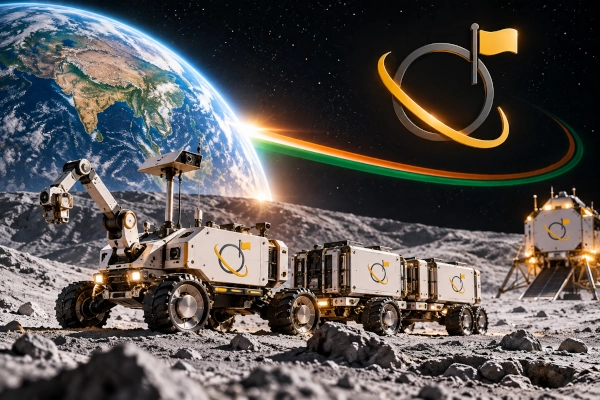
Indian space technology startup Cosmochute Space Pvt. Ltd. is developing a reusable robotic transportation and infrastructure platform designed to support scientific research, equipment deployment and sustained operations on the lunar surface. Based in Ahmedabad, Gujarat, the company is working to address one of the emerging challenges of Moon exploration: transporting, deploying and operating scientific instruments and commercial payloads after they reach the lunar surface.
The startup’s flagship programme, LEAP, combines autonomous lunar rovers, modular cargo transportation systems and specialised payload protection technologies. The integrated platform aims to reduce the engineering complexity and operational costs associated with lunar exploration by providing reusable infrastructure capable of supporting multiple scientific and commercial missions.
In its latest development, announced on October 15, 2026, Cosmochute raised $1.5 million in pre-seed funding, led by Accel and Prosus Ventures through the Atoms X programme. The investment will support the development of its lunar mobility platform, expansion of its engineering team and advancement of its commercialisation plans.
The development represents another step in India’s emerging private space technology ecosystem, where startups are increasingly moving beyond satellite manufacturing and launch services into advanced robotics, planetary exploration and infrastructure designed for operations beyond Earth.
Cosmochute Founded to Develop Reusable Infrastructure for Lunar Exploration
Cosmochute was established by Janhavi Gore, Amit Chowdhary and Dhruv Alok Sangal, bringing together expertise in aerospace engineering, robotics and technology development. The company focuses on building reusable infrastructure that can support long-duration activities on the Moon rather than developing individual robotic systems exclusively for one mission.
Janhavi Gore serves as Chief Executive Officer, Amit Chowdhary as Chief Operating Officer and Dhruv Alok Sangal as Chief Technology Officer. The founding team is pursuing a platform-based approach to lunar robotics, in which standardised systems can accommodate different scientific instruments, research equipment and commercial payloads.
The company’s central objective is to make lunar surface operations more accessible to organisations that want to conduct experiments, deploy instruments or undertake scientific investigations without independently developing an entire mobility platform.
Traditional planetary exploration missions frequently require specialised vehicles and deployment mechanisms designed around the requirements of individual payloads. This approach can involve substantial engineering costs, extensive testing and limited opportunities to reuse equipment across different missions.
Cosmochute aims to address these challenges by developing modular robotic systems that can transport multiple payloads, provide essential operational support and accommodate different scientific requirements within a common infrastructure architecture.
The company describes its long-term vision as establishing foundational robotic infrastructure for economic activities beyond Earth, beginning with lunar exploration.
LEAP Programme to Provide Modular Transportation on the Moon
The LEAP programme forms the foundation of Cosmochute’s lunar infrastructure strategy. It combines robotic mobility, cargo transportation, payload deployment and environmental protection into an integrated system intended for sustained operations on the lunar surface.
At the centre of the programme is an autonomous lunar rover capable of navigating difficult terrain while carrying scientific equipment and transporting additional payloads through a specialised trailer system. The architecture is designed to provide flexibility in handling instruments with different dimensions, operational requirements and mission objectives.
Lunar terrain presents considerable engineering challenges. The surface contains fine regolith, loose rocks, impact craters, slopes and uneven geological formations that complicate robotic movement. Vehicles operating in this environment must maintain stability while navigating obstacles and protecting sensitive equipment from vibration, dust and extreme temperatures.
The LEAP platform seeks to address these challenges through autonomous navigation, modular payload accommodation and integrated robotic handling systems.
By providing a common mobility platform for multiple scientific payloads, Cosmochute aims to reduce the need for every research organisation to develop a separate lunar transportation vehicle.
The platform is intended to support activities such as scientific instrument deployment, geological investigations, surface sampling and other research operations associated with future lunar missions.
EPOC Autonomous Lunar Rover Forms the Core of the System
Cosmochute’s primary robotic vehicle is EPOC, a modular lunar rover designed to provide autonomous mobility and support scientific payload operations.
According to the company’s published technical specifications, EPOC has a dry mass of approximately 240 kilograms, excluding its payload. The rover incorporates autonomous navigation technologies intended to support route planning, hazard detection and movement across uneven lunar terrain.
Its navigation architecture is designed to identify obstacles and select suitable paths while maintaining vehicle stability. These capabilities are particularly important on the Moon, where communication delays and operational constraints make continuous manual control from Earth difficult.
EPOC also incorporates modular payload bays that allow different instruments to be carried within the same vehicle architecture. This approach can accommodate scientific experiments and other equipment without requiring extensive changes to the rover’s fundamental mechanical design.
Another important feature is its planned robotic arm, which is intended to support payload handling, equipment replacement, regolith extraction and sample collection. Such capabilities can enable a rover to perform tasks beyond transportation, including interacting with scientific instruments and manipulating materials on the lunar surface.
Cosmochute is developing EPOC as a reusable infrastructure asset capable of supporting multiple activities during sustained lunar operations.
OASYS Trailer Designed to Transport Multiple Scientific Payloads
The second major component of Cosmochute’s lunar robotics architecture is OASYS, a specialised trailer designed to operate alongside the EPOC rover.
OASYS provides additional cargo transportation capacity through a modular arrangement of standardised payload compartments. The system is intended to accommodate scientific instruments and commercial equipment while protecting them during movement across the lunar surface.
According to Cosmochute’s published specifications, the integrated platform is designed to accommodate up to 120 kilograms of payload, with a total capacity exceeding 64U in standardised payload volume. The company lists a trailer mass of approximately 130 kilograms.
The use of standardised payload compartments is important because scientific instruments often differ in physical dimensions, electrical connections and operating requirements. A common accommodation system can simplify mechanical integration and reduce the engineering effort required for individual payloads.
OASYS also incorporates a planned sequential payload deployment mechanism, allowing instruments to be accessed and deployed during different stages of a mission.
The trailer is designed to dock with the rover, which provides the mobility required to transport equipment to designated lunar locations.
This modular approach could support missions involving several experiments, allowing equipment to be delivered and deployed at different sites without relying on an entirely separate transportation system for each instrument.
Cartridge System Designed to Protect Equipment During Lunar Nights
One of the most demanding challenges in lunar exploration is maintaining the operation of scientific instruments under extreme environmental conditions.
The Moon experiences substantial temperature variations between sunlight and darkness. At many lunar locations, the day-night cycle lasts approximately 29.5 Earth days, resulting in periods of darkness lasting roughly two Earth weeks.
During these extended lunar nights, temperatures can fall dramatically, creating serious challenges for batteries, electronics, sensors and other sensitive equipment.
Cosmochute is developing a specialised Cartridge Payload Survival System to help protect scientific payloads against these environmental extremes.
The system incorporates passive thermal control, multilayer insulation and radiative heat-management technologies designed to regulate the temperature of enclosed equipment.
It is also intended to provide electrical power and data connectivity for scientific instruments operating within the platform.
According to Cosmochute, the system is designed around a specified internal operating temperature range of -40°C to +85°C, with a peak payload power requirement of approximately 300 watts.
The company is developing Cartridge to accommodate instruments requiring controlled operating conditions, including optical payloads and equipment used for geological investigations.
The system also envisages access to lunar regolith samples, enabling experiments that require interaction with surface materials.
Developing dependable thermal protection and power-management capabilities will be essential to supporting longer-duration robotic operations and reducing the vulnerability of scientific instruments to the lunar environment.
Lunar South Pole Exploration Creates Demand for Specialised Robotics
The increasing international focus on the Moon’s south polar region has created opportunities for developing specialised robotic infrastructure.
The lunar south pole is of particular scientific interest because some permanently shadowed regions may contain deposits of water ice and other volatile materials. These resources are important for understanding the Moon’s geological history and could support future exploration activities.
However, permanently shadowed regions present particularly difficult operating conditions. They receive little or no direct sunlight, experience extremely low temperatures and pose challenges for navigation, communications and electrical power generation.
Cosmochute identifies payload hosting in permanently shadowed regions as one of the potential applications of its lunar infrastructure technologies.
Its planned systems are intended to support the transportation, protection and operation of scientific instruments in challenging lunar environments.
The company also envisages supporting experiments involving lunar regolith, optical observations and surface investigations.
Such technologies are relevant to future scientific missions seeking to study lunar geology, identify resources and understand the physical conditions prevailing at different locations on the Moon.
India’s successful Chandrayaan-3 mission demonstrated the country’s ability to achieve a controlled lunar landing and conduct robotic surface investigations. The expansion of private-sector expertise in lunar mobility and infrastructure can complement India’s established capabilities in planetary exploration.
Former Chandrayaan-1 Programme Director Mylswamy Annadurai Guides Cosmochute
An important element of Cosmochute’s technical development is its association with Dr. Mylswamy Annadurai, the distinguished Indian space scientist who served as Project Director of Chandrayaan-1 and held senior responsibilities in India’s planetary exploration programmes.
Cosmochute identifies Dr. Annadurai as its Chief Scientist, bringing experience from India’s lunar exploration activities to the startup’s robotic infrastructure development.
Chandrayaan-1, launched by the Indian Space Research Organisation in October 2008, was India’s first lunar mission. It helped establish the country’s capabilities in deep-space navigation, lunar science and planetary mission operations.
The mission also made important contributions to scientific investigations concerning water-related molecules on the lunar surface.
Experience gained through such programmes is valuable for emerging space technology companies developing systems intended to function under the demanding conditions of planetary exploration.
Dr. Annadurai’s involvement provides Cosmochute with access to expertise in spacecraft systems, mission engineering and lunar exploration requirements as it advances its robotic platform.
Cosmochute Raises $1.5 Million in Pre-Seed Funding Led by Accel and Prosus
Cosmochute’s latest development came on October 15, 2026, when the company secured $1.5 million in pre-seed financing, led by Accel and Prosus Ventures through the Atoms X programme.
The funding round also included participation from IIMA Ventures’ Deep-tech and Aerospace Acceleration Fund, Operators Studio and investor Chinmayi Muthyala.
The investment will support continued development of the company’s LEAP platform, including its modular rover, trailer and associated lunar infrastructure technologies.
Cosmochute also plans to expand its engineering capabilities and advance preparations for commercial applications of its technology.
The company is establishing lunar research and development laboratories at IIMA Ventures’ incubation facility. These laboratories are intended to support engineering activities associated with the development of robotic systems for lunar operations.
The investment comes as the global space industry increasingly explores commercial opportunities associated with lunar transportation, scientific instrumentation and infrastructure development.
For Cosmochute, the funding represents an opportunity to advance its technologies from early-stage development towards physical prototypes, system testing and eventual commercial deployment.
Atoms X Programme Supports Advanced Space Technology Development
Cosmochute is among the startups selected for the inaugural Atoms X programme, an initiative supported by Accel and Prosus Ventures to encourage the development of ambitious technologies requiring sustained research and engineering investment.
The programme focuses on early-stage companies developing breakthroughs in engineering, scientific technologies and new business models.
Unlike conventional software startups, companies working in advanced robotics, aerospace systems and other deep-technology industries often require extensive hardware development, testing and validation before their products become commercially viable.
Atoms X seeks to address some of these challenges by providing early-stage capital, mentorship and access to technical and commercial networks.
Accel and Prosus announced their partnership for the programme in October 2025, identifying long-term technology development as an important investment priority.
Cosmochute’s participation provides access to an ecosystem of investors, technology specialists and industry partners supporting companies working on complex engineering challenges.
The funding also reflects growing investor interest in private companies developing infrastructure for future space activities rather than concentrating exclusively on launch vehicles and satellite services.
Modular Lunar Infrastructure Could Reduce Mission Development Costs
A central objective of Cosmochute’s technology strategy is to reduce the complexity associated with deploying scientific instruments on the Moon.
Conventional lunar missions frequently depend on specialised vehicles and equipment designed for individual mission requirements. This approach can increase development costs because components must undergo extensive engineering, integration and qualification.
A modular platform offers an alternative in which different payloads share a common transportation and deployment architecture.
Cosmochute’s proposed system combines autonomous mobility, standardised cargo compartments, robotic manipulation and environmental protection within an integrated platform.
This approach is intended to allow scientific organisations and commercial customers to focus more resources on their instruments and experiments rather than independently developing all the infrastructure needed to operate them.
The company’s reusable architecture also seeks to extend the operational usefulness of robotic systems beyond a single payload deployment.
Achieving these objectives will require successful development and testing of the rover’s mobility systems, autonomous navigation, thermal protection, electrical infrastructure and payload-handling equipment.
As these technologies mature, standardised lunar transportation could become an important component of scientific exploration and future commercial activities on the Moon.
India’s Private Space Industry Expands Beyond Satellites and Launch Vehicles
Cosmochute’s development reflects the increasing diversity of India’s private space technology sector.
Indian startups have already established capabilities in satellite development, launch vehicles, propulsion systems, space electronics and related technologies. A growing number of companies are now exploring applications involving advanced robotics, orbital infrastructure and planetary exploration.
The liberalisation of India’s space sector and the establishment of the Indian National Space Promotion and Authorisation Centre (IN-SPACe) have created a framework for greater private participation in space activities.
Private companies can now pursue commercial opportunities across different parts of the space value chain, including spacecraft manufacturing, launch services, satellite applications and emerging technologies.
Lunar robotics represents a particularly challenging segment because equipment must operate under conditions very different from those encountered on Earth.
Success in this field requires expertise in autonomous systems, advanced materials, electronics, energy storage, thermal engineering and precision manufacturing.
The development of these capabilities can contribute to India’s wider technology ecosystem while creating opportunities for specialised engineering companies and component manufacturers.
Cosmochute’s focus on reusable lunar infrastructure adds another dimension to this evolving industry by addressing the operational requirements of future missions after their arrival on the Moon.
Cosmochute Advances India’s Ambitions in Lunar Robotics and Space Infrastructure
Cosmochute’s development of the LEAP lunar mobility platform represents an emerging effort to build reusable robotic infrastructure for scientific and commercial activities beyond Earth.
Through its EPOC rover, OASYS trailer and Cartridge payload survival system, the company is pursuing an integrated approach to lunar transportation, equipment deployment and environmental protection.
Its association with experienced space scientists, participation in the Atoms X programme and expanding engineering activities provide a foundation for continued technology development.
The latest $1.5 million pre-seed funding round will support the company’s efforts to advance its robotic systems, expand its workforce and prepare for commercial applications.
As space agencies and private companies pursue increasingly ambitious lunar exploration programmes, the development of dependable mobility and payload-support infrastructure will become an important engineering priority.
Cosmochute’s work demonstrates how India’s emerging private space industry is beginning to address these requirements through indigenous robotics, modular engineering and reusable technologies. The company’s progress will contribute to the development of specialised capabilities that can support future lunar science, exploration and commercial infrastructure.
References
- Cosmochute Space Pvt. Ltd. Official Company Website — Lunar Infrastructure Systems. Information on the company’s mission, LEAP programme and proposed lunar services.https://www.cosmochute.com/
- Cosmochute Space Pvt. Ltd. Lunar Infrastructure Platform. Technical information on the EPOC rover, OASYS trailer and Cartridge payload survival system.https://www.cosmochute.com/platform
- Cosmochute Space Pvt. Ltd. About Cosmochute. Information on the founding team, management, scientific leadership and technology objectives.https://www.cosmochute.com/about
- ETEntrepreneur, The Economic Times. Cosmochute Raises $1.5 Million Pre-Seed Funding Led by Accel, Prosus Ventures. October 15, 2026.https://entrepreneur.economictimes.indiatimes.com/news/funding/cosmochute-raises-1-5-mn-pre-seed-funding-led-by-accel-prosus-ventures/134960455
- Accel Atoms. Extending the Map of Possibility: Meet Our Inaugural Atoms X Cohort Backed by Accel and Prosus. March 25, 2026.https://atoms.accel.com/news/meet-the-startups-in-atomsx
- Accel Atoms. Partnering for the Next Decade of LeapTech Innovation: Why Accel and Prosus Are Joining Forces. October 27, 2025.https://atoms.accel.com/news/prosus-atomsx
- Cosmochute Space Pvt. Ltd. Careers — Lunar Robotics Engineering Opportunities. Information on the company’s engineering recruitment and technology development activities.https://www.cosmochute.com/careers
You may also like
-
IIT Guwahati and IIT Kharagpur Develop Brain-Inspired Vision Device That Uses 500 Times Less Energy
-
OSTO Launches AI-Native Cybersecurity Platform for Indian Startups and SMEs
-
BHEL Approves ₹500 Crore Expansion of Thermal and Nuclear Power Equipment Manufacturing at Haridwar
-
Reliance Building One of World’s Largest Battery Gigafactories in Jamnagar with 120 GWh Annual Capacity
-
HAL’s Indigenous Light Utility Helicopter Nears Final Certification, First 12 Deliveries Targeted for FY 2027–28
