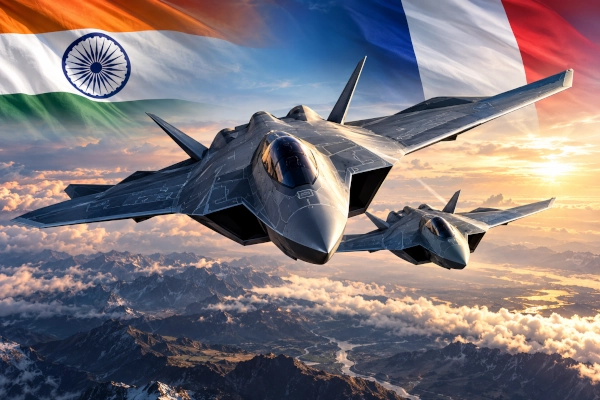
India has initiated efforts to participate in France’s sixth-generation fighter aircraft development programme, potentially opening a new chapter in strategic aerospace cooperation between the two countries. The initiative reflects India’s growing interest in advanced combat aviation technologies and its long-term objective of developing the capabilities required for future air warfare.
The Ministry of Defence confirmed its interest in the French-led Future Combat Air System (FCAS) initiative in a submission to Parliament’s Standing Committee on Defence, whose report was presented on August 7, 2026. The disclosure established that India was actively exploring participation in the programme rather than merely examining the possibility of acquiring a foreign-developed aircraft.
The development has gained further importance following changes to Europe’s original sixth-generation fighter programme and France’s decision to pursue a revised development strategy. According to French defence planning documents published in October 2026, Paris is preparing to advance work on a next-generation combat aircraft through a new demonstration phase beginning in 2027, followed by the planned development of an operational fighter from 2029.
India’s interest comes at a time when advanced fighter aircraft programmes increasingly emphasise stealth, artificial intelligence, network-centric operations, autonomous aircraft integration and next-generation propulsion. A potential partnership with France could provide opportunities for Indian aerospace organisations to participate in developing technologies intended to shape military aviation beyond 2040.
Ministry of Defence Confirms India’s Interest in Sixth-Generation Fighter Development
India’s interest in participating in a sixth-generation fighter programme received official confirmation through the Twenty-Fifth Report of Parliament’s Standing Committee on Defence, presented on August 7, 2026.
In its submission to the committee, the Ministry of Defence stated that it had initiated concerted efforts to join the Future Combat Air System programme spearheaded by the French government. The statement represented an important development in India’s long-term combat aviation planning, indicating that the government was pursuing opportunities for international participation in next-generation fighter development.
The parliamentary committee examined India’s preparedness for emerging military aviation technologies and the long-term requirements of the Indian Air Force. It emphasised the importance of establishing a clear development and acquisition roadmap for sixth-generation fighter aircraft, particularly as major aerospace powers continue investing in advanced combat aviation programmes.
The committee also sought additional information regarding India’s prospective participation, including the progress of discussions and the broad development roadmap. These recommendations reflect the importance of planning for technologies that require lengthy research, development, testing and industrial preparation before entering operational service.
India’s approach represents an effort to engage with next-generation aviation technologies during their development rather than relying exclusively on acquiring completed aircraft. Participation at an early stage could provide Indian organisations with opportunities to contribute engineering expertise, research capabilities and manufacturing resources to an international programme.
France Advances Plans for a New Sixth-Generation Combat Aircraft
France has outlined a revised development roadmap for its future combat aircraft as part of its wider military modernisation strategy. The country’s draft defence budget for 2027 includes provisions for advancing next-generation fighter development and associated technological capabilities.
According to documents accompanying the French government’s proposed 2027 budget, the next phase of fighter demonstration activities is scheduled to begin in 2027. The programme envisages progressing towards the development of an operational combat aircraft from 2029, establishing a framework for advancing the technologies required for France’s future air combat capabilities.
These plans follow significant changes to the original Future Combat Air System programme, which was launched through cooperation between France, Germany and Spain. The proposed New Generation Fighter formed the central combat aircraft component of that programme, supported by associated developments in unmanned systems, sensors and networked combat technologies.
France’s revised approach places greater emphasis on preserving its national ability to develop advanced combat aircraft and maintain the technologies necessary for future military aviation. The country’s updated military programming legislation, enacted in August 2026, specifically identifies the importance of retaining the industrial and technological capabilities required to develop a sixth-generation fighter.
The French government has also strengthened its defence investment plans. Its draft 2027 defence budget provides €63.4 billion for the defence mission, excluding pensions, representing an increase of approximately €6.5 billion compared with 2026. The additional resources support broader military modernisation priorities, including advanced equipment, operational preparedness and emerging defence technologies.
Changes to European FCAS Programme Create New Partnership Opportunities
The original Future Combat Air System emerged as a major European initiative intended to develop a comprehensive sixth-generation air combat capability. France and Germany launched the programme in 2017, with Spain subsequently joining the partnership.
The programme envisaged a New Generation Fighter operating alongside unmanned aircraft and connected through advanced information-sharing systems. Rather than developing an individual fighter aircraft in isolation, the project sought to establish an integrated combat aviation architecture capable of coordinating different platforms during complex military operations.
Dassault Aviation assumed a leading role in the development of the crewed fighter component, while Airbus and other European companies participated in different technological areas. The partnership brought together major aerospace manufacturers with substantial experience in military aircraft design, propulsion, avionics and defence electronics.
However, differences over industrial responsibilities, programme leadership and technological control created difficulties in progressing with the fighter development component. In June 2026, France and Germany ended their joint approach to developing the crewed next-generation fighter, prompting a reassessment of the original programme structure.
France has subsequently moved towards preserving its national fighter development capabilities while examining the future organisation of its next-generation combat aviation programme. This changing industrial environment has created opportunities for discussions with other international partners, including India.
India’s exploratory engagement is particularly relevant because of its established defence relationship with France and the countries’ experience in military aviation cooperation. The existing industrial and diplomatic framework provides a foundation for examining potential collaboration in advanced aerospace technologies.
Dassault Aviation’s Expertise Forms the Foundation of France’s Fighter Development
Dassault Aviation occupies a central position in France’s combat aircraft industry and has accumulated extensive experience in designing and manufacturing advanced military aircraft.
The company developed the Mirage family of fighters and the Rafale multirole combat aircraft, both of which have contributed to France’s military aviation capabilities and international defence partnerships.
Dassault’s expertise extends across aerodynamics, flight control systems, aircraft structures, weapons integration and advanced combat aircraft engineering. These capabilities provide an important industrial foundation for France’s ambitions to develop a sixth-generation fighter.
The company’s work on the nEUROn unmanned combat aircraft demonstrator has also contributed to European research in low-observable aircraft design, autonomous operations and advanced military aviation technologies.
Future combat aircraft development will require the integration of these established engineering disciplines with emerging technologies involving autonomous aircraft, artificial intelligence, advanced sensors and networked combat systems.
For India, cooperation with an established aerospace manufacturer such as Dassault could provide opportunities to expand domestic expertise in highly specialised areas of fighter aircraft development. Such cooperation would also build upon the relationship established through the Rafale programme and associated defence industrial activities.
Sixth-Generation Fighters Expected to Transform Air Combat
Sixth-generation fighter aircraft represent an emerging category of combat aviation systems designed to address the increasingly complex requirements of future aerial warfare.
Unlike earlier fighter generations, sixth-generation programmes generally focus on integrating crewed aircraft with autonomous systems, advanced sensors and distributed combat networks. The objective is to create a coordinated aviation capability in which information, surveillance and combat functions can be shared among multiple platforms.
Advanced stealth characteristics are expected to remain important, particularly as radar and other detection technologies continue to evolve. Future aircraft designs must account for threats across different electromagnetic frequencies while maintaining aerodynamic performance and operational flexibility.
Artificial intelligence and sophisticated mission-management systems are also expected to play an increasingly important role. These technologies could assist pilots in processing information from multiple sensors, identifying operational priorities and coordinating supporting aircraft during demanding missions.
Next-generation propulsion systems represent another major area of development. Future fighter engines may need to provide improved fuel efficiency, enhanced thrust, greater electrical power generation and advanced thermal management capabilities.
These technologies are particularly important as combat aircraft incorporate increasingly powerful sensors, electronic warfare equipment and sophisticated onboard computing systems. Developing them requires substantial investments in research, engineering, testing and industrial infrastructure.
Crewed Fighters and Autonomous Drones to Operate Together
One of the defining concepts associated with sixth-generation combat aviation is the integration of crewed fighter aircraft with autonomous or remotely controlled unmanned platforms.
These supporting aircraft, often described as Collaborative Combat Aircraft or remote carriers, are intended to undertake selected missions alongside conventional fighters. Their potential roles include surveillance, electronic warfare, reconnaissance and combat support, depending on their design and equipment.
In a future combat formation, a crewed fighter could coordinate with several unmanned aircraft operating at different distances and performing complementary tasks. Such an arrangement could extend surveillance coverage and provide additional operational flexibility while allowing pilots to concentrate on mission command and other critical responsibilities.
Developing these capabilities requires reliable communications, advanced autonomous flight control and the ability to exchange information securely between participating aircraft.
France has already undertaken research in unmanned combat aviation through the nEUROn programme. Its updated military planning framework also supports the development of accompanying drones for future Rafale configurations, including a longer-term stealth combat drone demonstrator.
These initiatives demonstrate that France’s future combat aviation strategy extends beyond the development of a single fighter aircraft. The broader objective involves creating an integrated system capable of combining advanced crewed aircraft, unmanned platforms and networked technologies.
For India, participating in research associated with such systems could complement ongoing domestic work in unmanned aviation, advanced avionics and autonomous defence technologies.
India–France Defence Partnership Provides a Strong Industrial Foundation
India and France have developed a longstanding defence relationship supported by cooperation in military aviation, naval systems, aerospace manufacturing and advanced defence technologies.
The relationship gained further momentum on February 17, 2026, when Defence Minister Rajnath Singh and French Minister of the Armed Forces Catherine Vautrin co-chaired the sixth India–France Annual Defence Dialogue in Bengaluru.
According to the Ministry of Defence, the discussions covered priority areas for the joint development and production of defence equipment. Both countries emphasised closer cooperation between their defence industries, particularly in specialised technologies requiring advanced engineering and manufacturing capabilities.
The two governments renewed their defence cooperation agreement for another ten years, strengthening the institutional framework supporting bilateral military and industrial engagement.
The dialogue also witnessed the signing of an agreement between Bharat Electronics Limited and Safran for cooperation in manufacturing HAMMER precision-guided weapons in India. The initiative reflects the increasing emphasis on establishing domestic manufacturing capabilities through partnerships between Indian and French defence enterprises.
India and France subsequently reaffirmed their commitment to advanced defence cooperation during talks between Prime Minister Narendra Modi and President Emmanuel Macron in Nice on June 14, 2026.
According to the Prime Minister’s Office, both leaders agreed to intensify cooperation in the co-design, co-development and co-production of advanced defence platforms and technologies. This commitment provides a diplomatic foundation for exploring more ambitious aerospace development partnerships, including potential cooperation in future combat aircraft programmes.
Rafale Cooperation Strengthens India’s Aerospace Relationship with France
The Rafale fighter programme has played an important role in strengthening defence aviation cooperation between India and France.
The Indian Air Force operates Rafale multirole fighters developed by Dassault Aviation, providing India with experience in the operation and maintenance of advanced French combat aircraft.
The programme has established institutional relationships involving aircraft manufacturers, defence agencies, technical organisations and military aviation personnel from both countries.
India has also expanded its Rafale relationship into naval aviation through the acquisition programme for Rafale Marine fighter aircraft. This development further strengthens the long-term aerospace relationship between India’s armed forces and the French defence industry.
Beyond aircraft procurement, India and France have pursued cooperation involving manufacturing, maintenance, aerospace components and specialised defence technologies. These activities have encouraged the participation of Indian engineering companies in international aerospace supply chains.
Such established industrial relationships are relevant when considering prospective cooperation in advanced fighter development. Sixth-generation aircraft programmes require long-term commitments involving specialised manufacturing infrastructure, engineering teams, research institutions and extensive technological integration.
India’s experience with French combat aircraft therefore provides a useful foundation for examining the industrial opportunities associated with a future fighter development partnership.
India’s Indigenous AMCA Programme Remains a Major National Priority
India is independently developing the Advanced Medium Combat Aircraft (AMCA), a fifth-generation stealth fighter intended to strengthen the Indian Air Force’s future combat capabilities.
The programme is being led by the Aeronautical Development Agency (ADA), with participation from India’s aerospace research and manufacturing ecosystem.
On May 27, 2025, Defence Minister Rajnath Singh approved the AMCA Programme Execution Model, establishing a framework for executing the aircraft development programme through partnerships with Indian industry.
The Ministry of Defence confirmed that the model provides equal opportunities for public and private sector enterprises to participate through a competitive selection process. Indian companies can submit proposals independently, through joint ventures or as part of industrial consortia.
The initiative aims to harness domestic engineering expertise and manufacturing capabilities for developing the AMCA prototype while strengthening India’s indigenous aerospace industrial ecosystem.
The AMCA programme represents a major step towards developing advanced stealth aircraft design, flight control systems, avionics integration and other specialised combat aviation technologies within India.
Prospective participation in France’s sixth-generation fighter initiative would address a different generation of combat aircraft and a longer-term technological horizon.
The two programmes could therefore serve complementary objectives, with AMCA strengthening India’s indigenous fifth-generation fighter capabilities while international cooperation provides opportunities to examine technologies associated with future sixth-generation aviation systems.
Advanced Engine Technologies Present Opportunities for Cooperation
Aircraft propulsion represents one of the most technologically demanding components of advanced fighter development.
Modern combat aircraft engines must deliver high thrust while maintaining reliability, fuel efficiency and performance across demanding flight conditions. Future fighter programmes also require improvements in thermal management, electrical power generation and materials capable of withstanding extreme operating temperatures.
Sixth-generation aircraft may place greater demands on propulsion systems because of their advanced sensors, electronic warfare equipment, onboard computing systems and evolving operational requirements.
France possesses considerable expertise in military aircraft propulsion through Safran, which manufactures the M88 engine used by the Rafale fighter.
The company has also undertaken research and development involving advanced propulsion technologies, engine materials and performance improvements.
India has identified indigenous aero-engine development as an important component of its long-term defence aerospace objectives. Collaboration in propulsion research could therefore represent a significant area of technological engagement between Indian and French aerospace organisations.
Participation in advanced engine development can also create opportunities for domestic industries involved in precision manufacturing, metallurgy, thermal engineering, specialised materials and aerospace testing.
The technological complexity of sixth-generation propulsion systems makes sustained research and industrial cooperation particularly relevant to countries seeking to expand their indigenous combat aircraft capabilities.
Indian Aerospace Industry Could Benefit from Advanced Technology Collaboration
India has developed an expanding aerospace manufacturing ecosystem comprising public sector enterprises, private manufacturers, research institutions and specialised engineering companies.
Hindustan Aeronautics Limited has accumulated extensive experience in manufacturing military aircraft, helicopters, aircraft structures and aviation systems. The Aeronautical Development Agency and Defence Research and Development Organisation have also contributed to the development of indigenous combat aircraft technologies.
Private sector companies have increasingly entered aerospace manufacturing through partnerships with international manufacturers and participation in advanced component production.
These capabilities provide a foundation for expanding India’s role in international aircraft development programmes.
Sixth-generation combat aircraft require specialised expertise in aerodynamic design, low-observable structures, composite materials, avionics, advanced electronics, propulsion and integrated software systems.
Participation in selected development activities could allow Indian companies to contribute to these technological areas while strengthening domestic engineering capabilities.
Research institutions and universities could also participate in collaborative programmes involving advanced materials, artificial intelligence, autonomous flight systems and computational engineering.
Such cooperation would complement India’s wider objective of building an aerospace industry capable of undertaking increasingly sophisticated research, design and manufacturing activities.
France’s 2027 Defence Plans Establish a New Development Framework
France’s draft defence budget for 2027 provides an important indication of the country’s intentions regarding future combat aviation.
The budget documents outline the continuation of research and demonstration activities associated with a next-generation fighter, including plans to initiate a further demonstration phase in 2027.
The proposed programme envisages beginning development of an operational aircraft in 2029, providing a broad timeline for the transition from technology demonstration towards a future combat aircraft.
Dassault Aviation Chief Executive Éric Trappier has also discussed the possibility of a future fighter demonstrator flying around 2031 or 2032. This represents an indicative development objective rather than a completed programme commitment.
France’s updated military programming legislation, adopted in August 2026, reinforces the country’s intention to preserve the industrial and technological capabilities needed to develop a sixth-generation fighter.
The legislation also identifies requirements associated with future French naval aviation and advanced strategic weapons integration, demonstrating the breadth of technologies involved in the country’s long-term combat aircraft planning.
These developments establish a revised framework within which France can pursue future fighter development while examining the structure of potential international industrial cooperation.
India’s acknowledged interest in participating in the programme comes during this period of technological planning and industrial reorganisation.
Sixth-Generation Fighter Development Requires Long-Term Industrial Planning
Developing a sixth-generation combat aircraft involves substantial technical and organisational challenges because the programme must integrate several advanced technologies into a reliable operational platform.
Aircraft design, propulsion, sensors, software, electronic warfare and autonomous systems must progress through extensive research, testing and validation before operational aircraft can enter military service.
The development process also requires specialised manufacturing facilities, ground-testing infrastructure, flight-test organisations and industrial supply chains capable of producing highly complex aerospace components.
International partnerships can provide a framework for sharing research responsibilities and bringing together complementary technological capabilities.
Such arrangements also require clear agreements concerning programme management, industrial responsibilities, intellectual property, certification and long-term production support.
For India, prospective participation in a sixth-generation programme would involve examining how its domestic aerospace industry can contribute meaningfully to the development process.
The country’s established aerospace research organisations and expanding private manufacturing sector provide important capabilities that could support selected technological activities.
A well-structured international partnership could also complement India’s indigenous development programmes by strengthening specialised engineering skills and expanding domestic experience in advanced aerospace technologies.
India’s Long-Term Air Power Planning Enters a New Technological Phase
The Indian Air Force’s future combat aviation requirements extend beyond the replacement of existing aircraft and the induction of new fighter platforms.
Advances in sensors, electronic warfare, unmanned aircraft, long-range weapons and integrated air defence systems are transforming the operational environment in which combat aircraft must function.
Future fighter aircraft will need to operate within increasingly complex networks of airborne, ground-based and space-supported systems.
The ability to exchange information securely, coordinate with autonomous aircraft and process large quantities of sensor data is becoming increasingly important.
India’s indigenous AMCA programme addresses several of these emerging requirements through the development of a modern fifth-generation combat aircraft.
Exploring participation in a sixth-generation programme would extend India’s planning horizon towards technologies intended for operational deployment in subsequent decades.
The parliamentary committee’s recommendations underline the importance of developing a coherent long-term roadmap for acquiring and developing such capabilities.
The Ministry of Defence’s engagement with the French-led programme demonstrates that India has begun examining the technological and industrial opportunities associated with the next generation of combat aviation.
India and France Explore a New Chapter in Advanced Combat Aviation
India’s efforts to explore participation in France’s sixth-generation fighter development programme represent a significant development in the countries’ expanding strategic aerospace relationship.
The initiative builds upon decades of cooperation involving combat aircraft, defence technologies, aerospace manufacturing and military aviation support.
France’s revised fighter development plans, together with its expanding defence investments, have created a new framework for advancing technologies associated with next-generation air combat capabilities.
India’s interest reflects the growing importance of long-term technological partnerships in developing sophisticated military aircraft systems.
The country’s established aerospace industry, indigenous research capabilities and ongoing AMCA programme provide a foundation for pursuing advanced aviation technologies through domestic development and international cooperation.
As India and France deepen their Special Global Strategic Partnership, exploratory cooperation in sixth-generation combat aircraft development offers another opportunity to expand engagement in advanced aerospace engineering.
The initiative also reinforces India’s broader commitment to strengthening indigenous technological capabilities, developing its aerospace manufacturing ecosystem and preparing for the evolving requirements of future air warfare.
References
1. Parliament of India — Standing Committee on Defence
Date: August 7, 2026
Document: Twenty-Fifth Report of the Standing Committee on Defence.
Details: Ministry of Defence submission concerning India’s efforts to participate in France’s sixth-generation Future Combat Air System programme and the committee’s recommendations on future fighter development planning.
Official Portal:
https://sansad.in/
2. Press Information Bureau, Ministry of Defence
Date: February 17, 2026
Title: Raksha Mantri & His French Counterpart Co-Chair 6th Annual Defence Dialogue in Bengaluru
Details: Renewal of the bilateral defence cooperation agreement, industrial collaboration and advanced technology partnerships.
https://www.pib.gov.in/PressReleasePage.aspx?PRID=2229311
3. Press Information Bureau, Prime Minister’s Office
Date: June 14, 2026
Title: Prime Minister Holds Official Talks with President of France
Details: India–France cooperation in co-design, co-development and co-production of advanced defence platforms and technologies.
https://www.pib.gov.in/PressReleasePage.aspx?PRID=2272748
4. French Ministry of the Armed Forces
Date: October 8, 2026
Title: Projet de loi de finances des Armées 2027 : LPM année 4
Details: France’s proposed defence expenditure, military modernisation priorities and future combat capability investments.
https://www.defense.gouv.fr/ministere/politique-defense/loi-programmation-militaire-2024-2030/projet-loi-finances-armees-2027-lpm-annee-4
5. Government of France — Légifrance
Date: August 16, 2026
Document: Loi n° 2026-791 actualisant la programmation militaire pour les années 2024 à 2030
Details: Updated French military programming legislation, including future combat aviation capabilities and sixth-generation fighter technology development.
https://www.legifrance.gouv.fr/eli/loi/2026/8/16/ARMD2602476L/jo/texte
6. Press Information Bureau, Ministry of Defence
Date: May 27, 2025
Title: Aatmanirbhar Bharat: Raksha Mantri Approves Advanced Medium Combat Aircraft Programme Execution Model Through Industry Partnership
Details: Official approval of the AMCA execution model and participation of Indian aerospace companies.
https://www.pib.gov.in/PressReleasePage.aspx?PRID=2131528
7. Dassault Aviation — Official Corporate Website
Details: Rafale combat aircraft, aerospace engineering, nEUROn unmanned combat aircraft demonstrator and future combat aviation technologies.
https://www.dassault-aviation.com/
8. French Ministry of the Armed Forces
Date: August 18, 2026
Title: Actualisation de la LPM : la France intensifie son effort de réarmement
Details: Implementation of France’s updated military programming legislation and investment priorities.
https://www.defense.gouv.fr/actualites/actualisation-lpm-france-intensifie-son-effort-rearmement
You may also like
-
General Atomics Reportedly Offers Gambit 5 Carrier-Based Combat Drone to Indian Navy
-
HAL’s Indigenous Light Utility Helicopter Nears Final Certification, First 12 Deliveries Targeted for FY 2027–28
-
Tata Advanced Systems Reportedly Considering LAMV 4×4 Production in Morocco
-
Indian Navy Initiates Communication Systems Upgrade for Kamorta-Class Anti-Submarine Warfare Corvettes
-
India Reportedly Offers Mine-Protected Vehicles to Kenya to Strengthen Defence Cooperation
