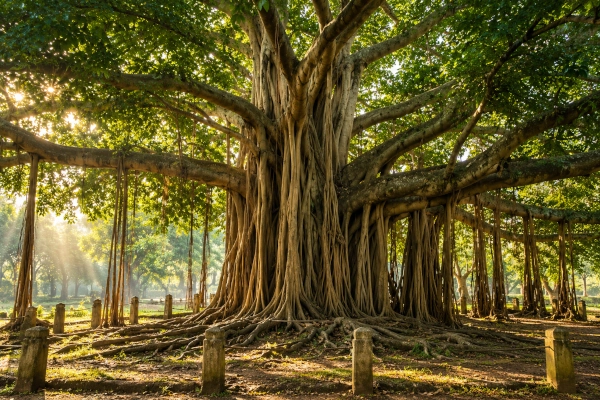
A monumental banyan tree standing in Munger, Bihar, has been scientifically dated to around 700 years, making it the oldest accurately dated Ficus benghalensis yet identified anywhere in the world.
The finding comes from researchers at the Birbal Sahni Institute of Palaeosciences in Lucknow, an autonomous institution under the Department of Science and Technology. Instead of relying on local tradition, architectural history or estimates based on the tree’s enormous size, the scientists analysed the tree’s wood using high-precision radiocarbon dating.
The Department of Science and Technology formally announced the finding on July 3, describing it as an important breakthrough in determining the age of tropical heritage trees whose biology makes conventional tree-ring dating difficult.
The research was published in the journal Quaternary Research by Cambridge University Press in April 2026. The research team comprised Trina Bose, Mayank Shekhar, Akhilesh K. Yadava, Avanish Mishra, Arya Pandey and Anurag Kumar, all affiliated with the Birbal Sahni Institute of Palaeosciences.
Why Dating a Banyan Is So Difficult
Determining the age of a banyan is far more complicated than counting the rings of a conventional temperate tree.
Many trees growing in regions with strongly defined seasons produce a clear annual growth ring. Scientists can count and analyse these rings through dendrochronology to reconstruct both the age of the tree and aspects of the climate under which it grew.
Tropical broadleaf trees often do not provide such a straightforward record. The Department of Science and Technology noted that most tropical broadleaf species lack sufficiently distinct annual growth rings for conventional dendrochronological dating.
Banyans create another complication because of the way they grow. Their branches send aerial roots towards the ground. Once these roots reach the soil, they thicken into supporting trunks. Over centuries, one tree can therefore develop into what appears to be a collection of separate trunks spread across a large area.
The original central trunk can also deteriorate or disappear while younger supporting trunks remain alive. Simply measuring the largest surviving trunk therefore cannot reliably reveal when the tree first began growing.
This is one reason the ages attributed to famous banyans have often depended on oral traditions, old documents or historical associations rather than direct scientific measurements.
Bihar Forest Department Asked Scientists to Investigate
The Munger investigation began after the Bihar Forest Department invited Dr Trina Bose of the Birbal Sahni Institute of Palaeosciences to determine the age of the tree.
Recognising the limitations of conventional tree-ring methods, Bose and colleagues Mayank Shekhar and Akhilesh K. Yadava developed an approach based on radiocarbon analysis of carefully selected wood from the banyan.
The tree stands on the ITC campus in Munger, where it has long formed part of the landscape surrounding a historic building traditionally known as the Burra Bunglow.
Rather than attempting to estimate age from the tree’s circumference or canopy, the scientists sought wood associated with the oldest surviving parts of the banyan.
They sampled material from an exposed secondary trunk and an ancient primary branch, concentrating particularly on wood close to the pith.
Scientists Went Looking for the Oldest Wood
The pith is important because it lies near the centre of a branch or trunk and represents wood formed during an early stage of its growth.
The researchers extracted alpha-cellulose from the selected wood samples. Alpha-cellulose is a stable component of plant cell walls and can provide suitable material for radiocarbon measurements.
The purified samples were then analysed using Accelerator Mass Spectrometry, or AMS, a highly sensitive technique capable of measuring the amount of radioactive carbon-14 remaining in organic material.
Those measurements were subsequently calibrated using the IntCal20 radiocarbon calibration curve and OxCal software to convert the radiocarbon measurements into a chronological estimate.
This approach allowed the scientists to obtain evidence from the tree itself rather than trying to infer its age from the historical events associated with it.
One Ancient Branch Revealed the Tree’s Extraordinary Age
The two samples produced markedly different ages, which is entirely consistent with the unusual growth structure of a banyan.
Wood taken from the pith of an exposed secondary trunk produced a radiocarbon measurement of 276 ± 36 years BP, while material from the old primary branch produced a measurement of 652 ± 37 years BP.
In radiocarbon terminology, BP means “Before Present”, with 1950 conventionally used as the reference year. Radiocarbon measurements are then calibrated because the concentration of atmospheric carbon-14 has varied through time.
After calibration and interpretation of the samples, the researchers concluded that the Munger banyan has a minimum radiocarbon age of approximately 700 years.
The word “minimum” is important.
The researchers have scientifically demonstrated that parts of the living banyan originated roughly seven centuries ago. That does not necessarily establish the exact year in which the original seed germinated. Since parts of the oldest central structure may no longer survive, the organism itself could potentially be older than the oldest wood available for sampling.
The scientifically defensible conclusion is therefore that the Munger banyan is at least about 700 years old.
The Tree Predates the Historic Building Beside It
The dating also overturned a long-standing interpretation of the history of the site.
Local tradition had associated the banyan with the historic Burra Bunglow, leading to the assumption that the tree might have been planted in front of the building as a gathering place where rulers and local people met and where village assemblies, religious events and cultural activities took place.
The building, based on its architectural characteristics, is thought to date from the late Mughal to early British period and has been estimated at roughly 300 to 350 years old.
The radiocarbon evidence demonstrates that the banyan is considerably older.
Rather than having been planted after the building was constructed, the tree was already centuries old when the structure appeared beside it.
The Department of Science and Technology said the result suggests that the banyan may instead represent a surviving remnant of a natural forest that once occupied the region.
That changes the historical relationship between the two landmarks. The building did not give rise to the tree; the tree was already part of the landscape and subsequently witnessed the construction of the building around which later historical traditions developed.
Oldest Accurately Dated Banyan — An Important Distinction
The finding does not mean that scientists have proven that no banyan tree anywhere in India or elsewhere is older.
India contains several celebrated banyans that have been attributed very great ages through historical accounts and local traditions. Establishing those ages scientifically is difficult for precisely the reasons encountered at Munger.
What makes the Bihar tree exceptional is that its age has been established directly through radiocarbon analysis of carefully selected wood.
The peer-reviewed study therefore describes it as the oldest accurately dated Ficus benghalensis in the world.
That wording is scientifically important. It distinguishes an experimentally supported age from estimates derived from folklore, written history or tree dimensions.
The Munger banyan could eventually lose that record if scientists radiocarbon-date another surviving banyan and demonstrate an even greater age. For now, however, it provides the oldest scientifically established chronology for the species.
A Tree That Has Lived Through Seven Centuries
An age of approximately 700 years places the early life of the Munger banyan somewhere around the 14th century, although radiocarbon dating does not justify assigning the tree a precise planting year.
What can be said with considerably greater confidence is that the tree was already growing centuries before the modern industrial site developed around it and before the Burra Bunglow was constructed.
Its survival also illustrates one of the remarkable biological characteristics of banyans. By continuously generating new aerial roots and secondary trunks, a banyan can maintain and expand its living structure even when parts of the original trunk deteriorate.
A very old banyan is therefore less like a conventional single-trunk tree and more like a continuously renewing living system.
Its canopy, branches, roots and cavities also form habitat for birds, insects and numerous other organisms. DST noted that banyans have both ecological importance and a long-standing place in India’s social and cultural landscape.
The Discovery Could Help Protect Other Ancient Trees
The significance of the Munger study extends beyond one extraordinary banyan.
Until now, the absence of reliable annual rings has made it difficult to establish scientifically defensible ages for many of India’s ancient tropical trees. The method demonstrated by the BSIP researchers provides conservation authorities with another way to investigate them.
By targeting pith material, isolating alpha-cellulose and combining AMS radiocarbon measurements with modern calibration techniques, researchers may be able to establish minimum ages for other heritage trees whose histories currently depend largely on tradition.
DST said the methodology could assist forest departments, governments and conservation organisations in identifying and protecting culturally and ecologically important trees. It could also contribute to biodiversity conservation, heritage management, environmental education and research into historical landscapes and past climatic conditions.
Ancient trees are valuable not only because of their age. They can preserve biological, ecological and environmental information covering periods far longer than a human lifetime. Establishing their chronology gives researchers a much clearer framework within which that information can be studied.
From Folklore to Measurable History
For generations, the ages of India’s great banyans have often existed somewhere between history and legend. Their enormous dimensions and cultural associations made their antiquity obvious, but establishing how old they actually were remained exceptionally difficult.
The Munger banyan demonstrates that this barrier can be overcome.
Scientists did not have to determine its age from the size of its canopy, the appearance of its trunks or stories handed down around it. Carbon preserved inside its own wood provided the evidence.
The result confirms that a living banyan in Bihar has survived for at least around seven centuries and establishes it, on presently available scientific evidence, as the world’s oldest accurately dated Ficus benghalensis.
More importantly, the work offers scientists a method to begin testing the histories of other ancient trees across India. Some of the country’s most celebrated banyans may ultimately prove equally old or older. The difference is that their antiquity can now increasingly be approached as a scientific question rather than one answered only by tradition.
You may also like
-
West Bengal to Build ₹12-Crore Astro Park in Nadia and Regional Biotech Park in Kalimpong
-
Mizoram Adds Two New Amphibians as Scientists Uncover Hidden Diversity in Northeast India
-
IISc Researchers Design Selective Membranes to Recover Uranium From Seawater
-
Indian Scientists Show a Single Timed Operation Can Delay Quantum Entanglement Loss
-
New Metallic Golden-Green Beetle Species Discovered in Wayanad Wildlife Sanctuary
