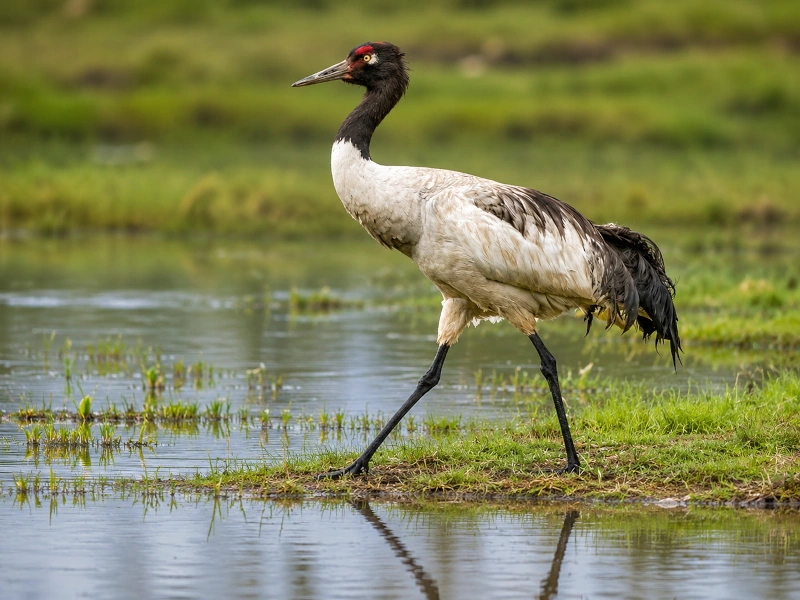
Ladakh has recorded a significant increase in its black-necked crane population, with the latest breeding-season survey documenting 108 birds in 2026, compared with 87 in 2025. The increase of 21 birds, representing approximately 24.14%, marks an encouraging development for the conservation of one of India’s most distinctive high-altitude bird species. The findings were announced by the Administration of the Union Territory of Ladakh on November 17, 2026, highlighting the results of sustained wildlife monitoring, nesting-site protection and community participation across the Changthang region.
The black-necked crane (Grus nigricollis), the State Bird of Ladakh, is a rare high-altitude wetland species recognised for its distinctive black head and neck, pale grey body and reddish crown. Its breeding habitats are concentrated in the wetlands of the Tibetan Plateau and adjoining Himalayan regions, including eastern Ladakh. The species holds considerable ecological and cultural significance for the region, where its seasonal presence is closely associated with the arrival of warmer conditions across the high-altitude landscape.
According to the latest survey, the number of adult cranes increased from 70 in 2025 to 86 in 2026, while the juvenile population rose from 17 to 22. The increase in both categories provides encouraging evidence of continued breeding activity in the surveyed habitats and reinforces the importance of protecting the sensitive wetlands used by the birds during their reproductive season.
Black-Necked Crane Population Reaches 108 in Latest Survey
The 2026 breeding-season survey recorded 86 adult black-necked cranes and 22 juveniles across the monitored habitats of the Changthang Range. These figures represent increases of approximately 22.86% in the adult count and 29.41% in the juvenile count compared with the previous year.
The findings continue a recent upward trend in the number of black-necked cranes recorded in Ladakh. According to the Union Territory Administration, adult crane counts increased steadily between 2021 and 2025, with an average annual growth rate of approximately 12.9% during that period.
The latest survey also indicates continued reproductive activity across the region. The number of juveniles recorded in 2026 is substantially higher than the nine hatchlings documented in 2021 and the seven recorded in 2022.
The presence of 22 juveniles in the 2026 breeding-season count is especially encouraging because successful reproduction is essential for maintaining small and geographically restricted wildlife populations.
However, annual counts can also be influenced by survey coverage, seasonal movements and the detectability of birds in different habitats. Continued monitoring across successive breeding seasons will therefore remain important for understanding the long-term population trend.
Chushul, Tso Kar, Kargyam and Korzok Emerge as Important Breeding Locations
The latest survey identified several important locations supporting black-necked cranes within the Changthang landscape.
Chushul recorded the highest number of cranes among the surveyed breeding sites, with 16 individuals. Tso Kar and Kargyam followed with 15 birds each, while Korzok recorded 14.
Together, these four locations accounted for 60 black-necked cranes, representing approximately 55.56% of the total population documented during the survey.
The concentration of cranes in these areas highlights the importance of maintaining suitable wetland habitats across eastern Ladakh.
The Changthang landscape is characterised by high-altitude lakes, marshes, grasslands and cold-desert ecosystems. Despite the region’s harsh climatic conditions and relatively sparse vegetation, its wetlands provide essential breeding and feeding habitats for several specialised bird species.
Black-necked cranes depend on shallow wetlands and surrounding grasslands for nesting, foraging and raising their young. These habitats provide access to aquatic vegetation, roots, insects and other food resources required during the breeding season.
The Tso Kar Wetland Complex is particularly significant because it is recognised as a Ramsar Site, reflecting its international importance as a wetland ecosystem.
Protecting these locations is therefore essential not only for the black-necked crane but also for the broader biodiversity associated with Ladakh’s fragile high-altitude environments.
Environment Protection Force Plays Important Role in Nesting-Site Conservation
The Ladakh Administration has attributed an important part of the conservation effort to the Environment Protection Force (EPF), whose personnel help safeguard nesting sites, eggs and hatchlings.
The Force includes former military personnel who contribute their experience and field capabilities to wildlife protection activities in the region.
One of the principal threats addressed by the Environment Protection Force is predation by free-ranging dogs.
Black-necked cranes frequently establish nests in open wetland environments where their eggs and young may be vulnerable to disturbance and predation. Although adult cranes can defend nesting territories, eggs and young birds remain susceptible to attacks, particularly during the early stages of development.
Free-ranging dogs pose a serious challenge because they can enter breeding habitats, disturb nesting pairs and prey upon eggs or hatchlings.
Protection of nesting locations can therefore contribute to reducing avoidable breeding losses.
Lieutenant Governor V. K. Saxena appreciated the contribution of Environment Protection Force personnel, particularly the ex-servicemen serving in the organisation, for their work in protecting the species.
The administration highlighted the importance of these field-level activities in strengthening wildlife conservation and maintaining the ecological integrity of the region’s breeding habitats.
Local Communities and Youth Contribute to Conservation Efforts
Community participation has emerged as another important component of Ladakh’s black-necked crane conservation activities.
The Union Territory Administration acknowledged the involvement of local residents, particularly young people, in supporting initiatives intended to protect the bird and its natural habitat.
Ladakh’s traditional communities have longstanding relationships with the region’s landscapes and wildlife. Their knowledge of seasonal environmental conditions, grazing patterns and wetland locations can contribute to conservation awareness and local monitoring.
Community-based conservation is particularly relevant in remote high-altitude regions where wildlife habitats are spread across extensive areas and permanent monitoring resources may be limited.
Local participation can help identify nesting locations, report threats and encourage practices that reduce unnecessary disturbance during the breeding season.
The administration also organised Ladakh’s first Black-Necked Crane Festival earlier in 2026 to increase public awareness of the species and the importance of its conservation.
The festival highlighted the ecological significance of the Changthang wetlands and encouraged greater participation by local communities and younger generations.
Such awareness programmes complement direct habitat protection by strengthening public understanding of the ecological importance of the bird.
Black-Necked Crane Is a Flagship Species of Himalayan Wetlands
The black-necked crane is among the world’s most specialised high-altitude crane species, occupying wetlands and open landscapes across the Tibetan Plateau and adjoining Himalayan regions.
The species is distinguished by its black head and neck, pale grey body, dark wings and reddish crown. Its slender legs and long neck are well adapted to foraging in wetland and grassland environments.
Black-necked cranes generally breed in open, marshy habitats where they can establish territories and construct nests using available vegetation.
Their breeding success depends on several environmental conditions, including the availability of suitable nesting locations, adequate food resources, water levels and protection from disturbance.
The species is listed as Near Threatened on the IUCN Red List and receives the highest level of legal protection under Schedule I of India’s Wild Life (Protection) Act, 1972.
Although the species occurs across a wider range in Asia, its breeding distribution within India is highly restricted, making the conservation of Ladakh’s wetlands particularly important.
The black-necked crane also serves as an indicator of the ecological condition of high-altitude wetland environments.
Maintaining the quality of these habitats can benefit other species, including waterbirds and organisms dependent on the unique ecosystems of the cold desert.
Protecting Fragile Wetlands Remains Essential
Despite the encouraging increase in the latest count, black-necked cranes continue to face environmental challenges associated with their specialised habitats.
High-altitude wetlands are sensitive to changes in water availability, seasonal precipitation, temperature and human activity.
Disturbance around breeding locations can affect the ability of cranes to establish territories and raise their young successfully.
Free-ranging dogs represent an immediate threat in several breeding areas, while broader environmental pressures can influence the availability and condition of suitable nesting habitats.
The conservation of black-necked cranes therefore requires a combination of habitat protection, monitoring, responsible management of human activities and local cooperation.
The involvement of the Environment Protection Force and local communities demonstrates the value of combining institutional conservation efforts with participation at the grassroots level.
Continued monitoring will also be important for understanding changes in the number of breeding pairs, juvenile survival and the distribution of cranes across Ladakh’s wetlands.
These observations can help conservation authorities identify priority locations and adapt protection measures according to conditions on the ground.
Ladakh’s Conservation Efforts Record Encouraging Results
The latest survey findings represent an important development for Ladakh’s wildlife conservation efforts.
The increase from 87 black-necked cranes in 2025 to 108 in 2026 demonstrates a positive change in the breeding-season population recorded across the monitored habitats.
The rise in juvenile numbers is particularly encouraging because it indicates continued breeding activity in the region.
The concentration of birds at Chushul, Tso Kar, Kargyam and Korzok also reinforces the importance of safeguarding these locations as part of a wider high-altitude wetland conservation strategy.
The Ladakh Administration has recognised the role of the Environment Protection Force, local communities and young conservation volunteers in supporting these efforts.
Their participation highlights how wildlife protection can benefit from cooperation between government institutions and communities living close to sensitive habitats.
The 2026 findings provide an encouraging foundation for continued conservation work, although sustained monitoring will be necessary to establish whether the increase represents a longer-term population recovery.
A Positive Milestone for High-Altitude Wildlife Conservation
The increase in Ladakh’s black-necked crane population to 108 birds in 2026 marks an encouraging milestone for the conservation of the Union Territory’s State Bird.
The rise in both adult and juvenile counts demonstrates the importance of continued attention to the species and its breeding habitats.
The findings also highlight the ecological value of Changthang’s high-altitude wetlands, which provide essential habitat for black-necked cranes and other wildlife adapted to the Himalayan cold desert.
The contribution of the Environment Protection Force and local communities reflects the importance of coordinated, field-based conservation efforts, particularly in protecting vulnerable nesting sites from avoidable threats.
By strengthening habitat protection, maintaining scientific monitoring and encouraging public participation, Ladakh can continue building upon its recent conservation progress.
The 2026 survey offers a positive example of how institutional commitment, community involvement and sustained attention to fragile ecosystems can contribute to protecting India’s distinctive wildlife heritage for future generations.
You may also like
-
Scientists Discover Five New Horned Frog Species in Arunachal Pradesh
-
Rare Spotted Flycatcher Recorded in Gadag, Reported as North Karnataka’s First Sighting
-
Bar-headed Geese Return to Maharashtra’s Nandur Madhmeshwar Wildlife Sanctuary
-
Three Butterfly Species Recorded for First Time in Kerala’s Silent Valley National Park
-
Rare Willow Warbler Recorded for First Time in Karnataka at Mangaluru Grasslands
