India’s Defence Research and Development Organisation has taken a broad portfolio of indigenous missile, airborne surveillance, underwater warfare and armoured-vehicle technologies to Africa Aerospace and Defence 2026 in South Africa, putting some of India’s most important home-grown defence systems before military delegations and industry representatives attending the continent’s largest aerospace and defence exhibition.
DRDO began its participation at the five-day exhibition on September 16 at Air Force Base Waterkloof in Tshwane. Its display includes the Astra Mk1 beyond-visual-range air-to-air missile, Akash-NG surface-to-air missile, Airborne Early Warning and Control system, Medium Range Maritime Reconnaissance system, Wheeled CBRN Reconnaissance Vehicle, PDDS-X Portable Diver Detection Sonar, Low Frequency Variable Depth Sonar and technologies associated with an Active Protection System for armoured vehicles.
DRDO said its participation highlights India’s indigenous defence capabilities and its intention to strengthen international defence cooperation. The organisation is displaying its technologies at Hangar 2, Stall 2W 15 during the exhibition.
AAD 2026 runs from September 16 to 20, with the first three days devoted to the defence and aerospace trade exhibition and the final two days incorporating the public air show. The official organisers describe AAD as Africa’s only aerospace and defence exhibition combining air, land and maritime technologies with a major air show.
Astra Mk1 Brings India’s Indigenous Air-to-Air Missile Capability
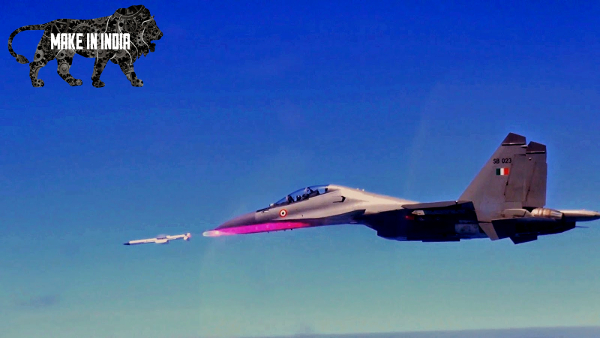
Among the most important weapons represented at the DRDO pavilion is Astra Mk1, India’s indigenous beyond-visual-range air-to-air missile.
Developed by DRDO in coordination with the Indian Air Force, Astra was created to give Indian combat aircraft an indigenous capability to engage hostile aircraft beyond visual range. The missile has already progressed from development and testing into production, with Bharat Dynamics Limited serving as a principal production agency.
The missile programme represents a strategically important area of Indian defence indigenisation because air-to-air missiles require a combination of propulsion, guidance, seekers, navigation, control systems and highly specialised electronics. Astra has been integrated with the Su-30MKI, while the weapon family is intended to support a wider range of Indian combat aircraft.
Displaying Astra in South Africa therefore places an operationally relevant Indian missile technology directly before international military delegations rather than presenting India’s defence industry only through developmental prototypes.
Akash-NG Represents the Next Generation of India’s Air Defence Programme
DRDO is also displaying the Akash New Generation, or Akash-NG, which represents a substantially redesigned evolution of India’s indigenous Akash surface-to-air missile family.
Akash-NG has been developed to counter high-speed and manoeuvring aerial threats while reducing the overall footprint of the ground-based weapon system. DRDO has incorporated an indigenous radio-frequency seeker and a new missile configuration alongside the associated multifunction radar, command-and-control equipment and launch system.
The system successfully completed major user-evaluation trials in December 2025, an important step towards induction into the Indian Air Force. DRDO said those trials covered engagements against targets operating at different ranges and altitudes, including low-altitude and high-altitude scenarios.
Its presence at AAD also carries a wider significance because the original Akash system has already moved into the export market. DRDO’s official material states that production partners BDL and BEL have trained personnel from a friendly foreign country and that an Akash firing unit has previously been flagged off for export.
Akash-NG consequently represents not simply the next stage of India’s domestic ground-based air-defence programme but also a system that could eventually form part of India’s expanding portfolio of exportable missile technologies.
Indigenous AEW&C Highlights India’s Airborne Surveillance Capability
The Airborne Early Warning and Control system is another major technology being highlighted by DRDO in South Africa.
India’s indigenous AEW&C programme produced the Netra system, integrating sophisticated surveillance and mission electronics aboard the Embraer ERJ-145 platform. The aircraft is designed to detect and track airborne and surface targets while sharing an air-situation picture with fighters and ground stations through secure data links.
The system combines radar surveillance with electronic and communications-support measures, allowing it to detect and classify radar and communication emissions in addition to tracking conventional airborne targets.
DRDO’s export documentation describes the AEW&C platform as capable of functioning as an airborne command-and-control centre, with onboard workstations, multiple data links and a self-protection suite.
This gives the AAD display a capability dimension extending beyond missiles. Airborne early-warning systems are force multipliers because they provide military commanders with a much larger surveillance horizon than many ground-based sensors while also helping coordinate fighter and air-defence operations.
Maritime Reconnaissance and Sonar Technologies Join the Display
DRDO has given maritime surveillance and underwater security a prominent place in its South African showcase.
The displayed portfolio includes a Medium Range Maritime Reconnaissance capability, alongside the PDDS-X Portable Diver Detection Sonar and Low Frequency Variable Depth Sonar technologies developed within India’s naval research ecosystem.
The PDDS family was developed by DRDO’s Naval Physical and Oceanographic Laboratory to detect underwater intruders such as divers and diver-delivery vehicles. The system can be deployed from a ship, harbour wall, pier or seabed and is designed to automatically detect, track and classify underwater targets before alerting an operator.
DRDO’s export documentation gives the portable system a 360-degree azimuth coverage and states that it can operate continuously for harbour and ship protection. Such equipment has particular relevance for naval bases, ports, anchorages and other coastal installations that may face underwater sabotage or infiltration threats.
The Low Frequency Variable Depth Sonar addresses a different problem: detecting submarines at longer distances while allowing the sonar to operate at different depths according to prevailing underwater acoustic conditions.
DRDO describes its low-frequency variable-depth sonar technology as suitable for detecting, localising and classifying quiet submarines in active and passive modes. Variable-depth operation allows the sonar to exploit changing oceanographic conditions while reducing the limitations imposed by a fixed hull-mounted sensor.
Taken together, the sonar technologies demonstrate the growing depth of India’s indigenous anti-submarine warfare and maritime-security research.
Wheeled CBRN Vehicle Brings a Specialised Battlefield Capability
The Wheeled CBRN Reconnaissance Vehicle represents the land-warfare component of DRDO’s display.
Developed around an indigenous 8×8 wheeled platform, the vehicle is designed to conduct reconnaissance in environments potentially contaminated by chemical, biological, radiological or nuclear agents.
DRDO says the vehicle integrates specialised CBRN instrumentation with a high-mobility platform developed specifically for the reconnaissance role. The vehicle design incorporates lessons and improvements derived from Indian Army trials of the Wheeled Armoured Platform 8×8.
Its purpose is to allow military units to enter potentially contaminated areas, identify hazards and collect information while providing the crew with the mobility and protection required for operations in such conditions.
CBRN reconnaissance receives less public attention than missiles or aircraft, but it remains an important element of battlefield protection because forces operating without reliable detection equipment may be unable to determine the extent or nature of contamination following a chemical, biological or radiological incident.
Active Protection Technologies Address the Changing Threat to Armoured Vehicles
DRDO is also presenting technologies connected with an Active Protection System, reflecting the rapidly changing threat environment facing tanks and other armoured fighting vehicles.
Unlike conventional armour, an active protection system attempts to detect an incoming anti-armour weapon and counter it before it reaches the vehicle. DRDO identifies active-protection technologies capable of defeating chemical-energy anti-armour threats as an important development area under its Combat Vehicles Research and Development Establishment.
The requirement has become increasingly important as armoured vehicles face advanced anti-tank guided missiles, top-attack weapons, loitering munitions and armed drones in addition to traditional tank guns.
Showing the technology at an international defence exhibition indicates that DRDO’s overseas portfolio is increasingly extending beyond established missile and radar products into technologies intended for the next generation of protected combat vehicles.
AAD Provides Direct Access to African Defence Markets
The choice of AAD for this broad DRDO display is significant because the exhibition is designed around direct interaction between defence manufacturers, armed forces, government delegations and procurement organisations.
The organisers describe AAD as a meeting point for international defence companies, senior military delegations, chiefs of armed services and procurement officials. The event combines air, maritime and land warfare technologies within a single exhibition.
Its 2026 exhibitor list also shows a substantial Indian industrial presence. Alongside Indian government and DRDO-linked technologies, companies listed by the organisers include Bharat Electronics Limited, Hindustan Aeronautics Limited, Tata Advanced Systems, Advanced Weapons and Equipment India, EyeROV, Accord Software and Systems and Zeus Numerix.
That wider participation gives India an opportunity to present not simply isolated defence products but an increasingly broad industrial ecosystem ranging from missiles and aircraft systems to electronics, autonomous underwater platforms and specialised engineering technologies.
From Domestic Development to International Defence Cooperation
DRDO’s AAD 2026 portfolio is notable for its breadth. Instead of concentrating solely on headline weapons, the organisation has brought together technologies covering air-to-air combat, ground-based air defence, airborne surveillance, maritime reconnaissance, underwater detection, anti-submarine warfare, CBRN reconnaissance and armoured-vehicle protection.
That diversity reflects the direction in which India’s indigenous defence programme has evolved. DRDO increasingly develops the underlying technology while production is transferred to defence public-sector companies and private manufacturers capable of supplying the Indian Armed Forces and, where approvals permit, overseas customers.
International exhibitions therefore serve a different purpose from domestic technology demonstrations. They allow potential foreign users to examine Indian systems, open discussions with production agencies and assess technologies against their own operational requirements.
No new export contract should be inferred merely from DRDO’s participation at AAD 2026. However, placing Astra Mk1, Akash-NG, AEW&C and advanced naval and land-warfare technologies before military delegations in South Africa significantly broadens international exposure for India’s indigenous defence-development programme.
As India seeks to expand its defence-industrial presence overseas, AAD 2026 provides a major African platform on which to demonstrate that its export offering now extends well beyond individual weapon systems into sensors, surveillance networks, underwater warfare systems and technologies spanning the air, land and maritime domains.
You may also like
-
OBSC Perfection Secures ₹8.9 Crore Israeli Defence Order for Precision Fuze Components
-
India and Russia Explore New Defence Co-Production and Joint Technology Development Opportunities
-
DRDO Advances Indigenous Submarine AIP System as ₹1,990 Crore Kalvari-Class Integration Programme Progresses
-
Paras Defence Clarifies Guardian-1 Counter-Drone Partnership with US Firm Powerus Amid Pakistan Deal Concerns
-
India’s Defence Procurement Approvals Cross ₹1.62 Lakh Crore as Indigenous Manufacturing Gains Momentum
