Indian defence electronics company Apollo Micro Systems Limited has received Transfer of Technology for DRDO’s Semi-Active Laser Homing System (SALHS), adding an indigenous precision-guidance technology to its growing portfolio of missile and munition subsystems.
Apollo disclosed the development to the BSE and National Stock Exchange on September 16, 2026, under Regulation 30 of SEBI’s listing regulations. The company said the technology transfer was presented during the DRDO-Industry VIMARSH 2026 programme in New Delhi in the presence of Defence Minister Rajnath Singh.
The development coincides with progress on another major Apollo programme, the Multi-Influence Ground Mine, or MIGM, developed by DRDO for the Indian Navy. The indigenous underwater mine, designated VIGHANA by Apollo, has already received Acceptance of Necessity from the Defence Acquisition Council and is moving towards production, with Apollo serving as one of DRDO’s designated production partners.
What the Semi-Active Laser Homing System Does
The technology transferred to Apollo was developed by the Instruments Research and Development Establishment (IRDE), Dehradun, a DRDO laboratory specialising in electro-optical and laser-based defence technologies.
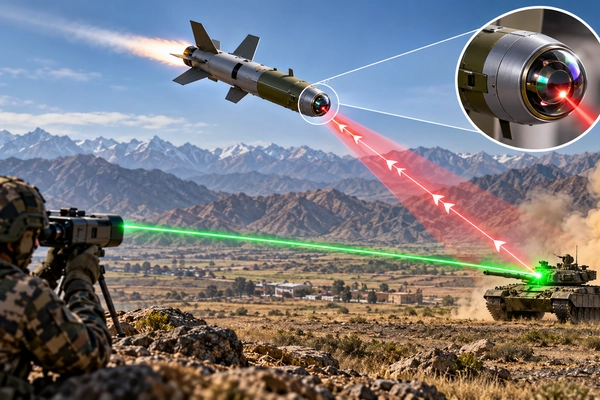
DRDO describes Semi-Active Laser Homing as a technique that provides in-flight guidance to a munition against a designated target. A separate laser designator illuminates the target, while the homing system aboard the weapon detects laser energy reflected from it and generates the information required to steer the weapon towards the designated point.
This differs from a fully autonomous seeker that independently searches for a target. In semi-active laser guidance, the target must first be illuminated with coded laser energy. The weapon’s seeker then follows the reflected signal during its terminal approach.
The principle is widely applicable to precision-guided weapons because it allows a comparatively small target area to be designated while enabling the munition to make corrections during flight.
Precision Optics at the Heart of the Seeker
DRDO’s official technical description provides considerably more detail about the indigenous SALHS.
The system contains front-end optics designed to collect scattered laser radiation reflected from the target, together with a detector and associated proximity electronics that process the returning signal. An interference filter suppresses unwanted background radiation so that the seeker can distinguish the designated laser energy from surrounding optical noise.
A silicon quadrant detector receives the reflected laser radiation after it is focused by the optical assembly. The electronics employ four low-noise trans-impedance amplifier channels with variable gain to process the detector output.
This configuration allows the seeker to determine the direction from which the designated laser energy is arriving. That directional information can then be used by the munition’s guidance system to generate course corrections during flight.
Apollo says the transferred technology is designed for potential integration across multiple missile and munition platforms, although each application would still require platform-specific integration, testing and qualification.
DRDO Opened SALHS to Indian Industry in 2025
The technology transfer follows DRDO’s decision to make the indigenous SALHS available to Indian industry.
IRDE formally published the technology for transfer on September 16, 2025, offering up to five licences under DRDO’s Category-A technology-transfer framework.
One year later, Apollo’s selection gives the Hyderabad-based company access to the technology and the associated technical documentation and manufacturing know-how necessary to develop production capability.
The transfer is important because seekers and guidance systems represent some of the most technically demanding elements of precision weapons. Their manufacture requires expertise spanning electro-optics, detectors, signal-processing electronics, guidance interfaces and high-precision engineering.
For Apollo, the addition therefore extends its involvement beyond electronic subsystems into a technology that directly contributes to the terminal accuracy of guided weapons.
VIGHANA Gives Apollo a Second Major DRDO Programme
Alongside SALHS, Apollo used its September 16 announcement to highlight progress on the Multi-Influence Ground Mine programme.
The MIGM is an indigenous underwater naval mine designed and developed by DRDO’s Naval Science and Technological Laboratory at Visakhapatnam, with contributions from the High Energy Materials Research Laboratory in Pune and Terminal Ballistics Research Laboratory in Chandigarh.
The Ministry of Defence confirmed in May 2025 that DRDO and the Indian Navy had successfully conducted a combat firing of the indigenous MIGM using a reduced explosive charge. The ministry identified both Bharat Dynamics Limited and Apollo Micro Systems as production partners for the weapon.
Unlike a conventional naval mine responding to a single type of trigger, a multi-influence mine is intended to exploit signatures generated by passing vessels. DRDO developed MIGM specifically to strengthen the Navy’s ability to counter modern stealth ships and submarines.
Navy Procurement Received DAC Approval in July
The programme reached another important stage on July 3, 2026, when the Defence Acquisition Council approved procurement of the Multi-Influence Ground Mine for the Indian Navy.
The MIGM was included among approximately ₹52,000 crore of capital acquisition proposals approved by the DAC that day. The Ministry of Defence said the mine would help deny an adversary freedom of manoeuvre in the maritime battlespace.
Apollo now says the programme is entering its production phase and that it intends to execute the supply chain domestically. The company identifies the weapon as VIGHANA in its corporate material.
The production transition is particularly important because it takes MIGM beyond the technology-development and demonstration stages towards eventual operational supply to the Navy.
Two Different Technologies, One Wider Indigenisation Push
SALHS and VIGHANA address very different areas of warfare. The former is an electro-optical precision-guidance technology for weapons attacking laser-designated targets, while the latter is an underwater naval weapon intended to restrict hostile ship and submarine movement.
Their convergence within Apollo’s portfolio nevertheless illustrates how India’s private defence industry is increasingly taking responsibility for technologies originally developed by DRDO.
That process was a central theme of VIMARSH 2026. The Ministry of Defence said nine licensing agreements for technology transfer were handed to 13 manufacturing partners during the event. DRDO also introduced measures to give MSMEs and deep-tech companies greater access to funding, incubation and testing facilities while establishing a framework for sharing selected software source codes with licensed manufacturers.
DRDO Chairman Rajesh Kumar Singh said more than 2,300 technology transfers have now been handed to over 1,100 industries, while technologies associated with around 50 DRDO-developed missiles have been made available for greater industry participation.
Apollo Expands From Electronics Into Complete Defence Technologies
Apollo Micro Systems has traditionally worked across defence electronics, avionics, missile subsystems, electronic warfare and underwater systems. The acquisition of SALHS technology and its position as a production partner for MIGM show the company moving further into mission-critical weapon technologies.
SALHS gives Apollo an indigenous seeker and precision-guidance capability with potential applications across different guided weapons. VIGHANA, meanwhile, places the company inside the production ecosystem for an advanced indigenous naval mine that has already passed a combat firing and received government approval for procurement.
The significance of the two programmes consequently extends beyond Apollo itself. Both demonstrate DRDO’s increasingly deliberate effort to move mature technologies into Indian manufacturing companies, creating multiple domestic production capabilities instead of retaining critical defence technologies exclusively within government laboratories.
Refence :
Defence Research and Development Organisation (DRDO) — Semi Active Laser Homing System (SALHS), Instruments Research and Development Establishment
Ministry of Defence / PIB — VIMARSH DRDO-Industry Synergy Meet, 15 September 2026
Ministry of Defence / PIB — DAC Capital Acquisition Approvals, 3 July 2026
Ministry of Defence / PIB — DRDO and Indian Navy Combat Firing of Multi-Influence Ground Mine, 5 May 2025
Apollo Micro Systems Limited — BSE/NSE Business Update, 16 September 2026
You may also like
-
India and Russia Explore New Defence Co-Production and Joint Technology Development Opportunities
-
NTPC Identifies Three Nuclear Power Plant Sites as India Advances 30 GW Atomic Energy Expansion
-
Seven Indian SMEs Debut on Stock Exchanges as Electronics, Software and Engineering Firms Access Public Markets
-
DRDO Advances Indigenous Submarine AIP System as ₹1,990 Crore Kalvari-Class Integration Programme Progresses
-
Paras Defence Clarifies Guardian-1 Counter-Drone Partnership with US Firm Powerus Amid Pakistan Deal Concerns
