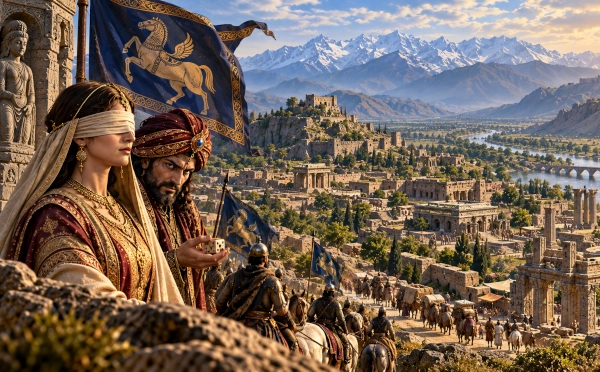
Among the great northwestern kingdoms described in the Mahabharata, Gandhara occupies a uniquely important place. It was the homeland of Gandhari, wife of Dhritarashtra and mother of the Kauravas, and of her brother Shakuni, whose actions became deeply intertwined with the rivalry between the Pandavas and Kauravas. The kingdom stood at the northwestern gateway of ancient Bharat, in a region that connected the Indus plains with the mountain routes leading towards Afghanistan and Central Asia.
The historical core of Gandhara is generally placed around the Peshawar Valley, Taxila and Pushkalavati, with its wider geographical and cultural sphere extending through the valleys of the Swat and Kabul rivers. In modern terms, this corresponds mainly to northwestern Pakistan and adjoining eastern Afghanistan. Encyclopaedia Iranica describes ancient Gandhara as a region on both sides of the Indus around Takshashila, or Taxila, and Pushkalavati, while the British Museum defines the wider historic region as encompassing northwestern Pakistan and eastern Afghanistan, including the lower Kabul and Swat valleys.
The Land of Gandhara
Gandhara occupied one of the most strategically important geographical positions in the ancient subcontinent. Its landscape combined fertile river valleys, plains, mountain foothills and corridors leading through the Hindu Kush. The Peshawar Valley formed one of its principal centres, while Taxila lay farther southeast near the Indus approaches. To the north, routes led through Swat and Dir, while the Kabul River provided a natural corridor westwards towards the Afghan highlands.
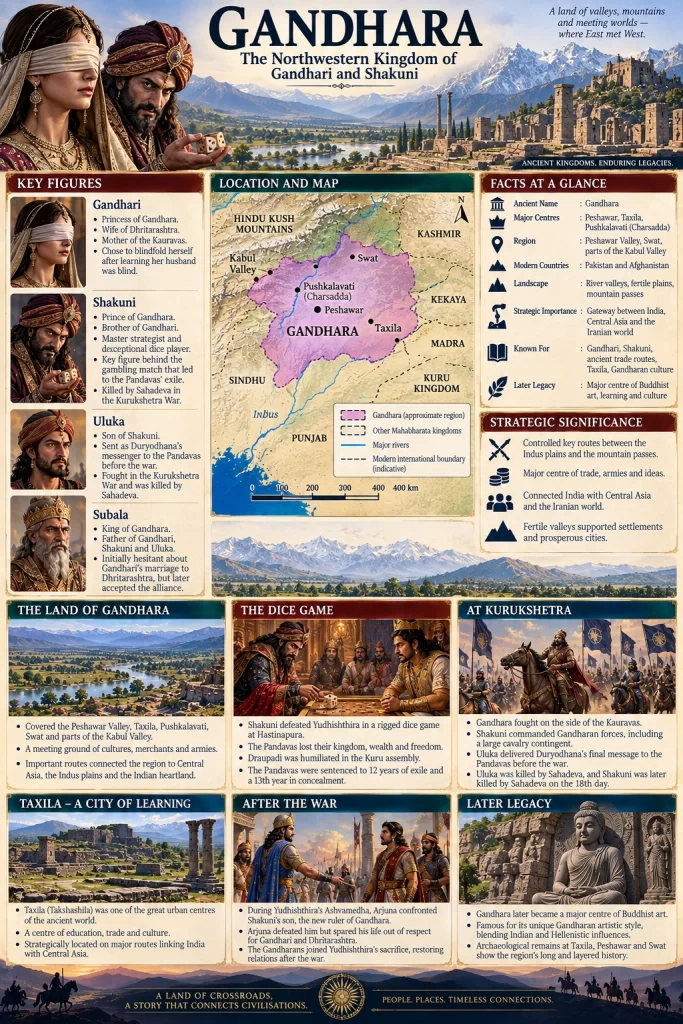
This geography made Gandhara a meeting ground between the Indian subcontinent, the Iranian world and Central Asia. Routes running through the region carried merchants, soldiers, ideas and religious traditions for centuries. UNESCO’s description of the Shahbazgarhi inscriptions notes an ancient route connecting the Peshawar Valley with Swat, Dir and Chitral to the north and Taxila to the southeast, illustrating how closely these areas were linked.
The precise boundaries of the epic kingdom cannot be reconstructed as though they were modern political borders. Different periods used the name Gandhara somewhat differently. The safest identification is therefore a core territory around the Peshawar–Taxila–Pushkalavati region, surrounded by a broader Gandharan sphere reaching into Swat and the Kabul River valley.
Gandhari — The Princess of Gandhara
Gandhara’s most important connection with the Kuru dynasty began with Gandhari, daughter of King Subala of Gandhara.
The Adi Parva records that Bhishma learned that Gandhari had received a boon connected with becoming the mother of many sons. He subsequently sought her marriage to Dhritarashtra. Although King Subala initially hesitated because Dhritarashtra was blind, he ultimately accepted the alliance with the powerful Kuru house.
When Gandhari learned that her future husband could not see, she famously chose to cover her own eyes. Her brother Shakuni accompanied her to the Kuru court and formally gave his sister in marriage to Dhritarashtra before returning to his own country.
The marriage created a lasting dynastic bond between distant Gandhara and Hastinapura. Gandhari subsequently became the mother of Duryodhana, Dushasana and the other Kaurava brothers, making the royal family of Gandhara maternal relatives of the Kauravas.
This connection would eventually bring Shakuni and other Gandharan princes into the heart of Kuru politics.
Shakuni — The Gandharan Prince at Hastinapura
Shakuni, son of Subala and brother of Gandhari, became the most famous male figure associated with Gandhara in the Mahabharata.
Although remembered above all for his political manoeuvring and mastery of dice, Shakuni was also a prince of an established northwestern royal house. The Mahabharata identifies him repeatedly as Subala’s son and connects him directly with the kings of Gandhara.
Shakuni’s involvement in Kuru affairs became especially consequential after Duryodhana witnessed the wealth and splendour of Yudhishthira’s court at Indraprastha. Consumed by jealousy, Duryodhana turned to his maternal uncle for a way to defeat the Pandavas without confronting them directly in battle.
Shakuni proposed gambling.
Gandhara and the Dice Game
The catastrophic dice game at Hastinapura became the episode through which Shakuni most decisively altered the course of the Mahabharata.
Shakuni told Duryodhana that although Yudhishthira was fond of dice, he was not an accomplished player. Shakuni, by contrast, presented himself as exceptionally skilled and proposed defeating Yudhishthira through the gaming board rather than through military force.
When Yudhishthira arrived at the assembly, Shakuni challenged him. Yudhishthira openly criticised deceitful gambling but nevertheless accepted the challenge because he believed that refusing a royal summons and challenge would violate his duties as a Kshatriya.
The consequences were devastating. Through successive wagers, Yudhishthira lost his wealth, kingdom and eventually the freedom of himself and his brothers. Draupadi was brought into the assembly and humiliated. A subsequent game condemned the Pandavas to twelve years in exile followed by a thirteenth year in concealment.
The dice game transformed the rivalry within the Kuru dynasty into an irreparable conflict.
Through Shakuni, a prince from distant Gandhara thus became one of the central figures in the chain of events leading to Kurukshetra.
Sahadeva’s Vow Against Shakuni
After the humiliation caused by the gambling match, the Pandavas made a series of vows against those they regarded as responsible.
Sahadeva specifically directed his anger towards Shakuni. He declared that he would eventually kill the Gandharan prince and his followers in battle.
The vow established a personal confrontation that would not be completed until the final stages of the war.
This connection is particularly significant because Shakuni had used strategy and gambling to defeat the Pandavas politically, whereas Sahadeva vowed that the eventual reckoning would take place openly on the battlefield.
Gandhara Joins the Kaurava Alliance
When diplomacy finally failed, Gandhara naturally entered the war on the side of the Kauravas.
Shakuni’s connection with Duryodhana was both political and familial. Gandhari was Duryodhana’s mother, making Shakuni his maternal uncle. Gandharan warriors therefore formed part of the vast coalition assembled around Hastinapura.
Shakuni was not merely an adviser watching events from behind the lines. He fought actively during the Kurukshetra War and commanded forces of his own.
During the eighteenth day’s fighting, the Shalya Parva describes Shakuni operating with a formidable Gandharan cavalry force, including thousands of horsemen armed for battle. He attempted to attack the Pandava army from the rear, demonstrating the continued military strength of the Gandharan contingent even near the end of the war.
Gandhara was therefore represented at Kurukshetra both through its royal family and through organised military forces.
Uluka — The Gandharan Messenger Before Kurukshetra
Another important Gandharan prince in the epic was Uluka, the son of Shakuni.
Immediately before the war, Duryodhana selected Uluka to carry a deliberately provocative message to the Pandava camp. Uluka arrived before Yudhishthira, Krishna, the Pandavas and their assembled allies and explained that, as an envoy, he was merely required to repeat the words entrusted to him.
He then delivered Duryodhana’s challenges and insults to the Pandava leaders.
The episode gives Uluka an unusual position in the narrative. A Gandharan prince effectively served as the final messenger between the opposing coalitions immediately before the armies entered battle.
Uluka later fought alongside his father in the Kaurava army.
The Final Battle of the Gandharans
By the eighteenth day of Kurukshetra, the Kaurava coalition had collapsed.
Bhishma, Drona, Karna and Shalya had fallen. Much of the enormous army that had originally assembled around Duryodhana had been destroyed. Shakuni, Uluka and the remaining Gandharan forces nevertheless continued fighting.
Sahadeva now moved to fulfil the vow he had made after the dice game.
During the fighting, Uluka attempted to aid his father but was struck down by Sahadeva. The Shalya Parva then describes Sahadeva pursuing Shakuni as the Gandharan prince attempted to withdraw under the protection of his remaining cavalry.
Shakuni was eventually killed by Sahadeva, bringing to an end a rivalry that had begun years earlier in the gambling hall at Hastinapura.
The death carried considerable symbolic weight. Shakuni had defeated Yudhishthira through dice; Sahadeva now defeated Shakuni through arms.
Gandhara After Kurukshetra
The Mahabharata does not end Gandhara’s story with Shakuni’s death.
During Yudhishthira’s Ashvamedha sacrifice, the sacrificial horse eventually travelled into Gandhara. Arjuna followed it and encountered the new ruler of the country, identified as Shakuni’s son.
The Gandharans, still carrying memories of Shakuni’s death and the destruction of Kurukshetra, confronted Arjuna in battle. Arjuna defeated them but did not destroy their royal house. The mother of the Gandharan ruler and elderly ministers approached him and sought peace.
Arjuna then told Shakuni’s son that he had spared him partly out of remembrance for Gandhari and Dhritarashtra. Hostilities ceased, and the young ruler was invited to attend Yudhishthira’s horse sacrifice.
The episode provides an important epilogue to Gandhara’s role in the epic. Despite the destruction caused by Shakuni and the war, kinship eventually provided the basis for reconciliation between the surviving Gandharan royal family and the Pandavas.
Taxila and Pushkalavati
Two of the most famous centres associated historically with Gandhara were Takshashila, or Taxila, and Pushkalavati.
Encyclopaedia Iranica places Gandhara around these two major cities, with Pushkalavati generally identified with the region of modern Charsadda, northeast of Peshawar.
Taxila became one of the great urban centres of the northwest. Archaeology reveals a succession of settlements there extending from early occupation through the cities of Bhir Mound, Sirkap and Sirsukh. UNESCO describes Taxila as strategically located on a major branch of the long-distance routes linking Central Asia and the wider world with the subcontinent.
The archaeological history of Taxila should not be mechanically equated with the chronology of the Mahabharata. Much of the monumental evidence visible today belongs to significantly later periods. Nevertheless, Taxila’s extraordinary longevity illustrates why the Gandharan geographical zone remained strategically important for centuries.
Gandhara Before and After the Epic Tradition
Gandhara is one of the ancient geographical names that can be traced across several different historical traditions.
The name appears already in early Sanskrit literature. Encyclopaedia Iranica notes references to the Gandharis in the Rigveda and Atharvaveda, while Gandhara later appears among the major regions known to Panini. Around the sixth and fifth centuries BCE, it also became part of the political geography of the Achaemenid Persian Empire.
Later, the region passed through the political worlds of Alexander, the Mauryas, Indo-Greeks, Indo-Scythians, Indo-Parthians and Kushans.
Under the Mauryas, Gandhara remained a major administrative and communication zone. The rock edicts at Shahbazgarhi, written in Kharoshthi, provide striking evidence of Ashoka’s authority in the Peshawar region during the third century BCE.
These historical developments belong to periods distinct from the epic narrative, but they confirm the continuing importance of the same northwestern geographical corridor.
The Later Gandharan Cultural World
Centuries after the world portrayed in the Mahabharata, Gandhara became internationally famous as one of the great centres of Buddhist culture and art.
Taxila developed into an important centre of religious activity and learning, while monasteries and stupas spread across the broader region. Gandharan artistic traditions eventually combined Indian religious themes with artistic influences derived from Hellenistic, Iranian, Central Asian and other traditions.
The celebrated Buddha images associated with Gandharan art belong mainly to the early centuries CE and should therefore not be projected backwards onto the society described in the Mahabharata. They represent a much later phase of the region’s extraordinary history.
What remains constant is Gandhara’s geographical role as a crossroads.
Gandhara as the Northwestern Gateway
Few ancient kingdoms possessed a geographical position as significant as Gandhara.
Eastwards lay the Punjab and the route towards Madra, Kekaya and ultimately the Kuru country. Southeastwards, Taxila connected with routes descending towards the Indus and the Gangetic plains. Northwards, the Swat and mountain valleys opened towards the highlands. Westwards, the Kabul River corridor led towards Afghanistan and ultimately Central Asia and the Iranian world.
This position made Gandhara both a frontier and a bridge.
It could receive influences from beyond the Hindu Kush while remaining deeply connected with the political and cultural world of the subcontinent. Its later archaeological record—Persian, Mauryan, Hellenistic, Buddhist and Kushan—dramatically demonstrates the consequences of occupying such a crossroads.
Gandhara in Modern Geography
In modern terms, ancient Gandhara is best understood as a region spanning northwestern Pakistan and adjoining eastern Afghanistan.
Its principal historical centres included the Peshawar Valley, Charsadda/Pushkalavati and Taxila, while the broader Gandharan geographical and cultural sphere reached northwards into Swat and westwards along the Kabul River Valley. The boundaries varied considerably over time and should therefore not be represented as a single rigid territorial outline.
The geographical identification can consequently be stated broadly as:
Gandhara — the Peshawar, Taxila and Swat regions together with parts of the Kabul River Valley — principally modern Pakistan, extending into eastern Afghanistan.
Gandhara occupies an exceptional place in the Mahabharata. Through Gandhari’s marriage to Dhritarashtra, the kingdom became permanently connected with the Kuru dynasty. Through Shakuni, it became deeply involved in the political struggle that destroyed that dynasty. Through Uluka and the Gandharan armies, it participated directly in Kurukshetra. Finally, through Arjuna’s encounter with Shakuni’s surviving son after the war, Gandhara also became part of the epic’s attempt to restore political order after the catastrophe.
Its importance extends far beyond the epic itself. Situated between the Indus world and the Hindu Kush, Gandhara was one of the great crossroads of ancient South Asia, a region through which kingdoms, armies, merchants, languages, religions and artistic traditions moved for centuries. The lands around Peshawar, Taxila, Swat and the Kabul River therefore preserve one of the richest geographical continuities associated with the ancient northwestern world described in Indian tradition.
You may also like
-
Kekaya or Kaikeya: The Western Punjab Kingdom Divided by the Kurukshetra War
-
Madra: The Ancient Punjab Kingdom of Shalya and Madri in the Mahabharata
-
BRICS Theatre Festival 2026 Opens in New Delhi, Bringing Together Nine Nations to Strengthen Cultural Cooperation
-
Sauvira: The Indus Realm Linked With Jayadratha in the Mahabharata
-
Sindhu: The Indus Kingdom of Jayadratha in the Mahabharata
