Among the northwestern kingdoms appearing repeatedly in the Mahabharata, Sauvira is one of the most closely connected with the Indus world. Ancient texts frequently pair it with Sindhu, creating the compound Sindhu-Sauvira, while geographical traditions generally place Sauvira in the lower Indus and adjoining southern Punjab–Sindh region of present-day Pakistan.
Sauvira was therefore part of the great western corridor connecting the Gangetic kingdoms of ancient Bharat with the Indus Valley, Gandhara, the Arabian Sea and routes leading farther northwest. Its best-known connection with the Mahabharata comes through Jayadratha, who is repeatedly associated with both the Sindhus and the Sauviras and whose actions would have profound consequences for the Pandavas.
The Land of Sauvira
Precisely defining Sauvira is difficult because ancient political boundaries did not correspond to modern provincial borders and because different literary traditions seem to use the name somewhat differently.
A long-standing historical identification places Sauvira mainly on the eastern side of the Indus, extending across parts of what are now northern Sindh and southern Punjab. Some geographical reconstructions place its core around the Rohri–Khanpur region, while medieval scholar Al-Biruni associated Sauvira with the wider Multan region and neighbouring areas.
B. C. Law’s study of ancient Indian peoples similarly describes Sauvira as including territory east of the Indus extending towards Multan, while distinguishing it from Sindhu proper on the opposite side of the river.
The safest identification for the series is therefore a broad one:
Sauvira occupied parts of the lower and middle Indus country, especially northern Sindh and adjoining southern Punjab in present-day Pakistan.
Sauvira and Sindhu
The strongest feature of Sauvira’s literary geography is its intimate association with Sindhu.
The two names occur together so frequently that ancient and modern scholars have sometimes debated whether they represented two separate neighbouring kingdoms, different divisions of a larger political region, or overlapping names applied to closely connected peoples.
Traditional geographical scholarship notes that Jayadratha, ruler of Sindhu, is also described as lord of Sauvira, and the terms Saindhava and Sauvira can sometimes occur in closely related contexts.
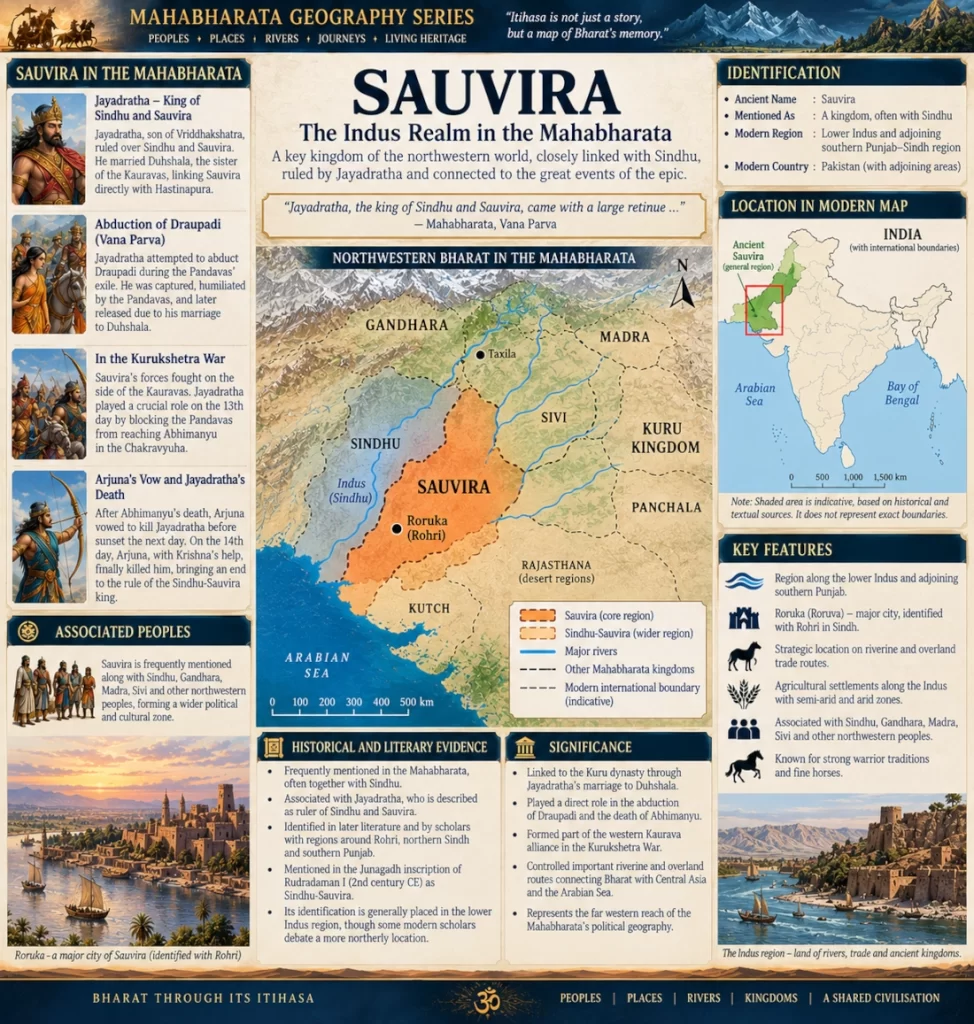
One useful way of understanding the relationship is to regard Sindhu-Sauvira as a wider Indus political zone, within which individual territories could retain their own identities while coming under the authority of the same ruler.
This would explain why the Mahabharata can distinguish Sindhus from Sauviras in some passages while associating them under Jayadratha elsewhere.
Jayadratha and the Sauviras
The most famous ruler connected with Sauvira is Jayadratha.
Jayadratha was the son of Vriddhakshatra and husband of Duhshala, the daughter of Dhritarashtra and Gandhari and the only sister of the Kaurava brothers. His marriage brought the distant Indus kingdoms directly into the political network of Hastinapura.
The Mahabharata describes Jayadratha as ruler of the Sindhus and Sauviras, while some traditions also connect him with neighbouring Sivi territory. Sauvira was consequently part of the western political bloc that became closely aligned with Duryodhana.
This relationship eventually brought Sauvira’s warriors into the Kurukshetra War.
The Abduction of Draupadi
Jayadratha’s first major confrontation with the Pandavas occurred during their forest exile.
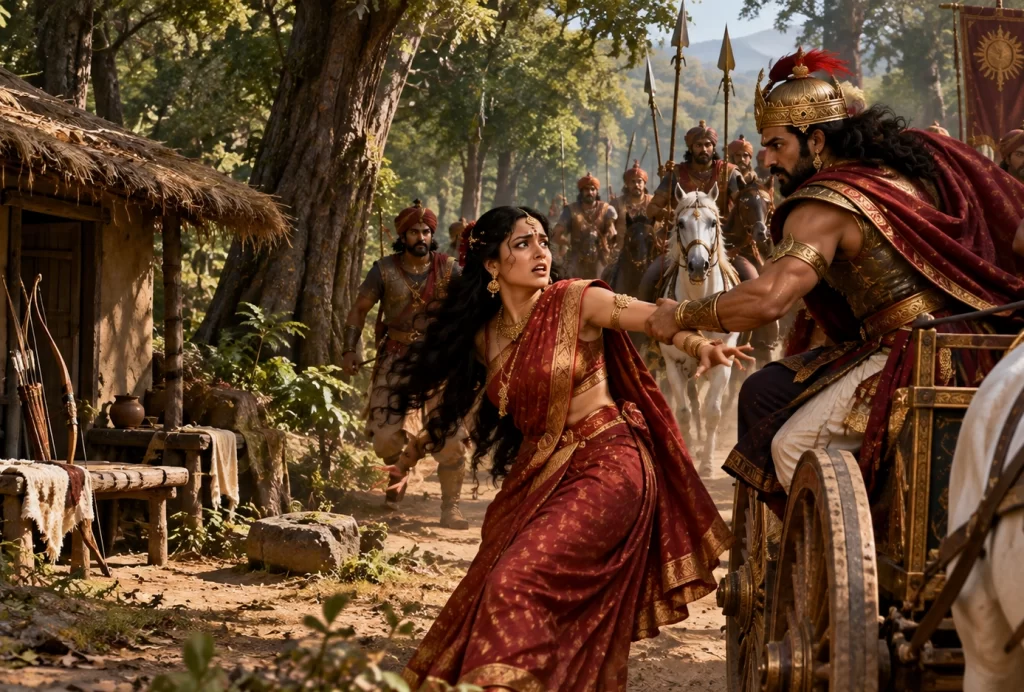
While travelling with a sizeable retinue, Jayadratha encountered Draupadi when the Pandavas were temporarily absent. Despite learning who she was and despite her rejection of him, he attempted to carry her away forcibly.
The episode is particularly valuable geographically because Jayadratha’s entourage is associated with warriors drawn from Sindhu, Sauvira and neighbouring western regions.
The Pandavas pursued the abductors, defeated Jayadratha’s forces and rescued Draupadi.
Bhima wanted Jayadratha killed, but his life was spared partly because he was married to Duhshala. Instead, he was publicly humiliated before being released.
The decision to spare him would later have devastating consequences.
Sauvira in the Kaurava Alliance
When the Kurukshetra War began, Jayadratha entered the conflict firmly on the side of Duryodhana.
The broader Sindhu-Sauvira military grouping formed part of the Kaurava coalition, alongside forces from Gandhara, Madra and other northwestern regions.
This demonstrates the geographical breadth of the war described in the epic. Kurukshetra was not merely a struggle among the kingdoms surrounding the Ganga and Yamuna. Armies came from across the political landscape of ancient Bharat, including distant territories extending into the Indus Valley.
Sauvira therefore occupied an important position within the western wing of the Kaurava alliance.
Sauvira and the Tragedy of Abhimanyu
Jayadratha’s role became decisive on the thirteenth day of the Kurukshetra War.
Drona arranged the Kaurava army in the formidable Chakravyuha. Abhimanyu, the young son of Arjuna, knew how to penetrate the formation, and the other Pandavas intended to follow closely behind him.
Jayadratha prevented them from doing so.
He had received a boon enabling him, under extraordinary circumstances, to resist the other Pandava brothers for a single day. As Abhimanyu entered the formation, Jayadratha blocked Yudhishthira, Bhima, Nakula, Sahadeva and their supporting forces.
Abhimanyu consequently became isolated.
Surrounded by some of the greatest Kaurava warriors, the young prince fought an extraordinary battle before being killed.
Although Jayadratha did not single-handedly kill Abhimanyu, his successful blocking of the Pandavas was a crucial factor in preventing them from coming to the young warrior’s aid.
Through Jayadratha, therefore, Sindhu-Sauvira became directly connected with one of the most emotional turning points of the entire epic.
Arjuna’s Vow Against Jayadratha
When Arjuna learned of Abhimanyu’s death, he swore that he would kill Jayadratha before sunset the following day.
The vow transformed Jayadratha into the central objective of the fourteenth day’s battle.
The Kaurava commanders surrounded him with powerful warriors and positioned him deep behind their formations. Drona, Karna, Kripa, Ashvatthama and other commanders attempted to prevent Arjuna from reaching him.
Arjuna, driven by grief and supported by Krishna, fought his way across the battlefield.
Near sunset, he finally reached Jayadratha and killed him.
The death of Jayadratha removed the most famous ruler associated with the Sindhu-Sauvira region from the war and avenged Abhimanyu’s isolation inside the Chakravyuha.
Sauvira’s Capital — Roruka
Outside the Mahabharata, Sauvira appears prominently in Buddhist and other ancient Indian traditions.
Its most famous city is Roruka, sometimes written Roruva, which has often been identified with the region of Aror or Rohri in Sindh, close to the Indus. Later literary traditions remember Roruka as an important urban and commercial centre.
This identification is particularly significant because Rohri occupies a strategic location beside the Indus.
A city controlling such a point could participate in trade moving north and south along the river while also connecting routes extending eastwards towards Rajasthan and Punjab.
The association between Sauvira and Roruka therefore reinforces the picture of the kingdom as an important participant in the commercial geography of northwestern Bharat.
A Kingdom Along Major Trade Routes
Sauvira’s location gave it considerable strategic value.
The Indus acted as one of the great communication arteries of the subcontinent. Goods, people and animals could move between Punjab and the lower Indus, while overland routes connected the region with Gandhara, Rajasthan, Kutch and western coastal territories.
Some Buddhist sources remember Sauvira in association with major centres of commerce, and ancient geographical studies describe its position within the trading networks of northwestern India.
Agricultural products from the Indus floodplain could circulate alongside livestock, textiles and commodities moving across much greater distances.
Sauvira was therefore not simply a remote western kingdom. It stood near one of the major intersections between riverine commerce, overland caravan routes and routes towards the Arabian Sea.
The Landscape of Sauvira
The physical environment of Sauvira would have contrasted sharply with many of the eastern kingdoms appearing in the Mahabharata.
Its life revolved around the Indus and its associated river systems. Fertile riverine belts existed alongside increasingly dry plains, scrublands and desert margins.
Agriculture depended heavily upon access to river water and seasonal flooding. Settlements concentrated near waterways, while pastoral communities could exploit surrounding drier regions.
Farther east lay the desert approaches leading towards Rajasthan and Kutch. Northwards stretched the Punjab river system. Southwards, the Indus eventually spread into its delta before entering the Arabian Sea.
This geographical diversity made Sauvira both an agricultural region and a natural transit corridor.
Sauvira Beyond the Mahabharata
References to Sauvira did not disappear after the epic tradition.
The region continued to be recognised in early historical literature, and the name Sindhu-Sauvira appears centuries later in the celebrated Junagadh inscription of the Western Kshatrapa ruler Rudradaman I, dating to approximately the second century CE.
The inscription’s reference to Sindhu-Sauvira indicates that the regional designation remained meaningful long after the period represented in epic tradition. Ancient historical studies consequently treat Sindhu-Sauvira as one of the established geographical regions of western and northwestern India.
This does not prove that the political kingdom described in every literary source was identical across centuries. It does, however, demonstrate the remarkable longevity of the regional name.
A Geography With Some Scholarly Debate
The exact placement of Sauvira deserves one qualification.
Traditional scholarship generally identifies Sauvira with Sindh and the lower-to-middle Indus region, often extending towards Multan. Other modern scholarship has challenged this reconstruction.
For example, Indologist Asko Parpola has argued from a close analysis of the Mahabharata that its Sindhu and Sauvira references may point more strongly towards the Punjab or upper Indus region than towards modern Sindh itself.
This debate illustrates a recurring problem in reconstructing Mahabharata geography: place names could shift geographically over long periods, political territories could expand or contract, and the epic itself developed through centuries of transmission.
For a broad geographical series, however, the conventional placement of Sauvira across the lower Indus–southern Punjab and Sindh zone remains a useful identification, provided the uncertainty is acknowledged.
Sauvira in Modern Geography
In today’s geography, ancient Sauvira can be associated broadly with parts of Pakistan, especially:
- Northern and central Sindh, particularly the Indus corridor around Rohri and adjoining districts
- Territory extending towards southern Punjab and the Multan region
- The eastern side of the Indus and neighbouring dry plains
- Areas forming part of the wider historical Sindhu-Sauvira cultural zone
These should not be interpreted as precise political boundaries. Like many ancient kingdoms, Sauvira probably changed in extent according to the power of individual rulers and the allegiance of local communities.
Sauvira in the Geography of the Mahabharata
Sauvira illustrates the enormous western reach of the world described in the Mahabharata.
Located within the greater Indus system, it occupied a strategic region where fertile river valleys met dry plains and long-distance trade routes. Its inhabitants were linked with Sindhu, Gandhara, Madra and the wider northwestern world, while its rulers maintained political connections stretching all the way to Hastinapura.
Through Jayadratha’s marriage to Duhshala, Sauvira became connected with the Kuru dynasty. Through the attempted abduction of Draupadi, its ruler became a personal enemy of the Pandavas. Through Jayadratha’s intervention at the Chakravyuha, the Sindhu-Sauvira kingdom became inseparable from the death of Abhimanyu. And through Arjuna’s subsequent vow, Jayadratha became the focus of one of the most dramatic episodes of the Kurukshetra War.
The Sauvira of ancient tradition can therefore be placed broadly in the lower Indus and adjoining southern Punjab–Sindh region of present-day Pakistan, closely intertwined with Sindhu and positioned along some of the most important river and overland corridors of ancient Bharat.
You may also like
-
Sindhu: The Indus Kingdom of Jayadratha in the Mahabharata
-
Kuninda or Kulinda: The Himalayan Realm of the Mahabharata in Uttarakhand and Himachal Pradesh
-
Durga versus Mahishasura: Weapons, Battlefield Tactics and the Triumph of Shakti
-
Kuluta: The Kullu Valley Kingdom of the Mahabharata
-
Trigarta: The Kangra–Jalandhar Kingdom of the Mahabharata
