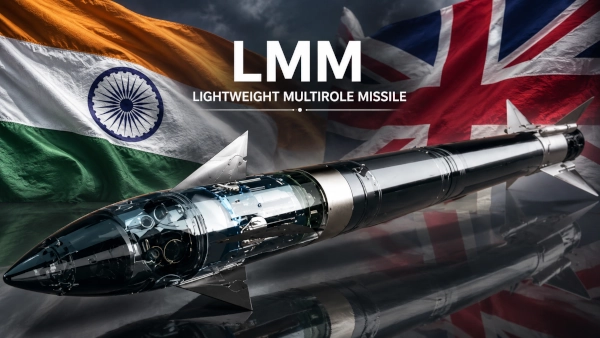
India and the United Kingdom are moving closer to formalising a major procurement agreement for Lightweight Multirole Missiles (LMMs) for the Indian Army, with the planned Indian requirement reportedly increasing substantially since the two governments first announced the procurement pathway in October 2025.
British officials indicated on 26–27 August 2026 that an Inter-Governmental Agreement for the missiles is expected to be signed soon. India is now expected to emerge as one of the largest customers for the weapon, reflecting the Army’s growing requirement for highly mobile short-range missiles capable of countering drones, helicopters and other low-altitude threats.
The latest development represents an expansion of an arrangement announced on 9 October 2025, when India and the UK agreed to proceed through a government-to-government route for an initial supply of LMM systems. The British government placed the value of the planned package at around £350 million, covering missiles and launchers manufactured by Thales UK in Belfast for the Indian Army.
The important advancement in August 2026 is that the Indian requirement is reportedly no longer limited to the quantities envisaged when the £350-million arrangement was announced. British officials have indicated that the planned numbers have increased considerably. A revised final quantity and corresponding contract value have not yet been officially disclosed, meaning the eventual agreement could differ significantly from the original package.
A Compact Missile for the Changing Low-Altitude Battlefield
The Lightweight Multirole Missile, commonly associated with the British service name Martlet, is a compact precision-guided missile developed by Thales for employment against a broad range of relatively small and mobile targets. Unlike heavier surface-to-air missiles intended to engage aircraft at medium or long ranges, LMM is designed for deployment closer to frontline forces.
Its relevance has increased dramatically with the proliferation of unmanned aerial vehicles and one-way attack drones. Modern land formations require large numbers of relatively inexpensive interceptors that can be positioned around tactical units without consuming the much more expensive missiles carried by larger air-defence systems.
LMM was designed from the outset for integration across multiple platforms. Thales has demonstrated the missile for employment from land vehicles, helicopters, UAVs and naval platforms, allowing the same basic weapon architecture to support several operational roles.
For the Indian Army, such flexibility could allow LMM launchers to accompany mobile formations and provide a close-in layer beneath India’s longer-ranged air-defence systems. The missile could strengthen protection of command posts, artillery batteries, logistics areas, mechanised formations and other high-value battlefield assets against helicopters and increasingly numerous UAV threats.
Indian Requirement Appears to Be Growing
The increase in India’s planned procurement is particularly significant because missile-intensive warfare has demonstrated the importance of maintaining large interceptor inventories.
A short-range air-defence system deployed across numerous Army formations cannot depend on a small reserve of missiles. Individual tactical units may require multiple launchers, while wartime consumption against repeated waves of UAVs can rapidly increase expenditure rates.
The UK itself has moved towards large-volume LMM production. In 2025, Thales recorded a British Ministry of Defence contract covering 5,000 LMM missiles, illustrating the production scale now being established for the weapon family.
An expanded Indian order would therefore provide the Army with greater depth while also increasing the strategic importance of India within the LMM manufacturing ecosystem.
The Deal Is Moving Beyond a Straight Import
The larger significance of the LMM programme lies in the industrial partnership being developed alongside the initial missile procurement.
At Aero India 2025, Thales and Bharat Dynamics Limited strengthened their existing cooperation on very-short-range air defence. The companies signed an initial agreement covering Laser Beam Riding MANPADS, including STARStreak High Velocity Missiles and launchers. The British government simultaneously confirmed that Thales and BDL intended to move on to co-production of LMM in India.
The stated objective is for BDL and other Indian companies to become part of Thales’s international missile supply chain rather than merely assemble imported weapons. Britain specifically described the arrangement as supporting Atmanirbhar Bharat while expanding manufacturing capacity for future requirements and exports.
This creates a two-stage pathway. Imported or UK-manufactured missiles can address the Army’s immediate operational requirement, while progressively deeper Indian production can provide longer-term supply security and potentially reduce dependence on foreign manufacturing.
Such localisation becomes increasingly important when missile consumption can rise suddenly during a conflict. A domestic production line offers India greater ability to replenish stocks, undertake modifications and expand procurement without depending entirely on overseas production schedules.
LMM Adds to India’s Expanding VSHORAD Layer
The prospective LMM acquisition also needs to be viewed alongside India’s broader effort to strengthen its very-short-range air-defence network.
The Army is simultaneously introducing and developing several complementary systems rather than relying upon a single missile. Thales and BDL are already working on the STARStreak-based Laser Beam Riding MANPADS requirement, while DRDO’s indigenous VSHORADS programme has reached an advanced stage of testing.
These systems employ different guidance concepts and could therefore offer useful operational diversity. A mixed inventory complicates an opponent’s countermeasure problem because a technique effective against one missile seeker may not necessarily defeat another.
India’s increasing focus on this layer reflects an important lesson from recent warfare: sophisticated long-range air-defence systems alone cannot economically defeat every small drone approaching troops or infrastructure. Forces need numerous mobile weapons positioned much closer to the units being defended.
Building a Wider India-UK Complex Weapons Partnership
The LMM agreement has strategic significance beyond the missile itself. When Prime Ministers Narendra Modi and Keir Starmer announced the initial government-to-government procurement pathway in October 2025, both countries explicitly linked it with a planned long-term collaboration on complex weapons.
The missile programme is therefore becoming one component of a much broader India-UK defence-industrial relationship involving weapons, naval propulsion and advanced manufacturing.
The UK government has described the LMM programme as establishing a route toward deeper industrial cooperation between the two countries. For India, the value of such an arrangement will ultimately depend upon the level of local manufacturing, technology participation and Indian control over future production.
If LMM co-production progresses as planned, Bharat Dynamics could become not only a supplier for Indian requirements but part of Thales’s wider global missile-production network. That would represent a considerably more advanced industrial relationship than conventional licensed assembly.
Formal Agreement Is Now the Key Milestone
The next major milestone will be the signing of the Inter-Governmental Agreement and disclosure of the final procurement numbers.
The original £350-million figure dates to 9 October 2025 and should not be interpreted as a newly announced August 2026 contract value. What has changed is the scale of India’s expected requirement, with British officials now indicating that the number of missiles envisaged has risen considerably.
Until the agreement is formally signed, the revised missile quantity, delivery schedule and value should therefore remain treated as pending.
Nevertheless, the direction of the programme is becoming increasingly clear. India is moving towards acquiring a substantially larger inventory of lightweight precision missiles while simultaneously establishing a domestic production partnership between Thales and Bharat Dynamics.
For the Indian Army, the result could be a much deeper stock of short-range interceptors suited to the rapidly expanding drone and low-altitude threat. For India’s defence industry, the more consequential development could be the gradual transition from purchasing LMMs from Britain to participating directly in their manufacture and global supply chain.
The emerging LMM agreement is therefore evolving from a £350-million missile procurement into a broader air-defence and industrial partnership, combining immediate operational capability with the possibility of sustained missile production in India.
You may also like
-
Indian Navy Vice Chief Inspects Japan’s Mogami-Class Stealth Frigate as India-Japan Shipbuilding Cooperation Expands
-
India and Russia Explore Joint Icebreaker Construction as Maritime Industrial Cooperation Expands
-
Philippine Marine Wargames Reportedly Show BrahMos Can Penetrate Chinese Destroyer Air Defences
-
Safran Signs 18 Agreements with Indian Aerospace Suppliers, Expanding Make in India Manufacturing Partnerships
-
Indian Army’s Vajra Corps Certifies First Batch of Drone Operators, Strengthens Battlefield Surveillance
