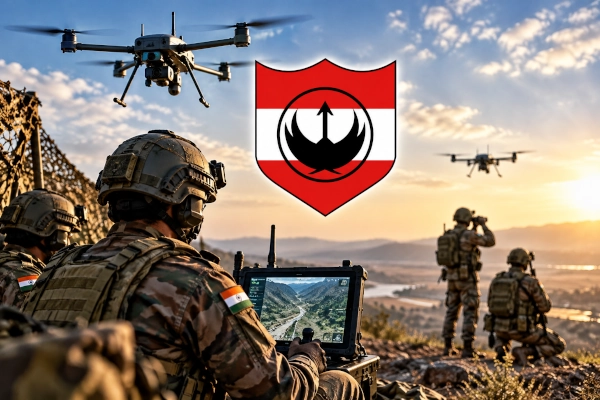
The Indian Army has strengthened its unmanned aerial systems capabilities with the successful certification of the first batch of drone operators from Vajra Corps, a key formation of Western Command headquartered in Jalandhar, Punjab. The personnel completed specialised flying training at the newly established Golden Arrow Remote Pilot Training Organisation (RPTO), gaining skills required to operate drones for military surveillance, reconnaissance and battlefield awareness.
Lieutenant General Amit Kabthiyal, General Officer Commanding of Vajra Corps, presented Remote Pilot Certificates to the newly trained personnel following the successful completion of their training. The development was reported on 8 October 2026 and subsequently confirmed through an announcement on Vajra Corps’ official social media account.
The initiative reflects the Indian Army’s growing emphasis on developing specialised technical manpower as unmanned aerial systems become an integral part of modern military operations.
Golden Arrow RPTO Provides Structured Drone Training
The first batch completed its training under a programme conducted at the Golden Arrow Remote Pilot Training Organisation, a recently established drone training and certification facility.
According to Vajra Corps, the programme follows a certification framework approved by the Directorate General of Civil Aviation (DGCA). It provides structured instruction designed to equip military personnel with the knowledge and practical skills required for safe and effective drone operations.
The training covers aircraft handling, flight operations, operational safety procedures and the practical employment of unmanned aerial platforms. Operators learn to control aircraft, understand flight characteristics and maintain the discipline required for reliable aerial missions.
Unlike conventional classroom instruction, drone-pilot training requires practical experience in operating unmanned aircraft under varying conditions. Personnel must develop proficiency in managing flight controls, understanding environmental limitations and responding appropriately to unexpected situations.
The programme provides a foundation for developing operators who can support military formations through the disciplined employment of unmanned technology.
Vajra Corps Commander Emphasises Technological Competence
Lieutenant General Amit Kabthiyal interacted with the successful trainees and commended their dedication and professional commitment.
Addressing the personnel, he highlighted the expanding role of unmanned aerial systems in contemporary warfare and stressed the importance of continuously improving technical competence, innovation and adaptability.
The Corps Commander encouraged the operators to apply their newly acquired skills to strengthen operational effectiveness.
The interaction demonstrated the importance being placed on technology-based military training at the formation level. Developing specialised capabilities among serving personnel allows the Army to integrate emerging technologies into existing operational structures.
The number of personnel who received certification has not been publicly disclosed.
Drone Operators Strengthen Surveillance and Reconnaissance
One of the principal objectives of the training programme is to improve the Army’s ability to gather timely information about the battlefield.
Small unmanned aerial systems can observe terrain, monitor selected areas and provide commanders with aerial perspectives that may not be available through ground-based observation alone.
For military formations operating across extensive geographical areas, this capability helps improve awareness of local conditions and potential threats.
Reconnaissance drones can also assist in identifying obstacles, examining movement corridors and observing changes in the surrounding environment. Their relatively small size and operational flexibility make them useful for missions where deploying larger aircraft may be unnecessary.
According to an Army defence spokesperson quoted in media reports on 10 October, the newly trained operators will contribute to surveillance, reconnaissance and improved battlefield situational awareness.
These capabilities support the wider objective of providing commanders with accurate information for operational planning and decision-making.
Importance of Drone Capabilities Along India’s Western Front
Vajra Corps operates under the Indian Army’s Western Command, which has important responsibilities concerning India’s western security environment.
Military formations in this region must maintain readiness across operational areas that include plains, agricultural landscapes, built-up environments and strategically important transport corridors.
Drone-based observation can complement existing surveillance systems by providing flexible aerial coverage over selected areas.
Small unmanned aircraft offer particular advantages when monitoring terrain features and supporting local reconnaissance requirements. They can collect information without requiring personnel to move physically into every area under observation.
Such platforms are not substitutes for conventional reconnaissance assets, but they expand the range of options available to commanders.
For formations responsible for maintaining operational readiness along sensitive borders, the availability of trained drone operators adds an important layer to existing intelligence and surveillance capabilities.
Lessons from the Growing Use of Drones in Modern Warfare
Recent conflicts have demonstrated how unmanned aerial systems are changing military operations across multiple domains.
Small drones are increasingly employed for reconnaissance, artillery observation, infrastructure monitoring and tactical information gathering. Larger unmanned systems can undertake extended surveillance missions and carry specialised sensors.
The widespread availability of relatively inexpensive drone technology has also accelerated the development of counter-drone systems, electronic warfare equipment and battlefield communication networks.
These developments create new challenges for military forces. Operators must understand not only how to fly unmanned aircraft but also how to employ them effectively within environments where communications, navigation and electronic systems may face interference.
The fighting between India and Pakistan during Operation Sindoor in 2025 further highlighted the operational significance of unmanned aerial platforms and the need for effective responses to aerial threats.
The Vajra Corps certification programme forms part of the Army’s broader adaptation to a battlefield where technical competence is increasingly important alongside conventional combat skills.
Training Standards and Flight Safety Remain Essential
Operating military drones requires careful attention to aviation safety, equipment reliability and established procedures.
Pilots must understand how weather conditions, visibility, terrain and battery limitations affect aircraft performance. They also need to recognise operational boundaries and follow appropriate procedures during take-off, flight and landing.
Structured certification programmes help standardise these foundational skills.
The DGCA-approved training framework provides a recognised approach to remote-pilot instruction. However, civil remote-pilot certification and military operational qualification serve different purposes.
Military missions can involve specialised aircraft, restricted operating environments and additional requirements that fall outside ordinary civilian drone operations.
Consequently, successful completion of RPTO training provides a foundation for drone proficiency rather than automatic qualification for every military unmanned-aircraft mission.
Further training may be necessary depending on the type of platform, operational responsibility and mission requirements assigned to individual personnel.
Building Technical Expertise Within Army Formations
The establishment of dedicated drone training facilities creates opportunities for the Army to develop technical expertise within its own formations.
Traditionally, many specialised aviation functions have depended on personnel trained through centralised institutions or dedicated aviation units. The growing availability of smaller unmanned platforms allows additional military personnel to acquire relevant operating skills.
Formation-level training can improve access to qualified operators and encourage greater familiarity with emerging technologies among troops.
It also supports the development of instructors, maintenance personnel and technical specialists who can help sustain unmanned systems over their operational lifecycles.
As drone fleets expand, the availability of trained personnel becomes essential for maintaining equipment readiness and ensuring effective utilisation.
An unmanned aircraft represents only one part of the overall capability. Its operational value also depends on qualified operators, functioning ground-control equipment, reliable communications and the ability to interpret information collected during missions.
The Golden Arrow RPTO initiative contributes to this important human-resource component of military modernisation.
Integrating Drone Intelligence into Battlefield Decision-Making
The increasing use of unmanned aerial platforms is also changing how military information is collected and distributed.
Drone-mounted cameras and sensors can provide aerial observations that support command posts, reconnaissance teams and other battlefield elements.
The value of these observations depends on how effectively personnel can interpret and communicate the information.
Commanders may need to combine drone imagery with reports from ground units, surveillance equipment and other intelligence sources to develop an accurate understanding of operational conditions.
Timely information can improve coordination between different elements of a military formation and help commanders respond to changing situations.
However, successful integration also requires secure communication channels, reliable data handling and clearly defined operational procedures.
As the Army expands its use of unmanned systems, the development of trained operators will need to progress alongside improvements in communication infrastructure and information management.
Indian Army Advances Towards a Technology-Enabled Fighting Force
The certification of Vajra Corps’ first batch of drone operators represents a practical step in the Indian Army’s efforts to develop a more technologically capable force.
The achievement establishes a trained group of personnel who can contribute to the effective employment of unmanned aircraft while supporting the development of additional technical expertise within the formation.
The programme also illustrates a wider shift in military preparedness. Modernisation increasingly involves the acquisition of advanced equipment together with the training, maintenance and organisational capabilities required to employ it effectively.
By developing indigenous human expertise in drone operations, the Indian Army is strengthening an important foundation for future battlefield surveillance and reconnaissance capabilities.
The Golden Arrow RPTO initiative marks another step towards building a skilled, adaptable and technology-driven Indian Army, capable of combining conventional military strengths with emerging unmanned systems to meet evolving national security requirements.
References
- Indian Army — Vajra Corps, Official Social Media Account, October 2026. Skilling Vajra Yodhas – Drone Flying Certification.
https://x.com/vajracorps_ia - SSBCrack — 8 October 2026. Lt Gen Amit Kabthiyal Awards Remote Pilot Certificates to Vajra Corps Drone Operators.
https://www.ssbcrack.com/2026/10/lt-gen-amit-kabthiyal-awards-remote-pilot-certificates-to-vajra-corps-drone-operators.html - City Air News — 9 October 2026. Vajra Corps Strengthens Drone Warfare Capabilities as First Batch Successfully Completes RPTO Training.
https://www.cityairnews.com/content/vajra-corps-strengthens-drone-warfare-capabilities-as-first-batch-successfully-completes-rpto-training - The Tribune — 10 October 2026. First Batch of Vajra Corps Drone Operators Completes Training.
https://www.tribuneindia.com/news/jalandhar/first-batch-of-vajra-corps-drone-operators-completes-training/ - Hindustan Times — 10 October 2026. Vajra Corps Trains First Batch of Drone Operators.
https://www.hindustantimes.com/cities/chandigarh-news/vajra-corps-trains-first-batch-of-drone-operators-101791573694604.html
You may also like
-
Philippine Marine Wargames Reportedly Show BrahMos Can Penetrate Chinese Destroyer Air Defences
-
Safran Signs 18 Agreements with Indian Aerospace Suppliers, Expanding Make in India Manufacturing Partnerships
-
India to Seek 35% Increase in Defence Modernisation Budget for FY 2027–28
-
INS Trishul Arrives in UK for Exercise KONKAN 2026 as India and Royal Navy Expand Maritime Cooperation
-
INS Sahyadri Arrives in Russia for Exercise INDRA 2026 to Strengthen India-Russia Naval Cooperation
