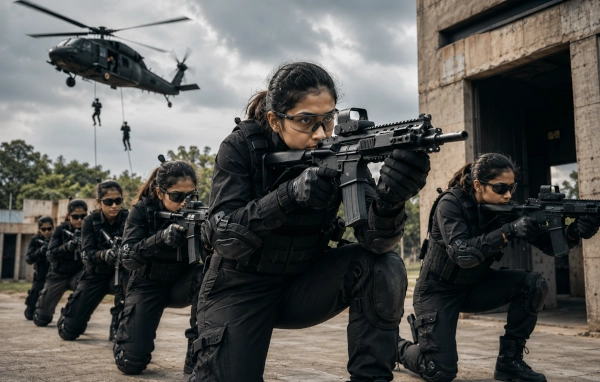
The National Security Guard Training Academy at Manesar has launched its first Mahila Commando Conversion Course, opening a specialised counter-terrorism training pathway for women personnel drawn from State Police Forces and the Central Armed Police Forces. The initiative represents a significant expansion of India’s effort to build advanced tactical capability among women already serving across the country’s internal-security organisations.
The inaugural course began in August 2026 and will run for approximately 12 weeks. Unlike a general physical-training programme, the Mahila Commando Conversion Course is intended to convert already serving police and CAPF personnel into personnel capable of undertaking demanding tactical assignments requiring advanced weapons skills, close-quarter intervention and counter-terror expertise.
Training covers intensive physical conditioning, weapons handling, marksmanship, tactical intervention, hostage rescue and specialised counter-terrorism techniques. These are capabilities normally associated with units required to respond rapidly to attacks on sensitive installations, hostage situations, armed assaults and other high-risk internal-security contingencies.
A major feature of the programme is its emphasis on operational readiness rather than simply increasing numerical representation of women within security organisations. Participants are expected to be trained to the physical, technical and tactical standards necessary for specialist duties where speed, weapon proficiency, coordination and decision-making under extreme pressure are critical.
The initiative also expands the reach of the NSG’s counter-terrorism expertise beyond personnel permanently serving with the elite force. The Manesar Training Centre already functions as a major national institution for urban counter-terrorism, bomb detection and disposal, counter-IED operations and specialist training for State Police Forces and CAPFs. By training personnel from different organisations together, the NSG can help establish common operating standards and improve interoperability during emergencies requiring multiple agencies to operate alongside one another.
Importantly, completion of the course does not automatically induct the participants into the NSG. The women will return to their respective State Police or Central Armed Police organisations after training, taking specialised knowledge and tactical skills back to their parent units. This creates a multiplier effect in which NSG-developed practices can gradually spread across a much wider portion of India’s internal-security architecture.
The first batch includes women already serving in operational police formations. Reporting from Manesar indicates that 25 women from the Rajasthan Armed Constabulary’s 5th Battalion at Ghatgate are among those participating, alongside personnel from other State Police Forces and CAPFs. The NSG has not publicly disclosed the complete strength of the inaugural batch.
The training has particular relevance for security duties at sensitive government installations, strategic facilities, border-area establishments and Quick Reaction Teams, where personnel may have to respond immediately to an armed intrusion or terrorist attack. Advanced marksmanship, room intervention and hostage-rescue skills can significantly improve the ability of local security units to contain a crisis while specialised national-level forces are mobilised.
Women personnel already perform security duties across airports, metro systems, public events, religious sites and other crowded environments. Developing specialised women commando teams can provide additional operational flexibility during search, intervention and rescue situations in which the presence of trained women personnel can be tactically important.
The programme also reflects the changing nature of India’s counter-terror architecture. Rather than concentrating the highest levels of tactical expertise within a small number of elite formations, security planners increasingly require a distributed network of well-trained response teams capable of acting immediately during the opening stages of an attack.
The NSG’s own Training Centre was established in 1985 and has evolved into one of India’s principal centres for advanced counter-terrorism instruction. It conducts specialist courses and joint exercises involving the CAPFs, State Police organisations and counter-terrorism forces from friendly foreign countries, allowing methods developed by the Black Cats to strengthen security organisations beyond the NSG itself.
The Mahila Commando Conversion Course therefore represents more than the creation of another training programme for women. Its larger significance lies in preparing women personnel for high-risk operational assignments traditionally requiring specialist commando skills, while distributing those capabilities across police and paramilitary formations throughout the country.
You may also like
-
Indian Navy Vice Chief Inspects Japan’s Mogami-Class Stealth Frigate as India-Japan Shipbuilding Cooperation Expands
-
Philippine Marine Wargames Reportedly Show BrahMos Can Penetrate Chinese Destroyer Air Defences
-
Safran Signs 18 Agreements with Indian Aerospace Suppliers, Expanding Make in India Manufacturing Partnerships
-
Indian Army’s Vajra Corps Certifies First Batch of Drone Operators, Strengthens Battlefield Surveillance
-
India to Seek 35% Increase in Defence Modernisation Budget for FY 2027–28
