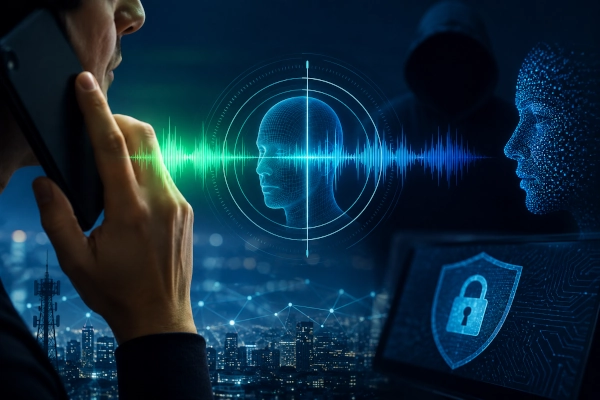
Bengaluru and San Francisco-based startup DetectifAI is developing technology designed to identify AI-generated, cloned and manipulated voices while a telephone conversation is still taking place, addressing one of the fastest-growing threats created by generative artificial intelligence.
Founded in 2025 by Tarini Padmanabhuni, DetectifAI is building what it describes as a voice-trust layer capable of verifying who is speaking, analysing whether speech is synthetic or replayed and flagging suspicious interactions before a sensitive transaction or conversation proceeds. The startup is particularly targeting financial institutions, KYC providers, telecom networks and other organisations where voice is frequently used as part of customer verification.
Detecting Deepfakes During the Call
Most conventional deepfake-detection systems analyse audio or video after it has already been recorded or circulated. DetectifAI is pursuing a different approach by attempting to perform rolling detection during live calls, allowing suspicious audio to be identified in real time.
The company says its models can operate on-device or at the network edge, reducing dependence on repeated cloud processing and potentially cutting the delay between receiving suspicious speech and producing a warning. DetectifAI is developing the technology for mobile phones, telecommunications platforms and enterprise calling systems.
Its system analyses portions of speech for characteristics associated with synthetic, cloned or replayed voices. The resulting detection can then be connected with other security controls, allowing a transaction to proceed, trigger additional verification or be sent for manual review.
Deepfake Scam Inspired the Startup
Padmanabhuni’s decision to focus on deepfake detection followed an AI-enabled scam that targeted her grandfather. The incident demonstrated how synthetic voices could move beyond manipulated online content and become tools for direct financial fraud and impersonation.
AI voice-cloning systems can increasingly reproduce the speech characteristics of real individuals from relatively small audio samples. Criminals can potentially use these synthetic voices to impersonate family members, customers, executives or officials during telephone conversations.
The problem is particularly serious because people have traditionally treated a familiar voice as evidence of identity. Generative AI is weakening that assumption and forcing financial institutions and telecom operators to develop additional ways of establishing whether the person speaking is genuine.
Focus on Banking and Identity Verification
DetectifAI is initially concentrating on the banking, financial services and insurance sector, where voice-based interactions are widely used for customer verification, payment reminders, transaction confirmation, loan servicing and contact-centre operations.
Its platform combines deepfake detection with speaker verification. In a high-risk interaction, a live voice can be compared with a previously enrolled reference while the audio signal is simultaneously checked for evidence of synthetic generation, cloning or replay.
This layered approach is important because detecting whether a voice sounds synthetic and proving who is speaking are not the same problem. A robust security system may therefore need to evaluate both authenticity and identity before allowing sensitive actions to continue.
DetectifAI Reports 95.4% Benchmark Accuracy
DetectifAI has published results from its own MLADD-v3 audio deepfake benchmark, reporting 95.4% overall detection accuracy and an area-under-curve score of 0.99 across a balanced set of 2,000 English-language audio samples.
The test included 1,000 genuine and 1,000 synthetic samples generated using 12 commercial text-to-speech providers. DetectifAI reported 954 correctly identified real samples and 954 correctly identified synthetic samples, with 46 false positives and 46 false negatives in each category.
These figures are company-published benchmark results rather than an independent certification of universal real-world performance. Deepfake-detection accuracy can vary considerably depending on language, audio compression, background noise, the voice-generation model used and the threshold selected for identifying suspicious speech.
DetectifAI itself acknowledges that deployment performance depends on factors including the dataset, communication channel, language, generator and operating conditions.
Building a Broader Voice-Trust Layer
The startup’s ambition goes beyond creating a single deepfake-detection application. DetectifAI wants to build an authentication layer that can sit inside telecom networks, banking systems and mobile devices to help determine whether a digital voice interaction can be trusted.
Its platform is being developed around four connected functions: automating voice interactions, verifying the speaker, inspecting the signal for manipulation and maintaining evidence around the final decision. This could allow enterprises to build security workflows in which suspicious calls automatically trigger stronger identity checks or human intervention.
Padmanabhuni has described the long-term objective as making voice authenticity a standard component of digital communications, in much the same way that other technologies became embedded into audio processing and communications infrastructure.
Five Deepfake-Detection Patents Pending
Padmanabhuni, a computer science graduate specialising in cyber-physical systems from Manipal Institute of Technology, says she has five patents pending relating to deepfake detection.
DetectifAI currently has a team of around 10 people and has attracted seed backing from investors including former TechCrunch Editor-at-Large Josh Constine and Silicon Valley investor Manohar Kamath. The company has not publicly disclosed the size of its funding round.
Its participation in The Residency founder programme in San Francisco has also helped the startup develop connections within the US technology and investment ecosystem.
A Growing Need for Real-Time Authentication
The rapid improvement of generative AI means that synthetic voices are likely to become harder for ordinary listeners to distinguish from genuine speech. This creates a growing security problem for banks, businesses and individuals that rely on voice communication to establish trust.
Post-event deepfake analysis can help determine whether fraud occurred, but it may arrive too late to stop money being transferred or sensitive information being disclosed. Real-time detection therefore represents a particularly valuable direction for the technology.
DetectifAI is attempting to move that defence directly into the call itself. If its models can maintain high accuracy across different languages, telephone networks, noisy environments and rapidly changing voice-generation systems, the technology could become useful for banks, telecom providers and digital identity platforms.
The broader challenge will remain an ongoing technological contest. As voice-generation models improve, detection systems must continuously adapt to new techniques.
For an Indian-origin startup operating between Bengaluru and San Francisco, DetectifAI represents an interesting emerging capability at the intersection of artificial intelligence, cybersecurity, telecommunications and financial fraud prevention. Its effort to identify manipulated voices before a live conversation ends could become increasingly relevant in a digital environment where hearing a familiar voice is no longer sufficient proof that the person on the other end of the call is real.
You may also like
-
India’s Economic Warfare Challenge: Strategic Autonomy, Energy Security and the Rise of a Global Power
-
India-US Trade Deal Stalemate: Why Washington’s Tariff Pressure Has Failed to Secure an Agreement
-
US Double Standards in Foreign Policy: 16 Recent Cases Involving India, Russia, China and Global Trade
-
India’s Arctic Energy Ambitions: Russian Oil, LNG and a New Sea Route to Indian Ports
-
India and Russia Explore Joint Icebreaker Construction as Maritime Industrial Cooperation Expands
