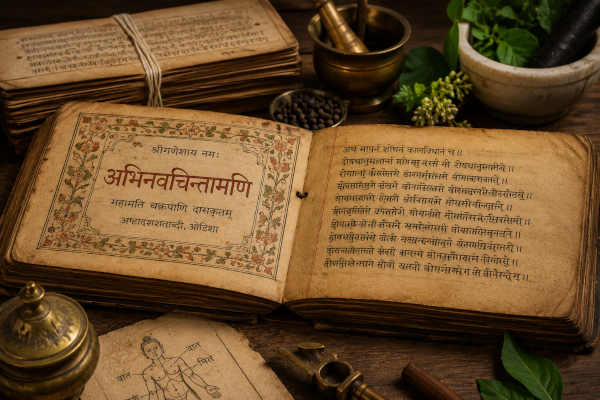
The Ministry of Culture’s Gyan Bharatam Portal has recorded more than 88,800 manuscripts held on different traditional writing materials, marking an important step in India’s efforts to document and preserve its extensive manuscript heritage.
Union Minister for Culture and Tourism Gajendra Singh Shekhawat provided the figures in a written reply to the Lok Sabha. According to the Ministry, the portal currently contains records of 83,045 paper manuscripts, 5,772 palm-leaf manuscripts and three birch-bark manuscripts, taking the total number of registered manuscripts to 88,820. The portal currently carries no manuscript recorded on parchment.
Paper manuscripts constitute the largest part of the collection, reflecting the widespread use of paper for recording religious, philosophical, literary, scientific, administrative and historical knowledge during different periods of Indian history. Palm-leaf manuscripts represent another major category, especially in regions where palm leaves served as the principal writing material for centuries.
The Ministry explained that the manuscripts belong to several historical periods. Establishing the precise age of each document requires detailed research, decipherment, palaeographical examination and scholarly analysis. Dating and decoding the manuscripts will therefore remain a continuous process as researchers study their scripts, languages, physical materials and historical contexts.
Gyan Bharatam was announced in the Union Budget 2025–26 as a flagship initiative of the Ministry of Culture. Its work includes surveying and registering manuscripts, developing technological infrastructure, documentation, conservation, digitisation, publication, capacity building and academic research.
The digital portal can help create an organised national record of manuscripts preserved in libraries, universities, temples, monasteries, mutts, private collections and other repositories. Digital documentation also enables researchers to identify important collections and supports the long-term conservation of manuscripts vulnerable to humidity, insects, material deterioration, accidental damage and natural disasters.
India’s manuscripts contain knowledge relating to philosophy, Ayurveda, astronomy, mathematics, linguistics, literature, architecture, governance, performing arts and several other disciplines. The development of a searchable digital record under Gyan Bharatam can strengthen scholarly access while supporting the preservation of original manuscripts for future generations.
Reference:
Press Information Bureau, Government of India. “Preservation of Manuscript Books and Records Papers.” Ministry of Culture, 20 July 2026. https://www.pib.gov.in/PressReleasePage.aspx?PRID=2286583&lang=1®=3 Press Information Bureau, Government of India. “Preservation and Digitization of Manuscript Heritage.” Ministry of Culture, 23 March 2026. https://www.pib.gov.in/PressReleasePage.aspx?PRID=2243787&lang=1®=3
You may also like
-
Setu — The Sacred Southern Crossing Between Rameswaram and Lanka
-
One Voice – One Resolve – One India: Namami Bharatam Marks 150 Years of Vande Mataram Across the Nation
-
Dravida — The Ancient Tamil Country of Rivers, Temples and the Southern Ocean
-
Pandya — The Southern Kingdom of the Vaigai, Tamiraparani and the Pearl-Rich Sea
-
Chola — The Kaveri Kingdom of Fertile Fields, Ancient Cities and the Eastern Sea
