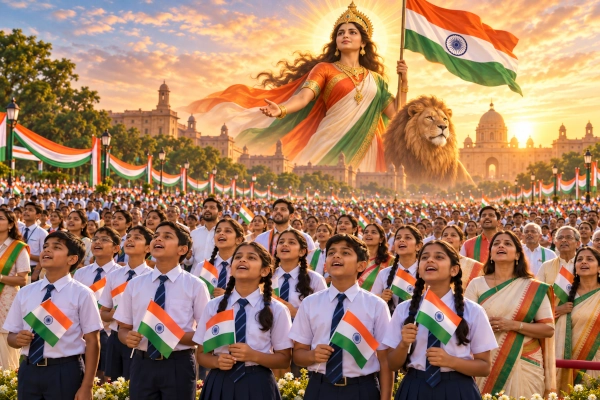
Vidya Bharati Akhil Bharatiya Shiksha Sansthan organised the nationwide Namami Bharatam programme on September 25, 2026, to commemorate 150 years of Vande Mataram. Students, teachers, parents and citizens participated in coordinated programmes across thousands of locations, with the central activity built around a simultaneous rendition of the complete national song.
The programme was designed not only as a mass singing event but also as a cultural and educational initiative. Schools and institutions associated with Vidya Bharati organised exhibitions, discussions, cultural programmes and activities explaining the historical journey of Vande Mataram, its role in the freedom movement and its continuing place in Indian public life.
Nationwide Singing at 11 A.M.
Participants across the country were invited to sing Vande Mataram together at 11 a.m. under the theme “One Voice – One Resolve – One India.” Vidya Bharati had announced participation across more than 25,000 locations and projected involvement from over one crore students, teachers, parents and citizens.
The nationwide scale made Namami Bharatam one of the largest coordinated programmes organised to mark the 150th year of Vande Mataram. However, the final post-event national participation figure has not yet been independently certified, so the one-crore number remains the organiser’s announced estimate rather than a verified final count.
Guwahati Hosts a Major Programme
One of the prominent events took place at the Srimanta Sankaradeva International Auditorium at Kalakshetra in Guwahati, where former Chief of Army Staff General Upendra Dwivedi (Retd.) attended the programme.
Same-day coverage confirmed his participation and address at the event. During his remarks, General Dwivedi referred to the Northeast as a gateway to India and spoke in the broader context of national unity and cultural identity.
The Guwahati programme formed part of a wider mobilisation across the Northeast, where organisers had projected participation from about 1,500 Vidya Bharati schools and more than three lakh students, teachers and members of the public.
Delhi Sees Large-Scale Participation
Delhi also hosted multiple Namami Bharatam programmes, including a major gathering at PGDAV College in Lajpat Nagar. Vidya Bharati Delhi Prant had earlier announced that more than one lakh students, teachers, parents and citizens would participate at around 300 locations across the capital.
Other programmes were organised at schools in Hari Nagar, Rajouri Garden and Punjabi Bagh, with senior Vidya Bharati office-bearers and invited guests participating in the commemorative events.
The Delhi programmes combined collective singing with educational activities intended to introduce younger participants to the historical background of Vande Mataram.
Remembering the Historical Journey of Vande Mataram
Vande Mataram occupies a distinctive place in India’s national history. Written by Bankim Chandra Chattopadhyay and later incorporated into his novel Anandamath, the composition became closely associated with the freedom movement.
During the struggle against British rule, the song was used at public gatherings, political meetings and nationalist movements. Its opening words became a widely recognised expression of anti-colonial mobilisation and national identity.
After Independence, Vande Mataram was accorded the status of India’s National Song, while Jana Gana Mana became the National Anthem. The 150th-year commemoration therefore combines a cultural anniversary with remembrance of the song’s role in the freedom struggle.
Schools Turn the Programme Into a Learning Exercise
An important feature of Namami Bharatam was its focus on education rather than limiting the programme to ceremonial singing.
Schools organised exhibitions, interactive sessions and cultural activities explaining the origins of Vande Mataram, its spread during the freedom movement and its significance in modern India. This allowed students to engage with the song through history, literature and public memory.
For younger participants, the programme was intended to connect a familiar national symbol with the historical circumstances in which it became important.
Record Certification Process Underway
The organisers had submitted the nationwide programme for record certification to the Asia Book of Records and the India Book of Records, based on the scale of simultaneous participation across multiple locations.
A Cultural Programme on a National Scale
Namami Bharatam brought together schools, families and citizens in a coordinated national commemoration of Vande Mataram. Its scale reflected Vidya Bharati’s extensive educational network, while the programme’s historical content gave the event a broader purpose beyond mass participation.
The anniversary also placed renewed focus on the journey of Vande Mataram from a nineteenth-century literary composition to one of the most recognisable songs associated with India’s freedom movement.
With events held across Delhi, Assam and many other parts of the country, the September 25 programme became a nationwide observance linking education, history, culture and public participation.
References
Vidya Bharati Akhil Bharatiya Shiksha Sansthan — Official Namami Bharatam programme information and event calendar
https://vidyabharti.net/events
You may also like
-
Kekaya or Kaikeya: The Western Punjab Kingdom Divided by the Kurukshetra War
-
Madra: The Ancient Punjab Kingdom of Shalya and Madri in the Mahabharata
-
BRICS Theatre Festival 2026 Opens in New Delhi, Bringing Together Nine Nations to Strengthen Cultural Cooperation
-
Sauvira: The Indus Realm Linked With Jayadratha in the Mahabharata
-
Indian Railways Announces 3,548 NTPC Graduate Vacancies, Applications Open Until November 6, 2026
