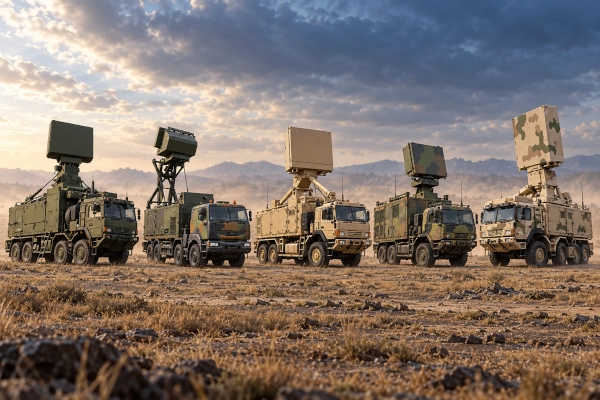
The flag-off of Bharat Electronics Limited’s indigenous 3D CAR Prime radar at BEL’s Ghaziabad complex has drawn attention to India’s expanding ground-based air-surveillance capability. The radar belongs to a class of mobile systems designed to detect, track and provide three-dimensional information on airborne targets, allowing an air-defence network to build an accurate picture of the surrounding airspace.
The obvious question is how the Indian radar compares with established systems such as BEL’s Rohini, Saab’s Giraffe AMB, Thales’ Ground Master 200 and HENSOLDT’s TRML-4D. A completely numerical comparison is not yet possible because BEL has not publicly released a full specification sheet for 3D CAR Prime covering parameters such as instrumented range, target capacity, antenna architecture and update rate. What can be compared with confidence is the role of each radar, its publicly known technology and the direction in which modern air-surveillance systems are evolving.
3D CAR Prime Builds on India’s Existing Radar Ecosystem
The 3D Central Acquisition Radar, or 3D CAR, belongs to an Indian radar-development lineage that produced systems such as Rohini for the Indian Air Force and Revathi for naval use. DRDO documentation describes the earlier Central Acquisition Radar programme as an S-band radar technology that was progressively upgraded and adapted through collaboration involving DRDO, BEL and Indian industry.
The newly flagged-off 3D CAR Prime appears to represent a further development within this broader ecosystem, although BEL has not yet publicly disclosed enough technical detail to determine precisely how far the Prime configuration differs from earlier variants. Improvements could involve signal processing, electronic counter-countermeasures, networking, target handling or antenna technology, but these should not be assumed without official confirmation.
What is clear is that the radar is being manufactured indigenously and has entered India’s defence-production chain. That makes 3D CAR Prime important not only as an operational sensor, but also as evidence of India’s growing ability to manufacture advanced radar electronics and associated subsystems domestically.
Rohini Is the Closest Publicly Documented Indian Benchmark
Among Indian systems, Rohini is the most useful benchmark for understanding the role of 3D CAR Prime. BEL describes Rohini as an S-band mobile medium-range three-dimensional surveillance radar capable of track-while-scan operation against airborne targets at ranges of up to 150 kilometres.
Rohini incorporates integrated Identification Friend or Foe capability, frequency agility, electronic counter-countermeasures and networked distribution of target tracks. Its role is to continuously detect and track aircraft while generating range, bearing and altitude information for a wider air-defence network.
The operational relationship between Rohini and 3D CAR Prime is therefore more important than a simple comparison of range. Both belong to the broader Indian requirement for mobile acquisition and surveillance radars capable of feeding integrated air-defence systems, although the precise performance improvement represented by the Prime version remains undisclosed.
Saab Giraffe AMB Shows the Shift Towards Multi-Mission Surveillance
Sweden’s Giraffe AMB occupies a similar operational space but has evolved into a highly mobile multi-mission radar family. Saab developed the system for short- and medium-range ground-based air defence, with the radar capable of rapidly updating the air picture while detecting aircraft, helicopters, unmanned aerial vehicles and other targets.
The newer Giraffe AMB D, unveiled by Saab in 2026, illustrates how far this category has evolved. Saab states that the new version uses a compact AESA antenna, digital beam forming and a software-defined architecture, while offering an instrumented range of up to 250 kilometres and the ability to manage large numbers of simultaneous tracks.
The system is also designed to detect small drones and support counter-rocket, artillery and mortar missions. This reflects a major shift in radar design, where a single system is increasingly expected to perform several surveillance and battlefield functions that were once handled by separate sensors.
Thales GM200 Combines Surveillance With Battlefield Functions
France’s Thales Ground Master 200, particularly the newer GM200 Multi Mission family, represents another approach to medium-range mobile air surveillance. Thales describes the system as capable of detecting targets ranging from low, slow and small objects to highly manoeuvrable aircraft at distances of up to around 250 kilometres in surveillance mode.
The modern GM200 family uses 4D AESA technology and a software-defined architecture. It combines air surveillance with functions such as rocket, artillery and mortar warning, weapon-location support and coordination of ground-based air-defence systems.
This makes the GM200 more than a conventional air-surveillance radar. It reflects the growing international trend towards multi-role sensors that can support both air defence and wider battlefield awareness from a single mobile platform.
HENSOLDT TRML-4D Represents a Modern AESA Air-Defence Radar
Germany’s TRML-4D, developed by HENSOLDT, is another important reference point. It uses active electronically scanned array technology and is designed to detect, track and classify a large number of targets, including aircraft, helicopters, cruise missiles and smaller low-flying objects.
HENSOLDT has publicly stated that TRML-4D can manage approximately 1,500 targets within a surveillance radius of up to 250 kilometres. The radar has also become closely associated with modern ground-based air-defence networks through its integration with systems such as IRIS-T SLM.
The value of TRML-4D lies not merely in range, but in its ability to manage complex airspace and provide rapid updates on difficult targets. This is increasingly important as air-defence systems confront a mixture of aircraft, drones, cruise missiles and other low-altitude threats.
Publicly Available Comparison
Because the detailed specifications of 3D CAR Prime have not yet been released, the comparison must distinguish between confirmed public information and parameters that remain undisclosed.
| Radar | Country | Broad Role | Public Range Figure | Publicly Known Technology | Notable Capability |
|---|---|---|---|---|---|
| 3D CAR Prime | India | Mobile 3D air surveillance and acquisition | Not publicly disclosed | Detailed Prime configuration not publicly disclosed | Indigenous production within India’s 3D CAR family |
| Rohini | India | Medium-range 3D air surveillance | Up to 150 km | S-band 3D radar | Track-while-scan, ECCM, IFF and networked track distribution |
| Giraffe AMB / AMB D | Sweden | Mobile multi-mission air surveillance | AMB D up to 250 km | Compact AESA on AMB D | UAV detection, C-RAM capability and high update rate |
| Ground Master 200 | France | Medium-range multi-mission surveillance | Up to 250 km | 4D AESA variants | Air surveillance, GBAD support and weapon-location functions |
| TRML-4D | Germany | Air-defence surveillance and target acquisition | Up to 250 km | AESA with digital beam forming | High target capacity and focus on low-flying threats |
These figures should not be read as a simple ranking. Instrumented range is not the same as effective detection range against every target, because actual performance depends on radar cross-section, altitude, terrain, clutter, electronic interference, waveform design and signal processing.
A radar with a larger quoted range is therefore not automatically superior in every operational situation. Its real value depends on how well it performs against the specific threats it is designed to detect and how effectively it integrates with the wider air-defence system.
AESA and Digital Processing Are Reshaping Modern Radar Design
One of the clearest trends visible in Giraffe AMB D, GM200 and TRML-4D is the move towards AESA antennas, digital beam forming and software-defined radar architectures. These technologies allow radar systems to steer beams electronically, allocate resources dynamically and adapt operating modes through software.
AESA architectures also provide advantages in reliability and electronic warfare resilience because they use many transmit-receive elements rather than relying on a single transmitter path. The radar can vary waveforms, adjust operating parameters rapidly and continue functioning even if individual modules fail.
However, antenna technology alone does not determine overall effectiveness. Signal processing, clutter rejection, electronic counter-countermeasures, target classification, networking and command-and-control integration can be equally important.
This is why it would be premature to declare 3D CAR Prime either ahead of or behind these foreign systems until BEL releases more detailed technical data.
Modern Air Defence Demands More Than Long Detection Range
The growth of drones, cruise missiles and loitering munitions has changed the requirements placed on surveillance radars. Traditional aircraft remain important targets, but modern air-defence networks must also deal with small UAVs, low-altitude missiles and potentially large numbers of simultaneous threats.
This requires rapid update rates, strong clutter rejection, electronic counter-countermeasures and increasingly sophisticated target classification. It also requires the radar to communicate quickly with command-and-control systems so that another sensor or weapon can act on the track.
Mobility has become equally important because a radar that remains in one location for too long can itself become a target for electronic intelligence or precision weapons. Modern systems therefore combine detection capability with rapid deployment and networked operation.
Where 3D CAR Prime Fits in India’s Air-Defence Architecture
For India, the importance of 3D CAR Prime lies in the development of a wider indigenous sensor network rather than in competition with any single foreign radar. BEL already manufactures several classes of ground-based radar, while DRDO and Indian industry have developed additional surveillance and multifunction sensors for different layers of air defence.
A system such as 3D CAR Prime can contribute to this layered architecture by detecting targets, generating tracks and feeding that information into command-and-control networks. Other sensors and weapon systems can then use that information to build a wider and more accurate air picture.
Indigenous Production Is as Important as Radar Performance
The significance of 3D CAR Prime goes beyond the radar delivered from BEL’s Ghaziabad facility. Domestic manufacturing means that Indian companies can participate in the production of radar electronics, microwave modules, signal-processing hardware and other critical subsystems.
This matters because radar systems require long-term maintenance, upgrades and software improvements throughout their service lives. A stronger domestic supply chain gives India greater control over spares, modifications and future variants while reducing dependence on foreign suppliers for critical surveillance infrastructure.
The larger achievement is therefore not simply the production of another radar. It is the gradual creation of an Indian industrial ecosystem capable of designing, manufacturing and supporting increasingly sophisticated air-defence sensors.
References
Bharat Electronics Limited — Official information on 3D Surveillance Radar Rohini and BEL’s land-based radar portfolio.
Bharat Electronics Limited — September 2026 announcement confirming the flag-off of the indigenously manufactured 3D CAR Prime Radar at BEL Ghaziabad.
Defence Research and Development Organisation — Documentation on the Central Acquisition Radar, Rohini and related Indian radar-development programmes.
Astra Microwave Products Limited — Investor and industry disclosures concerning modules supplied for 3D CAR Prime and other Indian radar programmes.
Saab — Official Giraffe AMB and Giraffe AMB D technical information.
Thales — Official Ground Master 200 and GM200 Multi Mission product information.
HENSOLDT — Official TRML-4D technical and product information.
You may also like
-
CSIR-CRRI Partners with Industry to Develop Advanced Indigenous Airport Runway and Pavement Materials
-
Paras Semiconductors Secures 43 Acres in Madhya Pradesh for Proposed ₹6,200 Crore Advanced Chip Packaging Facility
-
Indian Army Special Forces Depart for Indonesia for Exercise Garuda Shakti 2026
-
India to Train 600 Nigerian Army Soldiers in Specialised Jungle and Mountain Warfare
-
ICAR Scientists Develop Indigenous Protective Gloves for Cotton Farmers, Sign Commercial Manufacturing Agreement
