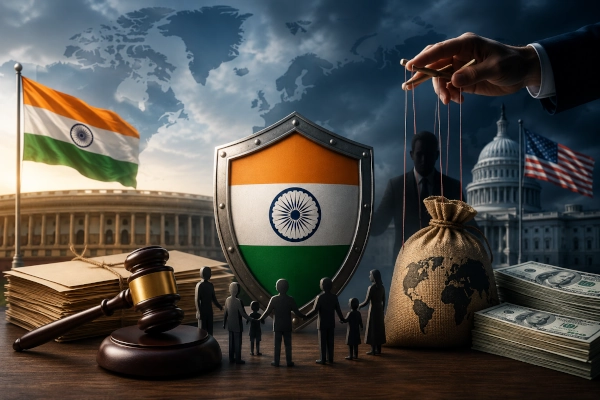
The Foreign Contribution (Regulation) Act, commonly known as FCRA, is one of India’s principal safeguards against the opaque use of overseas money within the country. It regulates how Indian associations, trusts, non-governmental organisations and certain individuals may receive and utilise contributions originating from foreign sources. Its purpose is to ensure that international charity, development assistance and religious or social funding remain transparent, traceable and consistent with India’s sovereignty, public order and national security.
The law does not impose a general prohibition on foreign donations. During 2024–25, around 16,200 registered associations reportedly received approximately ₹22,963 crore under the FCRA framework. This demonstrates that India continues to permit substantial foreign-supported work in healthcare, education, disaster relief, scientific research, welfare and cultural activity, provided recipients follow the prescribed banking, auditing and reporting requirements.
Why India Needs the FCRA
Money entering a country from abroad can serve humanitarian purposes, while it can also be used to shape political narratives, influence public policy, mobilise pressure campaigns or advance the strategic and religious interests of overseas organisations. The source of funding, the conditions attached to it and its final use therefore matter.
Under FCRA, recipients must obtain registration or prior permission, receive foreign contributions through designated banking channels, maintain separate accounts and file audited annual returns. These requirements establish a traceable chain between the foreign donor, the Indian recipient and the activities financed by the contribution.
Earlier government reviews identified violations including receiving funds without permission, failing to maintain exclusive accounts, omitting annual returns, transferring money to unauthorised organisations, using grants for purposes different from those declared and registering foreign-funded assets in individual names. These are precisely the kinds of practices that a regulatory framework must detect and prevent.
FCRA is particularly important because elected representatives, political parties, judges, public servants, election candidates and organisations of a political nature occupy sensitive positions within India’s constitutional system. Allowing such actors to receive unrestricted foreign funding could create conflicts of interest and provide external entities with indirect access to India’s political and administrative institutions.
The Importance of the 2026 Changes
The revised FCRA Rules notified in June 2026 require registrations to identify the approved purposes for which foreign funds may be used and the States or Union Territories in which the organisation will operate. The government argues that this will make permissions more precise and allow activity- and location-based monitoring. The rules also clarify eligible faith-based activities and exclude proselytisation from the permitted use of foreign contributions.
The FCRA Amendment Bill, 2026, which remains under parliamentary consideration, proposes a designated authority to manage foreign-funded assets when an organisation’s registration is cancelled, surrendered, expires or otherwise ceases. Under the proposal, the vesting may initially be provisional, with the assets restored when registration is renewed. Permanent vesting would arise only where the organisation fails to restore its legal status within the prescribed period or becomes defunct.
These provisions are important because foreign contributions can be converted into schools, hospitals, offices, land, vehicles, media infrastructure or other durable assets. When the authorisation under which the money was received ceases to exist, the law requires a clear mechanism for determining who controls those assets and how they may continue to be used.
Why American Figures Have Objected
In 2026, Republican Congressman Chris Smith publicly urged the United States administration to press India to withdraw the proposed amendments. He argued that the measures could harm Christian and faith-based organisations receiving support from abroad. Separate reporting indicated that Republican Senator Jim Risch and some Democratic lawmakers had also raised concerns about the possible impact on civil society and religious organisations.
International organisations including Human Rights Watch and the International Commission of Jurists have argued that the revised rules give the Indian government excessive discretion, restrict freedom of association and could be used against organisations critical of government policy. Indian opposition parties and some religious institutions have raised similar concerns.
Foreign governments and organisations also have a practical interest in the issue. American foundations, charities, churches, advocacy networks and development organisations have funded activities in India for decades. Stricter Indian regulation limits the freedom of foreign donors to choose recipients, transfer funds through intermediary organisations, finance activities across multiple regions or support religious outreach under broad programme descriptions.
FCRA therefore reduces the ability of overseas institutions to operate through loosely monitored financial networks. From India’s perspective, this is regulatory accountability. From the perspective of affected foreign donors and recipients, it may appear as a restriction on their organisational reach.
Is FCRA Targeting an American “Deep State Fund”?
“Deep state” is a political expression rather than a defined legal or financial category. American government agencies, private foundations, religious charities, human-rights organisations and philanthropic institutions are separate entities with different sources of finance and different objectives. Their activities should be examined through documented funding records rather than placed under a single label.
At the same time, it is legitimate for India to investigate whether money described as charitable or developmental is being used for political mobilisation, undisclosed advocacy, religious conversion, litigation campaigns or activities beyond the declared purpose of the grant. The proper test is evidence: who provided the money, who received it, what conditions were attached and how it was spent.
FCRA provides the state with the legal and financial trail required to conduct that examination. Without disclosure requirements, even legitimate organisations would find it difficult to demonstrate that their activities are independent and lawful.
The American Double Standard Debate
American criticism also attracts attention because the United States maintains its own laws against undisclosed foreign influence. The Foreign Agents Registration Act requires certain persons acting for foreign principals in political, lobbying, public-relations or influence-related activities to register and disclose their relationships, receipts and expenditure. The US Department of Justice describes the law as an important national-security tool for exposing foreign attempts to influence American opinion, policy and legislation.
In June 2026, a bipartisan group of US senators advanced legislation intended to close loopholes that foreign governments and foreign-linked entities could use to influence American policymaking without adequate disclosure. Its supporters argued that citizens must know who is financing attempts to shape public policy.
FARA and FCRA are not identical. The American law focuses primarily on disclosure by agents undertaking specified activities for foreign principals, while India’s law also regulates the receipt, transfer and utilisation of foreign contributions. Yet both are founded on a common principle: foreign money and foreign-directed influence must remain visible to the state and the public.
It is therefore reasonable for India to argue that Washington cannot treat foreign-influence regulation as essential for American democracy while portraying Indian regulation as inherently illegitimate.
Regulation Must Remain Fair and Reviewable
Strong regulation also creates a responsibility for fair enforcement. Registration decisions should follow published standards, organisations should receive clear reasons for adverse action, genuine compliance errors should be distinguished from deliberate misuse, and affected parties must retain access to judicial review.
The government states that FCRA decisions can be challenged before Indian courts and that the framework does not prevent legitimate humanitarian, educational or religious work. Critics nevertheless fear that broad concepts such as national interest and public order could be applied selectively. Transparent orders, consistent procedures and timely appeals are therefore essential to maintaining public trust.
A Necessary Protection for Indian Sovereignty
India has every right to welcome international cooperation while insisting that foreign funding operate under Indian law. Charitable work gains credibility when donors are identifiable, accounts are audited, activities correspond to declared purposes and political or religious influence is not concealed behind development language.
The strongest case for FCRA rests on documented principles that financial transparency, democratic accountability, protection against foreign interference and India’s sovereign right to determine how overseas money may be used within its territory.
REFERENCES
- Press Information Bureau, Government of India. “FCRA: Foreign Contribution (Regulation) Act—Transparency, Sovereignty and Democratic Accountability.” 22 July 2026.
- Ministry of Home Affairs, Government of India. Foreigners-II Division: Foreign Contribution Regulation Act.
- Ministry of Home Affairs, Government of India. FCRA Online Services—Acts, Rules, Amendments and Registered Associations.
- Press Information Bureau, Government of India. “Foreign Contribution (Regulation) Act—Frequently Asked Questions.” 22 July 2026.
- United States Department of Justice. Foreign Agents Registration Act: Overview and Frequently Asked Questions.
- United States Senate Committee on Foreign Relations. “PAID OFF Act to Prevent Undisclosed Foreign Influence.” 22 June 2026.
- United States Congressman Chris Smith. Opinion on India’s proposed FCRA amendments. 21 May 2026.
- The Indian Express. “What FCRA Amendment Bill 2026 Proposes and Why It Has Sparked a Row.” 3 April 2026.
You may also like
-
Centre Expands Coastal Storage List to 26 Petroleum and Chemical Products Under CRZ Rules
-
Eight Years of Ayushman Bharat: How India Built a Healthcare Safety Net for More Than 60 Crore People
-
India Makes BIS Standards Mandatory for Smartphone Screen Protectors From April 2027
-
NHAI to Bring AI, Live Location Tracking and Smart Emergency Dispatch to 1033 Highway Helpline
-
India Tightens E-Commerce Rules on Search Rankings, Discounts, Dark Patterns and Sponsored Listings
