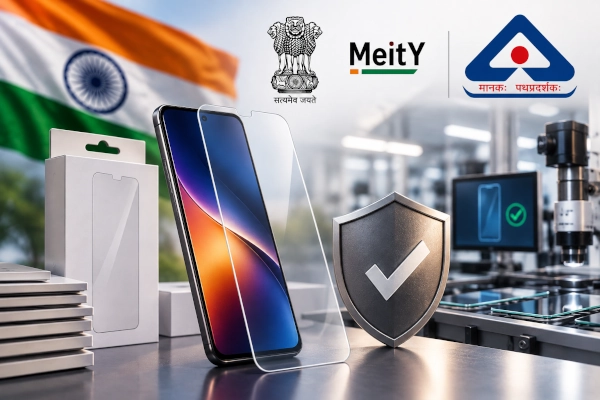
The Government of India has brought smartphone screen protectors under the country’s compulsory BIS registration framework, establishing mandatory quality requirements for a product category that has largely operated as an unorganised accessories market.
The Ministry of Electronics and Information Technology (MeitY) issued a notification on 21 September 2026 amending the Electronics and Information Technology Goods (Requirement of Compulsory Registration) Order, 2021. The amendment adds “Screen Protectors for Smartphones” as the 66th product category under the compulsory registration framework and links the product to IS 19348:2025 — Glass Screen Protector — Specification.
The mandatory requirement will take effect from 1 April 2027. From that date, covered smartphone screen protectors intended for the Indian market will have to comply with the prescribed Indian Standard and applicable Bureau of Indian Standards (BIS) registration and marking requirements.
BIS Introduced India’s Glass Screen Protector Standard in 2025
The new regulation builds on IS 19348:2025, a standard developed by the Bureau of Indian Standards for glass screen protectors. BIS established the standard in July 2025, creating measurable specifications for the optical quality, dimensions, manufacturing defects and mechanical strength of chemically tempered screen-protector glass.
The underlying standard has a broader technical scope covering glass screen protectors used with electronic display devices. However, the latest MeitY compulsory-registration amendment specifically identifies screen protectors for smartphones. The mandatory requirement should therefore be read according to the product category identified in the notification.
The move gives manufacturers and importers a transition period of roughly six months before compulsory compliance begins in April 2027.
Optical Clarity Becomes a Defined Quality Requirement
One of the principal areas covered by IS 19348:2025 is visible-light transmission. A screen protector must provide physical protection without excessively reducing the brightness and clarity of the smartphone display underneath it.
For ordinary transparent glass screen protectors, visible-light transmission must exceed 89%. Screen protectors incorporating a privacy film have a lower threshold, with visible-light transmission required to be at least 59%.
The requirement creates a measurable benchmark for optical performance rather than allowing manufacturers to market products solely on claims about transparency or clarity.
Thickness Must Match the Manufacturer’s Declaration
The standard also regulates the physical thickness of screen-protector glass.
The actual thickness must remain within 10% of the manufacturer’s declared nominal thickness. This ensures that products sold with a stated thickness remain within a defined manufacturing tolerance.
The specification additionally covers dimensions and cut-side characteristics, establishing uniform requirements for the physical construction and finishing of the glass.
Limits Introduced for Bubbles, Pinholes and Scratches
Manufacturing defects are another important component of the new standard.
IS 19348:2025 places limits on defects including pinholes, inclusions, bubbles and scratches. Pinholes, inclusions and bubbles exceeding 300 micrometres are not permitted, while larger scratches are also restricted.
The standard additionally requires the glass to be free from visually distinguishable reams, strings, lines and other linear or extended faults beyond the permitted limits.
These provisions are intended to establish consistent manufacturing quality across products rather than leaving visual acceptance entirely to individual brands or suppliers.
Screen Protector Glass Must Meet Strength Requirements
The BIS standard does not stop with appearance and optical clarity. It also establishes mechanical requirements for chemically tempered glass.
The glass must have a surface compression of at least 500 MPa. Surface compression is produced during chemical tempering and contributes to the ability of thin glass to resist stresses encountered during handling and everyday use.
Mechanical strength is further evaluated through a prescribed four-point bending test. A sample consisting of multiple pieces is subjected to controlled mechanical loading, and the resulting fracture-strength measurements are analysed statistically.
The specified 10th-percentile fracture stress must be at least 200 MPa. Using multiple specimens rather than relying on a single sample provides a more representative assessment of production consistency.
BIS Specifies a Structured Testing Process
The standard establishes sampling and testing procedures for different production lots.
Samples are initially examined for visual defects and light transmission. They are subsequently tested for thickness, dimensions and cut-side characteristics before undergoing surface-compression and mechanical-strength evaluation.
This sequence allows manufacturers and testing laboratories to assess both the visible quality of the product and the underlying physical properties of the tempered glass.
Packaging and Traceability Requirements Introduced
IS 19348:2025 also establishes marking and packaging requirements designed to improve product traceability.
Packages must carry information including the source of manufacture, nominal thickness, batch or code number, and month and year of manufacture. Individual pieces of chemically tempered screen-protector glass are also subject to identification requirements relating to their manufacturing source and year.
Such information becomes particularly important under a compulsory conformity regime because products circulating through distributors and retailers need to remain traceable to their manufacturing source.
Mandatory Compliance Begins on April 1, 2027
The September 2026 MeitY notification changes the regulatory position of smartphone screen protectors in India.
When BIS introduced IS 19348:2025 in 2025, the existence of the standard did not by itself make BIS registration compulsory for every smartphone screen protector sold in India. The latest amendment brings the product under the Electronics and Information Technology Goods (Requirement of Compulsory Registration) Order, 2021.
The provisions become applicable to smartphone screen protectors conforming to IS 19348:2025 from 1 April 2027. BIS has also incorporated the product into its compulsory registration framework as Item 66.
The 2021 Order contains an exemption for products manufactured specifically for export where they conform to the specifications required by the overseas purchaser. The latest requirement is therefore principally directed at products entering the Indian domestic market.
A Major Change for India’s Screen Protector Market
The regulation could significantly affect a smartphone-accessories market characterised by large volumes of inexpensive imported products.
Industry estimates cited following the announcement place India’s screen-protector market at more than 500 million units annually. Industry representatives have also estimated that developing a more organised domestic manufacturing ecosystem around the new quality requirements could create a market worth approximately ₹12,000–16,000 crore.
The India Cellular and Electronics Association has estimated that the industry could support around 60,000 direct and indirect jobs and potentially generate approximately ₹2,000 crore in GST revenue. These are industry projections rather than government targets, but they indicate the scale manufacturers see in the transition towards a regulated market.
Industry stakeholders have also estimated that more than 90% of India’s current screen-protector demand is met through low-cost imports. A mandatory national standard creates a common technical threshold for covered domestic and imported products entering the Indian market.
Opportunity for Made-in-India Screen Protectors
For Indian manufacturers, the regulation could provide an opportunity to build domestic production around a clearly defined quality benchmark.
Manufacturers capable of producing chemically tempered glass meeting the required standards for optical transmission, dimensional accuracy, surface compression and fracture strength will be able to compete in a market where compliance becomes mandatory rather than optional.
Indian electronics companies have already started investing in domestic tempered-glass screen-protector manufacturing. The regulatory framework could encourage further investment in glass processing, chemical tempering, coatings, precision cutting, testing and packaging.
The development also fits into the wider effort to deepen India’s electronics manufacturing supply chain beyond finished smartphones. Accessories, components, display-related products and supporting materials represent additional manufacturing opportunities surrounding India’s large mobile-phone industry.
From a Low-Cost Accessory to a Standardised Electronics Product
Smartphone screen protectors are relatively simple products compared with processors, displays or communications hardware, but the scale of India’s smartphone market makes them a substantial consumer-electronics category.
From 1 April 2027, screen protectors covered by the MeitY order will enter a more structured regulatory environment. Manufacturers and importers will have to demonstrate conformity with defined requirements covering thickness, transparency, manufacturing defects, mechanical strength, identification and packaging.
For consumers, the change introduces a common quality benchmark into a market where products of widely varying quality have often been sold under similar descriptions.
For Indian industry, the regulation could help transform screen protectors from a predominantly imported, price-driven accessory into a more organised domestic manufacturing segment built around BIS-certified quality and Made-in-India production.
References
Ministry of Electronics and Information Technology, Government of India — Amendment to the Electronics and Information Technology Goods (Requirement of Compulsory Registration) Order, 2021, dated 21 September 2026.
Bureau of Indian Standards — IS 19348:2025: Glass Screen Protector — Specification.
Bureau of Indian Standards — Official notification establishing IS 19348:2025, July 2025.
Bureau of Indian Standards — Compulsory Registration Scheme, Scheme-II product list, Item 66: Screen Protectors for Smartphones.
India Cellular and Electronics Association — Industry assessment of India’s smartphone screen-protector market following the compulsory standards notification.
You may also like
-
India’s Electronics Exports to China Surge as Made-in-India Components Enter Chinese Supply Chains
-
Netrasemi Advances Indigenous Edge AI With 12-nm Vision and Surveillance SoC
-
Addverb Expands Beyond Warehouses as Indian Semiconductor Fabs Open New Market for Precision Robotics
-
Integra Robotics Secures Indian Patent for VR-Controlled Remote Robotic Manipulation Technology
-
Indian Deep-Tech Startup Hylenr Completes Phase-I Fusion Reactor Validation at Texas A&M University
