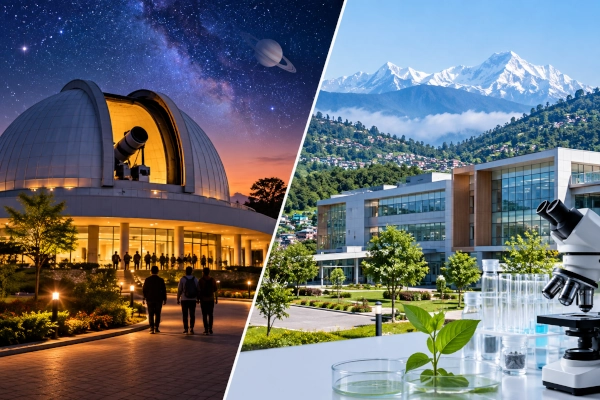
West Bengal is expanding its science and biotechnology infrastructure with a ₹12-crore Astro Park at Krishnanagar in Nadia and a regional Biotech Park in Kalimpong, creating new facilities for astronomy education, science outreach, biotechnology research and innovation outside Kolkata.
Details of the projects were presented by the Department of Science and Technology and Biotechnology during the West Bengal State Science & Technology Congress 2026, being held at the New Town Convention Centre in Kolkata. The Congress is one of the department’s flagship programmes, bringing together scientists, researchers, academic institutions, innovators and government agencies working across different areas of science and technology.
₹12-Crore Astro Park Planned at Krishnanagar
The larger of the newly highlighted science-infrastructure initiatives is the proposed Astro Park at Krishnanagar in Nadia district. According to the state government’s official Science & Technology Congress material, the facility will cover around two acres and involve an estimated outlay of ₹12 crore.
The project is being developed in collaboration with the National Council of Science Museums, under the Ministry of Culture, Government of India. The site is located along the Tropic of Cancer, a geographical feature that the state has identified as an advantage for developing the location as an astronomy and science-education destination.
Rather than functioning solely as an astronomical research installation, the project is being positioned as a combined astronomy, science education and science-tourism facility. This would allow students and the general public to engage with astronomy through dedicated infrastructure while also giving Nadia a specialised science-outreach destination.
The involvement of the National Council of Science Museums is relevant to this model. NCSM operates and develops science centres and museums across India with an emphasis on interactive science communication, astronomy and activity-based learning. Its recent projects have included astronomy galleries, immersive displays and other public-facing science infrastructure.
School Astro Labs Form Part of Wider Astronomy Programme
The Astro Park forms part of a wider effort by the state science department to expand astronomy and STEM exposure among students.
Official plans presented at the Science & Technology Congress include the promotion of Astro Labs and centres of excellence in schools, where students would receive hands-on exposure to astronomy, space science and emerging technologies through activity-based learning.
Such facilities can bridge the gap between classroom science and observational or experimental learning. Astronomy in particular offers an accessible route into physics, mathematics, optics and space science, allowing students to connect concepts taught in school with observations of planets, stars and other celestial objects.
The Krishnanagar facility could therefore serve a wider educational role by complementing smaller school-level astronomy initiatives and providing a dedicated destination for science outreach.
Regional Biotech Park Planned in Kalimpong
West Bengal is simultaneously moving ahead with plans for a regional Biotech Park at Kalimpong, extending biotechnology infrastructure into the Himalayan region of the state.
The Department of Science and Technology and Biotechnology says the proposed facility will place particular emphasis on local resource potential.
The location gives the project a different character from the existing Kolkata Biotech Park. Kalimpong and the surrounding Himalayan region possess distinctive biodiversity, horticultural resources, medicinal and aromatic plants and agricultural systems that can support biotechnology research and commercial applications relevant to the region.
The state’s biotechnology programme already encompasses areas including agriculture, healthcare, environmental science, medicinal plants and academia-industry collaboration. Its official policy framework identifies biotechnology as a tool for both research and economic development, including applications involving indigenous plant resources and environmental protection.
Building Beyond the Kolkata Biotech Park
The Kalimpong project would expand an ecosystem currently centred heavily around the Kolkata Biotech Park in Salt Lake’s Sector V.
The existing Kolkata facility is a nine-storey bio-incubation centre established to support biotechnology startups and companies. It provides specialised laboratory infrastructure and common scientific equipment, including genome and DNA sequencing systems, chromatography equipment, PCR facilities and other instruments required for biotechnology research and product development.
According to the Science & Technology Congress material, 11 biotechnology companies are currently operating from the Kolkata Biotech Park. The state has also established 56 dedicated biotechnology laboratories in educational and research institutions through its Biotechnology based Opportunities Offered to Science & Technology, or BOOST, programme.
A regional facility in Kalimpong would take this model beyond Kolkata while allowing biotechnology programmes to be shaped around the biological and agricultural resources of the Himalayan districts.
The Kalimpong proposal is not entirely new. West Bengal government planning documents had earlier identified preparation of a detailed project report and land-related work for a regional biotechnology facility in Kalimpong. Its inclusion among the state’s current science-infrastructure priorities indicates that the project is now being carried forward as part of the wider biotechnology network.
Wider Push for Research and Scientific Infrastructure
The two projects are part of a considerably broader science programme being pursued by the state.
Official data presented for the 2026 Congress lists more than 350 active research and development projects across 13 scientific disciplines, ranging from physical and biological sciences to engineering, geoinformatics, artificial intelligence, medicinal plants and climate research.
More than 50 educational and research institutions have also received laboratory and infrastructure support through the West Bengal’s science and technology infrastructure programme. The facilities supported include laboratories, scientific equipment, computational infrastructure and fabrication laboratories.
In biotechnology, the state is also attempting to connect research more closely with entrepreneurship and commercialisation. Alongside the Kolkata Biotech Park, programmes covering biotechnology laboratories, student training, research projects and technology development are intended to create a pipeline extending from academic research to startup formation and commercial applications.
Geoinformatics and Himalayan Research Also Expanding
Kalimpong is also part of West Bengal’s work under the National Mission for Sustaining the Himalayan Ecosystem. The state’s science department is involved in projects covering landslide-susceptibility mapping and springshed water-security initiatives across Darjeeling and Kalimpong.
The department has also developed a State Geo-Portal for the use of spatial information across government departments, including applications involving water bodies, agriculture and forest mapping.
These programmes indicate that the proposed Kalimpong biotechnology facility could eventually sit within a broader scientific network covering biodiversity, Himalayan ecology, geospatial research and biotechnology rather than operating as an isolated laboratory complex.
Taking Science Infrastructure Beyond Kolkata
The location of the two projects is notable. A major share of West Bengal’s high-end scientific infrastructure has traditionally been concentrated around Kolkata and its surrounding institutional belt. Locating specialised facilities in Nadia and Kalimpong begins to distribute parts of that ecosystem across different regions of the state.
The two projects also address very different areas of science. The Krishnanagar Astro Park is being designed around astronomy, public engagement and science education, while the Kalimpong Biotech Park is intended to develop biotechnology capabilities around regional biological resources.
Together, they reflect an attempt to connect scientific infrastructure with the particular strengths of their locations: astronomy and science outreach at Krishnanagar on the Tropic of Cancer, and biotechnology linked to local resource potential in the Himalayan district of Kalimpong.
Sources:
Government of West Bengal — Department of Science & Technology and Biotechnology
West Bengal State Science & Technology Congress 2026 — Official Discussion Points
National Council of Science Museums (NCSM), Ministry of Culture, Government of India
Government of West Bengal — Biotechnology and Science & Technology Programmes
You may also like
-
A Decade of Cosmic Flickering Reveals New Clues About A Rare Giant Binary Black Hole System
-
Indian Researchers Screen 94 Pea Lines to Identify High-Protein, Mineral-Rich Breeding Material
-
Indian Researchers Combine AI and Infrared Spectroscopy to Detect Parkinson’s-Linked Biochemical Changes in Fruit Flies
-
IIT Hyderabad Develops Lung-Derived Bioink for 3D Bioprinting and Regenerative Medicine
-
Indian Scientists Discover Molecular Switch That Can Regulate Cellular Autophagy
