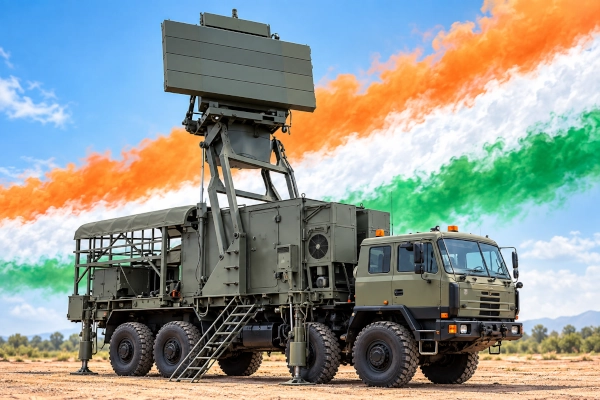
Bharat Electronics Limited has flagged off an indigenously manufactured 3D CAR Prime Radar from its Ghaziabad facility, marking another addition to India’s expanding domestic air-defence surveillance infrastructure. The radar was flagged off by Sanjeev Kumar, Secretary (Defence Production), during his visit to the BEL Ghaziabad complex on 24 September 2026.
BEL confirmed the development through an official update following the visit. The company described the 3D CAR Prime as an indigenously manufactured radar and placed the event within its continuing effort to strengthen domestic capabilities in advanced defence electronics.
3D CAR Prime Flagged Off at BEL Ghaziabad
The Defence Production Secretary visited BEL Ghaziabad along with senior officials from the Department of Defence Production. He was received by Rashmi Kathuria, Executive Director and Unit Head, along with other senior officials of the complex.
During the visit, the 3D CAR Prime Radar was formally flagged off. BEL
Part of India’s Indigenous 3D Radar Lineage
The 3D CAR Prime belongs to a broader Indian radar-development lineage built around the 3-Dimensional Central Acquisition Radar, or 3D CAR.
The earlier Central Acquisition Radar, also associated with the Rohini configuration, was jointly developed by DRDO’s Electronics and Radar Development Establishment and BEL. BEL has described the original system as an S-band three-dimensional surveillance radar equipped with an integrated Identification Friend or Foe system.
Unlike a two-dimensional surveillance radar that primarily provides range and azimuth, a three-dimensional radar can determine range, azimuth and elevation. This allows an air-defence network to establish not only where an aerial object is located horizontally but also its altitude, producing the three-dimensional track required for effective interception.
Central Acquisition Radars Feed the Air-Defence Network
A central acquisition radar performs the wide-area surveillance role within an air-defence architecture. It continuously searches the surrounding airspace, detects potential aerial threats and develops target tracks that can subsequently be passed to command-and-control systems and engagement radars.
Such radars are therefore positioned near the beginning of the air-defence kill chain. The sequence begins with surveillance and detection, followed by identification, tracking, threat assessment and assignment of an appropriate weapon system.
Earlier 3D CAR Became an Important Element of Akash
BEL’s 3D Central Acquisition Radar has long been associated with India’s Akash surface-to-air missile ecosystem.
According to BEL’s published Akash system specifications, the Central Acquisition Radar provides three-dimensional measurements of target range, azimuth and elevation and contributes the wide-area surveillance picture required by the weapon system.
BEL states that the Central Acquisition Radar associated with its existing Akash configuration provides surveillance coverage out to 120 kilometres. It works alongside the system’s multifunction radar, command elements and missile batteries to detect aerial targets and support their subsequent engagement.
These published specifications relate to BEL’s established Central Acquisition Radar within the Akash architecture. BEL has not publicly confirmed that every figure associated with the earlier 3D CAR applies unchanged to the new 3D CAR Prime configuration.
Ghaziabad Remains a Major BEL Radar Centre
BEL’s Ghaziabad unit has played an important role in the company’s radar, communication and air-defence businesses.
India’s radar programmes have increasingly relied on cooperation between DRDO laboratories responsible for indigenous technology development and BEL for engineering, systems integration, production and lifecycle support.
This model has produced several generations of surveillance and battlefield radars for the Indian Armed Forces. The manufacturing of newer systems such as 3D CAR Prime represents the continuation of that domestic radar-industrial base.
Air Surveillance Is Becoming More Demanding
Modern air-defence radars face a considerably more complicated target environment than earlier generations of surveillance systems.
Airspace may simultaneously contain conventional aircraft, helicopters, cruise missiles, unmanned aircraft and other aerial objects travelling at widely differing speeds and altitudes. Electronic warfare can further complicate detection and tracking by attempting to jam or deceive radar systems.
Contemporary air defence therefore depends increasingly on networked sensors capable of rapidly building and updating a common air picture. Surveillance radars form the outer sensing layer of this architecture, providing early warning and target information to command centres and weapon systems.
Indigenous Radar Production Reduces External Dependence
Domestic production of sophisticated radar systems gives India greater control over upgrades, maintenance, spares and integration with indigenous command-and-control networks.
Radar technology is particularly important because the effectiveness of an air-defence missile depends heavily on the sensor network supporting it. Increasing missile range without corresponding improvements in detection, tracking and data processing would provide only a partial improvement in defensive capability.
India’s investment in indigenous radar development has consequently progressed alongside programmes for Akash, QRSAM and other air-defence systems.
3D CAR Prime Adds to BEL’s Expanding Defence Electronics Portfolio
BEL today operates across a wide range of defence-electronics technologies, including surveillance radars, fire-control systems, electronic warfare, military communications, missile-system electronics and network-centric command systems.
The flag-off of the 3D CAR Prime demonstrates that advanced radar manufacturing remains an active part of that portfolio. It also comes as India seeks to increase domestic production of critical defence-electronics systems rather than relying predominantly on imported sensors and associated support infrastructure.
References
Bharat Electronics Limited — Official update on the visit of Secretary (Defence Production) Sanjeev Kumar to BEL Ghaziabad and flag-off of the indigenously manufactured 3D CAR Prime Radar, 24 September 2026.
https://www.linkedin.com/company/bharat-electronics-limited/
Bharat Electronics Limited — Akash Missile System, official product information, including Central Acquisition Radar capabilities.
https://bel-india.in/product/akash-missile-system/
Bharat Electronics Limited — Annual Report 2010–11, description of the 3-D Central Acquisition Radar (Rohini) developed jointly with LRDE.
https://bel-india.in/wp-content/uploads/2023/03/2010-2011-Annual-Report.pdf
Bharat Electronics Limited — Corporate Brochure, Missile Systems and 3D Central Acquisition Radar.
https://bel-india.in/wp-content/uploads/2023/05/Corporate-BEL-Brochure_20-pages.pdf
You may also like
-
General Atomics Reportedly Offers Gambit 5 Carrier-Based Combat Drone to Indian Navy
-
BHEL Approves ₹500 Crore Expansion of Thermal and Nuclear Power Equipment Manufacturing at Haridwar
-
Reliance Building One of World’s Largest Battery Gigafactories in Jamnagar with 120 GWh Annual Capacity
-
HAL’s Indigenous Light Utility Helicopter Nears Final Certification, First 12 Deliveries Targeted for FY 2027–28
-
Tata Advanced Systems Reportedly Considering LAMV 4×4 Production in Morocco
